

 Based on 116 Verified Google Reviews
1. Facing the Reality of Criminal Sentencing
If you are reading this report, you are likely standing at one of the most frightening crossroads of your life. The criminal justice system in Ontario is a labyrinth of rules, procedures, and potential penalties that can feel overwhelming to anyone who has not spent a career navigating them. You may be lying awake at night, staring at the ceiling, wondering if you are going to jail. You may be worried about your job, your reputation, your family, and your future. These fears are natural, and they are valid.
In my twenty-five years of practice—first as a prosecutor for the Crown and now as a criminal defence lawyer dedicated exclusively to protecting the rights of the accused—I have stood beside thousands of individuals in your exact position. I understand the weight of the uncertainty you are carrying. I know that the terminology used in courtrooms—words like “conditional discharge,” “suspended sentence,” and “probation”—can sound confusingly similar, yet they carry vastly different consequences for your life.
The purpose of this comprehensive report is to demystify one of the most common yet misunderstood sentencing options available in Canadian criminal law: the Suspended Sentence.
This is not merely a glossary definition. This is a deep dive into the mechanics of the law, the strategic considerations of sentencing, and the long-term implications of this specific outcome. My goal is to arm you with the knowledge you need to understand your situation, to reduce your anxiety by replacing the unknown with facts, and to demonstrate how a skilled defence can make the difference between a cell and a sentence served in the community.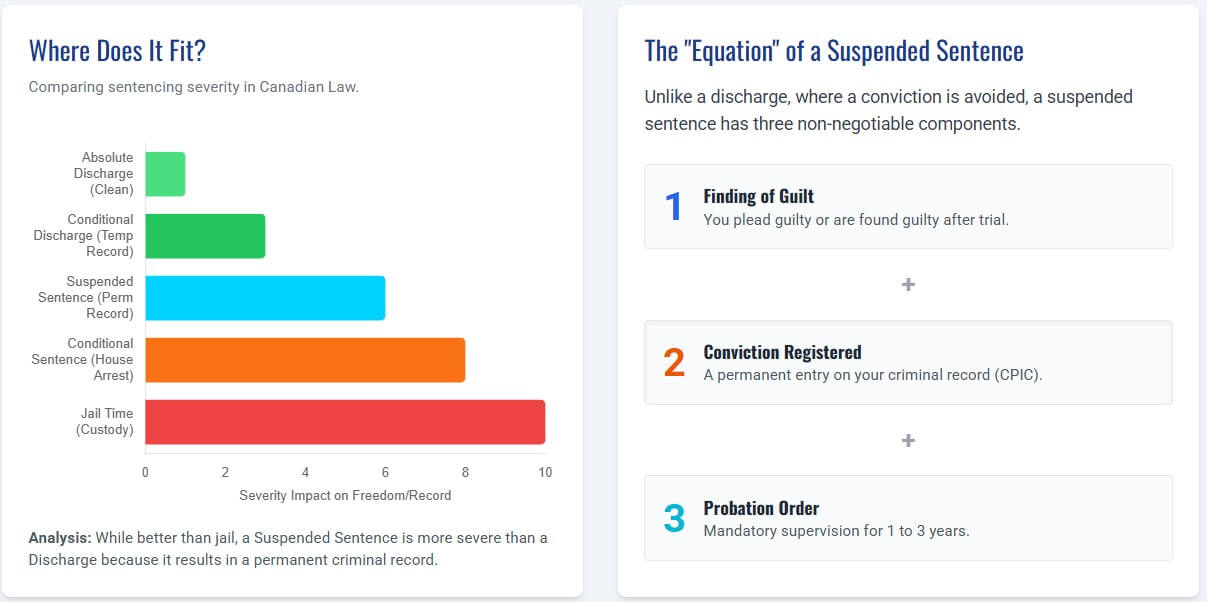
1.1 The Lawyer’s Role: From Prosecutor to Defender
When I assess a case, I look at it through two lenses. As a former prosecutor, I know exactly how the Crown builds a file. I know which aggravating factors they will highlight to argue for a harsher penalty. I know how they view a “suspended sentence”—often as a concession that must be earned.
As your defence counsel, I use that insight to dismantle their arguments. I know that sentencing is not an automated calculation; it is a human process of persuasion. It involves convincing a judge that you are more than the sum of the charges against you. It involves presenting your background, your character, and your potential for rehabilitation in a way that compels the court to exercise its discretion in your favour.
A suspended sentence is often a victory in cases where jail time is a real possibility. It is a recognition by the court that while a crime has been committed, the offender does not require incarceration to learn their lesson or to protect the public. However, it is not a “get out of jail free” card. It comes with strings attached—strings that, if pulled, can drag you back into the very jeopardy we fought to avoid.
1.2 Scope of This Report
In the following sections, we will explore:
- The Legal Authority: A detailed analysis of Section 731 of the Criminal Code, which gives judges the power to suspend sentences.
- The Probation Order: The mandatory and optional conditions that will govern your life for up to three years.
- Comparative Analysis: How a suspended sentence differs from a conditional discharge, a conditional sentence (house arrest), and actual jail time.
- The Sentencing Hearing: What happens in court, from Pre-Sentence Reports to Victim Impact Statements.
- Breach Consequences: The severe risks of violating your probation and the process of revocation.
- Long-Term Impact: The reality of living with a criminal record, travel restrictions, and the path to a Record Suspension (Pardon).
We will rely exclusively on authoritative sources, including the Criminal Code of Canada, decisions from the Supreme Court of Canada and Ontario Courts, and guidelines from the Public Prosecution Service of Canada. There is no room for hearsay or “street law” here—only the hard facts that will determine your future.
2. The Legal Framework: Section 731 of the Criminal Code
To understand a suspended sentence, we must start with the source of the court’s power: the Criminal Code of Canada. This federal statute governs all criminal offences and sentencing procedures across the country.
2.1 The Statutory Definition
Section 731(1)(a) of the Criminal Code 1 serves as the foundation for the suspended sentence. It states that where a person is convicted of an offence, a court may, having regard to the age and character of the offender, the nature of the offence, and the circumstances surrounding its commission, suspend the passing of sentence and direct that the offender be released on the conditions prescribed in a probation order.
This single sentence is packed with legal significance. Let us break down each component to understand what it truly means for you.
2.1.1 “Where a person is convicted of an offence”
This is the most critical distinction for a client to understand immediately. A suspended sentence is not an acquittal. It is not a discharge. To receive a suspended sentence, there must be a formal conviction registered against you.
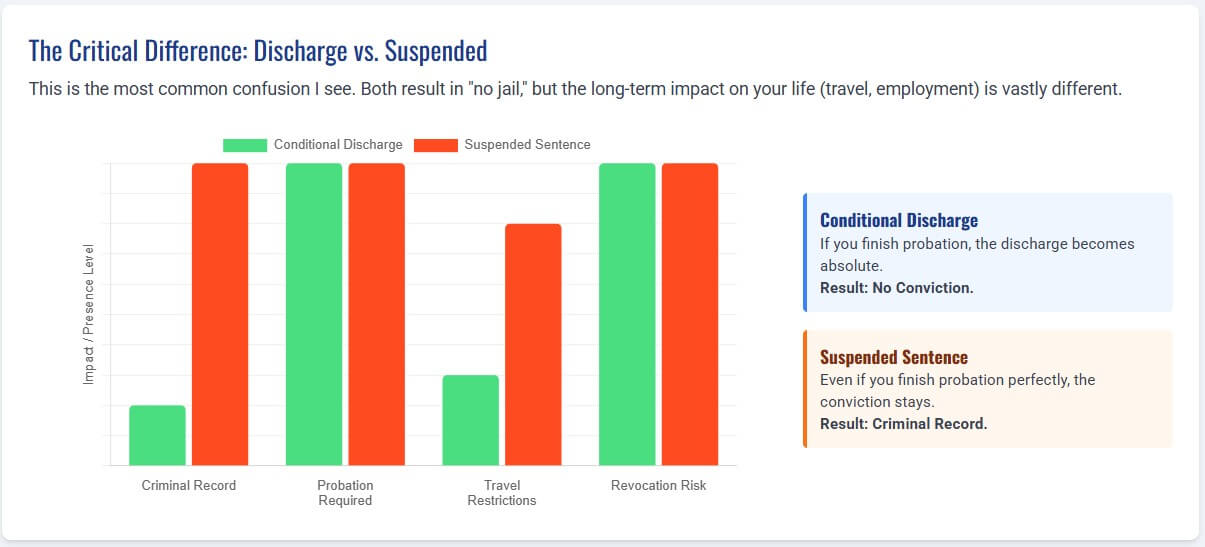
- Implication: You will have a permanent criminal record. This record will appear on background checks for employment, housing, and volunteer positions. It will be visible to border agents. Unlike a conditional discharge, which eventually “disappears” from the public record if conditions are met, a suspended sentence remains until you successfully apply for and receive a Record Suspension (formerly known as a pardon) years down the road.
2.1.2 “Suspend the passing of sentence”
The terminology here is historical but important. Technically, the judge is not imposing a “sentence” of punishment (like a fine or jail) at that moment. Instead, they are “suspending” or pausing the judgment. They are essentially saying, “I am holding the punishment in abeyance. If you behave, you will never face it. If you misbehave, I can bring you back and impose it.”
- Implication: You walk out of the courtroom a free person. You are not handcuffed. You do not go to a detention centre. You go home. However, the threat of the sentence hangs over your head for the duration of your probation.
2.1.3 “Probation Order”
The statute explicitly links the suspension of sentence to a probation order. You cannot have a suspended sentence without probation. The probation is the mechanism of control. It is the “leash” that the court attaches to you in exchange for your freedom.1
2.2 Eligibility Criteria: When is it Available?
Not every crime allows for a suspended sentence. Section 731(1)(a) specifies that this option is available “if no minimum punishment is prescribed by law”.1
2.2.1 Mandatory Minimum Penalties (MMPs)
Certain offences in the Criminal Code carry mandatory minimum penalties. If you are convicted of one of these offences, the judge’s hands are tied. They must impose the minimum jail time or fine prescribed by Parliament. They cannot suspend the sentence.
- Examples: Certain firearm offences, sexual offences against children, and some repeat impaired driving offences carry MMPs. In these cases, a suspended sentence is legally impossible.
- My Role: Part of my defence strategy is often to negotiate plea deals to lesser included offences that do not carry mandatory minimums, thereby unlocking the door to a suspended sentence.
2.2.2 Judicial Discretion
Even if an offence is eligible, the judge is not required to grant a suspended sentence. The text of Section 731 uses the word “may”—”a court may… suspend the passing of sentence”.1 This means it is a discretionary decision. The judge must weigh specific factors:
- Age of the Offender: Youthful offenders (under 25) are often given more leniency to avoid “criminalizing” them for life. Conversely, elderly offenders might receive suspended sentences due to health issues or the hardship of incarceration.
- Character of the Offender: This is where we present the “real you.” We submit character reference letters, proof of employment, evidence of your role in the community, and any steps you have taken toward rehabilitation (e.g., counseling).
- Nature of the Offence: Is it a violent crime? A property crime? A breach of trust? Violent crimes make it harder to argue for a suspended sentence, though not impossible.
- Circumstances Surrounding its Commission: Was this a planned, sophisticated operation, or a momentary lapse of judgment? Was there provocation? Were you under extreme stress or suffering from mental health issues?
2.3 The Philosophy of Restraint
Canadian law operates under the “principle of restraint” in sentencing. Section 718.2(d) and (e) of the Criminal Code state that an offender should not be deprived of liberty if less restrictive sanctions may be appropriate.4
- Sanctions other than imprisonment: The law directs judges to look for alternatives to jail for all offenders, and particularly for Indigenous offenders (under the Gladue principles).
- The Argument: When I stand in court to argue for a suspended sentence, I am leveraging this principle. I argue that sending you to jail would be “overkill”—that society can be adequately protected and the crime adequately denounced by placing you under strict supervision in the community, rather than warehousing you in a cell.
3. Probation: The Substance of the Sentence
If a suspended sentence is the “pause” button on jail, probation is the condition of that pause. It is not merely a formality; it is a court order with the full weight of the law behind it. Understanding your probation order is the single most important factor in staying out of jail once you leave the courthouse.
3.1 Duration of Probation
A probation order attached to a suspended sentence can be in force for a maximum of three years.3
- Typical Lengths: In my experience, probation orders typically run for 12, 18, or 24 months. A full 3-year order is usually reserved for more serious cases or cases requiring long-term rehabilitation (like deep-seated addiction or domestic violence programming).
- Effective Date: The order comes into force on the date it is made.3
3.2 Compulsory Conditions (The “Musts”)
Under Section 732.1(2) of the Criminal Code, every single probation order—without exception—must contain the following three conditions.6 These are non-negotiable.
3.2.1 Keep the Peace and Be of Good Behaviour
This phrase sounds archaic, but it is legally all-encompassing.
- “Keep the Peace”: You must not disrupt public order. This obviously includes not fighting or causing disturbances.
- “Be of Good Behaviour”: This is broader. It effectively means you must not break any law—federal, provincial, or municipal.
- The Trap: If you are caught shoplifting a chocolate bar, you have breached this condition. If you are caught with a tiny amount of an illegal substance, you have breached this condition. Even getting a serious traffic ticket (like Careless Driving) could theoretically be argued as a breach, though it is usually reserved for criminal acts.
- Implication: You are living under a microscope. Behaviour that might result in a warning for a regular citizen can result in a criminal breach charge for you.
3.2.2 Appear Before the Court When Required
If the judge or the court administration summons you, you must attend. Failing to show up is not just a “failure to appear”; it is a breach of your probation.
3.2.3 Notify the Court or Probation Officer of Changes
You must notify the court or your probation officer in advance of any change of name or address, and promptly notify them of any change in employment or occupation.7
- Why this matters: The state needs to know where you are. If a probation officer tries to visit you or mail you a letter and you have moved without telling them, you are in breach. I always advise clients to notify their officer in writing (email is fine) so there is a paper trail of compliance.
3.3 Optional Conditions (The “Mays”)
This is the area of sentencing where your defence lawyer earns their fee. While the “musts” are set in stone, the “mays” are subject to argument. Under Section 732.1(3), the judge can impose a wide variety of additional conditions.6 My job is to ensure these conditions are necessary, reasonable, and minimally intrusive to your life.
3.3.1 Reporting to a Probation Officer
- The Condition: “Report to a probation officer within two working days… and thereafter as directed.”
- The Reality: You will be assigned a specific officer. You will have an intake meeting where they assess your risk level.
- Frequency: Reporting might be weekly, monthly, or effectively seemingly non-existent (reporting by phone) depending on your risk assessment. If you are low-risk, employed, and compliant, the officer has the discretion to make this very unintrusive. If you are high-risk or difficult, they can demand you attend their office frequently during work hours.
3.3.2 Abstinence Clauses (Alcohol and Drugs)
- The Condition: “Abstain from the consumption of alcohol or other intoxicating substances” or “Abstain from owning, possessing or carrying a weapon”.7
- Strategic Argument: If you are an alcoholic, a total abstinence condition sets you up for failure. A single beer becomes a criminal offence. I often argue for a modified condition, such as “Do not be outside your residence while under the influence of alcohol,” or “Abstain from alcohol except in accordance with a medical prescription” (rare for alcohol, common for cannabis).
- Drugs: The condition usually reads “Abstain from the consumption of drugs except in accordance with a medical prescription.” This protects you if you are prescribed medication.
3.3.3 No Contact / No Association
- The Condition: “Do not communicate, directly or indirectly, with [Victim Name] or.”
- Implications: “Indirectly” includes social media likes, sending messages through friends, or even smiling at them across a street.
- Domestic Exceptions: In domestic cases, we often fight for a “safety valve” clause, such as “No contact except with the written revocable consent of the complainant filed with the probation officer.” This allows a couple to reconcile if they choose to, without needing to go back to court to change the order.
3.3.4 Restitution and Community Service
- Restitution: The court can order you to pay compensation for loss or damage.8 This is often a condition of probation. Failure to pay is a breach.
- Community Service: The court can order up to 240 hours of community service to be performed over a maximum of 18 months.7 This is unpaid work for a non-profit. It is a way to “pay back” society.
3.3.5 Treatment and Counseling
The court can order you to attend and actively participate in treatment programs (e.g., Partner Assault Response (PAR) program, anger management, substance abuse counseling).8 You may have to sign a waiver allowing the probation officer to talk to your counselor to confirm you are actually attending.
4. Distinguishing the Suspended Sentence: What It Is Not
One of the most frequent conversations I have with clients involves explaining the difference between a suspended sentence and other outcomes that sound similar. These distinctions are critical because they affect your record and your liberty differently.
4.1 Suspended Sentence vs. Conditional Discharge
This is the most pivotal comparison for many first-time offenders.
| Feature | Conditional Discharge (s. 730) | Suspended Sentence (s. 731) |
| Conviction | NO (If conditions met) | YES (Permanent record) |
| Probation | Yes (Mandatory) | Yes (Mandatory) |
| Criminal Record | Temporary (Purged after 3 years) | Permanent (Requires Pardon) |
| Typical Use | Minor offences, first-time offenders | Moderate offences, need for deterrence |
- The Difference: With a conditional discharge, the court finds you guilty but chooses not to convict you. Instead, they discharge you on conditions. If you follow the probation, the discharge becomes absolute, and you effectively have no criminal conviction record.1
- My Strategy: I will always fight for a conditional discharge first. I argue that a conviction (suspended sentence) would be disproportionate to the offence and would harm your employment prospects unfairly. A suspended sentence is often the “fallback” position if the judge feels a discharge is too lenient.
4.2 Suspended Sentence vs. Conditional Sentence (CSO)
Many clients—and even some junior lawyers—confuse these two. They are vastly different in severity.
- Conditional Sentence (CSO): This is governed by Section 742.1. It is a sentence of imprisonment served in the community.11 It is often called “house arrest.”
- Punitive Nature: As established by the Supreme Court in R. v. Proulx, a CSO is intended to be punitive. It usually involves strict 24/7 house arrest, curfews, and severe restrictions on liberty.13
- Breach Consequence: If you breach a CSO, the presumption is that you are arrested and sent to actual jail to serve the remainder of the time.
- Suspended Sentence: This is primarily rehabilitative. While you are on probation, you are generally free to move about the community, hold a job, and live a normal life, provided you follow your conditions.9
- Hierarchy: The courts view a suspended sentence as less severe than a CSO. In Proulx, the Supreme Court situated the CSO between incarceration and a suspended sentence.14
4.3 Suspended Sentence vs. Intermittent Sentence
- Intermittent Sentence: This is a jail sentence of 90 days or less served on weekends (e.g., Friday 6 PM to Monday 6 AM).15 You are in custody on weekends and on probation during the week.
- Suspended Sentence: You are never in custody.
4.4 Suspended Sentence vs. Fine
- Fine: A monetary penalty. It results in a conviction.
- Suspended Sentence: No money is paid to the court (though a victim surcharge applies). The “currency” you pay with is your good behaviour and compliance with conditions.
- Combination: It is possible for a judge to impose both a fine and a probation order, or a suspended sentence with a probation order that includes restitution, but technically a suspended sentence suspends the “passing of sentence,” so usually, it stands alone as the primary sanction.1
5. The Sentencing Hearing: A Step-by-Step Guide
If you have pled guilty or been found guilty, the next phase is the sentencing hearing. This is where the decision between jail, a suspended sentence, or a discharge is made. It is not a rubber stamp; it is a contested hearing where we present evidence and argument.
5.1 The Pre-Sentence Report (PSR)
Often, I will request a Pre-Sentence Report (PSR) before sentencing.
- What it is: A report prepared by a probation officer who interviews you, your family, your employer, and sometimes the victim.
- Content: It covers your age, maturity, character, behaviour, attitude, and willingness to make amends.17
- Importance: A positive PSR is gold. If the probation officer writes, “This offender is a suitable candidate for community supervision,” it makes it very difficult for a judge to insist on jail. I prepare my clients extensively for this interview—honesty, remorse, and politeness are key.
5.2 Victim Impact Statements (VIS)
The Crown is required to file any Victim Impact Statements.
- Content: The victim describes the physical, emotional, and financial harm caused by the crime.18
- Impact: In cases of violence or fraud, a powerful VIS can sway a judge toward a harsher sentence. We must be respectful of the victim’s pain while gently steering the court back to the legal principles of rehabilitation.
5.3 The Crown’s Submission
The prosecutor will argue first. They will likely focus on:
- Denunciation: The need to express society’s disapproval of the act.
- Deterrence: The need to stop you (specific deterrence) and others (general deterrence) from doing this again.9
- Aggravating Factors: Breach of trust, violence, prior record, impact on victim.
5.4 The Defence Submission (My Role)
This is where I fight for you. I will construct a narrative based on Section 718 principles:
- Mitigating Factors: First-time offender status, early guilty plea (saving court resources), remorse, employment, family support.9
- Gap Principle: If you have a record but it is old, I argue that you have lived a law-abiding life for years and this was a momentary lapse.
- Collateral Consequences: I argue that the conviction itself is a heavy punishment due to its impact on your career and travel, so jail is unnecessary.
- Indigenous Background (Gladue): If you are Indigenous, I will file a Gladue report. The court must consider systemic factors (colonialism, residential schools) and look for alternatives to imprisonment.4 This is a powerful mandate for a suspended sentence over jail.
5.5 The Judge’s Decision
The judge acts as the final arbiter. They must determine a “fit” sentence. They will look at the “range” of sentences for similar crimes. My job is to provide them with case law showing that other people in your situation received suspended sentences, making it the appropriate and fair outcome for you.
6. Breach of Probation: The Sword of Damocles
I often tell my clients: “Getting a suspended sentence is a win, but keeping it is the challenge.” The danger of a suspended sentence lies in the consequences of failure.
6.1 The Offence of Breach (Section 733.1)
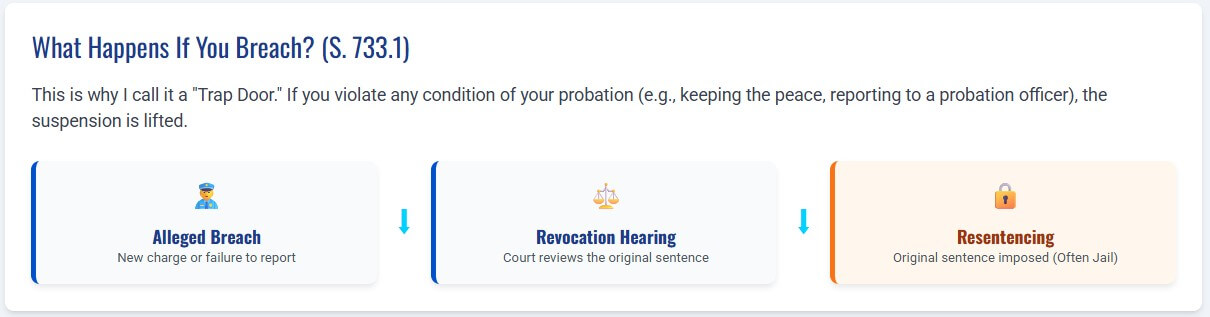
Under Section 733.1 of the Criminal Code, failing to comply with a probation order without “reasonable excuse” is a criminal offence.19
- The Charge: You can be charged with “Breach of Probation.”
- The Penalty: It is a hybrid offence.
- If proceeded by indictment (rare for minor breaches), maximum is 4 years jail.
- If summary conviction (common), maximum is 18 months jail and/or $5000 fine.
- The Record: A conviction for breach looks terrible on a record. It tells future judges, “This person does not listen to court orders.”
6.2 Revocation of the Suspended Sentence
This is the unique mechanism that makes suspended sentences dangerous.
- The Law: Under Section 732.2(5)(d), if you are convicted of a new offence (including the breach itself) while the suspended sentence is still active, the Crown can apply to revoke the suspended sentence.3
- The Consequence: The court can then impose any sentence that could have been imposed for the original offence.
- Scenario: Imagine you received a suspended sentence for a serious assault where the Crown originally wanted 6 months in jail. Three months later, you miss a reporting appointment and get charged with breach. The judge can revoke your suspended sentence and send you to jail for the original assault, plus sentence you for the breach. You effectively go back to square one, but with a worse track record.
6.3 What is a “Reasonable Excuse”?
The law provides a defence: “without reasonable excuse”.19
- Medical Emergency: If you missed court/reporting because you were in the hospital, that is a reasonable excuse. (Bring documentation!).
- Impossibility: If a snowstorm shut down all transit and you could not get to the probation office, that might be a reasonable excuse.
- Not Reasonable: “I forgot,” “I overslept,” “I had to work” (unless you tried to reschedule and were denied), or “I didn’t think it was important.”
- Advice: If you think you might breach (e.g., you are going to be late), call your probation officer immediately. A proactive call often stops a breach charge before it is laid.
7. The Long-Term Impact: Living with a Suspended Sentence
A suspended sentence allows you to remain in the community, but it casts a long shadow.
7.1 Employment and Background Checks
- Criminal Record: A suspended sentence results in a conviction. It will show up on a standard CPIC check.
- Vulnerable Sector: If the offence was sexual or violent, it may also appear on a Vulnerable Sector Check, barring you from working with children or the elderly.
- Duty to Disclose: Generally, you do not have to disclose a record to a current employer unless your contract says so. However, many professions (teachers, nurses, security guards, truck drivers) have regulatory bodies that must be notified of any criminal conviction.
7.2 Travel Restrictions
- United States: The US border is notoriously strict. A criminal conviction for a “crime of moral turpitude” (which includes theft, fraud, and most drug offences) generally makes you inadmissible. Even a simple assault conviction can lead to intense scrutiny or denial of entry.
- Waivers: You may need to apply for a US Entry Waiver (I-192). This is expensive and takes months to process. A suspended sentence does not “expire” for border purposes in the same way it does for Canadian pardons.
7.3 Record Suspensions (Pardons)
You are not branded for life, but the road to a clean slate is longer with a suspended sentence than with a discharge.
- The Eligibility Clock: You must wait a specific period after you have completed your sentence before applying to the Parole Board of Canada.
- The Calculation:
- For a Conditional Discharge, the waiting period is usually 1 or 3 years.
- For a Suspended Sentence (Summary Conviction), you must wait 5 years.
- For a Suspended Sentence (Indictable Offence), you must wait 10 years.
- When does the clock start? This is a point of confusion. According to Government of Canada guidelines 20, for a suspended sentence, the 5 or 10-year waiting period usually begins from the date of sentencing or the expiration of the probation order depending on interpretation of “sentence completion.”
- The most current guidance for probation (which is always part of a suspended sentence) is that probation is part of the sentence. Therefore, you count 5/10 years from the end of the probation period.
- Example: You are sentenced on Jan 1, 2024 to a suspended sentence with 2 years probation. Probation ends Jan 1, 2026. Your 5-year wait for a pardon starts Jan 1, 2026. You are eligible to apply on Jan 1, 2031.
This significant delay is why I fight so hard for a discharge. The difference between a discharge and a suspended sentence can be years of additional stigma.
8. Specific Contexts: Domestic Violence, Drugs, and Theft
8.1 Domestic Violence Cases
The justice system treats domestic violence with extreme caution.
- Policy: The Crown Policy Manual instructs prosecutors to prosecute vigorously. Diversion is rarely offered for domestic violence unless the allegations are minor and the accused accepts responsibility.
- Suspended Sentences: These are common in domestic cases where the accused pleads guilty and completes the Partner Assault Response (PAR) program. The court sees the completion of the program as rehabilitation.
- The Sting: The probation order will almost certainly contain a “No Contact” order and a “No Weapons” ban (Section 110 or probation condition). This can affect your ability to live in your own home or hunt/sport shoot.
- Family Court: Be aware that a criminal conviction for domestic assault can be used as evidence in family court to restrict child custody.22
8.2 Drug Offences
- Addiction vs. Crime: Courts increasingly recognize that addiction is a health issue.
- Drug Treatment Court (DTC): If you are facing non-violent drug charges (possession, minor trafficking to support a habit), we may apply for DTC. This is a rigorous program of judicial supervision and treatment.
- Outcome: Successful completion of DTC can lead to a suspended sentence or, in some cases, a stay of proceedings (dropping of charges), which is the gold standard.23
8.3 Theft and Property Crime
- Breach of Trust: If you stole from an employer, courts take this very seriously. Jail is often the starting point. However, a suspended sentence can be achieved if full restitution is made upfront.
- My Strategy: I often advise clients to bring a bank draft for the full amount of the theft to court before sentencing. “Money on the table” is a powerful silencer of Crown arguments for jail. It shows concrete remorse.
9. The Value of Experienced Counsel
A suspended sentence is a complex legal tool. It sits in the middle of the sentencing spectrum—more severe than a discharge, but less severe than jail. It offers a second chance, but it demands strict compliance and carries the weight of a criminal record.
Navigating the path to a suspended sentence requires more than just showing up to court. It requires a strategic defence that humanizes you, contextualizes your actions, and leverages the principles of restraint found in the Criminal Code. It requires knowing the difference between a “must” and a “may” in probation conditions. It requires the foresight to protect your future ability to travel and work.
Why Choose Jeffrey I. Reisman?
- Former Prosecutor: I know the Crown’s playbook. I know when they are bluffing and when they are holding a strong hand. I use this experience to negotiate better outcomes for you.
- 25+ Years Experience: I have handled thousands of sentencing hearings. I know the judges in Toronto, Brampton, Newmarket, and Oshawa. I know what arguments resonate with them.
- 24/7 Availability: Criminal charges don’t stick to business hours. Neither do I. When you are stressed at 2 AM, I am here to take your call.
You do not have to face this alone.
If you are charged with a criminal offence, contact me immediately. Let’s review your disclosure, identify your defences, and build a strategy to keep you out of jail and protect your future.
Call Jeffrey I. Reisman Criminal Defence Lawyer today.
Free Consultation. 24/7 Support. Proven Results.
10. Quick Reference Tables
Sentencing Options Comparison
| Sentencing Option | Finding of Guilt? | Conviction Registered? | Custody (Jail)? | Probation? | Record Suspension Wait (Summary) |
| Absolute Discharge | Yes | No | No | No | 1 year |
| Conditional Discharge | Yes | No (if conditions met) | No | Yes | 3 years |
| Suspended Sentence | Yes | Yes | No | Yes | 5 years* |
| Fine | Yes | Yes | No | Optional | 5 years |
| Conditional Sentence (CSO) | Yes | Yes | Yes (served in community) | Optional | 5 years |
| Intermittent Sentence | Yes | Yes | Yes (weekends) | Yes | 5 years |
| Imprisonment | Yes | Yes | Yes | Optional | 5 years |
*Wait time calculated from end of probation.
Common Probation Conditions (Section 732.1)
| Condition Type | Description | Mandatory/Optional |
| Keep the Peace | Do not commit any new criminal or provincial offences. | Mandatory |
| Appear in Court | Attend all scheduled court dates. | Mandatory |
| Notify Changes | Tell probation officer of change in address/job. | Mandatory |
| Reporting | Meet with probation officer as directed (weekly/monthly). | Optional |
| No Contact | Do not communicate with victim/witnesses. | Optional |
| No Go | Do not attend specific addresses (e.g. victim’s home). | Optional |
| Weapons Ban | Do not possess knives, firearms, etc. | Optional |
| Abstinence | Do not consume alcohol/drugs. | Optional |
| Restitution | Pay compensation to victim. | Optional |
| Community Service | Perform unpaid work (max 240 hours). | Optional |
**
Sources
- Criminal Code ( RSC , 1985, c. C-46), accessed January 23, 2026, https://laws-lois.justice.gc.ca/eng/acts/c-46/page-123.html
- Criminal Code ( RSC , 1985, c. C-46) – Justice Laws Website, accessed January 23, 2026, https://laws-lois.justice.gc.ca/eng/acts/c-46/section-731.html
- Advanced Search – Justice Laws Website, accessed January 23, 2026, https://laws-lois.justice.gc.ca/search/Advanced.aspx?&ddC0nt3ntTyp3=Statutes&txtS3arch3xact=probation&h1dd3nPag3Num=1&txtT1tl3=%22Criminal+Code%22
- The Changing Face of Conditional Sentencing – Department of Justice Canada, accessed January 23, 2026, https://www.justice.gc.ca/eng/rp-pr/csj-sjc/jsp-sjp/op00_3-po00_3/p2_4.html
- Criminal Code ( RSC , 1985, c. C-46) – Department of Justice Canada, accessed January 23, 2026, https://laws-lois.justice.gc.ca/eng/acts/c-46/page-124.html
- Criminal Code ( RSC , 1985, c. C-46) – Justice Laws Website, accessed January 23, 2026, https://laws-lois.justice.gc.ca/eng/acts/c-46/section-732.1.html
- ARCHIVED – Criminal Code – Justice Laws Website, accessed January 23, 2026, https://laws-lois.justice.gc.ca/eng/acts/C-46/section-732.1-20081001.html
- Probation – Legal Aid Ontario, accessed January 23, 2026, https://www.legalaid.on.ca/faq/probation/
- How sentences are imposed – Canadian Victims Bill of Rights, accessed January 23, 2026, https://www.justice.gc.ca/eng/cj-jp/victims-victimes/sentencing-peine/imposed-imposees.html
- Suspended sentence – Legal Aid Ontario, accessed January 23, 2026, https://www.legalaid.on.ca/faq/suspended-sentence/