

 Based on 116 Verified Google Reviews

Can an absolute discharge assault sentence happen in Canada? Yes, in some assault cases. But assault is fact-driven, and a discharge is never automatic. I can’t predict an outcome without the disclosure, the agreed facts, and the sentencing record. This is general information, not advice on your charge.
Quick answer: Can assault lead to an absolute discharge in Canada?
An absolute discharge for assault is legally possible in some cases because a discharge is a sentencing option under section 730 of the Criminal Code . In plain English, that means the court can find a person guilty but choose not to register a conviction if the legal test is met .
A discharge for assault is usually argued in lower-level cases, not every assault case. The exact offence, the level of force, any injury, the relationship between the parties, whether there was a weapon, whether there is a prior record, and the broader public-interest concerns all matter as concrete sentencing factors .
An assault-specific analysis matters because the same label can cover very different conduct. A brief shove with no injury is not sentenced the same way as repeated punches, an assault in a domestic setting, or an assault involving bodily harm or a vulnerable complainant .
What an absolute discharge means
An absolute discharge means the court has made a finding of guilt but does not register a conviction, and there is no probation attached to that sentence . That is why people ask about Absolute discharge Canada and criminal record effects at the same time.
An absolute discharge is not an acquittal. An acquittal means the charge was not proven. A discharge happens after guilt has been established, usually by a guilty plea or a finding of guilt after trial .
An absolute discharge is also not the same as a withdrawal, a stay, or a peace bond. A withdrawal or stay ends the prosecution without a finding of guilt. A peace bond is a separate court order, usually with conditions, and it is not a conviction either .
An absolute discharge is different from a conditional discharge because a conditional discharge includes probation for up to 3 years . If the court wants supervision, counselling, no-contact terms, or community service, a Conditional discharge Canada result may be the more realistic ask.
An absolute discharge is different from a suspended sentence because a suspended sentence is a conviction followed by probation under the Criminal Code sentencing scheme . In short, suspended sentence means conviction plus probation. Absolute discharge means no conviction and no probation.
The legal test under Criminal Code section 730
Section 730 of the Criminal Code allows a court to grant an absolute or conditional discharge if the offence is legally eligible, it is in the best interests of the accused, and it is not contrary to the public interest .
> Criminal Code, section 730: a court may discharge an accused absolutely or on the conditions prescribed in a probation order if the court considers it to be in the accused’s best interests and not contrary to the public interest, subject to the offence being one for which a discharge is available .
A discharge is not available for every offence. The usual statutory limits are that there must be no mandatory minimum punishment, and the offence must not be punishable by 14 years or life . That is the framework lawyers mean when they talk about whether an offence is discharge-eligible.
The “best interests of the accused” branch looks at the real effect of a conviction on that person. Concrete factors can include a first offence, employment consequences, professional licensing issues, immigration concerns, school impact, family responsibilities, treatment progress, and evidence that the conduct was out of character .
The “not contrary to the public interest” branch looks outward. Judges consider denunciation, deterrence, the seriousness of the assault, harm to the complainant, community safety, the need for accountability, and whether a non-conviction sentence would still respect the public importance of condemning violence .
Eligibility does not equal entitlement. Even where section 730 applies, sentencing remains discretionary, and the court still has to decide whether a discharge fits the actual assault facts before it .
Can your type of assault charge qualify?
The first question is always the legal category of assault, because some assault offences are more likely to be discharge-eligible than others, and some may be excluded by the offence’s maximum punishment or other statutory features . I would confirm the exact subsection and Crown election before giving any opinion.
| Assault offence | General discharge eligibility | Practical position on absolute discharge | Why courts refuse it | Is conditional discharge more realistic? |
|---|---|---|---|---|
| Common assault / simple assault | Often the main category where a discharge may be argued, depending on facts and mode of prosecution | Sometimes arguable in low-force, low-harm, first-offender cases | Injury, repeated violence, domestic context, prior record, weapon use, breach context | Yes, where the judge wants counselling or supervision |
| Assault causing bodily harm | Eligibility must be checked carefully against the current offence structure and maximum penalty | Absolute discharge is much harder to argue because bodily harm increases seriousness | Actual injury, public-interest concern, deterrence, vulnerability of complainant | More realistic than absolute discharge if a discharge is legally available at all |
| Aggravated assault | Usually not treated as a realistic discharge case because of the gravity of wounding, maiming, disfiguring, or endangering life | Absolute discharge is generally not a practical sentencing ask | Serious bodily harm and strong denunciation factors | A conviction-based sentence is usually the central issue |
| Sexual assault | Must be checked very carefully under the current law because discharge availability can be restricted by offence classification and maximum punishment | I would not assume an absolute discharge is available or realistic without reviewing the exact charge and current law | Sexual component, public-interest concerns, complainant vulnerability, sentencing principles | Depends on current legal eligibility, which must be verified for the exact charge |
Common assault is where people usually ask about an absolute discharge for assault or conditional discharge for assault. Even then, the same offence can range from a brief push with no injury to a sustained attack. The label alone never answers the sentencing question .
Assault causing bodily harm raises the bar because bodily harm means more than a trivial or transient injury as a matter of criminal law language . Once there is meaningful injury, the public-interest case for a discharge gets harder.
Aggravated assault is one of the most serious assault offences. It involves wounding, maiming, disfiguring, or endangering life . In practical terms, this is not the kind of offence people should assume fits an assault discharge Canada argument.
Sexual assault needs separate and current legal analysis. Competitors often overstate this area. I would not tell anyone that sexual assault can receive an absolute discharge without checking the exact offence, Crown position, and current statutory framework first. Every case turns on its own facts.
How judges assess whether assault is serious enough to rule out a discharge

Judges usually focus on the actual violence, not just the charge name. Low-level force, no injury, a brief incident, no weapon, no planning, no breach of court orders, and no ongoing safety risk are concrete facts that can support a discharge argument .
Judges also look hard at post-offence conduct. Early responsibility, counselling, anger-management work, medical treatment, sobriety steps, genuine insight, restitution where legally relevant, and strong letters from work or school can all become part of the sentencing record .
First-offender status helps, but it is never enough by itself. A first time assault in Canada case can still lead to outcomes ranging from discharge to probation, suspended sentence, fine where legally available, or custody depending on the offence, the injury, the context, and the offender’s background .
Certain facts work strongly against a discharge. Significant injuries, repeated blows, use of a weapon, assault in a domestic setting, offences committed while on release, prior violence, intimidation after the event, and a vulnerable complainant all raise public-interest concerns in a concrete way .
A judge may also weigh collateral consequences without letting them override the seriousness of the violence. Employment loss, immigration impact, professional licensing problems, and cross-border travel issues can matter under the “best interests” branch, but they do not erase aggravating facts .
Absolute discharge vs conditional discharge vs conviction vs suspended sentence
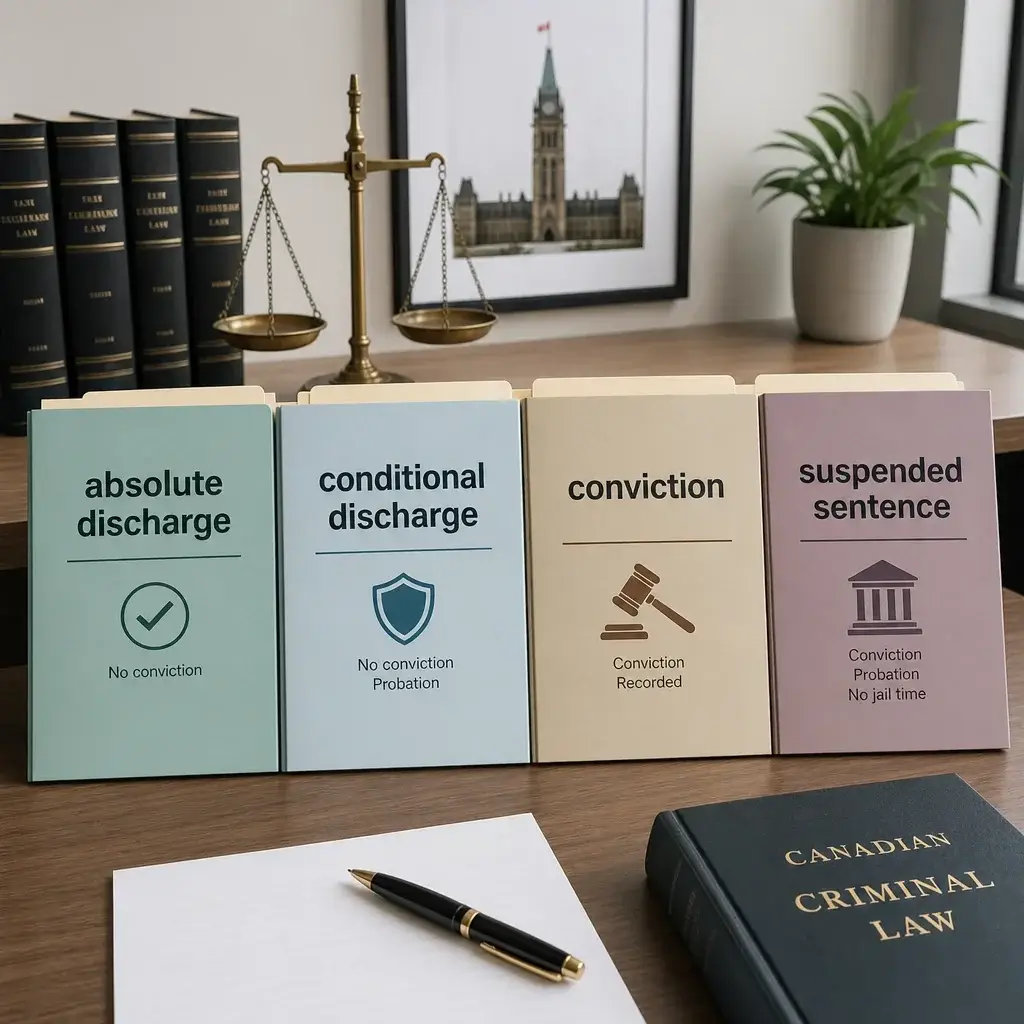
The shortest answer is this: absolute discharge vs conditional discharge turns mainly on probation and supervision, while suspended sentence and a straight conviction both involve a conviction .
| Outcome | Conviction registered? | Probation? | Breach risk? | Practical use in assault cases | Record visibility point |
|---|---|---|---|---|---|
| Absolute discharge | No conviction registered | No | No probation breach because there is no probation | Used where the court finds guilt but decides no conviction and no supervision are needed | May still appear in systems or checks for a period before record repositories update or purge it |
| Conditional discharge | No conviction registered | Yes, probation can be up to 3 years | Yes, breach of probation can trigger further proceedings | Common fallback where the court wants counselling, reporting, no-contact terms, or accountability | May appear for longer than an absolute discharge in record systems |
| Conviction with fine or probation | Yes | Sometimes | If probation is imposed, yes | Used where the court finds a conviction is required but jail is not | Criminal record consequences attach |
| Suspended sentence | Yes, it is a conviction plus probation | Yes | Yes | Used where a conviction is required but the court suspends the passing of a custodial sentence and imposes probation | Criminal record consequences attach |
A conditional discharge can be the more realistic sentencing position where the court wants structure. Typical conditions can include keep the peace and be of good behaviour, report to probation, attend counselling, avoid contact with the complainant, stay away from places, perform community service, or make restitution if lawful and appropriate .
A suspended sentence is often confused with a discharge, but the difference is basic and important. One avoids a conviction. The other does not. That distinction matters for anyone asking Does a conditional discharge mean a criminal record or comparing future record effects.
Does an absolute discharge create a criminal record or show up on background checks?

A discharge is generally treated differently from a conviction, but that does not mean it is invisible everywhere from day one. People searching Absolute discharge criminal record or criminal record after absolute discharge usually need that nuance, not a slogan.
An absolute discharge is not a conviction, but police and court information can still exist in record systems for a period of time, and different checks can return different results depending on timing, record source, and local retention practices .
The RCMP’s national records system and local police databases do not always work the same way. A standard criminal record check, a judicial matters check, and a vulnerable sector check are different products with different disclosure rules .
The commonly cited retention point is about 1 year after sentence for an absolute discharge and about 3 years after sentence for a conditional discharge in national repositories, but readers should treat that as a point to verify for the current system and exact check type . Local police records, fingerprints, photographs, and court files can follow different removal or destruction processes.
| Outcome | Commonly cited national retention point | Conviction? | Can it appear on some checks during that period? | Local police records may remain separately? |
|---|---|---|---|---|
| Absolute discharge | About 1 year from sentence | No | Yes, depending on the check and timing | Yes |
| Conditional discharge | About 3 years from sentence | No | Yes, depending on the check and timing | Yes |
| Conviction | No automatic short purge timeline of this kind | Yes | Yes | Yes |
A vulnerable sector check can raise separate concerns because the disclosure rules are different and more sensitive to the purpose of the screening . I would never tell a client that an assault discharge will “never” appear on any background check. That is too broad.
Fingerprints and photographs can also be separate from the discharge itself. In Ontario, a person may need to take active steps to ask for destruction or return, and local police service policies can differ . If record consequences matter for work, licensing, immigration, or travel, this needs case-specific review.
Employment, professional licensing, immigration, and U.S. travel after an assault discharge

Employment forms do not all ask the same question. Some ask only about convictions. Others ask about findings of guilt, discharges, outstanding charges, court orders, or any police contact. The safe rule is to answer the form exactly as written and get legal advice where the stakes are high .
Professional licensing bodies often ask broader questions than ordinary employers. A regulator may ask about conduct, findings of guilt, discharges, probation orders, honesty on applications, or any matter relevant to good character and suitability to practise .
Immigration consequences can turn on the exact statute, the exact question on the form, and the exact disposition. Canadian law may treat a discharge differently from a conviction, but immigration decision-makers may still examine the underlying facts, admissibility issues, or disclosure obligations in a specific process .
U.S. travel is its own problem. American border officials use U.S. law and U.S. entry rules, not Canadian sentencing labels, and they may not treat a Canadian discharge the way a Canadian employer would . Anyone with urgent travel issues should get advice before assuming an Absolute discharge Ontario result solves the border problem.
What happens if the judge will not grant an absolute discharge?
If the court refuses an absolute discharge, the next live issue is usually whether a conditional discharge is available and realistic. In assault cases, that often becomes the middle ground when the judge wants supervision, counselling, or enforceable no-contact conditions .
If a discharge is refused entirely, sentencing moves into conviction-based options. Depending on the exact assault offence and facts, that can include a fine where lawful, probation, a suspended sentence, or custody . I can’t tell anyone which outcome applies without the disclosure and sentencing record.
The Crown’s position matters, but it does not decide the sentence. A joint submission from Crown and defence carries weight in Canadian sentencing law, but the judge still has to decide whether the proposed result is fit and lawful .
The agreed statement of facts also matters because it defines what the judge is actually sentencing. In my work, having prosecuted before, I read that document carefully. Sometimes the right fight is about wording, injuries, context, or aggravating details that overstate what the evidence really supports.
Can a conditional discharge be breached, revoked, or appealed?
A conditional discharge carries probation, so it carries breach risk. If a person fails to follow probation conditions, the Crown can allege a breach of probation under the Criminal Code .
The more serious consequence is that a breach can also expose the person to further action on the original discharge sentence under the Criminal Code probation and revocation framework . That is one reason a Conditional discharge Ontario outcome is not the same as an absolute discharge, even though both avoid a conviction at the outset.
An absolute discharge has no probation, so there is no probation order to breach. Once imposed, the sentence is usually simpler in structure because there are no ongoing reporting or counselling terms attached .
Appeal rights exist in criminal sentencing, but the route and time limits depend on the court level, the issue, and who is appealing . That is too fact-specific to reduce to a slogan. If sentencing has already happened, get advice quickly because appeal deadlines can be short.
How to improve the chances of a discharge in an assault case
The most useful work usually happens before sentencing, not at sentencing. If you want an absolute discharge assault outcome considered, the defence needs a proper record: the correct offence analysis, accurate agreed facts, letters, counselling proof, work or school documents, and any immigration or licensing material that genuinely matters .
A discharge argument works best when it answers both branches of section 730. The defence has to show why avoiding a conviction is in the accused’s best interests and why a discharge is still not contrary to the public interest in an assault case .
Helpful materials can include counselling records, anger-management attendance, addiction treatment evidence, character letters, proof of employment, school transcripts, volunteer history, restitution documents where relevant, and Gladue materials where they apply . The point is not volume. The point is credible rehabilitation evidence.
The Crown’s position can make a real difference because it frames the sentencing debate and the agreed facts. But even where the Crown opposes a discharge, the defence can still argue for it if the law and facts support the ask .
Use this simple checklist before assuming a discharge is available:
- Confirm the exact assault charge and mode of prosecution
- Check whether section 730 legally allows a discharge for that offence
- Examine the actual force, injury, relationship context, and any aggravating factors
- Gather proof of counselling, treatment, work, school, or other rehabilitation
- Identify real collateral consequences from a conviction, not speculative ones
- Assess whether a conditional discharge is the more realistic fallback
If you are facing an assault charge or a sentencing hearing, speak with a criminal defence lawyer about whether an absolute or conditional discharge is legally available and realistically arguable on your facts. A free consultation may help you sort out the sentencing framework, but no lawyer can responsibly promise a result.
Examples: when an absolute discharge for assault may be realistic, and when it usually is not
A low-level common assault may be the classic absolute discharge examples category. Example: a person with no record pushes another adult once during a brief argument, there is no injury, no weapon, immediate remorse, counselling has started, and the person faces concrete job licensing consequences from a conviction . That is the kind of fact pattern where an absolute discharge may be arguable.
A conditional discharge may be the more realistic ask where the facts are still on the lower end but the court wants structure. Example: a first offender slaps a family member during a heated dispute, there is minor redness, no prior violence, and counselling has begun, but the judge wants enforceable treatment and no-contact terms .
A conviction-based sentence becomes more likely where the assault includes repeated punches, visible injuries, intoxication, threatening conduct afterward, or a breach of release terms . Those facts raise denunciation and public-protection concerns in a way that makes a discharge harder to defend.
A discharge is usually not treated as a realistic sentencing position for very serious violence. Example: an assault with major injuries, a weapon, a vulnerable complainant, or a significant prior record for violence . In those cases, the legal focus is usually not on an absolute discharge for assault at all.
Sexual assault should be treated with special caution. I would not use it as a generic What is an example of an absolute discharge scenario without checking the exact current law first, because overbroad online claims in this area are often wrong.
FAQ
What is an absolute discharge for assault?
An absolute discharge for assault is a sentence where the court finds guilt but does not register a conviction and does not impose probation . It is available only if the offence is legally eligible and the judge finds it is in the accused’s best interests and not contrary to the public interest .
Does an absolute discharge give you a criminal record?
It is not a conviction, so it is different from a criminal conviction record . But that does not mean it disappears everywhere at once. It can still appear in some police or court systems, and some background checks may show it for a period depending on the check type and timing .
How long does an absolute discharge stay on your record?
The commonly cited retention point is about 1 year from sentence in national systems for an absolute discharge . A conditional discharge is commonly cited at about 3 years . Local police files, fingerprints, photos, and court records can follow different timelines and processes.
Does absolute discharge show on a criminal record?
On a standard criminal-record question about convictions, a discharge is generally treated differently because it is not a conviction . But some police background checks, local records, or broader screening products may still reveal discharge information for a period. The exact answer depends on the check being run.
Can you get an absolute discharge for assault in Canada?
Yes, some assault cases can qualify. Common assault is the category where this issue most often arises . But discharge availability depends on the exact offence, current law, the seriousness of the facts, the offender’s background, and the sentencing materials put before the judge.
What is the difference between an absolute discharge and a conditional discharge?
The main difference is probation. An absolute discharge has no probation . A conditional discharge includes probation, which can last up to 3 years . Both avoid a conviction at the outset, but only a conditional discharge carries ongoing conditions and breach risk.
What is the difference between a suspended sentence and an absolute discharge?
A suspended sentence is a conviction plus probation . An absolute discharge is no conviction and no probation . That is a major legal and practical difference for record consequences and future screening.
Will I go to jail for first time assault in Canada?
Jail is not automatic for a first assault charge. Depending on the offence and facts, outcomes can range from discharge to probation, suspended sentence, fine where lawful, or custody . No responsible lawyer can predict the result without reviewing the disclosure, the exact charge, and the sentencing record.
Can an absolute discharge be granted for sexual assault?
You should not assume that. Sexual assault has to be checked carefully under the current Criminal Code framework because discharge availability can depend on the exact charge and offence structure . This is an area where online summaries are often too broad.
Will an absolute discharge show up on a police background check?
It can, depending on the check type, the timing, and the record source . A discharge may be treated differently on a standard criminal record check than on a judicial matters check or vulnerable sector screening. Local police records can also create separate issues.
Can employers or licensing bodies ask about a discharge?
Yes, some can. It depends on how the question is written. Some ask only about convictions. Others ask about findings of guilt, discharges, probation orders, charges, or broader conduct issues . Read the wording carefully and get advice where the consequences are serious.
Can you travel to the United States after an absolute discharge?
A discharge under Canadian law does not guarantee U.S. entry . U.S. border officials apply U.S. rules and may treat the underlying incident differently than a Canadian employer or court would. If travel matters, get advice before assuming the discharge solves it.
If you are trying to understand whether absolute discharge for assault or conditional discharge for assault is even on the table, start with the exact charge, the Crown election, and the agreed facts. Then review the sentencing record like a criminal lawyer would. That is where the real answer usually is.