

 Based on 116 Verified Google Reviews
Most people searching aggravated assault with a deadly weapon meaning assume it is one exact charge everywhere. It is not. In plain English, the phrase usually means an assault made more serious because a weapon was used, shown, threatened, or because the injuries were very serious, but the legal label changes by jurisdiction.
What aggravated assault with a deadly weapon means in plain English
The phrase usually describes an assault that becomes more serious because of a deadly or dangerous weapon, serious injury, or both. The exact elements depend on where the charge was laid, because Canada, Florida, Washington, and Minnesota do not use the same statutory scheme.
An ordinary assault can be an attempt or threat to apply force, or actual force without consent, depending on the jurisdiction. An aggravated assault with a weapon usually means the Crown or prosecutor alleges something more than a basic assault, such as a knife being brandished, a gun being pointed, a bottle being used to strike, or injuries that are alleged to be life-endangering.
In Canada, the Criminal Code does not generally use the exact everyday phrase “aggravated assault with a deadly weapon” as a standard offence title. Canadian charges are usually laid as assault, assault with a weapon, assault causing bodily harm, or aggravated assault under section 268 of the Criminal Code .
Assault vs assault with a weapon vs aggravated assault
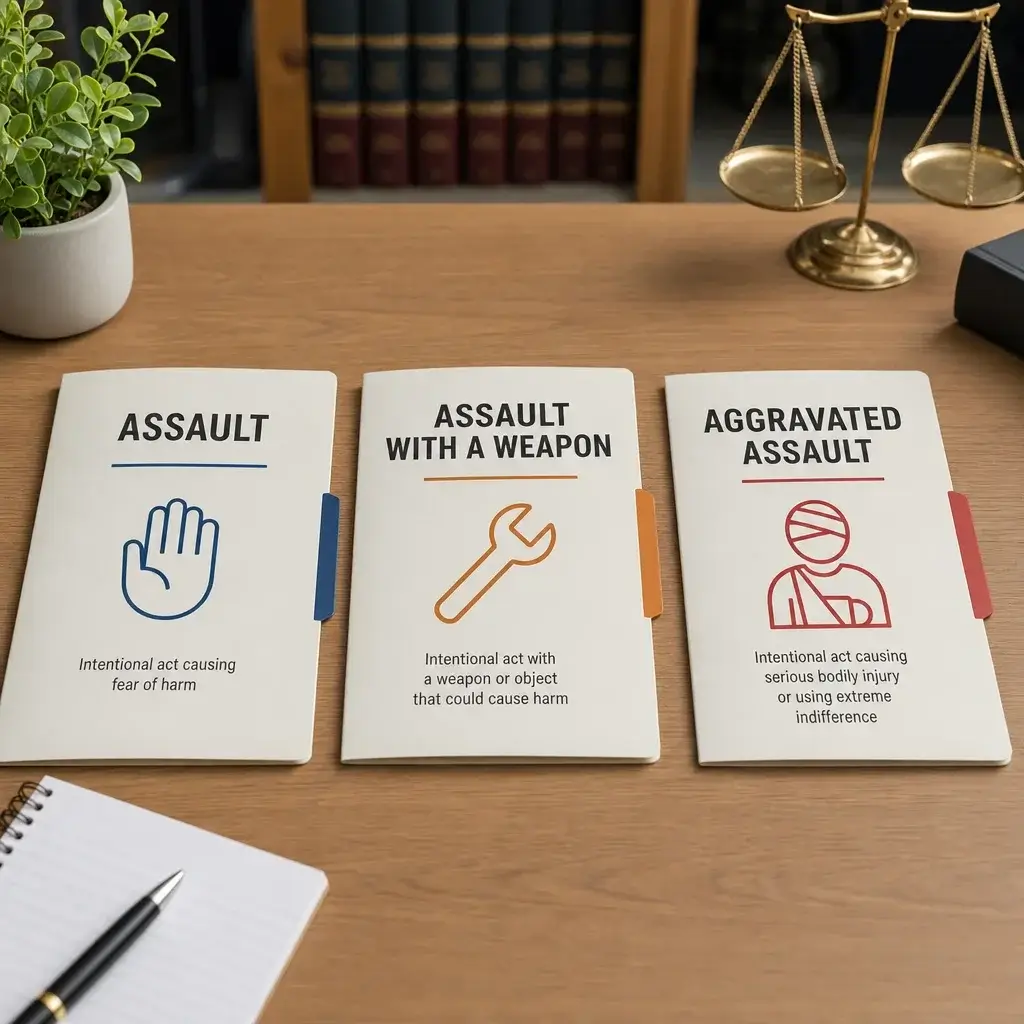
The basic difference is seriousness. Simple assault is the lowest assault level. Assault with a weapon adds alleged weapon use or a threat involving a weapon. Aggravated assault is the most serious standard assault offence in Canada because it requires wounding, maiming, disfiguring, or endangering the life of the complainant under section 268 .
If you are asking whether aggravated assault is better or worse than assault, it is worse in legal exposure. The allegation is more serious, the maximum penalty is higher, bail can be harder, and the sentencing risk is higher if there is a conviction.
Here is the practical comparison:
| Charge label | Typical conduct alleged | Weapon required | Injury required | Relative seriousness |
|---|---|---|---|---|
| Assault | Applying force, attempting force, or threatening force | No | No | Lowest |
| Assault with a weapon | Assault involving a weapon, imitation weapon, or threat with one | Yes, or alleged use/display | No | More serious |
| Assault causing bodily harm | Assault causing more than trivial or transient injury | No | Yes, bodily harm | More serious |
| Aggravated assault | Assault that wounds, maims, disfigures, or endangers life | No, but a weapon is often alleged | Yes, very serious harm or life-endangering harm | Most serious standard assault charge in Canada |
In some U.S. states, the label is different. A state may use aggravated assault with a deadly weapon, aggravated battery, or second-degree assault with a dangerous weapon. Those terms are not interchangeable across jurisdictions.
What counts as a deadly weapon, dangerous weapon, weapon, imitation weapon, or firearm
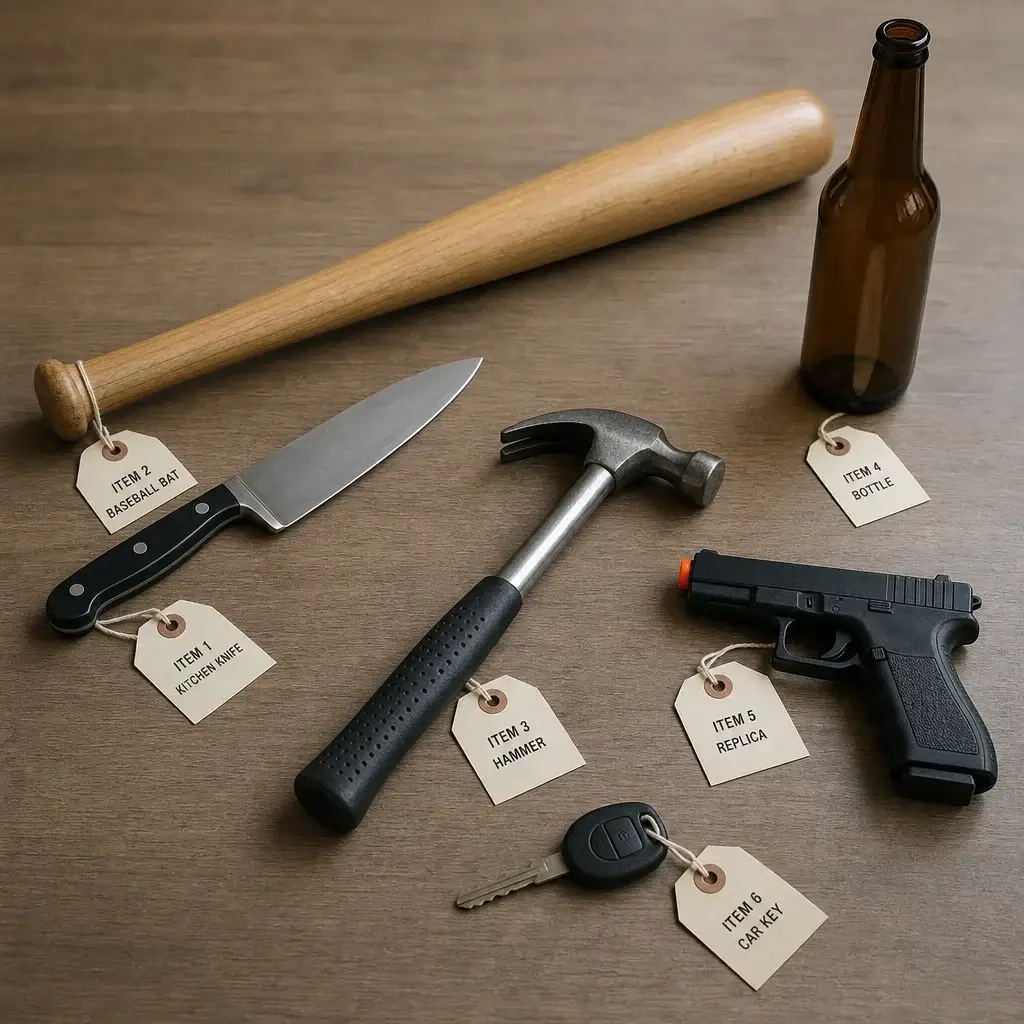
A weapon is not limited to guns and knives. In criminal law, an ordinary object can become a weapon because of how it was used, carried, displayed, or threatened to be used.
Common examples include a firearm, knife, bottle, hammer, crowbar, baseball bat, steel-toed boot, vehicle, or heavy household object. A chair, a mug, a tool, or even a car key can be alleged to be a weapon if the facts suggest it was used to hurt or threaten someone.
In Canada, the Criminal Code definition of weapon includes anything used, designed to be used, or intended for use in causing death or injury, or for threatening or intimidating a person . That is why an object that is harmless on a kitchen table can become a weapon in an assault case.
An imitation weapon can matter too. In Canadian assault with a weapon law, an imitation weapon can still support the charge if it was used or threatened in the assault allegation under section 267 .
This quick comparison helps:
| Term | Common meaning | Example | Does the law vary by jurisdiction? |
|---|---|---|---|
| Weapon | Broad term tied to use or intended use | Bottle, bat, car | Yes |
| Dangerous weapon | Object capable of causing harm as used | Hammer, crowbar | Yes |
| Deadly weapon | Object capable of causing death or serious harm | Knife, gun | Yes |
| Imitation weapon | Replica or object presented as a weapon | BB gun, replica handgun | Yes |
| Firearm | Gun regulated as a firearm by local law | Pistol, rifle, shotgun | Yes |
Does a firearm have to be loaded, pointed, fired, or even used to count?
No, not always. In many jurisdictions, a gun does not have to be fired for a serious assault-type charge to be alleged. The display, pointing, brandishing, threat, or use of the firearm as a blunt object may be enough, depending on the statute and the facts.
A loaded gun and an unloaded gun are not always treated the same way in every place. Some laws focus on the victim’s fear and the apparent ability to carry out the threat. Others focus more closely on whether the firearm was operable, loaded, discharged, or used to strike someone.
In Canada, pointing a firearm can itself be a separate Criminal Code offence under section 87 . A charge of assault with a weapon or a firearms-related offence may also be laid depending on what was said, how the gun was handled, and whether force or threats are alleged.
A few practical firearm examples show why the facts matter:
- Pointing a handgun during an argument may support a firearm-related charge even if no shot is fired.
- Swinging a gun and striking someone with it may be treated as weapon use even if the gun never discharged.
- Showing a gun tucked in a waistband while making threats may support a serious allegation in some jurisdictions.
- Saying you have a gun when you do not may still support a threat-based charge, but the exact charge may differ.
Can you be charged without physical contact or serious injury?
Yes. Physical contact is not always required for an assault-type charge. In Canada, assault can include an attempt or threat to apply force if the complainant has reasonable grounds to believe you can carry it out at that time .
That is why a threat with a knife, a raised bat, or a pointed gun can lead to an assault charge even if no one was struck. The issue is not only whether contact happened. The issue can also be whether there was an intentional act, a threat of force, present ability, and fear created by the conduct.
Serious injury is also not required for every weapon charge. Assault with a weapon does not require the same level of injury as aggravated assault in Canada. Aggravated assault requires a much higher level of harm, namely wounding, maiming, disfiguring, or endangering life under section 268 .
Three short examples show the difference:
- A person raises a knife and moves toward someone who backs away. That may support assault with a weapon even without contact.
- A person throws a bottle and causes cuts needing stitches. That may support assault causing bodily harm or assault with a weapon.
- A person beats someone with a metal bar and the injuries endanger life. That may support aggravated assault.
Does “without intent to kill” matter?
Yes, but not in the way people often think. An aggravated assault with a deadly weapon without intent to kill can still be a very serious charge. The law often does not require proof that the accused meant to kill.
The prosecutor may only need to prove the intent required for the assault offence itself, such as intentionally applying force, attempting force, threatening force, or intentionally using an object as a weapon. For aggravated assault in Canada, the Crown still has to prove the assault and the serious result, but not an actual intent to kill as an essential element of section 268 .
Intent to kill is a different allegation. If the evidence suggests a planned effort to cause death, the case can move into attempted murder territory, which is a separate offence with very different legal elements and much higher exposure.
In practice, intent is usually inferred from surrounding facts, not from a confession. Prosecutors look at words spoken, prior threats, the type of weapon, the number of blows, where the body was targeted, the distance involved, whether the attack continued after the complainant was down, and what happened afterward.
That is why a search for aggravated assault with a deadly weapon without intent to kill or aggravated assault with deadly weapon without intent to kill points to a real issue. The absence of an intent to kill does not make the allegation minor. It simply means the Crown may be alleging a serious assault rather than attempted murder.
How these charges are defined in Canada
Canada separates these offences under the Criminal Code rather than using one catch-all label. The key offences are common assault under section 266, assault with a weapon or assault causing bodily harm under section 267, and aggravated assault under section 268 .
Section 267 covers two related paths. One is an assault with a weapon or imitation weapon. The other is an assault that causes bodily harm. The offence is hybrid, which means the Crown can proceed summarily or by indictment .
Section 268 covers aggravated assault. In plain language, that means an assault that wounds, maims, disfigures, or endangers the life of the complainant. It is also a straight indictable offence with a maximum penalty of 14 years’ imprisonment .
For assault with a weapon or causing bodily harm in Canada, the maximum penalty on indictment is 10 years’ imprisonment . On summary conviction, the maximum penalty depends on the current Criminal Code summary sentencing framework and should be checked against the present version of the Code before relying on it in any live case.
The phrase assault with a weapon Criminal Code Canada is therefore more accurate than trying to force all Canadian cases into a U.S.-style aggravated assault label. If someone in Ontario says they were charged with aggravated assault Canada, the actual Information or indictment should be read carefully to confirm whether the charge is under section 267 or section 268 .
How these charges are defined in Florida, Washington, and Minnesota
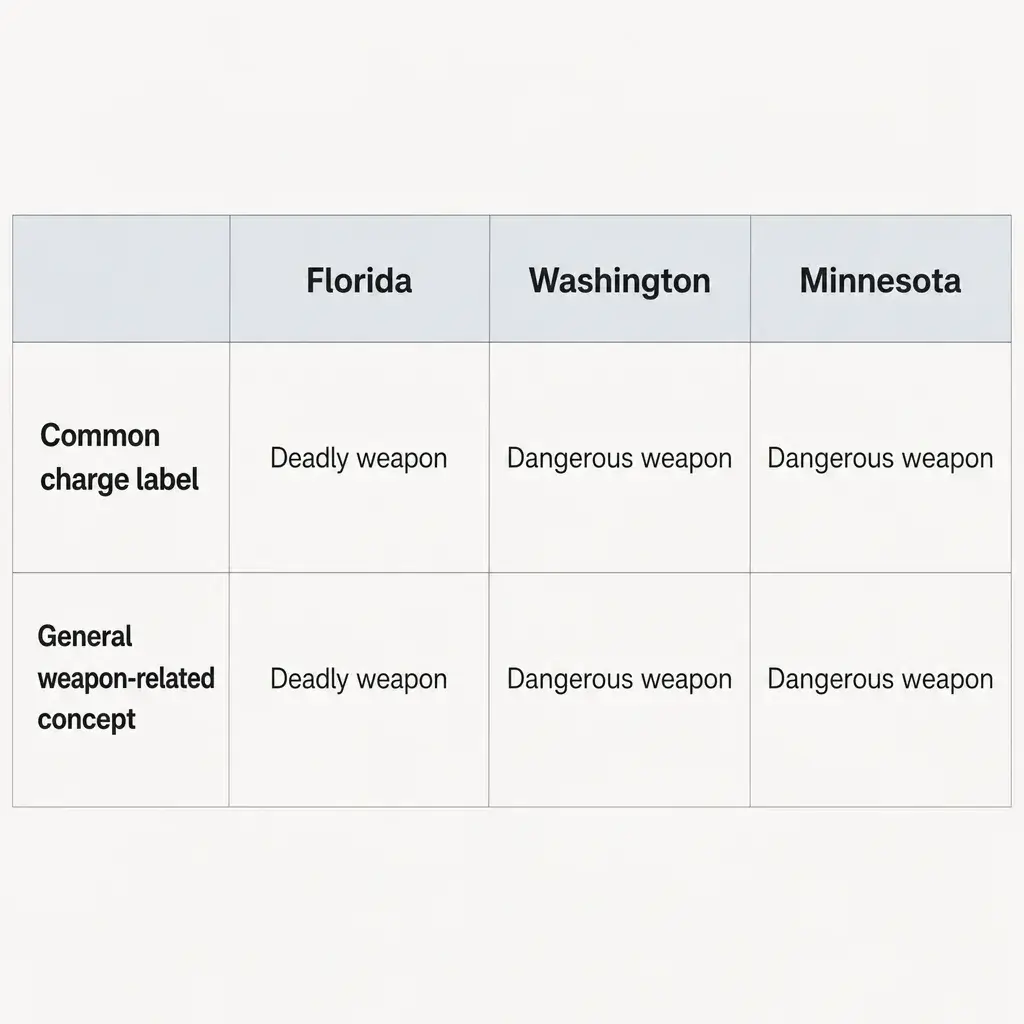
U.S. states use different labels and different penalty structures. A charge called 2nd degree aggravated assault with a deadly weapon in one place may not exist under that name in another.
This table keeps the systems separate:
| Jurisdiction | Common label | Core idea | Maximum penalty noted here |
|---|---|---|---|
| Canada | Assault with a weapon / aggravated assault | Weapon use, bodily harm, or life-endangering harm under the Criminal Code | 10 years for section 267 on indictment; 14 years for section 268 |
| Florida | Aggravated assault | Assault with a deadly weapon without intent to kill, or with intent to commit a felony | Up to 5 years and up to a $5,000 fine for a third-degree felony |
| Washington | Assault in the second degree | Assault with a deadly weapon is one route to second-degree assault | Up to 10 years and up to a $20,000 fine |
| Minnesota | Assault in the second degree | Assault with a dangerous weapon | Up to 7 years and up to a $14,000 fine; higher if substantial bodily harm is alleged under a separate provision |
Florida is the source of a lot of search confusion because its aggravated assault statute is often described as assault with a deadly weapon without intent to kill. That is Florida wording, not Canadian wording .
Washington and Minnesota use degree-based assault language. So a search for 2nd degree assault with a dangerous weapon or 2nd degree aggravated assault with a deadly weapon may be aiming at a state-law concept, not Ontario or Canadian law.
Because state statutes change, anyone facing a U.S. charge should have the exact charging document reviewed in that state. I cannot sensibly predict anything from a label alone.
Sentences and penalties: statutory maximums vs real-world drivers
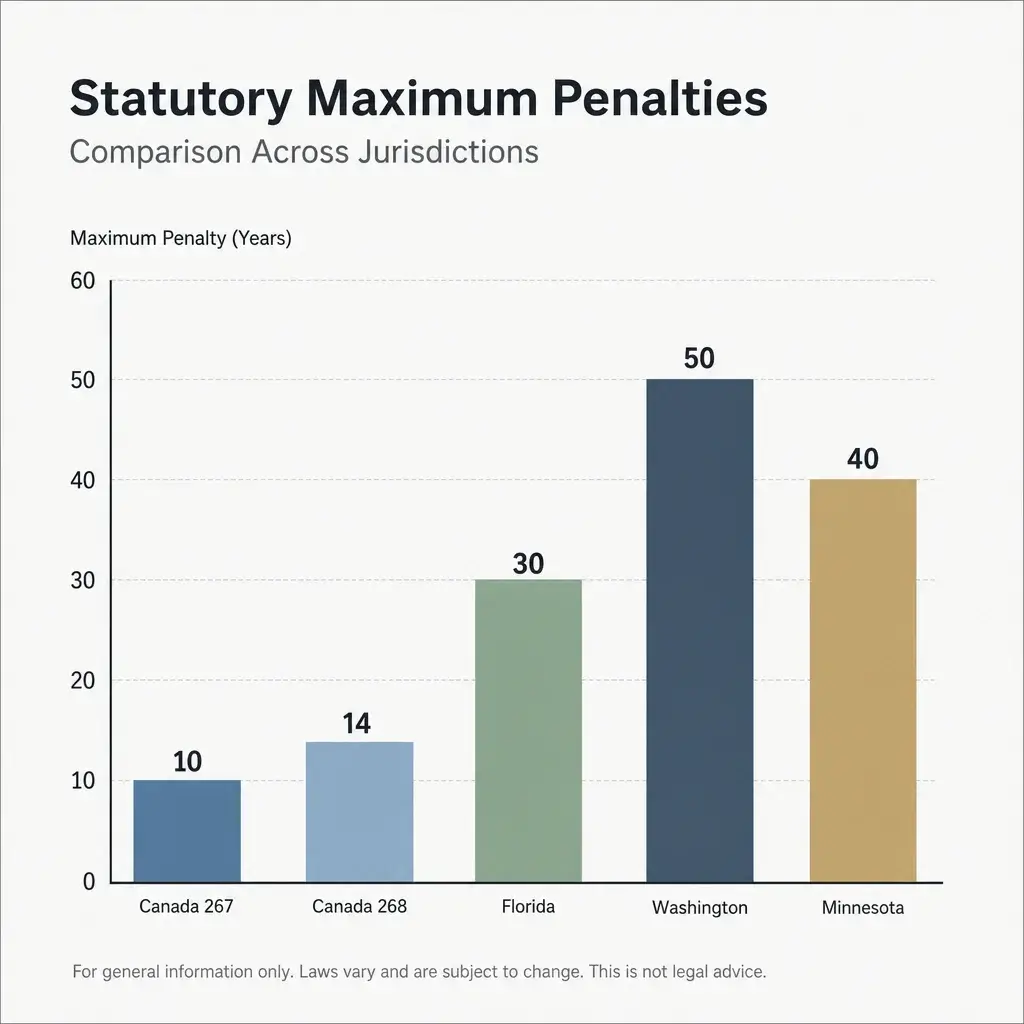
The first thing to separate is the statutory maximum from the likely sentence in any one case. They are not the same thing. The Criminal Code maximum tells you the outer ceiling. It does not tell you what any individual will receive.
In Canada, aggravated assault under section 268 carries a maximum of 14 years’ imprisonment . Assault with a weapon or assault causing bodily harm under section 267 carries a maximum of 10 years on indictment . Those are the Code-set maximums, not predictions.
In Florida, aggravated assault is commonly treated as a third-degree felony with a maximum of 5 years’ imprisonment and a fine up to $5,000 . In Washington, second-degree assault carries up to 10 years and a $20,000 fine . In Minnesota, second-degree assault with a dangerous weapon carries up to 7 years and a $14,000 fine, with different exposure where other harm findings apply .
What actually drives sentence exposure is the fact pattern. Courts look at the degree of injury, whether the weapon was a firearm or knife, whether the complainant was vulnerable, whether there was planning, whether the allegation arose in a domestic setting, whether there is a prior criminal record, whether the accused was on bail or probation, and whether responsibility is accepted by plea or the matter proceeds to trial.
Possible outcomes after a conviction can include jail or prison, probation, a suspended sentence, fines, restitution, weapons prohibitions, and a criminal record. The legally available options depend on the offence, the jurisdiction, and the sentencing law in force at that time.
I cannot tell anyone the aggravated assault with a deadly weapon sentence or aggravated assault with a firearm sentence for their own case without the disclosure, the record, and the exact court location. Every case turns on its own facts.
Will a first-time offender go to jail?
A first offender can still face jail on a serious weapon allegation. There is no rule that a first assault with a weapon offence in Canada avoids custody, and there is no honest lawyer who should promise that.
The factors that usually increase custody risk are a firearm allegation, serious injury, repeated blows, vulnerable victim, domestic context, prior violence history, breach of release terms, and evidence of planning. The factors that may reduce exposure can include a clean record, weaker proof, less serious injury, strong rehabilitation evidence, employment history, and early meaningful steps to address the underlying issue.
A first simple assault is not the same thing as a first assault charge with weapon involvement. Once a weapon or life-endangering injury is alleged, the case is treated far more seriously by police, the Crown, and the court.
When I review a first-offence case, I look at five things first: the exact charge, the injury evidence, the alleged weapon, the accused’s record, and the release history. Until I see the disclosure, I cannot responsibly go further than that.
What prosecutors usually try to prove
The prosecution must prove the legal elements of the charge beyond a reasonable doubt. In a weapon case, that usually means proving the assaultive act or threat, the involvement of the weapon, the required state of mind, the identity of the accused, and any injury element that makes the offence more serious.
For an aggravated assault with a deadly weapon charge or an assault charge with weapon allegation, the evidence often includes the complainant’s statement, a 911 recording, officer notes, body-worn camera footage, surveillance video, photos of injuries, medical records, text messages, social media messages, civilian witness statements, and any recovered object said to be the weapon.
Where a firearm is alleged, the prosecutor may also rely on operability evidence, forensic examination, shell casings, ammunition, fingerprints, DNA, gunshot residue, or admissions. Where no weapon was recovered, the case may rise or fall on identification, consistency, and credibility.
From a defence perspective, the weak points are often just as important as the Crown’s strongest evidence. Having prosecuted, I look for contradictions, delayed reporting, inconsistent descriptions of the object, missing medical proof, poor lighting, intoxication, motive to fabricate, self-defence evidence, and Charter issues around the seizure of the alleged weapon.
Common defences to aggravated assault with a weapon or firearm charges
The defence depends on the legal elements and the facts. There is no universal defence that fits every assault with a dangerous weapon allegation.
Self-defence can apply if the evidence supports a reasonable response to force or a threat of force. In Canada, self-defence is governed by section 34 of the Criminal Code, which looks at whether the act was committed for the purpose of defending or protecting and whether the response was reasonable in the circumstances .
Lack of intent can matter where the act was accidental, reflexive, or misinterpreted. No weapon can matter where the object was never used, never displayed, or was described inaccurately. No serious injury can matter where the Crown has charged aggravated assault but the medical evidence does not support wounding, maiming, disfigurement, or life-endangering harm.
Other defences may include mistaken identity, fabrication, insufficient proof, inconsistent witnesses, and in some cases a Charter challenge. Section 8 of the Charter protects against unreasonable search and seizure, and section 10(b) protects the right to retain and instruct counsel without delay . If police obtained evidence in breach of the Charter, I may argue to exclude it.
Consent has very limited value in serious assault law. Canadian law does not treat consent as a blank cheque for serious bodily harm. That issue is technical and fact-specific, so it should be reviewed against the exact allegation and the governing case law.
Bail, court process, and what to do right after arrest or charge

The first issue is release. A bail hearing, now formally called judicial interim release, is usually heard within 1 to 3 days of arrest if the accused is not released directly by police .
Weapon allegations often come with strict release conditions. Common terms include no contact with the complainant, not attending a home or workplace, curfew, reporting, no possession of weapons, and surrender of firearms or licences if applicable.
The next steps are usually disclosure, first appearances, Crown pre-trial discussions, possible resolution talks, motions, and trial if the matter does not resolve. A contested indictable matter can take roughly 6 to 18 months or more to finish, depending on the court, the disclosure, and whether expert evidence is involved .
Right after arrest or charge, the safest checklist is simple:
1. Use your right to silence. 2. Ask to speak to a lawyer before giving a statement. 3. Keep every release paper, undertaking, or bail order. 4. Obey no-contact and no-weapons terms exactly. 5. Save texts, photos, videos, and location data. 6. Write down witness names while memories are fresh. 7. Do not post about the case online. 8. Attend every court date.
If you breach release terms, you can face a new criminal charge on top of the assault allegation. That can affect bail and sentencing exposure in a very real way.
Collateral consequences beyond jail: record, immigration, travel, licensing, and weapons bans
A conviction for assault with a weapon or aggravated assault can create a permanent criminal record unless and until record-suspension rules are later met. That record can affect employment screening, volunteering, housing applications, and professional licensing.
Firearms consequences can be serious and separate from the main sentence. Canadian courts can impose weapons prohibition orders for certain offences, and firearms licensing consequences can follow even without a jail sentence. The exact scope depends on the charge, the disposition, and the order made by the court.
Immigration and travel consequences can also follow. For non-citizens, criminal charges and convictions can affect status, admissibility, and future applications. Travel to the United States can be affected by Canadian criminal history as well, but border decisions are made by the foreign state, not by the Ontario court.
These consequences are one reason I tell people not to focus only on the jail question. Even a non-custodial sentence can carry long-term effects. This is general information, not advice on your charge.
Examples of aggravated assault with a deadly weapon and related charges
Examples help because the labels are fact-driven. The same conduct may be called aggravated assault with a gun in one place and assault with a weapon in Canada.
Pointing a gun during an argument and threatening to shoot may be charged as aggravated assault with a firearm in a U.S. state, or as pointing a firearm, uttering threats, or assault with a weapon in Canada, depending on the facts.
Swinging a knife at someone and missing can still support a serious weapon allegation even though there was no contact. That is one clear example of why aggravated assault use of a deadly weapon can be alleged without an intent to kill.
Striking someone in the face with a bottle during a bar fight may support assault with a weapon, assault causing bodily harm, or aggravated assault depending on the injury evidence. A cut needing stitches is not the same thing as permanent disfigurement or life-endangering harm.
Driving a car at a person on purpose can turn a vehicle into a weapon. In one jurisdiction that may be charged as aggravated assault with a deadly weapon. In another, it may be assault with a weapon or even attempted murder if the evidence supports an intent to kill.
A severe beating that leaves permanent facial scarring may support aggravated assault in Canada because disfigurement is one of the section 268 markers .
FAQs about aggravated assault with a deadly weapon
What does an assault with a deadly weapon mean?
It usually means an assault made more serious because a weapon was used, shown, threatened, or alleged. The exact legal meaning depends on the jurisdiction. Canada often uses the charge label assault with a weapon instead of the U.S.-style phrase.
What is aggravated assault with a deadly weapon?
It is generally a more serious assault allegation involving a deadly or dangerous weapon, serious injury, or both. In Canada, aggravated assault usually refers to wounding, maiming, disfiguring, or endangering life under section 268 .
What is the difference between aggravated assault and assault with a weapon?
Assault with a weapon focuses on weapon involvement. Aggravated assault usually focuses on a higher level of harm or seriousness. In Canada, section 267 covers assault with a weapon or causing bodily harm, while section 268 covers aggravated assault .
Can you be charged with aggravated assault if no one was hit?
Sometimes yes, but that depends on the local law. A threat with a weapon can support a serious assault-type charge in some jurisdictions. In Canada, aggravated assault itself usually requires the very serious harm described in section 268, so no-contact cases are more commonly charged differently .
Does aggravated assault require intent to kill?
No, not usually. Intent to kill is a different allegation and may point toward attempted murder or another offence. A serious weapon assault can be charged without proof that the accused meant to kill.
What counts as a deadly or dangerous weapon?
Guns, knives, bats, bottles, hammers, vehicles, and ordinary objects used to injure or threaten can all be treated as weapons. The way the object was used is often more important than what the object usually is.
Is a firearm always a deadly weapon?
Not every jurisdiction uses the same wording, but a firearm is commonly treated as a deadly or dangerous weapon. Whether it had to be loaded, operable, pointed, or fired depends on the local statute and the facts.
What is the sentence for assault with a weapon in Canada?
Under section 267, the maximum sentence on indictment is 10 years’ imprisonment . The actual sentence in any case depends on the facts, the record, the injury, the weapon, and the sentencing law applied by the court.
How much jail time do you get for aggravated assault in Canada?
There is no universal answer. The statutory maximum for aggravated assault under section 268 is 14 years’ imprisonment , but I cannot predict a case-specific sentence without the disclosure and full background.
How long do you go to jail for aggravated assault with a deadly weapon in Florida?
Florida commonly treats aggravated assault as a third-degree felony with a maximum of 5 years’ imprisonment and up to a $5,000 fine . That is the statutory maximum noted here, not a prediction for any one Florida case.
Will a first-time offender go to jail for assault with a weapon?
A first offender can still go to jail. The risk turns on the weapon, the injuries, the context, the record, the bail history, and the strength of the evidence. No honest answer can go further without the disclosure.
Does assault with a weapon give you a criminal record?
A conviction can. A criminal record can affect employment, travel, immigration, licensing, and firearms issues. The long-term impact is one reason early legal advice matters.
What defences apply to aggravated assault with a weapon charges?
Possible defences include self-defence, lack of intent, accident, mistaken identity, no weapon, insufficient injury proof, fabrication, and Charter arguments about how evidence was obtained. The right defence depends on the exact legal elements of the charge.
Can charges be reduced or withdrawn before trial?
That can happen in some cases, but it depends on the evidence, the legal issues, the Crown’s review, and any resolution discussions. No one should promise that result, and I do not.
Speak to a criminal defence lawyer about an aggravated assault or assault with a weapon charge
A label alone does not tell you enough. Whether the allegation is properly treated as aggravated assault, assault with a weapon, assault causing bodily harm, a firearms offence, or something more serious depends on the statute, the disclosure, and the actual injuries.
When I am retained, I review the disclosure, examine the medical and witness evidence, assess any self-defence issue, and look for Charter problems the way a former Crown would. That is usually where the real case is. If you have been arrested or charged in Toronto or the GTA, get legal advice quickly, especially before giving any statement and before you breach a release term.
We do offer free consultations and are available 24/7, but this article is still only general information. For any live charge, speak to a criminal lawyer about your own facts and your own disclosure.