

 Based on 116 Verified Google Reviews
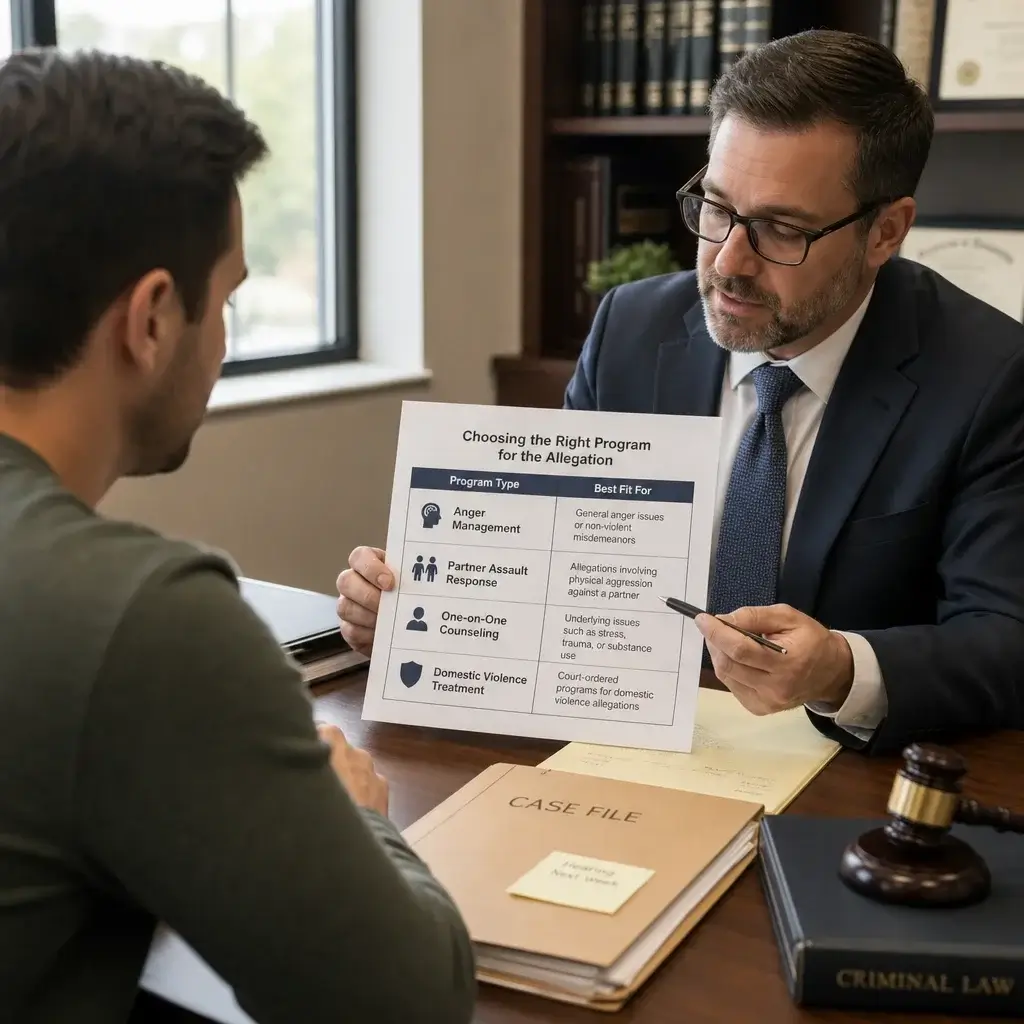
Most people think any anger course will help an assault case. That is where people get into trouble. In an anger management assault case, the right program depends on the allegation, the court stage, and whether the charge involves a partner or family violence dynamic. Enrolling may show initiative, but it does not guarantee any legal result. This is general information, not advice on your charge.
Anger management for an assault charge: when it may help and when it may not
Anger management for assault charge issues can be relevant when the allegation grew out of impulsive conflict, poor emotional regulation, or escalation in a road rage incident, bar fight, workplace dispute, neighbour conflict, or first-time assault allegation.
Court-ordered anger management is different from voluntary enrollment because a judge, bail term, probation order, or sentence condition can require attendance, while voluntary enrollment is something a person starts on their own before any order exists.
A lawyer should decide legal strategy, not the provider, because the disclosure may show whether the Crown is treating the case as a simple assault, a domestic allegation, a repeat-pattern file, or something more serious.
Assault is a hybrid offence in Canada, which means the Crown can proceed summarily or by indictment depending on the facts .
A simple assault charge can take months to resolve rather than days, and a defended matter commonly runs about 6–18 months depending on disclosure, court backlog, and whether it goes to trial .
Early enrollment may still matter at some stages because bail planning, resolution discussions, sentencing submissions, peace bond negotiations, and probation planning all look at different things.
I cannot predict whether taking a program will help your case without the disclosure, because every case turns on its own facts and on what problem the court thinks needs to be addressed.
Which program fits your case? Anger management vs PAR vs BIP vs domestic violence treatment
The biggest mistake is choosing a general anger management class when the court actually expects a partner assault response program or another domestic violence program.
General anger management classes usually focus on triggers, escalation signs, impulse control, communication, cognitive reframing, and conflict skills rather than patterns of coercion, jealousy, control, intimidation, or abuse in intimate relationships.
A P.A.R. course in Ontario usually refers to the Partner Assault Response program, which is a domestic violence intervention used in some intimate partner violence cases rather than a generic anger class .
The term Batterers’ Intervention Program is used in some jurisdictions, but names and delivery models differ by province and provider, so you need to confirm what the court, probation officer, or lawyer actually means before paying for anything.
If the allegation involves a spouse, dating partner, former partner, or co-parent, a partner assault response program may fit better than a general group program because the underlying issue may be relationship violence rather than anger alone.
If the allegation does not involve a partner, such as road rage, workplace conflict, a fight at a bar, or an argument with a neighbour, anger management counseling may be a closer match than a domestic violence program.
Women, LGBTQ clients, and non-partner assault clients are not excluded from anger work, but the right program still turns on the allegation pattern, not on gender or label.
| Program type | Typical fit | Main focus | Format options | Documentation that may be available |
|---|---|---|---|---|
| Anger management classes | Non-partner assault, road rage, workplace conflict, first-time impulsive assault | Triggers, regulation, communication, accountability | Group, one-on-one, online or in person | Enrollment letter, attendance record, completion report |
| One-on-one counseling | Complex history, privacy concerns, tailored work | Individual triggers, coping plan, behaviour change | Private sessions, virtual therapy or in person | Progress update, completion letter, clinical summary with consent |
| Partner Assault Response program | Intimate partner violence allegations | Relationship violence, beliefs, accountability, safety | Usually structured group, sometimes blended | Attendance and completion confirmation |
| Domestic violence program | Partner or family violence patterns | Abuse dynamics, control, responsibility, safety planning | Group or specialized treatment | Program-specific completion documents |
Will anger management satisfy the court or Crown?
No provider can promise that a court-approved anger management program will be accepted in every case because acceptance depends on the judge, the Crown, probation, the charge details, and whether the intervention actually matches the allegation.
The phrase court-approved anger management is often used loosely, but in real criminal practice there is a difference between a program the court ordered, a program a lawyer recommended, and a provider document that the court may consider.
A letter to the Crown may be useful only if it clearly states what program was taken, when it started, how attendance was tracked, and who delivered it.
Provider credentials matter because a bare online certificate from an unknown source may carry less weight than a document from a regulated professional or an established program with court-related experience.
Before you enroll, confirm whether the court expects anger management, a domestic violence program, individual counseling, a minimum number of sessions, or proof of active participation rather than just payment.
In Ontario criminal courts, disclosure review and Crown pre-trials are common points where counsel assess whether outside counselling material is worth raising, but that decision is case-specific and should be made carefully.
What documents may be provided for court-related cases

A provider may issue an enrollment confirmation, attendance record, progress update, completion report, or summary letter, but the exact document depends on the provider’s credentials and policies.
A useful completion report usually states the dates attended, the number of sessions completed, the format used, the topics covered, the completion status, and the provider’s name and role.
A short letter to the Crown is usually more practical than a long therapy narrative because criminal courts generally need proof of attendance and participation, not every personal detail discussed in sessions.
Confidentiality matters because deeper clinical content should only be released with the client’s informed consent and only when there is a good reason to disclose it.
Different systems may ask for different paperwork because probation, family court, immigration files, employers, and Children’s Aid can all look for different wording and levels of detail.
Documentation checklist before you enroll
- Ask what documents can be issued.
- Ask whether attendance is tracked session by session.
- Ask whether missed sessions are noted.
- Ask whether the provider can prepare a completion report.
- Ask whether a progress letter is available before completion.
- Ask what credentials appear on the document.
- Ask whether report fees are separate from treatment fees.
- Ask how long document preparation takes.
What happens in a court-related anger management program

Most court-related anger management counseling starts with intake, screening, and goal setting so the provider can decide whether the person needs a brief class, a structured multi-session program, or referral to something more specialized.
Individual sessions are often about 50 to 60 minutes , while group sessions can vary by provider and format.
Structured programs often run from about 6 to 12 sessions , but some educational formats are shorter and some one-on-one counseling plans run longer when the issues are deeper.
Session topics commonly include trigger identification, body signs of escalation, impulse control, communication skills, conflict resolution, accountability, and planning for high-risk situations.
Some providers also cover shame, fear, trauma, substance use, or stress responses when those factors are clinically relevant, because anger is often the visible behaviour rather than the only cause.
Homework may include reflection logs, trigger mapping, pause plans, breathing practice, communication scripts, and review of incidents that escalated.
Good programs are usually skill-building rather than lectures, and many draw from CBT-informed methods, psychoeducation, emotional regulation work, and behavioural rehearsal rather than one single model.
How long does anger management take?
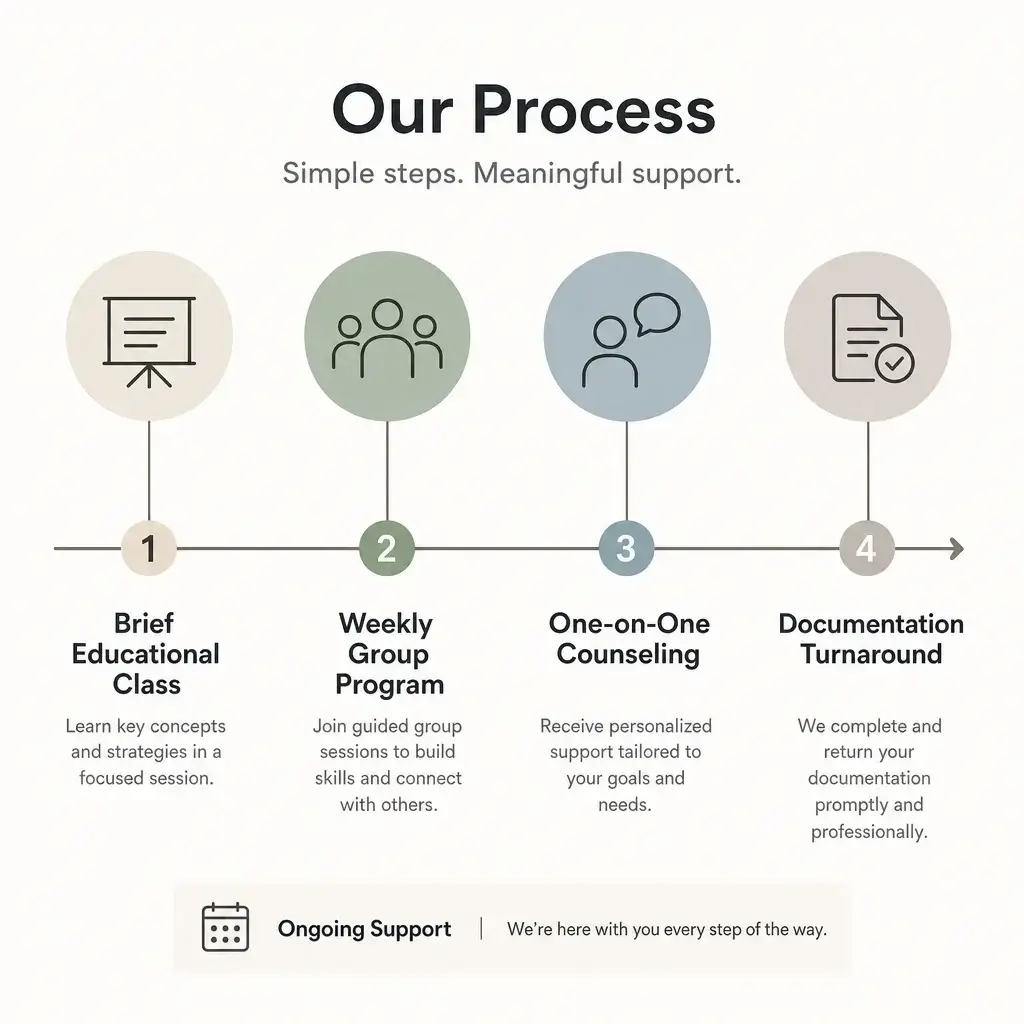
The timeline depends on whether the person needs a brief educational class, a group program, or one-on-one counseling tailored to the allegation and the court’s expectations.
Some educational formats are as short as 1 day , while many structured anger management classes or counseling plans run about 6–12 sessions .
A common scheduling window is about 4–12 weeks when sessions are held weekly , but that can stretch if sessions are missed or if the provider has limited availability.
If your lawyer or probation officer says the court expects a specific program length, the shortest option is not automatically the right option.
| Format | Typical time commitment |
|---|---|
| Brief educational class | 1 day or a short series |
| Weekly group program | 6–12 sessions |
| One-on-one counseling | Often 6 or more sessions, depending on goals |
| Documentation turnaround | Ask before enrolling, because it varies by provider |
Program formats: private, group, online, and in-person

One-on-one counseling fits people who need privacy, more personal detail, or work on issues that do not sit well in a group.
A group program can work well when the main need is structured education, accountability, and skills practice with others in similar situations.
Online anger management and virtual therapy can be practical for people who work shifts, live outside the city, or need faster scheduling, but you still need to confirm whether the court, probation officer, or lawyer will treat that format as suitable.
Virtual care should include identity verification, attendance tracking, and a clear consent process if the provider is going to issue court-related documents.
In-person sessions may feel more formal to some clients, while online formats may improve attendance because travel time drops to zero.
After-hours or weekend options can exist, but you need to ask because provider schedules differ widely.
Privacy in virtual therapy depends on basics that people forget, such as using a private room, headphones, secure internet, and a device nobody else can monitor.
Cost of anger management for an assault case
Cost usually depends on the intake process, whether the format is private or group-based, how many sessions are included, and whether a completion report or other documents are billed separately.
A cautious market-style estimate for one-on-one counseling is roughly CAD 130 to 200 per session .
A cautious market-style estimate for a multi-session program is roughly CAD 800 to 1800 in total depending on format and included documentation .
Letters or administrative documents may add roughly CAD 50 to 250 if billed separately .
You should ask for a written quote that states whether taxes, materials, intake fees, and report fees are included before you commit.
How to choose the right provider before you enroll
The right provider can explain the program clearly, the documentation clearly, and the limits clearly without promising any legal outcome.
Check credentials first because court-related files usually carry more weight when the provider is a regulated professional or an established program with a clear practice area.
Ask whether the provider has experience with assault-charge cases, probation reporting, family court documentation, immigration-related letters, or workplace requests, because each setting can require different wording.
A provider should be able to tell you the program format, the likely timeline, the attendance policy, the missed-session policy, the privacy policy, and the total cost before you pay.
Red flags include guaranteed court acceptance, guaranteed dropped charges, vague pricing, unclear credentials, or refusal to explain what a report will and will not say.
Free generic certificates from the internet may be cheap, but they can be the wrong fit if they do not track attendance, verify identity, or match the issue in the disclosure.
Questions to ask your lawyer before starting a program
Your lawyer can tell you whether anger management, a domestic violence program, or no program at all makes sense at your stage of the case.
Ask whether the allegation points toward general anger work, a Partner Assault Response program, or another intervention tied to partner or family violence.
Ask whether one-on-one counseling is acceptable, whether a group program is better, and whether online anger management is likely to create any concern in your court process.
Ask whether there is a minimum number of sessions, hours, or weeks the court will want to see, because some judges or probation officers focus on duration while others focus on fit and participation.
Ask what wording is most useful in a letter to the Crown or in a completion report, and ask when that document should be provided.
Ask whether the issue matters for bail, probation, sentencing submissions, diversion discussions, peace bond negotiations, or family court, because those stages serve different purposes.
If time permits, send the provider’s program description to your lawyer before paying, so you do not end up in the wrong service.
Lawyer questions checklist
- Does my case call for anger management or a partner-violence program?
- Is a group program acceptable?
- Is one-on-one counseling acceptable?
- Is online or virtual attendance acceptable?
- Is there a minimum session count or hour requirement?
- What document wording would actually help?
- When should proof of enrollment or completion be provided?
- Should I wait for disclosure before enrolling?
Special case types: partner assault, family violence, road rage, workplace assault, and first-time charges
Partner assault cases need extra care because the court may see the allegation as intimate partner violence rather than as a simple anger problem.
If the complainant is a spouse, ex-partner, dating partner, or co-parent, a PAR-type or other domestic violence program may fit better than a general anger management assault case response.
Family violence cases that do not involve a partner still need careful screening because allegations of control, threats, repeated abuse, or fear in the home may call for more than a standard anger class.
Road rage, workplace assault, bar fight, and neighbour dispute cases may fit anger management for assault charge planning more naturally when the allegation involves impulsive escalation rather than a pattern of domestic abuse.
First-time charges are not automatically minor, but they do often raise the practical question of whether early counseling shows insight and structure while the case moves through court.
Inclusive programming matters because women, LGBTQ clients, and non-partner assault clients should not be pushed into a model built for a different fact pattern.
Evidence-based skills covered in anger management
Anger work can be evidence-based without using one universal script, because different clinicians use different CBT-informed and emotional regulation methods.
The so-called 4 C’s of anger management are not a universal legal or clinical standard, but many programs teach a version of catch the trigger, calm the body, check the thought, and choose the response.
The 3 R’s of anger management are also not universal, but many clinicians use some version of recognize, reflect, and respond.
The 24 hour rule for anger is best understood as a cooling-off strategy, not a legal rule and not a requirement in therapy.
Seven common anger-management tools are pause plans, breathing, leaving the scene safely, trigger mapping, reframing thoughts, communication scripts, and repair or accountability after conflict.
Different providers describe the stages of anger differently, but most cover an early trigger phase, a build-up phase, an outburst or reaction phase, and a recovery phase.
Progress is usually measured by attendance, homework completion, reduced escalation, better insight into triggers, and a clearer plan for handling conflict.
Preparing for a first session usually means bringing the referral details, court dates if relevant, basic charge information, and a clear statement of what document may be needed.
Privacy, confidentiality, attendance, and missed sessions
Sessions are usually confidential, but court-related participation often involves client-authorized proof of attendance, participation, or completion.
There is a real difference between sharing therapy content and sharing administrative facts like dates attended, session count, and whether the program was completed.
If you miss a session, the provider may reschedule it, count it as an absence, or delay completion depending on the attendance policy.
Reliable attendance matters in court-related files because incomplete participation can limit what a provider is willing to say in a completion report.
Before you start, ask exactly what gets shared, who signs the consent, whether sessions are recorded, and how records are stored in virtual therapy.
Service area, scheduling, and next steps
If you are looking at online anger management, confirm first that the provider serves your province and can issue documentation that matches your location and court-related needs.
People in Toronto, Brampton, Scarborough, Oshawa, Newmarket, Vaughan, Etobicoke, and elsewhere in Ontario often prefer virtual therapy because it reduces travel and can fit around work, but the provider still needs to be the right legal and clinical fit.
The safest next step is simple: get the charge details, ask your lawyer what kind of program fits, then confirm the provider’s format, credentials, attendance policy, and documentation before you enroll.
If you have a court date, bail condition, or lawyer deadline coming up, deal with the program question early rather than assuming any certificate will do.
FAQ
Do I need anger management for an assault charge?
Not always. It may fit some assault allegations, especially non-partner conflict cases, but it may be the wrong choice if the court expects a domestic violence or partner-specific intervention.
Will anger management help with court requirements after an assault charge?
It can sometimes support a broader court plan, but it does not guarantee any result. The fit depends on the allegation, the court stage, the Crown position, and the documentation.
Is anger management the same as a PAR or domestic violence program?
No. General anger management focuses on triggers and regulation. PAR and other domestic violence programs focus on relationship violence, accountability, control, and safety.
Can anger management lead to a charge being withdrawn or dropped?
No one can promise that. A program may be one factor in how a case is presented or resolved, but it does not control the outcome.
What is court-ordered anger management like?
It is usually a required program or counselling plan with tracked attendance and some form of proof for the court, probation, or counsel.
How many sessions does anger management usually take?
Many structured programs run about 6–12 sessions , but some are shorter and some go longer.
Can I take anger management online for a court-related case?
Sometimes, yes, but you should confirm first that the format is acceptable for your legal purpose and that attendance and identity are properly tracked.
What documents can an anger management provider give for court or the Crown?
Common documents include enrollment letters, attendance records, progress updates, completion reports, and summary letters.
How much does anger management cost?
Private sessions often fall around CAD 130 to 200 each , and multi-session programs may run roughly CAD 800 to 1800 total , with extra fees possible for letters or reports.
Do I need to ask my lawyer before enrolling?
If you have one, yes. That can save you from taking the wrong program.
What happens if I miss a session?
That depends on the provider’s attendance policy. A missed session may need to be rebooked and may delay any completion document.
Are sessions confidential if I am involved in court?
Usually yes, but proof of attendance or completion can be released if you consent. Ask exactly what will and will not be shared.
Having prosecuted, I look at these issues the way the Crown does. Is the program the right fit for the allegation? Is the documentation clear? Does it actually address the concern in the file? If you are facing an assault charge, speak to your lawyer before enrolling if you can. If you do not have disclosure yet, ask for it. That is usually where the right answer starts.