

 Based on 116 Verified Google Reviews
Having prosecuted assault cases, I can tell you this much: the first mistakes usually happen before disclosure arrives. This assault defence checklist is general information, not advice on your charge. I can’t predict an outcome without the disclosure, and every case turns on its own facts.
Assault defence checklist: the first 24 hours after a charge
Start with your release paperwork and follow it exactly. Assault cases often come with an undertaking, release order, appearance notice, or summons, and each document tells you what you must do next .
Do not contact the complainant if your conditions forbid contact. Even an apology, a reply, or a message sent through a friend can become a separate breach allegation, and breaching release terms can make the case harder to defend .
Do not give police a statement about the incident before getting legal advice. You have a right to silence under section 7 of the Charter and a right to retain and instruct counsel without delay under section 10(b) .
Preserve your evidence now, before it disappears. Texts, call logs, photos, social media messages, ride-share records, doorbell video, and location history can be overwritten, deleted, or lost if you wait .
Write a private timeline while your memory is fresh. Include times, places, who was present, what was said, any alcohol or drug use, injuries on either side, and when police arrived, because details that seem minor on day 1 can matter at trial .
Identify witnesses and record their full names and contact information. Assault trials often turn on credibility and reliability, so independent witnesses can matter even where there is no video .
Keep the phone you used and disable auto-delete features. Original devices and original files can preserve metadata, timestamps, and message threads that cropped screenshots do not always show .
Gather neutral documents that place you somewhere or show sequence. Receipts, work schedules, transit records, GPS logs, building fob records, and medical notes can support timing or context .
Family members can help by organizing documents, screenshots, call logs, rides to court, and reminders about conditions. They should not contact the complainant, post online, or try to get anyone to change a statement .
Complainants do not control whether an assault case continues once police have laid a charge. In Canada, the prosecution is conducted by the Crown, so weak evidence, credibility problems, Charter issues, or an acceptable resolution may affect the case, but a complainant cannot simply cancel it .
Do-not-do list after an assault charge
- Do not contact the complainant directly or indirectly
- Do not discuss the facts with police without counsel
- Do not delete, edit, crop, or repost messages or videos
- Do not ask witnesses to “get on the same page”
- Do not post about the case on Instagram, Facebook, TikTok, Reddit, or group chats
- Do not miss fingerprinting, court, or reporting dates if they apply
- Do not ignore a bad release term; ask a lawyer about a variation instead
What assault means in Canada under the Criminal Code
Assault under Canadian criminal law does not require an injury. Section 265 of the Criminal Code defines assault, and section 266 creates the offence commonly called common assault or simple assault .
The Crown usually alleges intentional force without consent. That can mean a push, slap, grab, shove, punch, or any other intentional application of force, even where no visible injury follows .
An assault can also be alleged without actual contact. An attempt or threat by an act or gesture can qualify if the other person has reasonable grounds to believe you have the present ability to carry it out .
Words alone are not usually enough by themselves. Threatening words may matter as part of the circumstances, but the legal issue is usually whether conduct, gesture, movement, or surrounding facts created a reasonable apprehension of immediate force .
Accidental contact is not the same thing as assault. The Crown must still prove the physical act was intentional, so a reflex movement, doorway collision, or truly inadvertent bump raises a different issue from a deliberate shove .
“Assault CC 266” usually means a charge under section 266 after the general definition in section 265 is applied to the facts. In Ontario courts, people often shorten that to “assault CC 266 Ontario,” but the law is federal and applies across Canada .
Conduct that may be assault, may not be assault, and depends on context
| Situation | May be assault? | Why |
|---|---|---|
| Intentional shove in an argument | Yes | Intentional force without consent |
| Raised fist while moving toward someone | Possibly | Act or gesture plus present ability may matter |
| Accidental bump in a doorway | Not usually | Lack of intent can defeat the allegation |
| Friendly tap accepted in context | Not usually | Consent and social context matter |
| Threatening words from across a locked street | Context matters | Present ability and reasonable fear still matter |
| Grabbing someone to stop an immediate attack | Context matters | Self-defence or defence of another may arise |
The levels of assault in Canada and possible penalties
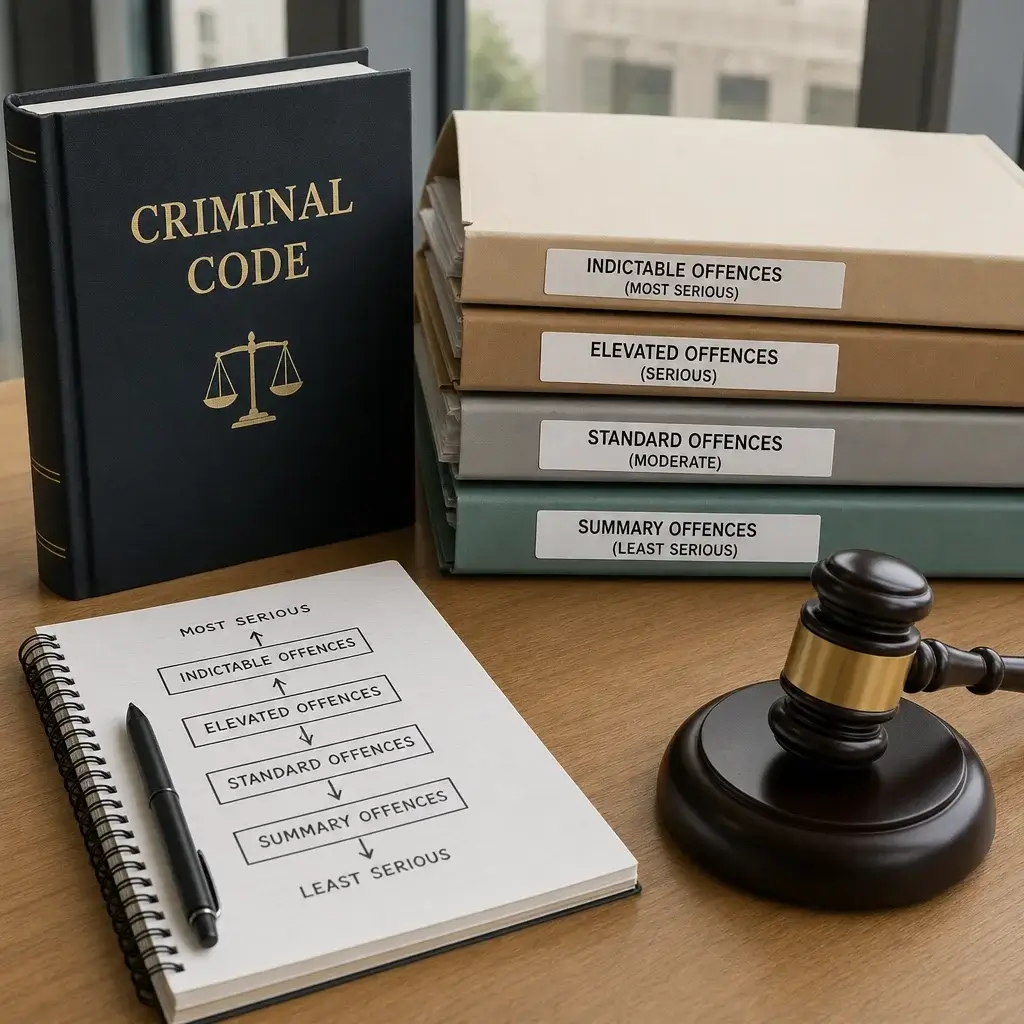
People often speak about the “three levels of assault Canada,” but the Code uses specific offences. The common categories are simple or common assault, assault with a weapon, assault causing bodily harm, and aggravated assault .
The lowest level assault charge people usually mean is common assault under section 266. It is still a criminal charge and can carry release conditions, fingerprinting, trial risk, and a criminal record if there is a conviction .
There is not a general mandatory minimum sentence for ordinary assault in Canada. The sentence range in any real case depends on the charge wording, the prosecution mode, injuries, record, context, and aggravating or mitigating factors, and this is general information only .
Simple assault under section 266 is a hybrid offence. The maximum penalty is 5 years if prosecuted by indictment .
Assault with a weapon or assault causing bodily harm under section 267 is also a hybrid offence. The maximum penalty is 10 years if prosecuted by indictment .
Aggravated assault under section 268 is more serious because it involves wounding, maiming, disfiguring, or endangering life. The maximum penalty is 14 years .
Summary conviction maximums changed in recent years for many Criminal Code offences, so I avoid giving a blanket figure unless I have the exact charge and current election in front of me. The Criminal Code and current charging documents control .
Assault charge comparison table
| Offence | What the Crown generally alleges | Injury or weapon factor | Relative seriousness | Maximum penalty |
|---|---|---|---|---|
| Common assault, s. 266 | Intentional force without consent, or qualifying threat/attempt | No injury required | Lowest of the usual assault categories | 5 years on indictment |
| Assault with a weapon, s. 267 | Assault while carrying, using, or threatening to use a weapon | Weapon elevates seriousness | More serious | 10 years on indictment |
| Assault causing bodily harm, s. 267 | Assault that causes bodily harm | Bodily harm elevates seriousness | More serious | 10 years on indictment |
| Aggravated assault, s. 268 | Wounding, maiming, disfiguring, or endangering life | Severe harm | Most serious of these categories | 14 years |
Best defence for assault: which defence fits which fact pattern?
There is no single best defense for assault. The best defence depends on what happened, what the evidence actually shows, and what the Crown can prove beyond a reasonable doubt .
Self-defence may apply where force was used for a defensive purpose and the response was reasonable in the circumstances. Section 34 of the Criminal Code governs self-defence and focuses on the threat, the purpose of the act, and the reasonableness of the response .
Consent may matter in some situations, but it has limits. Social contact, sports context, and mutual physical interaction can raise consent issues, but consent is not a blanket answer to every assault allegation .
Accident, reflex, or involuntary contact can be a defence because assault requires an intentional application of force. If the contact happened during a stumble, a startle response, or a crowded chaotic scene, the intent issue may be central .
Identity can be the real issue in a fast-moving incident. Poor lighting, intoxication, stress, group fights, and cross-racial identification concerns can all affect reliability .
Credibility and reliability gaps can themselves create reasonable doubt. In many common assault Canada cases, there is no independent video and the court must assess whether witness accounts are internally consistent, externally consistent, and believable against the surrounding evidence .
Charter breaches can matter where police obtained statements, searches, phones, or other evidence unlawfully. Section 8 protects against unreasonable search and seizure, section 9 protects against arbitrary detention, and section 24(2) allows a court to exclude evidence in some cases .
Defence-by-fact-pattern table
| Fact pattern | Possible defence | Evidence that helps | Common weakness |
|---|---|---|---|
| You pushed someone away during an attack | Self-defence | Injuries on you, video, 911 audio, witness accounts | Force may be alleged to be excessive |
| You stepped between two people | Defence of another | Neutral witnesses, sequence evidence, texts right after | Crown may dispute the threat level |
| Contact happened in horseplay or sport | Consent | Prior messages, event context, video | Consent may not cover the degree of force |
| Contact happened during a stumble or reflex | Accident or involuntary act | Scene video, medical notes, immediate statements | Crown may argue movement was deliberate |
| Scene was chaotic and fast | Mistaken identity | CCTV, location data, alibi records | Identification may still be accepted if other evidence supports it |
| Complainant account changed over time | Credibility and reliability challenge | Prior statements, 911 call, bodycam, texts | Some inconsistencies are minor, not fatal |
| Police obtained evidence improperly | Charter challenge | Notes, disclosure, warrant materials, detention timeline | Not every breach leads to exclusion |
Self-defence, consent, accident, and no intent explained simply
Self-defence in assault cases is not about who threw the first insult. The court looks at whether you believed force or a threat of force was being used against you or another person, whether you acted for a defensive purpose, and whether your response was reasonable in the circumstances under section 34 .
Reasonableness is fact-driven, not automatic. The court can consider the nature of the threat, whether weapons were present, size differences, the history between the people, the possibility of retreat, and the speed of the event .
Consent can matter in everyday interactions, but it is narrower than people think. A consensual sport, playful contact, or agreed physical interaction may look very different from an intentional assault outside that context .
Mutual shoving is not a free pass. The fact that both people were physical may affect context, credibility, and self-defence analysis, but it does not erase the Crown’s burden or create an automatic defence .
No intent can be a complete answer where the contact was truly accidental. A doorway collision, a reflexive arm movement after being startled, or an effort to avoid falling may not meet the definition of assault if the force was not intentional .
Attempts and gestures can be enough even without a strike. Moving toward someone with a raised object, closing distance aggressively, or making a threatening motion can become part of an assault allegation if the surrounding facts support present ability and reasonable fear .
What evidence is needed for an assault defence?

Assault cases often turn on witness testimony, but the strongest defence work usually combines testimony with digital, documentary, and physical evidence. A simple way to think about the 4 types of evidence is testimonial, documentary, physical or real evidence, and digital or audio-video material .
Testimonial evidence is what witnesses say in court. In assault files, that usually includes the complainant, the accused if they testify, civilian witnesses, and police witnesses .
Documentary evidence includes records created in a durable form. Text exports, medical notes, work schedules, school attendance records, receipts, and building access logs can all fit here .
Physical or real evidence includes objects and visible conditions. Torn clothing, photographs of injuries, damaged property, and the layout of the scene can affect whether the Crown’s theory makes sense .
Digital and audio-video evidence is now central in many assault charge Canada files. CCTV, doorbell footage, 911 calls, voicemails, photos with metadata, social media messages, and phone location history can support or undermine timing, identity, and self-defence claims .
The most useful evidence is the evidence that answers a disputed fact. If the issue is identity, look for timestamps and location; if the issue is self-defence, look for injuries, video, and sequence; if the issue is consent, look for prior messages and context .
Deleting material can seriously damage a defence. It can remove context that helps you, and in some situations it can create its own legal problems .
Digital evidence checklist: texts, CCTV, 911 calls, and phone data

Speed matters with digital evidence because some systems overwrite quickly. If there may be CCTV, doorbell footage, transit video, bar video, or condo surveillance, identify the camera owner and the location right away so counsel can assess preservation steps .
Save both screenshots and native exports where possible. Screenshots are useful, but full message exports, original image files, and voicemail files usually preserve more context and metadata .
Keep the original device and do not replace it casually. Phones can hold message history, location records, account access, and app data that may not transfer perfectly to a new device .
Disable auto-delete settings on messaging apps if you can do so without altering content. Vanishing messages and rolling deletion features can destroy evidence on both sides .
Preserve 911-related information even if you cannot obtain the audio yourself immediately. Note the time of the call, who made it if known, and any dispatch or incident number because 911 audio and call history may become important disclosure or production issues .
Location data can help or hurt. Google Maps history, Apple Significant Locations, ride-share logs, parking receipts, and photos with timestamps can test an alibi or confirm sequence .
Do not crop, annotate, filter, or repost key evidence. Edited images and clips create authenticity fights that distract from the real issue .
Digital evidence preservation checklist
- Screenshot important messages, then export the thread if possible
- Save voicemails and call logs
- Back up photos and videos in original format
- Keep the phone, charger, and account access details
- Note usernames, handles, and platform names
- Record where each file came from and when you saved it
- Identify possible CCTV locations and the owner of each camera
- Do not alter, crop, label, or repost the material
What happens after an assault charge in Canada?
Most assault cases start with an arrest, a release process, or a summons to attend court. The next steps usually include first appearance, disclosure, discussions with the Crown, and then either a resolution or a trial date if the matter is contested .
A bail hearing, now called a judicial interim release hearing, is generally heard within 1–3 days of arrest . If police release you directly, you may skip that step but still have strict conditions to follow .
Disclosure is the package of evidence the Crown must provide. It usually includes witness statements, police notes, photographs, recordings, and criminal record material where relevant, and I review it before I can give a reliable opinion on strengths or weaknesses .
A first appearance is usually administrative. It is often used to confirm counsel, set dates, and deal with disclosure status rather than to argue the full facts of the case .
A Crown pre-trial is a focused meeting about the case. That is where defence counsel can discuss disclosure gaps, legal issues, possible resolutions, and whether the matter should move toward trial .
Some assault matters resolve without a trial, but not because a person simply asks for charges to disappear. A withdrawal, stay, peace bond, diversion, plea, or trial all depend on the evidence, public-interest factors, the relationship context, injuries, and the Crown position .
A contested assault matter can take 6–18 months to resolve in many courts, depending on the charge, court location, disclosure issues, election, and trial availability . I would not rely on internet guesses for your case timeline .
Release and bail conditions: how to avoid breaching your terms
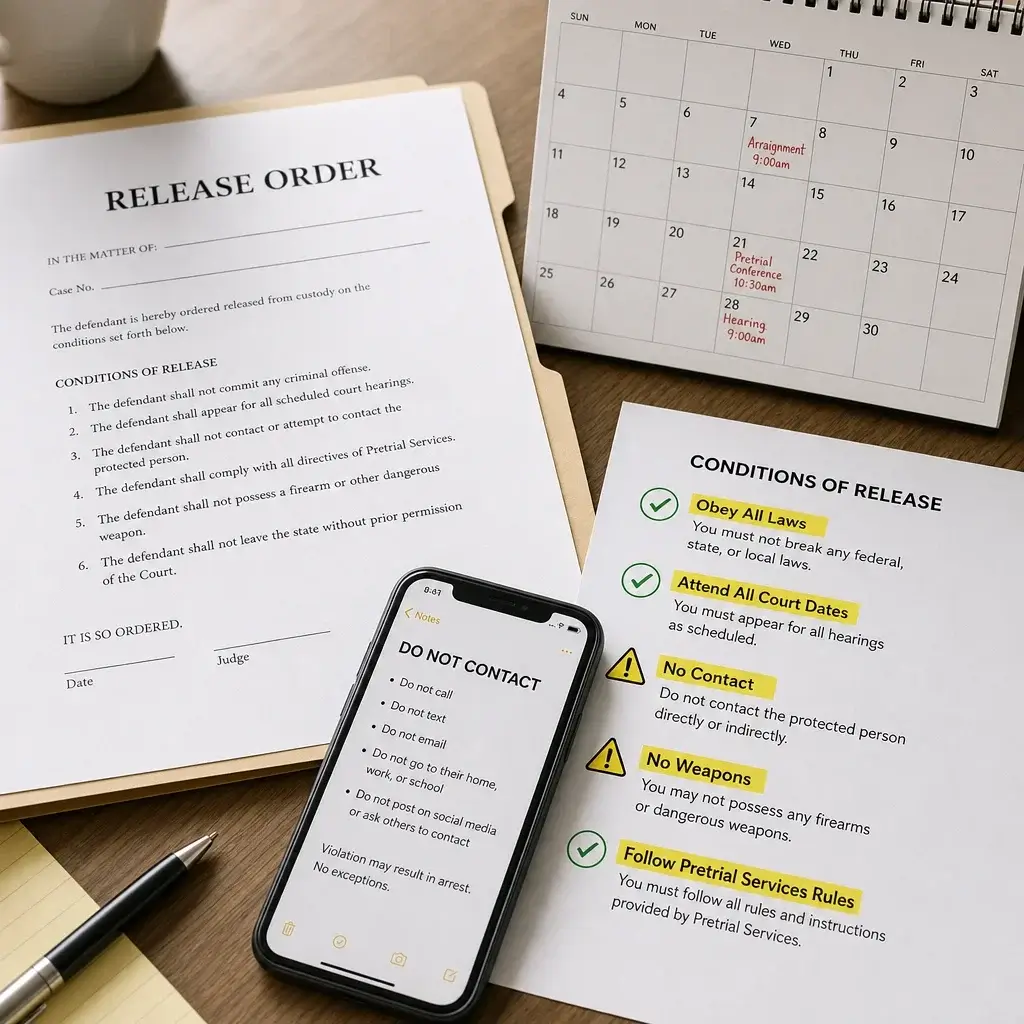
The most important rule is simple: obey the wording on the paper, not what anyone tells you informally. If your release says no contact, no attendance, keep the peace, or attend court, those words govern until a court changes them .
No-contact conditions are common in assault files, especially where the allegation involves a partner, ex-partner, or family member. They usually prohibit direct contact and indirect contact through friends, relatives, or social media .
No-attendance terms can affect where you live, work, or pick up children. If the address is impractical, do not ignore it; speak to a lawyer about seeking a variation instead .
Court attendance is mandatory when your release requires it. Missing court can lead to a bench warrant and separate criminal exposure .
Weapons and firearms restrictions may appear even in an ordinary assault case depending on the facts and release terms. Read every line carefully and ask if you do not understand a condition .
Release / bail conditions checklist
- Read the exact wording of each condition
- Save the complainant’s number as do-not-contact
- Tell friends and family not to pass messages
- Change routines to avoid accidental encounters
- Carry a copy or photo of your release paperwork
- Calendar all court and reporting dates
- Ask counsel about a variation if a term is unworkable
Domestic assault allegations: extra risks and immediate strategy
Domestic-context assault allegations usually move with stricter release terms from the start. No-contact and no-attendance conditions are common even where both people want to speak or live together again .
The practical impact can be immediate. People are often removed from the home, cut off from belongings, limited in parenting contact, and forced to arrange basic communication through counsel or approved channels .
Do not ask the complainant to recant, soften, or rewrite the allegation. That can become evidence against you and can create witness-interference concerns .
Evidence preservation is especially important in domestic cases because context matters. Prior texts, the sequence before and after the incident, 911 audio, neighbour observations, injuries on both sides, and photos of the scene can all affect credibility and reliability .
Family court issues may run beside the criminal case, but they are not the same process. Be careful about using criminal allegations in parenting disputes or vice versa without legal advice on both sides .
Can assault charges be resolved without a criminal record?
Yes, some assault matters can be resolved without a criminal record, but not every case qualifies. Possible outcomes can include a withdrawal, a stay, a peace bond, diversion where available, a discharge where legally available, or a not guilty finding after trial .
A first-time assault charge Canada file may receive closer attention for non-conviction options, but first-time status does not guarantee one. The Crown will still look at injuries, the relationship context, the public interest, the strength of the evidence, and any prior history .
A peace bond is not an acquittal. It is a separate type of resolution that may involve conditions for a set period and is used in some cases where the Crown agrees it is appropriate .
Diversion is not available in every adult assault case. Domestic allegations, significant injuries, weapon allegations, and public-safety concerns can all affect whether it is even on the table .
When people ask whether assault charges can be dropped in Canada, the real answer is that the Crown can withdraw or stay charges if the legal test and public-interest considerations support that step. A complainant’s preference may matter as part of the picture, but it does not decide the prosecution .
Collateral consequences of an assault conviction
The sentence is not the only consequence of an assault conviction. Employment, professional licensing, volunteering, school issues, family litigation, and travel can all be affected .
Immigration consequences can be serious and fact-specific. If you are not a Canadian citizen, or if your status is temporary or permanent resident status, speak to both criminal and immigration counsel quickly because criminal charges can affect admissibility and status under immigration law .
Travel to the United States can become harder after any criminal record, and border decisions are ultimately made by border authorities. No lawyer should promise entry results .
A conviction can also affect credibility in later family or civil proceedings. That matters in domestic allegations where parenting and access issues may already be active .
This page deals with ordinary assault, not sexual assault. If the allegation is sexual assault, the legal issues, evidentiary rules, and strategic concerns are different enough that you should read material specific to that charge .
Trial preparation checklist: working with a lawyer or representing yourself
Good trial preparation starts with one organized theory of the case. I want a clean timeline, the full disclosure, a witness list, your documents, your digital evidence, and a short list of what you say the real issues are .
If you have a lawyer, help by organizing rather than repeating. Label exhibits clearly, separate confirmed facts from assumptions, and put witness names, numbers, and what each person saw into one page .
Credibility and reliability are often the centre of an assault trial. Small inconsistencies do not automatically decide a case, but major shifts in timing, position, injury, or who started what can matter a great deal .
Disclosure should be reviewed more than once before trial. Police notes, civilian statements, photos, booking video, body-worn camera, and 911 materials can connect in ways that are easy to miss on a first read .
If you are self-represented, focus on procedure, not internet tactics. Learn your dates, ask for disclosure, understand how to subpoena a witness, and get legal advice where you can before trying to cross-examine on assumptions .
Bring everything to a consultation in organized folders if possible. One complete package is more useful than a long verbal summary .
Trial preparation checklist
- Put all disclosure in date order
- Prepare one chronology of events
- List every witness and what they can actually say
- Mark inconsistencies between statements and other records
- Gather digital files in original format where possible
- Bring release paperwork and upcoming court dates
- Write down your questions instead of relying on memory
FAQ: quick answers about assault charges in Canada
What is the best defense for assault?
There is no universal best defence. The strongest defence depends on the facts, the disclosure, and whether the real issue is self-defence, consent, accident, identity, credibility, or a Charter breach .
What evidence is needed for an assault?
The most helpful evidence is the evidence that answers the live dispute. That can include witness statements, texts, CCTV, 911 calls, photos, medical records, call logs, GPS data, and scene evidence .
What defences are available for assault?
Common defences include self-defence, defence of another, consent in limited contexts, accident or reflex contact, lack of intent, mistaken identity, credibility and reliability challenges, and Charter arguments about how evidence was obtained .
What are the three levels of assault in Canada?
People often say three levels, but the Code uses specific offences. The usual categories discussed are common assault, assault with a weapon or assault causing bodily harm, and aggravated assault .
Can assault charges be dropped in Canada?
They can be withdrawn or stayed by the Crown in appropriate cases, but complainants do not control the prosecution once charges are laid. The evidence, legal issues, and public interest drive that decision .
What is the lowest level assault charge?
The lowest level people usually mean is common or simple assault under section 266. It still remains a criminal charge with potentially serious consequences .
What does assault CC 266 mean?
It usually refers to a charge under section 266 of the Criminal Code, which is the offence provision for common assault, read with the assault definition in section 265 .
Is there a minimum sentence for assault in Canada?
For ordinary assault, there is not a general mandatory minimum sentence. Sentencing depends on the exact offence, the prosecution mode, the injuries, the record, and the facts .
Can a first-time assault charge in Canada be resolved without a criminal record?
Sometimes, yes. Possible non-conviction outcomes can include a withdrawal, stay, peace bond, diversion where available, or a discharge where the law permits, but no result can be predicted without the disclosure .
Can words alone be assault in Canada?
Usually not by themselves. Words can matter as part of the context, but assault generally requires force, or an attempt or threat by act or gesture with present ability and reasonable fear in the circumstances .
Next step if you have been charged
The safest next step is usually simple. Keep your conditions, preserve your evidence, and speak to a criminal lawyer before giving a statement or trying to fix the case yourself. If you want, our office can review the charge wording, the release terms, and the evidence-preservation issues in a free consultation. We do private retainer work only, not legal aid matters.