

 Based on 116 Verified Google Reviews
An assault conviction spent date usually depends more on the sentence than the offence label. A conviction for common assault, battery, ABH, or a more serious assault can become spent in some cases, but the answer turns on jurisdiction, sentence type, age at the time, later convictions, and any attached court orders.
A spent conviction is not the same as a deleted record. It usually means the law limits when you must disclose it, while the conviction may still exist on court, police, or higher-level disclosure systems. This is general information, not legal advice on your own record.
What “spent” means for an assault conviction
A conviction is usually called spent when the legal rehabilitation period has passed and no rule keeps it unspent. In plain English, that often means you do not have to disclose it for many ordinary purposes, but not for every purpose.
An unspent conviction is one that is still inside the rehabilitation period or remains disclosable because of the sentence or order attached to it. The practical difference between spent and unspent is disclosure. A criminal record can still exist even after a conviction becomes spent.
Assault does count as a criminal record if it resulted in a conviction. A charge alone is different from a conviction, and a caution or other disposal can have different rules from a conviction.
Quick answer: can an assault conviction ever be spent?
Yes, some assault convictions can become spent, and some may not, depending on the sentencing rules in the jurisdiction. The sentence usually matters more than whether the offence was called common assault, battery, ABH, or another assault offence.
A common assault conviction with a fine may become spent much sooner than an assault sentence involving custody or a long-running order. A more serious assault offence can still become spent if the sentence falls within the legal scheme that allows it.
Some sentence types, exclusions, or public protection rules can change that answer completely. That is why we tell readers not to rely on the offence name alone, and not to trust a generic spent convictions calculator UK tool unless it asks for the exact sentence wording.
How to work out when your assault conviction becomes spent
You work out the spent date by following the sentence, not the headline offence. Start with the exact jurisdiction, because England and Wales, Scotland, Northern Ireland, and Western Australia do not use identical rules.
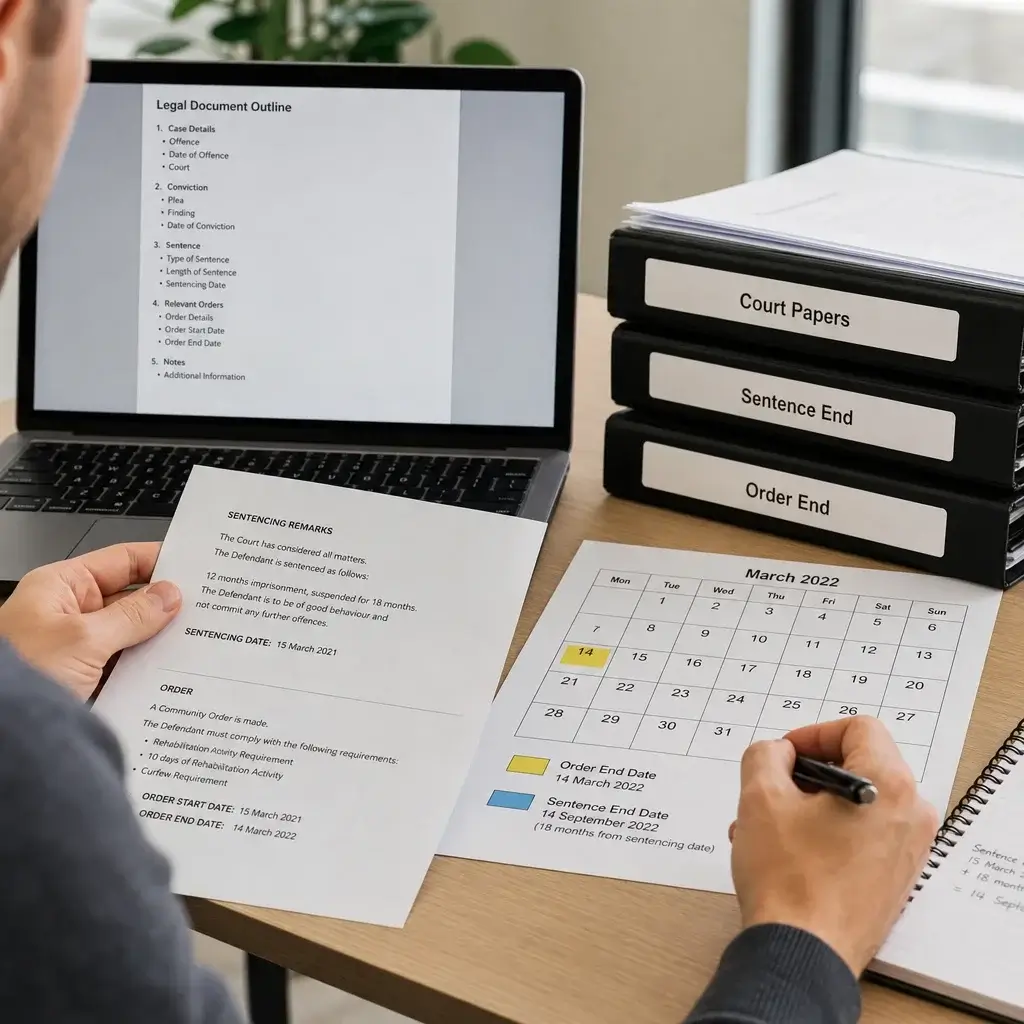
You then need the exact disposal from the court paperwork. The key details are the conviction date, sentence date, sentence length, date the sentence ended, any licence or suspension end date, and the end date of any attached order.
Age matters because under-18 rules can be shorter than adult rules in some systems. Use the person’s age at the point the law says is relevant in that jurisdiction, which should be checked against the governing rules if the record is old or cross-border.
The clock does not always start on the same day for every sentence. For some disposals it runs from conviction or sentence date, and for others it runs from the date the sentence or order ends.
The safest step-by-step method is:
- Identify the jurisdiction.
- Identify the exact offence outcome: conviction, caution, discharge, fine, community order, suspended sentence, or custodial sentence.
- Confirm whether the person was under 18 or adult for that rule set.
- Find when the sentence ended, not just when it was imposed.
- Check whether any order lasted longer than the main sentence.
- Apply the rehabilitation period for that sentence type in that jurisdiction.
- Check for later convictions that may affect the timing or disclosure position.
If you are missing paperwork, do not guess. The difference between a fine and a suspended custodial sentence can change the answer completely.
Decision tree: can my assault conviction be spent?
Use this short decision tree before you look at tables.
- If the outcome was not a conviction, such as a caution, different rules may apply.
- If it was a conviction, identify the sentence first.
- If there was custody or a suspended custodial sentence, check that rule before anything else.
- If there was an order, such as a restraining order, check whether it extends the relevant period or keeps the matter disclosable.
- If there were multiple sentences in one case, the longest relevant timeline can control the practical answer.
- If there was another conviction before the first became spent, re-check the whole timeline.
Rehabilitation periods by sentence type for assault convictions
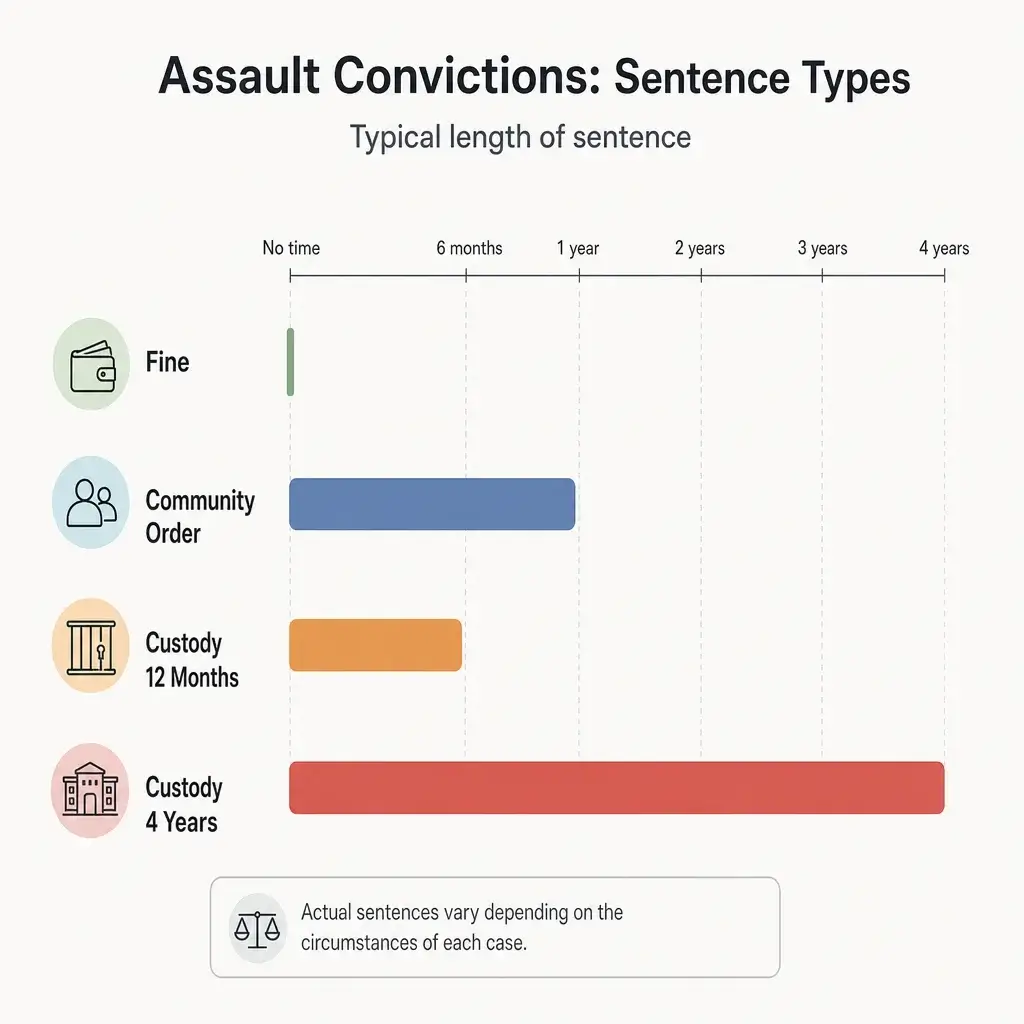
The table below gives a practical framework, but exact dates should be verified against the current law in the relevant jurisdiction before relying on them. The brief itself flags several figures as needing legal verification.
| Sentence or disposal | Adult rule | Under 18 rule | When the clock usually starts | Key caveat |
|---|---|---|---|---|
| Absolute discharge | Immediate or at end of order if one applies | Immediate or at end of order if one applies | Usually date of disposal | Check whether any linked order changes the result |
| Simple caution / youth caution | Immediate | Immediate | Date caution given | Caution rules are not the same as conviction rules |
| Conditional caution / youth conditional caution / diversionary caution | Around 3 months or when conditions end earlier | Around 3 months or when conditions end earlier | Date imposed or date conditions cease, depending on rule | Verify exact local rule |
| Fine | Around 12 months | Around 6 months | Usually date of conviction or sentence under that regime | Payment status may matter in some systems, so check the governing rule |
| Community order | Needs current jurisdiction check | Needs current jurisdiction check | Often from end of the order, not the start | Exact order end date matters |
| Custodial sentence of 12 months or less | Around 12 months after sentence end | Around 6 months after sentence end | End of sentence | Verify how licence periods are counted |
| Custodial sentence of more than 1 year up to 4 years | Around 4 years after sentence end | Around 2 years after sentence end | End of sentence | Exclusions and legislative changes must be checked |
| Custodial sentence of more than 4 years for some non-excluded offences | Around 7 years after sentence end | Around 42 months after sentence end | End of sentence | This area is accuracy-sensitive and must be checked carefully |
| Compensation order | May be spent when paid in full or when the conviction becomes spent under current law | Same principle | Depends on current rule | This is one of the points that must be verified before relying on it |
A spent convictions calculator is only as good as the sentence data you put into it. If the tool does not ask about age, custody, suspension, orders, and later convictions, it can give the wrong date.
Common assault vs ABH and other assault offences
There is no single spent period for assault by offence name alone. The sentence usually drives the rehabilitation period, which is why a common assault conviction spent answer can be different for two people convicted of the same offence.
A common assault with a fine may have a much shorter route to becoming spent than common assault with a suspended sentence. ABH or more serious assault may still become spent if the sentence structure allows it, but longer or custodial sentences usually push the date further out.
The lowest assault-type charge is not answered the same way in every jurisdiction. In England and Wales, readers often mean common assault or battery, but charge labels and offence hierarchy can differ, so the safer answer is to identify the exact offence wording on the charge sheet.
What changes the spent date: later convictions, multiple sentences, and court orders
A later conviction before the first one becomes spent can affect timing or disclosure, depending on the legal regime. This is one of the biggest reasons online calculators go wrong.
Where one case includes several disposals, the latest relevant date can control the practical spent date. That matters in assault cases where a conviction comes with a fine plus a separate order.
Orders can matter as much as the sentence. A restraining order, football banning order, SHPO, or another relevant order may keep the matter disclosable for longer or change when it is treated as spent under the local scheme.
An order made until further order needs special care. That wording can create a very different disclosure result from a fixed end date, and it is worth having the actual court paperwork checked rather than relying on memory.
Under 18s: are youth assault convictions spent sooner?
Youth rules are often shorter than adult rules, but they are not identical across jurisdictions. The brief flags under-18 figures such as 6 months, 2 years, and 42 months in some sentence categories, but those must be checked against the current law before use.
A youth caution may be spent immediately, while a youth fine may use a shorter period than the adult version. A youth custodial sentence can also have a shorter rehabilitation period than the equivalent adult sentence.
Spent rules and filtering rules are not the same thing. A conviction can be spent but still appear on a higher-level check, and a filtered record follows a different legal test.
Worked example one: a person under 18 receives a common assault fine. The likely starting point is the disposal date, and the likely period may be about 6 months if that rule applies in the jurisdiction. That still needs to be confirmed against the current youth framework before disclosure decisions are made.
Worked example two: an adult receives the same fine. The likely period may be about 12 months in the rule set flagged by the brief. Same offence, different age, different answer.
Will a spent assault conviction show on DBS or other record checks?
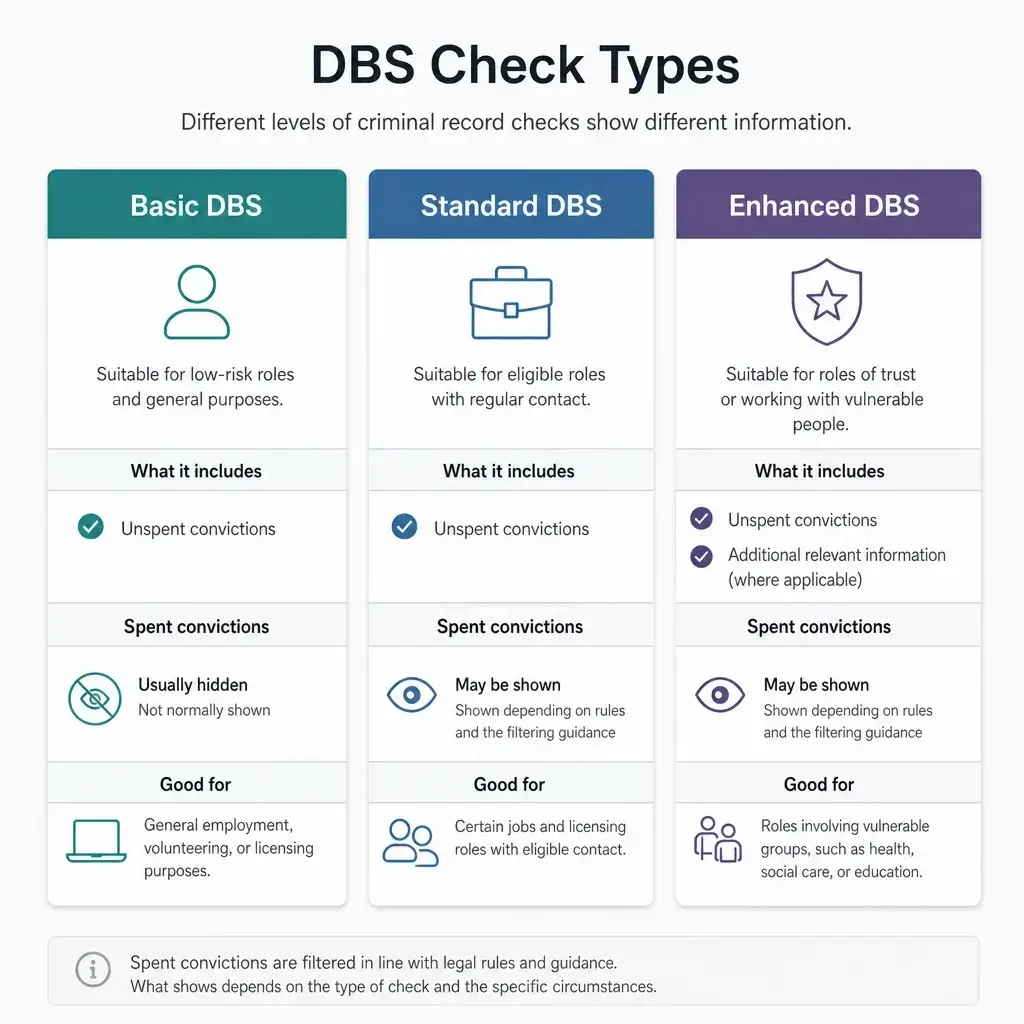
A basic DBS check generally shows unspent convictions only. That means a spent assault conviction will usually not appear on a basic DBS, unless the legal position is altered by a rule outside the usual spent-conviction framework.
Standard and enhanced checks can show more than a basic check. A spent conviction may still appear on a standard or enhanced DBS, and filtering is a separate question from whether the conviction is spent.
Here is the practical comparison readers usually need:
| Check type | What it generally shows | What a spent assault conviction may do |
|---|---|---|
| Basic DBS | Unspent convictions only | Usually not shown if spent |
| Standard DBS | More detailed record information, subject to current disclosure and filtering rules | May still appear |
| Enhanced DBS | Standard-level material plus possible relevant police information under the legal test | May still appear |
| AccessNI / PVG equivalents | Rules differ by system and jurisdiction | Must be checked under that regime |
A spent conviction and a filtered conviction are not the same thing. Someone searching if a conviction is spent do I have to declare it often really needs both answers: whether it is spent, and whether it may still show on a higher-level background check.
Do you have to declare a spent assault conviction for jobs, housing, insurance, or volunteering?
For many ordinary jobs, a spent conviction usually does not have to be disclosed. Exempt roles are different, and those roles may lawfully require more detailed disclosure.
Jobs involving children, vulnerable adults, policing, prisons, courts, some healthcare roles, and other regulated work are the first places to check for exemptions. This is not a complete list, and the exact exempt categories should be verified from the official regime before relying on it.
Volunteering can use the same distinction. Some voluntary roles need only a basic check, while others involving children or vulnerable adults can trigger standard or enhanced checking.
Housing and insurance are less straightforward than many websites suggest. The legal disclosure position, the wording on the application form, and the provider’s own screening practice may not all line up, so read the question carefully and get advice if it involves a spent record.
University, course, and professional-registration forms also vary. Some ask only about unspent convictions, while regulated placements or professions may ask broader questions under a lawful exemption.
Common exempt or higher-risk contexts include:
- Teaching and school roles
- Care work and healthcare with vulnerable people
- Police, prison, and court roles
- Some legal and financial-regulation roles
- Foster care, adoption, and similar safeguarding contexts
If the form does not clearly say spent or unspent, do not guess. The safer step is to check the legal basis for the question or get advice on the exact wording.
Worked examples: common assault spent-date calculator scenarios
These examples show the logic, not a substitute for checking the current law.
Example 1: common assault with a fine
If an adult receives a fine for common assault, the likely rehabilitation period may be about 12 months in the rule set flagged by the brief. The likely starting point is the date of conviction or sentence under that regime, which must be checked against the current statutory wording.
If the same fine is imposed on a person under 18, the likely period may be about 6 months. This is why how long until a conviction is spent UK cannot be answered without age and sentence type.
Example 2: common assault with a community order
A community order often runs from the end of the order, not the day it was imposed. If the order lasted 12 months , the spent date may be later than a fine even though the offence label is still common assault.
Example 3: assault with a suspended sentence
A suspended sentence can be treated closer to a custodial sentence than to a fine. The exact effect depends on the current rule set, including whether the calculation uses the custodial term, the operational period, or another statutory marker, so this is a point to verify carefully before relying on a calculator.
Example 4: assault conviction plus restraining order
An attached restraining order can change the real-world disclosure answer even if the main conviction period looks straightforward. If the order lasts longer than the main sentence, that later end date may matter to spent status, disclosure, or both.
Example 5: under-18 common assault caution
A youth caution may be spent immediately if that jurisdiction uses the rule flagged in the brief. That still does not answer what a higher-level disclosure system may show, because spent and filtered remain different questions.
If you want help calculating an old assault spent date from court paperwork or checking what may still need to be disclosed, legal advice is often worth it at this stage. This page is general information only.
How to check your own record and find the sentence details you need
You need the paperwork before you can answer can I check if I have a criminal record in a useful way. The key documents are the charge wording, certificate of conviction if available, sentencing note, order paperwork, and any later variation orders.
The details to gather are:
- Exact offence name and section
- Conviction date
- Sentence type
- Sentence length
- Date the sentence ended
- Any licence or suspension end date
- Any restraining or other order and its end date
- Whether there were later convictions
Access routes differ by jurisdiction. Depending on where the case was heard, the record may be obtainable through the court, a police record-check process, older solicitor files, or a formal disclosure request.
Do not assume every court keeps identical records forever or that every agency will issue the same level of detail direct to the individual. If you are missing old records, the practical step is to start with the court of conviction or a lawyer who can identify the likely source.
Jurisdiction differences: England & Wales, Scotland, Northern Ireland, and Western Australia
You should not assume one spent-conviction result transfers across borders. England and Wales are the main framework most readers mean, but Scotland, Northern Ireland, and Western Australia can use different rules, different terminology, and different processes.
Here is the high-level comparison:
| Jurisdiction | Main point to know | Practical risk |
|---|---|---|
| England & Wales | Often the default framework readers mean when asking when a conviction becomes spent | Rules still depend on sentence, age, orders, and later convictions |
| Scotland | Different disclosure terminology and rules may apply | Do not rely on an England-and-Wales calculator |
| Northern Ireland | Separate local rules and authorities may apply | Check the current Northern Ireland framework directly |
| Western Australia | May involve a Spent Conviction Order application process rather than the same automatic model | A UK-style automatic answer may be wrong |
The brief notes that Western Australia may use timing of around 10 years from conviction in some cases, but that point requires verification before publication or reliance. The same caution applies to territorial scope, Scottish terminology, and the exact Northern Ireland regime.
Canada and travel questions: what this page can and cannot answer
A spent conviction at home does not automatically settle travel or immigration questions. Searches like how long does an assault charge stay on your record in Canada, how long does a conviction stay on your record in Canada, and can I go to Canada if I have an assault on my record involve Canadian criminal-record and immigration rules, not just UK spent-conviction rules.
We would not give a firm answer on Canadian admissibility without checking the current official source or obtaining specific legal advice on the record involved. If travel matters, check the official Canadian immigration and admissibility guidance or get advice on the exact conviction and sentence.
FAQ
When does an assault conviction become spent?
It usually becomes spent when the rehabilitation period for the sentence has passed and no later conviction or attached order changes the result. The sentence, age, jurisdiction, and any order matter more than the assault label alone.
Does a common assault conviction become spent?
It can. A common assault conviction with a minor sentence may become spent sooner than one with a suspended or custodial sentence.
What is the difference between spent and unspent?
Spent usually means the law limits disclosure for many ordinary purposes. Unspent means the conviction is still within the active rehabilitation period or remains disclosable under the governing rules.
Does assault count as a criminal record?
Yes, if there was a conviction. A charge without conviction is a different issue.
Will a spent assault conviction show on a basic DBS check?
A basic DBS generally shows unspent convictions only. A spent assault conviction will usually not appear there.
Will a spent assault conviction show on a standard or enhanced DBS check?
It may. Standard and enhanced checks can disclose more than a basic check, and filtering is a separate test.
If my assault conviction is spent, do I have to declare it?
Often not for ordinary jobs, but exempt roles and some regulated contexts can be different. Read the exact question and check whether an exemption applies.
Does a suspended sentence count as custodial for spent-conviction rules?
It can be treated under rules that differ from a simple fine or discharge. This is one of the areas where the exact statutory wording should be checked before relying on a calculator.
What happens if I get another conviction before my assault conviction becomes spent?
A later conviction can affect the timeline or disclosure position. Recalculate the whole sequence rather than treating each record in isolation.
Can I check if I have a criminal record?
Usually yes, but the route depends on the jurisdiction and what level of record you need. Court records, police record checks, and solicitor files may each hold part of the answer.
How do I find the exact sentence details for an old assault conviction?
Start with the court paperwork, old solicitor file, and any record-check documents. You need the exact sentence type, length, and order dates before you can calculate a spent date properly.
Can I go to Canada if I have an assault conviction?
That cannot be answered safely from spent-conviction rules alone. Canadian admissibility uses its own legal framework, so check the official source or get advice on the exact record.
When to get legal advice
Legal advice is most useful where there was custody, a suspended sentence, a restraining order, later convictions, missing paperwork, an exempt job, or an overseas travel issue. Cross-jurisdiction records are another common problem because one country’s spent rule may not answer another country’s disclosure question.
If you are trying to work out when a conviction becomes spent, the practical next step is simple: get the exact sentence documents first, then compare the sentence, age, and order dates against the current rules for the right jurisdiction. If any part of that chain is unclear, have the paperwork reviewed before you disclose or fail to disclose the conviction.