

 Based on 116 Verified Google Reviews

Most people hear “alternative measures assault charge” and assume it means the case just disappears. That is not what it means. In some assault cases, a person may be allowed to complete an alternative measures program instead of moving through the usual prosecution path, but that decision is discretionary and local policies differ across Canada.
> Plain-English answer > > Alternative measures meaning, in a criminal case, is a diversion process authorized by Canadian law that may let a person deal with certain charges outside the ordinary prosecution stream if specific conditions are met. For assault files, that can include counselling, community service, conflict-resolution work, or other terms tied to the facts. It is not automatic. It is not available in every case. It usually requires accepting responsibility, and that is not the same thing as being found not guilty. Section 717 of the Criminal Code is the federal framework for adult alternative measures.
What alternative measures mean for an assault charge
Alternative measures in a criminal case are a formal diversion process that may allow an assault allegation to be addressed without the case continuing in the usual way through plea or trial. Section 717 of the Criminal Code provides the legal framework for adult alternative measures in Canada.
Alternative measures meaning in court is practical, not theoretical. The Crown or a designated program may screen the file, decide whether it is appropriate, and set conditions that must be completed before the prosecution is reconsidered. Local Crown policy, provincial program design, and the facts of the assault matter all affect that decision.
An alternative measures program for an assault charge is not the same as an acquittal, and it is not a finding that the allegation was false. It is one possible resolution path. I cannot tell anyone to accept it without reviewing the disclosure, because every case turns on its own facts and on whether there is a real defence.
Can an assault charge qualify for alternative measures in Canada?
Yes, some assault charges can qualify for diversion for assault charge Canada matters, especially lower-level allegations with limited injuries and no strong public-safety concerns. That said, there is no right to assault charge diversion, and no one should assume an assault case will be “dropped” just because diversion exists.
Can assault charges be dropped in Canada is really a wording problem. People use “dropped” loosely, but the legal result after successful completion may be a withdrawal, a stay, or another local non-prosecution result depending on the jurisdiction and program structure.
Serious injuries, repeat allegations, weapons, vulnerable complainants, domestic context, or sexual violence concerns usually make diversion harder to obtain. A viable defence can also change the analysis, because accepting responsibility may not be strategically wise where self-defence, identity, consent, or credibility is genuinely in issue.
Which assault charges are most and least likely to be eligible?
Simple assault is generally the lowest assault charge and is often the category most likely to be considered for alternative measures, especially where the alleged force was minor, injuries were limited, and the case is non-domestic. Simple assault is the basic assault offence under section 266 of the Criminal Code.
Domestic assault diversion is treated more cautiously in many jurisdictions because victim-safety concerns, repeat-contact risks, and local Crown policies are stricter in intimate-partner cases. Some domestic files may still be screened for diversion, but local policy matters a great deal and broad assumptions are risky.
Assault causing bodily harm diversion is harder to obtain because bodily harm means an injury that is more than merely trifling or transient, which raises the seriousness of the allegation. Assault causing bodily harm is prosecuted under section 267 of the Criminal Code.
Assault with a weapon is also generally more difficult to divert because the alleged use or threatened use of a weapon increases public-safety concerns. That does not create an absolute rule, but it changes how the Crown will assess the file. Assault with a weapon also falls under section 267 of the Criminal Code.
Sexual assault files are often screened under different policies and may be excluded from ordinary alternative measures streams or handled only in limited, specialized circumstances. Sexual assault is a separate offence under section 271 of the Criminal Code, and readers should not assume that assault diversion practices apply the same way.
Offence-by-offence comparison
| Charge type | Usual diversion position | Why it may be considered or resisted | Example scenario |
|---|---|---|---|
| Simple assault | Often the most realistic candidate | Minor force, limited injuries, no domestic context may help | Mutual pushing after a neighbour dispute |
| Domestic assault | More restrictive screening | Safety planning, repeat-contact risk, complainant protection | Partner allegation after an argument |
| Assault causing bodily harm | Harder to divert | Medical treatment, visible injuries, seriousness concerns | Bar fight causing a broken nose |
| Assault with a weapon | Harder to divert | Weapon allegation raises risk and denunciation concerns | Object thrown during an argument |
| Sexual assault | Often excluded or specially screened | Consent, power imbalance, victim vulnerability | Allegation of unwanted sexual touching |
Eligibility checklist: factors the Crown or program may consider
The Crown or program usually looks for signs that the case is suitable for a non-trial resolution under Section 717 Criminal Code principles. The statute requires, among other things, that the measures be appropriate having regard to the needs of the person accused and the interests of society and of the victim.
A first-time assault Canada file may be helped by no prior criminal record, limited or no injury, a non-domestic setting, low ongoing safety risk, and a realistic plan to complete counselling or community work. Stability matters because diversion only works if the person can actually finish the terms.
A prior record can make diversion harder, but it does not create a universal bar. Prior violence, prior diversion failures, breach history, ongoing no-contact issues, serious injuries, or a vulnerable complainant are all facts that can hurt eligibility.
Self-defence and mutual combat issues matter in a different way. If the best defense against an assault charge is that you acted lawfully in self-defence, or that the evidence is too weak to prove an intentional assault, accepting responsibility may undercut a stronger litigation position. Self-defence is governed by section 34 of the Criminal Code.
May help
- first allegation with no record
- limited injuries and no weapon
- non-domestic context
- low public-safety risk
- willingness to accept responsibility
- realistic plan to complete conditions
May hurt
- prior record or prior diversion failure
- breach history or no-contact concerns
- serious injury or medical treatment
- domestic violence or sexual violence context
- vulnerable complainant
- live self-defence issue that should be assessed before any admission
Do you have to plead guilty? Responsibility vs guilty plea explained
In many programs, alternative measures do not require a formal guilty plea in court, but they do require some form of accepting responsibility for the conduct. That distinction is central in assault cases.
Accept responsibility usually means acknowledging enough of the underlying conduct for the program to proceed. It is not the same thing as entering a guilty plea before a judge, and it is not the same thing as a conviction. But it can still carry legal and practical risk, especially if the facts are disputed.
A guilty plea is a court plea to the offence charged. Accepting responsibility is usually a program requirement outside that plea process. Those are different steps, and readers should not confuse “no guilty plea” with “no consequence.”
This matters most where there is a self-defence assault charge issue, a credibility fight, identity concerns, consent issues, or a mutual-combat bar incident with competing stories. I review the disclosure before I advise on diversion because a weak case may call for a different strategy than a strong one.
> Callout: Responsibility is not the same as a guilty plea > > – A guilty plea is entered in court. > – Accepting responsibility is usually part of the diversion agreement. > – Neither step should be taken casually in an assault file. > – If there is a real defence, legal advice should come before any admission.
If you have been offered alternative measures for an assault charge, speak to a lawyer before signing anything or making any statement to Crown or program staff. That is most important where immigration, professional licensing, family court, or vulnerable sector work may be affected.
How the assault diversion process works step by step
The process can start before or after a charge, which is why pre-charge diversion and post-charge diversion need to be kept separate. Pre-charge diversion means the file is referred before a formal charge is laid. Post-charge diversion means the charge has already been laid and the case is before the court.
A typical post-charge assault file starts with arrest or investigation, release conditions, and a first court date. The Crown then reviews disclosure, screens eligibility, and may refer the matter to an alternative measures program if the case and local policy support that step. First appearances in Ontario are often set within a matter of weeks after release, but the exact timing depends on the court and how the person was released.
The next step is usually an offer or referral with terms. The accused gets legal advice, decides whether to accept responsibility, signs the agreement if appropriate, and then completes the required conditions. During that time, the court matter is often adjourned while proof of completion is gathered. Adjournments of several weeks to a few months are common in criminal case management.
The overall process usually takes several weeks to several months, not a few days, because screening, programming, and proof of completion all take time. I would not give a tighter range without knowing the province, the program, the court location, and whether the file is pre-charge or post-charge.
After successful completion, the Crown may withdraw the charge, stay it, or otherwise end the prosecution according to local procedure. That is the point where people often say the charge was dropped, but the proper legal wording depends on the jurisdiction.
Step-by-step timeline
1. Police investigate or arrest. 2. Charge is laid, or the file is screened for pre-charge diversion. 3. Disclosure is requested and reviewed. 4. Crown or program assesses eligibility. 5. Offer is made, if the case is accepted. 6. Legal advice is obtained before any agreement is signed. 7. Conditions are completed. 8. Proof of completion is sent to Crown or the program. 9. Court case is resolved according to local practice.
Common alternative measures conditions in assault cases

The conditions in an alternative measures program are meant to connect to the facts of the alleged assault and to the local program rules. Common examples include counselling, anger management, conflict-resolution work, community service, treatment, apology letters where permitted, restitution in the right case, and restorative processes where safe and appropriate.
Assault cases often attract assault-specific terms rather than generic ones. If alcohol played a role, substance-use counselling may be proposed. If the incident involved a relationship conflict, counselling focused on healthy relationships or communication may be added.
No one should assume every condition is available everywhere. Some programs permit mediation or victim-offender work. Others do not. Donations, apology letters, or restorative options can be policy-sensitive and sometimes inappropriate, especially where there are safety concerns.
Common conditions by scenario
| Scenario | Conditions that may be considered | Why |
|---|---|---|
| Neighbour shove with no injury | Conflict-resolution course, apology process, community service | Addresses impulsive conflict |
| Bar fight after drinking | Anger management, substance-use counselling, community work | Connects to alcohol and aggression |
| Domestic allegation | Counselling, partner-violence programming, strict no-contact compliance | Focus on safety and behaviour change |
| Bodily harm allegation | Counselling, treatment, structured accountability terms | Injury raises seriousness concerns |
Victim participation, objections, and restorative justice
Victim participation may matter in assault diversion, but it is not automatically the same as veto power. Section 717 requires that the victim be given an opportunity to participate if they so wish and if it is appropriate in the circumstances.
If the victim does not want to take part in mediation or restorative justice, the program may still proceed in some cases through other conditions. That depends on local policy, safety concerns, and whether victim participation is considered necessary for the file.
If the victim objects, the objection is important but not always legally decisive. The Crown still has to assess public interest, program policy, safety, and the facts of the case. In domestic assault diversion files, objection and safety concerns may carry even more weight.
Restorative justice can be useful in the right case, but it is not appropriate in every assault matter. It is often unsuitable where there is coercion, fear, strong power imbalance, ongoing no-contact concerns, or a domestic pattern that makes direct participation unsafe.
What happens after successful completion?
Successful completion usually means the prosecution does not continue in the ordinary way, but the exact legal result depends on the jurisdiction. In one place the charge may be withdrawn. In another, it may be stayed or handled through another local procedure.
That outcome is different from an acquittal after trial and different from a finding of not guilty. The case ends because the diversion path was completed, not because a judge found the allegation unproven after hearing evidence.
Can assault charges be dropped in Canada is therefore only partly answered by diversion. Sometimes the practical result looks like the charge was dropped. The proper legal label still matters, especially for record, employment, immigration, and licensing questions.
Will you get a criminal record? Record checks, vulnerable sector checks, and retention
Successful alternative measures often avoid a criminal conviction record, but that does not mean there is no record of any kind anywhere. A conviction record, a police record, a court record, and an internal justice record are different things.
Criminal record after alternative measures is usually the wrong shorthand. The better question is whether there was a conviction and what databases or local records may still note the charge or the person’s participation in the program. Those are separate issues.
A standard criminal record check is aimed at conviction information. Police information checks and vulnerable sector checks can raise different concerns, and local police service practices can differ. I would not promise that alternative measures will be invisible on every type of screening.
Does a charge stay on your record forever is not something I would answer with a single national rule, because retention and disclosure practices vary by police service, province, and the kind of check being requested. If employment, volunteering, immigration, or licensing is a serious concern, get case-specific advice before accepting responsibility.
Immigration and licensing bodies may care about more than convictions alone. They may ask about charges, admissions, pending matters, or underlying conduct. That is why a no-conviction resolution can still require careful planning.
Could first-time assault still mean jail if you do not get diversion?
First-time assault does not automatically mean jail in Canada. Sentence exposure depends on the exact charge, the facts, the injuries, the context, the person’s record, and whether the Crown proceeds summarily or by indictment where the offence allows that election.
Simple assault under section 266 can be prosecuted by indictment or summarily. The maximum penalty is 5 years if proceeded with by indictment, or on summary conviction the maximum is 2 years less a day or a fine of $5,000, or both.
Assault causing bodily harm under section 267 carries a maximum of 10 years by indictment, or 2 years less a day on summary conviction. Those are statutory maximums, not a prediction of what any person will receive.
Will I go to jail for first time assault in Canada is therefore the wrong question to answer from a webpage. The right question is what the Crown can prove, what the disclosure shows, whether there is a defence, and whether a non-conviction resolution is realistically available.
Alternative measures vs peace bond vs withdrawal vs stay vs discharge vs guilty plea
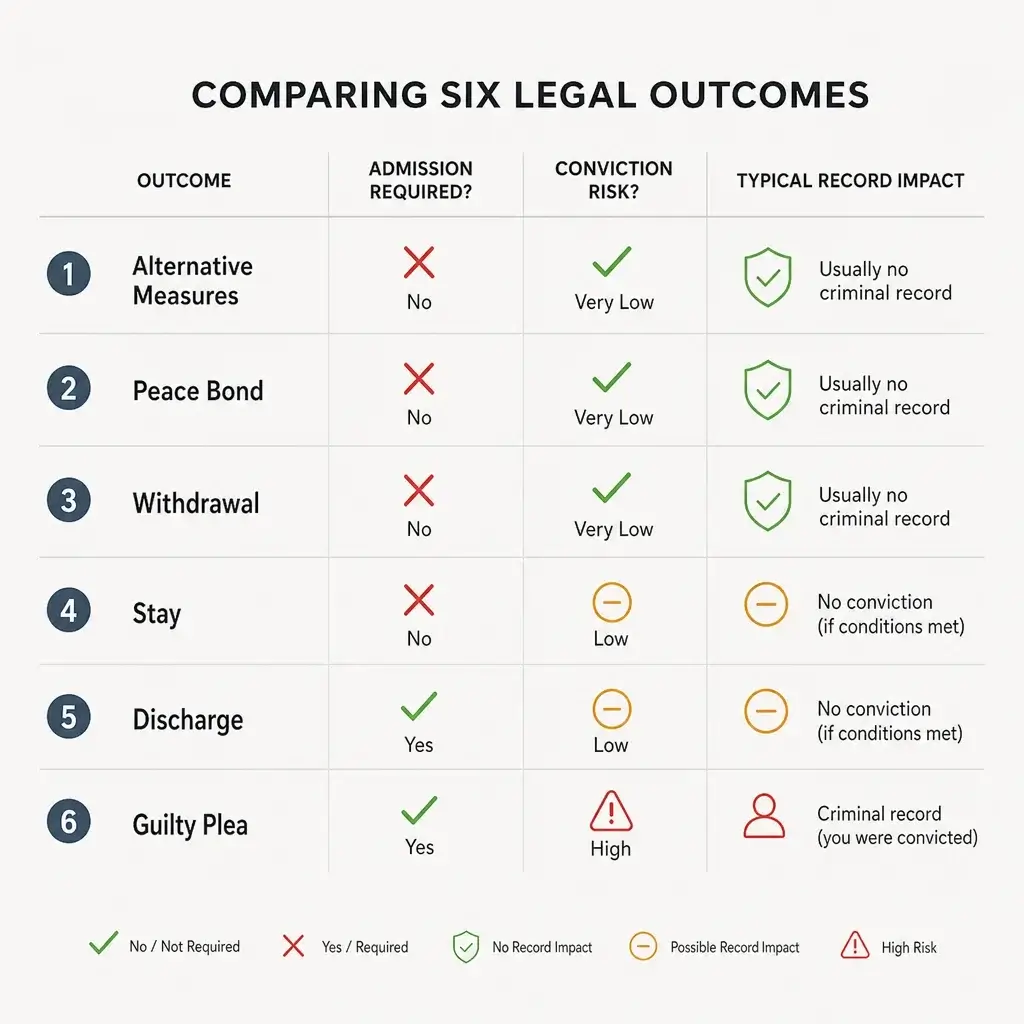
These are different tools and outcomes, not interchangeable labels. A peace bond is not the same as diversion. A discharge is not the same as a withdrawal. A guilty plea is not the same as accepting responsibility in an alternative measures program.
A peace bond under section 810 of the Criminal Code is a recognizance to keep the peace and be of good behaviour for up to 12 months. It is not a conviction for the underlying assault charge, but it can involve conditions.
A withdrawal ends the charge by Crown decision. A stay stops the prosecution, though a stayed charge can in some cases be revived within 1 year. That 1-year period is set out in section 579 of the Criminal Code.
A discharge follows a finding of guilt. An absolute discharge or conditional discharge avoids a registered conviction, but it still follows a guilty plea or finding of guilt and carries its own record consequences. Discharges are governed by section 730 of the Criminal Code.
A guilty plea to an assault charge means admitting the offence in court. Alternative measures usually aim to avoid that plea, but they may still require an admission of responsibility outside court. That is why the choice is strategic, not automatic.
Comparison table
| Resolution | What it is | Admission required | Conviction risk | Record impact |
|---|---|---|---|---|
| Alternative measures | Diversion under a program | Usually accept responsibility | Usually designed to avoid conviction if completed | No automatic conviction record, but other records may still exist |
| Peace bond | Court order to keep the peace | No guilty plea to the charge itself | No conviction for the charge | Can still appear in some records or court history |
| Withdrawal | Crown ends prosecution | No guilty plea | No conviction on the charge | Court and police records may still exist |
| Stay | Prosecution halted | No guilty plea | No conviction unless revived and continued | Record consequences differ from a withdrawal |
| Discharge | Sentence after finding of guilt | Guilty plea or finding of guilt | No registered conviction, but guilt is entered | Specific discharge record rules apply |
| Guilty plea | Plea of guilt in court | Yes | Conviction may follow unless discharge granted | Most direct conviction exposure |
How self-defence, mutual combat, alcohol, or a prior record can change the analysis
The decision whether to accept assault charge diversion should start with the evidence, not with the offer. If there is a real self-defence claim, a serious credibility problem in the Crown case, or an identity issue, diversion may not be the best route.
Self-defence assault charge cases are especially sensitive because section 34 looks at whether the act was committed for the purpose of defending or protecting against force or a threat of force, and whether the act was reasonable in the circumstances. That analysis is fact-specific and can be stronger than people first think.
Mutual-combat bar incidents are also fact-heavy. Two people may both have been drinking, both may claim the other started it, and video or witness evidence may be uneven. In that setting, I review disclosure carefully before I advise anyone to accept responsibility.
Alcohol and drug facts can cut both ways. They can make the Crown more concerned about risk, but they can also support a treatment-focused plan inside diversion if the program sees the case as manageable.
Prior record diversion questions are practical as much as legal. A dated, unrelated record may be treated differently from recent violence, prior breaches, or earlier failures on diversion. There is no honest national formula for that assessment.
Province and program differences across Canada
The Alternative measures Criminal Code framework is federal, but program delivery is local. Section 717 is national law. The way assault files are screened, referred, and completed depends on provincial and territorial programs and on local Crown policy.
What are alternative measures in BC is therefore not answered the same way as in Ontario or Alberta. The name of the program, who can refer the case, whether pre-charge diversion exists for adult assault matters, and what outcomes follow completion can all differ.
Having prosecuted, I can say this plainly: local Crown policy matters a great deal in assault files. Domestic allegations, bodily harm, victim consultation, and prior breaches are all filtered through local practice as much as through the Criminal Code framework.
> Callout: Province and territory differences matter > > – Section 717 Criminal Code is the federal starting point. > – Provinces and territories run programs differently. > – Police, Crown, or court-connected referrals may all exist, depending on the jurisdiction. > – Domestic and sexual violence screening can be much stricter in some places.
Federal framework vs local practice
| Level | What it controls | Practical effect on assault files |
|---|---|---|
| Federal law | Section 717 Criminal Code framework | Sets the legal basis for adult alternative measures |
| Provincial or territorial program | Program name, intake, conditions | Changes referral routes and available terms |
| Local Crown policy | Screening priorities and exclusions | Strongly affects domestic, injury, and repeat-offender cases |
When to speak to a lawyer before accepting alternative measures
The right time to get advice is before you accept responsibility, before you speak to Crown about the facts, and before you sign any diversion agreement. That is the stage where strategy is still open.
A lawyer should review the charge sheet, release papers, undertaking or bail terms, disclosure, prior record summary if any, and the actual program offer. In assault cases, I also look for self-defence issues, witness problems, inconsistent statements, body-worn camera, 911 audio, and any Charter issues if the police search or arrest is in dispute.
This is general information, not advice on your charge. If you are deciding between court and alternative measures on an assault file in Toronto, Brampton, Scarborough, Oshawa, Newmarket, or elsewhere in Ontario, speak to a criminal lawyer before making any admission. Our firm offers free consultations and 24/7 availability for private retainer criminal matters, but we do not take legal aid cases.
FAQ
Can a simple assault charge be resolved through alternative measures in Canada?
Yes, simple assault alternative measures are often the most realistic assault-diversion category, especially where injuries are minor and the case is non-domestic. But there is no automatic entitlement, and local policy still controls.
Do I have to plead guilty to get alternative measures for assault?
Usually not in the formal court sense, but you may have to accept responsibility as a program condition. That is a different step from a guilty plea and should be reviewed carefully with counsel.
Can domestic assault be diverted in Canada?
Sometimes, but domestic assault diversion is treated more cautiously in many jurisdictions because of safety concerns and local policy. No article can answer that safely without knowing the province and the facts.
What happens if I finish an alternative measures program?
The prosecution may be withdrawn, stayed, or otherwise ended under local procedure after proof of completion is filed. The exact legal wording depends on the jurisdiction.
Will alternative measures keep an assault charge off my criminal record?
It often avoids a conviction record, but it does not guarantee that no police, court, or internal justice record exists. Record-check and vulnerable-sector consequences need careful, local review.
How long does alternative measures usually take?
The process usually runs over several weeks to several months because screening, programming, and confirmation of completion all take time. I would not give a tighter range without knowing the program and court.
Can the victim stop alternative measures from happening?
Victim views matter and may be required to be sought, but they are not always a legal veto. Safety, appropriateness, and local Crown policy all matter.
What if I have a prior record?
A prior record can reduce eligibility, especially if it involves violence, breaches, or prior diversion failures. It does not create one universal national rule.
Can I choose court instead of alternative measures?
Yes. Diversion is usually an option to consider, not an order to accept. If there is a real defence, that choice should be made only after disclosure review and legal advice.
Should I accept responsibility if I acted in self-defence?
Not before a lawyer reviews the disclosure. Self-defence can be a complete defence under section 34, and accepting responsibility too early can affect strategy.
If you are weighing an alternative measures program against a plea, a peace bond, or a trial, the safest next step is simple: get the disclosure and have a criminal lawyer review it before you make any admission.