

 Based on 116 Verified Google Reviews

Most people searching assault vs aggravated assault are really asking how Canadian law separates a basic assault from a much more serious one. In Canada, common or simple assault is the base offence, assault with a weapon and assault causing bodily harm sit above it, and aggravated assault is the most serious assault offence in this group under the Criminal Code.
Assault vs aggravated assault in Canada: the short answer
The difference between assault and aggravated assault is the level of harm and the legal category the Crown proceeds under. Basic assault is the starting point under section 265 of the Criminal Code. Aggravated assault is under section 268 and deals with an assault that wounds, maims, disfigures, or endangers the life of the complainant.
Aggravated assault is worse than assault in both law and practical effect because it is treated as a more serious offence with a higher maximum penalty and usually harsher bail, record, employment, travel, and immigration consequences. Aggravated assault carries a maximum of 14 years’ imprisonment.
Canadian assault law is not built on U.S. terms like felony or battery. In Canada, a no-injury shove can still be assault, bodily harm usually points to section 267, and life-endangering or permanently serious injury can point to section 268.
Side-by-side comparison: assault, assault causing bodily harm, assault with a weapon, and aggravated assault
The clearest way to understand common assault vs aggravated assault is to compare the offences side by side. Section 265 defines assault, section 267 covers assault with a weapon, assault causing bodily harm, and choking, suffocating or strangling, and section 268 covers aggravated assault.
| Offence | Criminal Code section | What the Crown generally has to prove | Injury level | Weapon factor | Example | Mode of prosecution | Maximum penalty |
|---|---|---|---|---|---|---|---|
| Assault, often called simple or common assault | s. 265 | Intentional force without consent, or an attempt/threat by act or gesture creating present ability and reasonable fear | No injury required | No weapon required | A push, slap, grab, or raised fist with immediate threat | Hybrid offence | Up to 5 years if prosecuted by indictment |
| Assault with a weapon / assault causing bodily harm / choking | s. 267 | Assault plus weapon use, or bodily harm, or choking/suffocating/strangling | Bodily harm can be enough | Weapon use can be enough even without catastrophic injury | Swinging a bottle, cutting someone, causing a fracture, or alleged strangulation | Hybrid offence | Up to 10 years if prosecuted by indictment |
| Aggravated assault | s. 268 | Assault that wounds, maims, disfigures, or endangers life | Very serious or life-endangering harm | A weapon may be involved, but it is not required | Permanent scarring, major internal injuries, or injuries that endanger life | Indictable offence | Up to 14 years |
The difference between aggravated assault and assault with a weapon is that weapon use alone does not automatically make the case aggravated. A knife, bottle, bat, or other object may support a section 267 charge even where the injuries do not amount to wounding, maiming, disfigurement, or endangering life.
Aggravated assault vs assault causing bodily harm is usually a question about degree. Assault causing bodily harm is often the middle category, while aggravated assault is reserved for more serious injuries or life-endangering consequences.
What counts as assault in Canada?
Assault in Canada does not require injury, and it does not always require contact. Section 265 includes applying force intentionally without consent, attempting or threatening by act or gesture to apply force when the other person has reasonable grounds to believe you can carry it out, and, in some circumstances, accosting or impeding while openly carrying a weapon or imitation weapon.
A common assault charge in Canada can come from a push, slap, grab, spit, or blocked exit if the facts show intentional force or an immediate threat of force. Spitting has been treated as an application of force in Canadian assault law.
Threatening words alone are often not enough for assault if there is no immediate act, gesture, or present ability behind them. Threatening words plus advancing on someone, raising a fist, cornering them, or moving in to strike can support an assault charge because the law focuses on immediate fear of force, not just offensive language.
Simple assault Canada searches usually refer to this base offence, even though the Code itself uses the broader section 265 definition of assault. In plain language, simple assault, common assault, and basic assault are often used to describe the lowest level assault charge.
What makes assault become aggravated?

What makes an assault charge become aggravated is not the label police use at the scene but the evidence about the harm. Aggravated assault under section 268 is tied to wounding, maiming, disfiguring, or endangering life, which is a much higher threshold than the base offence.
The difference between simple and aggravated assault is usually driven by the severity of injury, the medical evidence, and whether the complainant’s life was put at risk. A punch with no injury may be charged as assault, a punch causing a fracture may fit assault causing bodily harm, and an assault causing life-threatening internal bleeding may move into aggravated assault territory.
Using a weapon may increase the charge, but it does not automatically make the offence aggravated assault. A weapon can support a section 267 assault with a weapon charge even where the complainant escapes serious injury.
Charges can change as the evidence develops because police often lay an initial charge based on what they know that day. Hospital records, photographs, specialist opinions, and later medical complications can all affect whether the Crown continues on assault, assault causing bodily harm, or aggravated assault.
Assault causing bodily harm vs aggravated assault

Assault causing bodily harm Canada law sits between simple assault and aggravated assault. Section 267 covers assault causing bodily harm, while section 268 covers aggravated assault.
Bodily harm has a specific legal meaning in Canadian criminal law. It generally means any hurt or injury that interferes with a person’s health or comfort and is more than merely transient or trifling.
Aggravated assault is not the same as assault causing bodily harm because aggravated assault requires a more serious level of harm. The usual dividing line is whether the evidence points to wounding, maiming, disfigurement, or endangering life, rather than injury that is serious but falls short of that threshold.
Aggravated assault vs assault causing bodily harm often turns on medical detail. Bruising, cuts needing stitches, or some fractures may support bodily harm, while permanent disfigurement, major loss of function, or life-threatening injuries may support aggravated assault. Every case turns on its own facts, and I cannot predict how a specific injury will be charged without the disclosure and medical records.
Strangulation allegations can complicate this comparison because section 267 expressly includes choking, suffocating, or strangling. If the evidence also shows life-endangering consequences, the case may be prosecuted more seriously.
Aggravated assault vs assault with a weapon or a “deadly weapon”
The phrase deadly weapon is usually U.S. wording, not standard Canadian charging language. In Canada, the more accurate comparison is aggravated assault vs assault with a weapon under section 267.
The difference between aggravated assault and assault with a deadly weapon is that a weapon-based assault can be charged under section 267 even if no one suffers catastrophic injury. Swinging a bottle and missing, or using a knife during an assault without causing life-threatening harm, can still be assault with a weapon.
Assault with a weapon can become aggravated assault if the injuries cross the much higher section 268 threshold. The law looks at the harm caused, not just the object used.
Canada-only terminology matters here because online search results often mix Canadian law with U.S. state law. Canada does not classify offences as felonies and does not use assault-and-battery language the same way many U.S. states do.
Domestic assault vs aggravated assault: are they the same?
Domestic assault vs aggravated assault is not a level-to-level comparison because the two labels describe different things. Aggravated assault describes seriousness of harm, while domestic assault usually describes the relationship context, such as intimate partners or family members, rather than a separate Criminal Code offence section.
A domestic case can still be charged as basic assault, assault causing bodily harm, assault with a weapon, or aggravated assault depending on the facts. The presence of a domestic relationship does not automatically make the charge aggravated assault.
Domestic allegations often affect release conditions right away. After arrest, a bail hearing or judicial interim release decision is commonly addressed within 1 to 3 days of arrest if the accused is held for court. In domestic cases, no-contact orders, non-attendance at the home, and limits on seeing children are common early conditions, depending on the facts and the court.
Aggravated assault vs domestic violence is therefore the wrong comparison if you are asking about legal seriousness. One is about injury level. The other is about who the complainant is and how the court manages risk, bail, and sentencing context.
Examples: common assault, assault causing bodily harm, and aggravated assault
Aggravated assault examples make more sense when you compare them with the lower categories. These are illustrations only, because actual charges depend on the evidence, the medical record, witness accounts, and the Crown’s assessment.
A common assault example would be a person shoving another during an argument, leaving no injury. Another common assault example would be raising a fist and lunging close enough that the other person reasonably believes they are about to be struck.
An assault causing bodily harm example would be a punch that breaks the complainant’s nose or causes a concussion. Another would be throwing an object that causes a cut needing stitches or a fracture that is painful and more than trivial.
An aggravated assault example would be an attack causing permanent facial scarring or loss of vision in one eye. Another would be an assault that causes life-threatening internal injuries or otherwise endangers life.
Weapon use fits its own category unless the harm becomes much more serious. Striking at someone with a bottle and causing a minor cut may support assault with a weapon or assault causing bodily harm, while causing permanent disfigurement with that same bottle may push the allegation into aggravated assault.
Penalties and sentencing in Canada
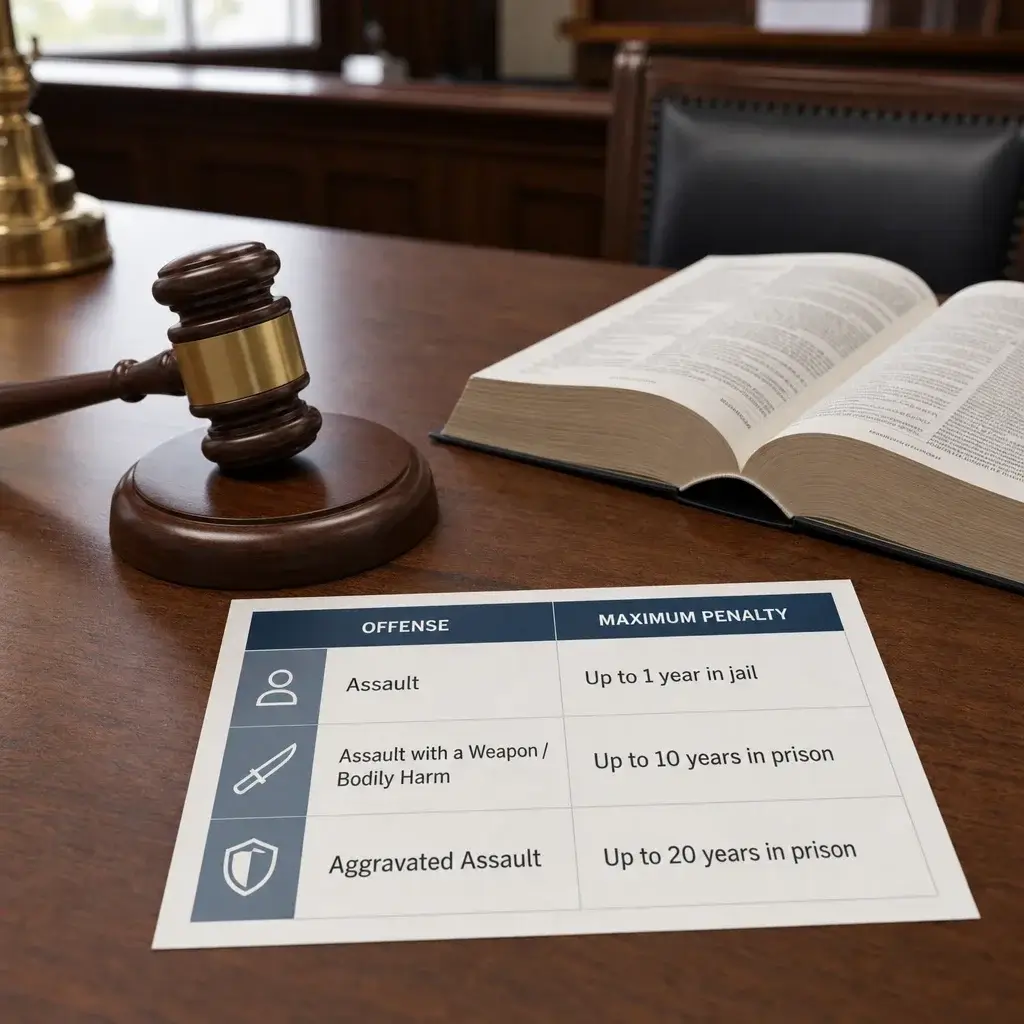
What is the punishment for simple assault in Canada depends first on how the Crown elects to proceed and then on the facts of the case. Assault under section 266 is a hybrid offence with a maximum of 5 years if prosecuted by indictment. I am not going to guess at a sentence on any live charge because the actual outcome depends on the injury, record, context, and the disclosure.
What is the punishment for assault causing bodily harm in Canada is more serious because section 267 also covers weapon use and choking allegations. If prosecuted by indictment, the maximum penalty is 10 years.
What is the punishment for aggravated assault in Canada is more serious again because aggravated assault is indictable only. The maximum penalty is 14 years.
There is no single most common sentence for aggravated assault that applies across Canada. Sentencing turns on the extent of injury, whether a weapon was used, whether the case involved a domestic relationship, the accused’s record, the complainant’s impact, and any mitigating or aggravating factors recognized by law.
Jail is legally possible for all of these offences, and the risk generally rises as the harm rises. A first-time accused person may still face probation, a criminal record, weapons prohibitions, counselling terms, or jail depending on the facts, so first offence does not mean minor offence.
| Offence | Classification | Maximum penalty |
|---|---|---|
| Assault | Hybrid | Up to 5 years on indictment |
| Assault with a weapon / assault causing bodily harm / choking | Hybrid | Up to 10 years on indictment |
| Aggravated assault | Indictable | Up to 14 years |
If you are facing any of these allegations, the first practical step is to have a criminal lawyer review the exact charge, your release conditions, and the disclosure before you decide how to respond. That is general information, not advice on your charge.
Real-world consequences beyond jail
Aggravated assault is worse than assault in practical terms because the consequences usually reach far beyond sentence alone. A more serious assault charge can affect bail, access to your home, contact with family, work, travel, immigration status, and professional licensing.
Release conditions can be immediate and disruptive. In Ontario courts, it is common to see no-contact terms, non-attendance clauses, weapons bans, and reporting conditions imposed at the front end of a case, especially where there are injury allegations or a domestic context.
A criminal record for assault can affect employment and travel even where jail is not imposed. Immigration consequences can be serious for non-citizens, but they depend on status, the exact offence, and the sentence, so that is one area where case-specific advice matters.
Firearms consequences can also arise because assault findings or release terms may lead to weapons prohibitions or licensing problems. I review those collateral issues early because they can matter as much as the charge itself.
How police and Crown decide which assault charge to lay
Police usually lay the initial charge based on the evidence available at the time of arrest, and the Crown later reviews the file in more detail. That review often includes witness statements, body-worn or surveillance video, 911 calls, photographs, medical records, and any admissions.
A charge can be upgraded or amended if the evidence becomes more serious than first believed. A complaint that starts as common assault may be prosecuted as assault causing bodily harm or aggravated assault once hospital records or expert opinions confirm the extent of injury.
The evidence that moves a case from simple assault to aggravated assault is usually medical and factual, not semantic. The Crown will look at whether the injuries amount to bodily harm, whether they are permanent or disfiguring, whether life was endangered, and whether there is reliable proof connecting the accused to that harm.
In Ontario, the next procedural step after the first court date is often disclosure review and then a Crown pre-trial. A less complex assault matter may resolve in about 6 to 12 months, while a trial matter or serious indictable case can take 12 to 24 months or more depending on the court location, disclosure volume, and whether expert evidence is involved.
Common defences to assault and aggravated assault charges
There are real defences to assault charges, but the defence depends entirely on the facts and the evidence. Common issues include self-defence under section 34 of the Criminal Code, identity, accident, lack of intent, credibility problems, and failure of proof.
Self-defence is not a slogan. It requires evidence that force was used for a defensive purpose and that the act was reasonable in the circumstances, which the court assesses using the factors set out in section 34.
Some cases turn on whether the alleged assault happened at all. In assault cases without neutral witnesses, cross-examination, prior inconsistent statements, text messages, videos, and the timing of complaints can matter a great deal.
Charter issues can also matter where police obtained statements, searches, or evidence unlawfully. Section 8 protects against unreasonable search and seizure, section 9 protects against arbitrary detention, section 10(b) protects the right to counsel, and section 24(2) is the exclusion remedy if a breach is proven and admission of the evidence would bring the administration of justice into disrepute.
Consent has a limited role in assault law and should not be overstated. In some settings it may be legally relevant, but it is not a broad answer to serious violence allegations. That is another area where I would want the disclosure before offering any view on a real case.
What to do after being charged with assault or aggravated assault
The safest first step after an assault charge is to follow your release conditions exactly. If your undertaking, release order, or bail says no contact or no attendance, do not test the wording and do not try to fix the situation yourself.
The next step is to preserve evidence, not edit it. Save messages, call logs, videos, photos, and social media content, and write down your timeline while your memory is fresh.
Do not give a statement to police in the hope of clearing things up before you have legal advice. The right to silence and the right to counsel exist for a reason, and trying to explain can damage a defence even where the allegation is false or exaggerated.
Ask for disclosure and have a lawyer review the exact charge. I cannot predict an outcome without the disclosure, and every case turns on its own facts, especially where the real dispute is about injury level, self-defence, identity, or credibility.
Key takeaways: how to tell which assault charge you are dealing with
The difference between assault and aggravated assault is easiest to spot with a short decision tree. If there is intentional force or an immediate threat of force, there may be an assault even with no injury.
If there is a weapon, choking allegation, or injury that is more than transient or trifling, the case may fit section 267 assault with a weapon or assault causing bodily harm.
If the evidence points to wounding, maiming, disfigurement, or endangering life, the case may fit section 268 aggravated assault. That is the highest level in this group and generally carries the highest stakes.
If the allegation happened in a relationship or household setting, domestic context may affect bail and prosecution approach, but it does not by itself answer whether the charge is simple assault, bodily harm, or aggravated assault.
Online labels are not enough. The charge on the information, the medical evidence, the witness evidence, and any release conditions are what matter. If you are trying to understand a live assault, assault causing bodily harm, domestic assault, or aggravated assault charge in Toronto or the GTA, speak to a criminal lawyer before giving a statement or making assumptions about the strength of the case.
FAQ
What is the difference between assault and aggravated assault in Canada?
Basic assault is the base offence under section 265, while aggravated assault under section 268 involves wounding, maiming, disfiguring, or endangering life.
Is aggravated assault worse than assault?
Yes in legal seriousness, maximum penalty, and practical consequences. Aggravated assault carries a maximum of 14 years, while basic assault carries a lower maximum.
Is aggravated assault the same as assault causing bodily harm?
No. Assault causing bodily harm is usually the middle category under section 267, and aggravated assault under section 268 is more serious.
What is the difference between aggravated assault and assault with a weapon?
Weapon use can support a section 267 charge even without catastrophic injury. Aggravated assault depends on the level of harm, not just the presence of a weapon.
Can you be charged with assault without touching someone?
Yes. An attempt or threat by act or gesture can be assault if it creates reasonable fear of immediate force.
Does assault require injury in Canada?
No. Injury is not required for basic assault.
What is considered aggravated assault in Canada?
An assault that wounds, maims, disfigures, or endangers life is aggravated assault under section 268.
What is a common assault charge in Canada?
Common assault is a plain-language way of describing the base assault offence, such as a push, slap, grab, or immediate threat of force without consent.
How much jail time do you get for aggravated assault in Canada?
There is no single answer for every case. The maximum penalty is 14 years, but the actual sentence depends on the facts, injury, record, and other sentencing factors.
Will I go to jail for first-time assault in Canada?
Jail is possible, but there is no automatic answer. First-time offenders can still face serious consequences, and I cannot predict a sentence without the disclosure and the facts.
Is domestic assault the same as aggravated assault?
No. Domestic assault describes relationship context. Aggravated assault describes serious harm. A domestic case can be charged at any assault level depending on the facts.
Can an assault charge be upgraded to aggravated assault?
Yes. Charges can change if later medical or witness evidence shows more serious injury than first believed.