

 Based on 116 Verified Google Reviews

Most people think a first assault charge means automatic jail. It does not. If you were charged with assault first offence, the early steps matter more than panic does. This is general information, not advice on your charge.
What to do immediately if you were charged with assault for the first time
A first assault charge is serious, but the first 24 to 72 hours are usually about release conditions, preserving evidence, and avoiding new mistakes. Read every page the police gave you. Your paperwork usually lists the charge, the court date, and any terms like no contact, stay away, or reporting requirements.
Your safest first step is to obey the release terms exactly as written until a court changes them. If you breach an undertaking, release order, or recognizance, that breach can become a separate criminal allegation. In domestic cases, the terms often include no contact with the complainant and staying out of the home, even where the underlying allegation is a common assault charge.
Your next job is to preserve evidence before it disappears. Save texts, call logs, photos, screenshots, ride records, door-camera footage, and names of witnesses. CCTV is often overwritten in days or weeks, depending on the system, so I tell people to act quickly. Write out a timeline while the details are still fresh.
The worst move is trying to fix the case yourself. Do not send apology texts. Do not post online. Do not ask friends or family to contact the complainant for you. If police want a statement after charge, use your right to silence and speak to a criminal lawyer first. Section 7 and section 10(b) of the Charter protect the right to silence and the right to counsel.
Domestic allegations create practical problems right away. A no-contact term can affect housing, parenting, work schedules, and access to medication or clothing left at home. Property pickup usually needs to be arranged through police, counsel, or another approved channel, not through direct contact.
What assault means in Canada, in plain English
In Canada, assault does not require a punch or an injury. Section 265 of the Criminal Code defines assault broadly. It includes applying force without consent, attempting or threatening to apply force when the other person has reasonable grounds to think you can carry it out, and in some situations accosting a person while openly carrying a weapon or imitation weapon.
What does assault CC 266 mean? Section 266 is the offence provision for common assault, sometimes called simple assault Canada in online searches. Section 265 tells you what conduct counts as assault. Section 266 makes that conduct a crime.
A shove, grab, slap, raised fist at close range, or threat of immediate force can all fit a basic assault allegation. Injury is not required for a basic assault charge. That is why people are sometimes surprised to face a charge after an argument where nobody needed medical treatment.
If you are searching what is the lowest charge for assault, the answer is usually common assault or basic assault under section 266. Ontario police and court paperwork may still use plain wording like assault or assault CC 266 Ontario. “Level 1 assault” is common search language, but it is not a formal Criminal Code category.
Quick decision tree: which assault label may apply?
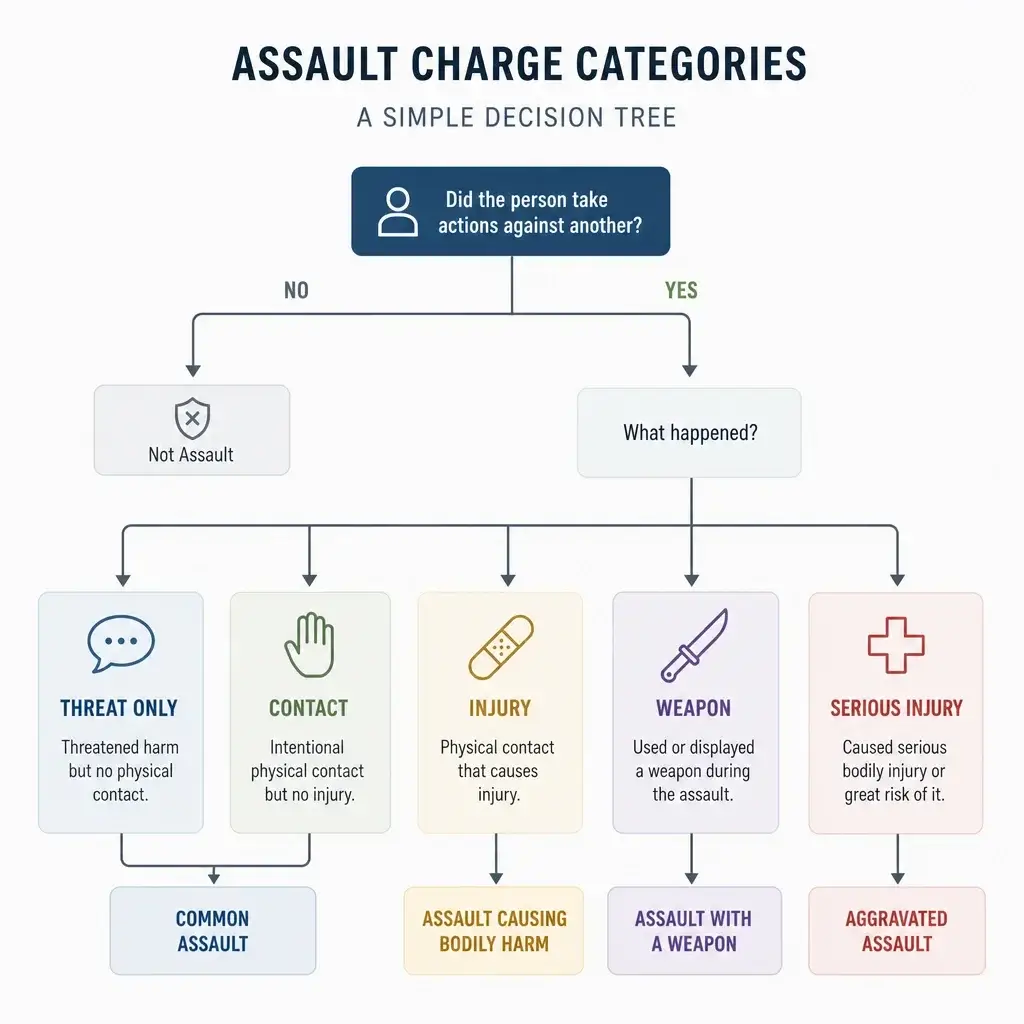
The label usually follows the facts: threat only, contact, injury, weapon, or serious injury. A threat with immediate ability to carry it out may still be common assault. A shove or slap with no real injury may still be common assault. If the allegation includes bodily harm or a weapon, the charge can move to a more serious category.
Minor force without injury often points to common assault. Bodily harm usually means an injury that interferes with health or comfort and is more than merely trivial or transient. A broken nose, stitched cut, or significant swelling can move a case out of simple assault Canada and toward assault causing bodily harm.
A weapon allegation raises the stakes even if the physical injury is limited. In Canadian law, a weapon can be an object used, intended to be used, or threatened to be used to cause injury or intimidation. An everyday item can become a weapon depending on how it was used.
Severe wounds or life-endangering injuries can lead to aggravated assault, which is far more serious. Choking or strangulation allegations also need careful review because Canadian law now treats that conduct separately in some circumstances. I would not rely on a generic online label when the wording on the information or release papers matters.
> Warning about mixed search results: Canada and the UK use different assault labels. If your paperwork says Criminal Code section 266, 267, 268, or 267(c), read the Canadian sections below. If your paperwork says section 47 or ABH, you may be reading UK material and should confirm the jurisdiction immediately.
Canada vs UK assault terms: do not mix them up
Canadian assault charges are usually framed under Criminal Code sections 265, 266, 267, and 268. Those are the terms I look for in Ontario disclosure and charging documents. They are not the same as UK offences such as common assault, assault by beating, or section 47 assault.
Section 47 assault first offence and assault by beating first offence are usually UK search terms. In UK usage, section 47 generally refers to assault occasioning actual bodily harm, often shortened to ABH. That is not standard Canadian charge wording, and Canadian sentencing rules should not be mixed with UK ones.
If your paperwork says CC 266, this guide is the right framework. If it says section 47 assault or assault by beating, check where the case is actually being prosecuted before relying on online advice. I see people get confused because search results blend Ontario, England, and forum posts into one page.
Difference between common assault, assault causing bodily harm, assault with a weapon, and aggravated assault
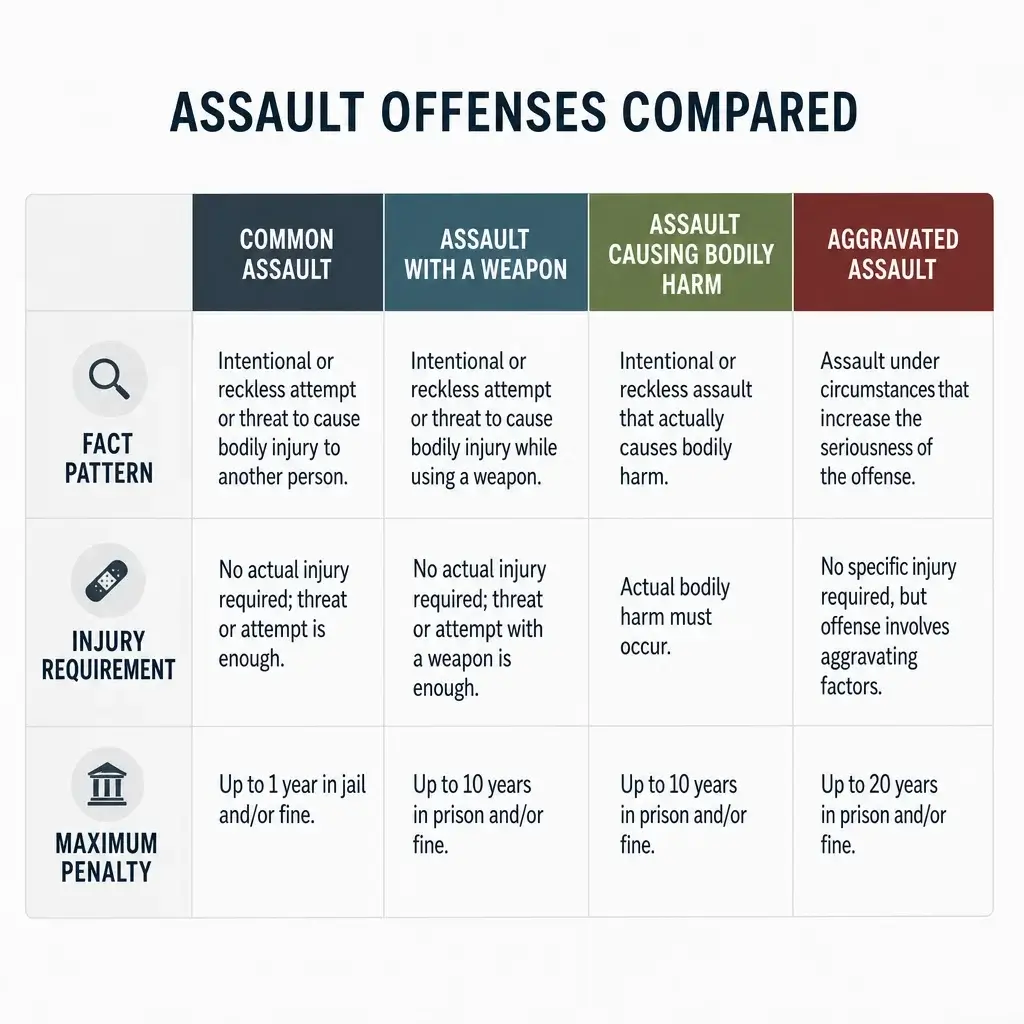
The Canadian categories differ mainly by force, injury, and weapons, not by online labels like level 1 assault Canada punishment. The table below is the plain-English version.
| Charge label | Typical fact pattern | Is injury required? | Maximum penalty |
|---|---|---|---|
| Common assault, s. 266 | threat, shove, grab, slap, minor fight | No | up to 5 years if prosecuted by indictment |
| Assault with a weapon, s. 267(a) | object used or threatened as a weapon | No | up to 10 years if prosecuted by indictment |
| Assault causing bodily harm, s. 267(b) | punch causing broken nose, cut needing stitches | Yes, bodily harm | up to 10 years if prosecuted by indictment |
| Aggravated assault, s. 268 | wounding, maiming, disfiguring, endangering life | Serious injury | up to 14 years |
Common assault is generally the least serious assault category in Canada. That answers the search for what is the lowest form of assault charge. It does not mean the case is minor in real life, because the court still looks at the setting, injuries, record, and any release breach.
If you are searching assault CC 266 Ontario or what does assault CC 266 mean, you are usually dealing with the basic common assault offence. If the disclosure shows medical records, weapon photos, or a stronger injury narrative, the Crown may proceed on a higher offence instead. I cannot predict the outcome without the disclosure.
Will you go to jail for a first assault charge?
Jail is possible on a 1st offence assault, but it is not automatic. In a true first-offender common assault case, the court still has a full range of outcomes available, from a peace bond or discharge in some cases to probation, fine, suspended sentence, or jail in more serious ones. There is no general mandatory minimum sentence for simple assault under section 266.
The question that matters is not “first offence” alone. Courts sentence based on the facts. Injury, use of a weapon, strangulation allegations, domestic context, breach of release conditions, a vulnerable complainant, or a prior violent record make the case more serious. No record, limited injuries, treatment steps, steady employment, and evidentiary weaknesses can support a less severe position.
The statutory maximum is not the same as the likely sentence in an ordinary first-time case. A common assault can proceed by summary conviction or indictment. Summary offences in Canada can carry maximums up to 2 years less a day, depending on the offence and the charging provision. That is a ceiling set by Parliament, not a prediction of what any person will receive.
If you are asking do first time offenders go to jail in Canada, the honest answer is yes, some do, but the legal system does not treat every shove, domestic argument, or threat-only allegation the same way. I review the disclosure, the injuries, the witness evidence, the background, and any Charter issues before I say what sentencing positions may be in play. Every case turns on its own facts.
Likely outcomes by fact pattern for a first offender
Different fact patterns usually produce different negotiations and sentencing positions. The table below sets out possibilities, not predictions.
| Scenario | What the Crown usually focuses on | Evidence that often matters | Outcomes that may be in play |
|---|---|---|---|
| Threat-only allegation | immediate ability, credibility, fear | witness statements, 911 call, texts | withdrawal, peace bond, trial, probation if convicted |
| Shove or grab with no injury | intent, credibility, context | video, photos, admissions, eyewitnesses | diversion in some places, peace bond, discharge, probation |
| Single slap | context, injury, prior relationship | photos, complainant statement, texts | peace bond, discharge, probation, jail risk if aggravating features exist |
| Mutual argument with conflicting stories | credibility and self-defence | independent witnesses, video, contemporaneous messages | withdrawal, trial, peace bond, plea to agreed facts |
| First-time domestic assault charge Canada with no visible injury | public interest, risk, relationship history | 911 audio, statements, body-worn video, neighbour evidence | peace bond, counselling-based resolution, probation, trial |
| Weapon allegation | object used, threats, fear, planning | weapon photos, scene evidence, admissions | more serious charge, tighter bail, probation or jail positions |
| Documented injury | medical proof and causation | hospital records, injury photos, timing evidence | bodily harm charge, probation or jail positions, trial |
The realistic range of outcomes changes sharply with the quality of the disclosure. A shaky identification, missing CCTV, inconsistent statements, or a strong self-defence narrative can matter more than the label on the charge. Having prosecuted, I read the case for weak points the way the Crown will. That might be a credibility problem, a bad statement, or a Charter issue.
What evidence is needed for assault charges?
Police need enough evidence to justify laying a charge, but proof in court is a higher standard. A charge can be laid on one complainant statement if police believe there are reasonable grounds. A conviction requires proof beyond a reasonable doubt in court. Those are two different stages.
Common evidence in an assault file includes the complainant’s statement, witness statements, 911 audio, body-worn video, CCTV, medical records, injury photos, text messages, voicemails, and any admissions. In a basic section 266 case, visible injury helps but is not required. That is why some common assault first offence cases turn almost entirely on credibility.
What evidence is needed for assault by beating is really a UK search phrase, but the practical answer is similar everywhere: the Crown tries to prove the contact, the identity of the person who used force, and the lack of lawful justification. Video, prompt complaint evidence, fresh injury photos, and neutral witnesses can strengthen that proof. Missing video, delayed complaint, or contradictory messages can weaken it.
How much evidence do you need to be charged is the wrong question if you are trying to predict the final result. Police can charge on a much thinner record than what the Crown will need to prove guilt at trial. That is why I always wait for disclosure before taking a hard position on the strength of the case.
Best defenses to a first assault charge
There is no single best defense for assault. The strongest defence depends on what happened and what the evidence can actually prove. In one case the issue is self-defence. In another it is identity, lack of intent, accident, consent in a limited context, or simple lack of proof.
Self-defence can apply where the person reasonably believed force was being used or threatened against them, acted for a defensive purpose, and the act was reasonable in the circumstances. Section 34 of the Criminal Code sets out the modern self-defence framework. Proportionality, immediacy, and corroboration usually matter a great deal.
Some assault cases are defended by showing no assault happened at all. If the contact was accidental, if the alleged threat was not immediate, or if the Crown cannot prove identity, the charge may not be made out. In he-said she-said cases, independent video, neutral witnesses, and timing records can be decisive.
Some cases turn less on a dramatic defence and more on weak disclosure. I look for inconsistent statements, missing notes, poor photo continuity, delayed complaint issues, and Charter problems. Section 8 of the Charter protects against unreasonable search and seizure, and section 10(b) protects the right to counsel. If police obtained evidence unlawfully, a Charter challenge may affect what the court can use.
A guilty plea should usually be considered only after disclosure is reviewed and the consequences are understood. I cannot tell anyone how to beat an assault charge in Canada in the abstract, because every case turns on its own facts, the disclosure, and the court record.
Can assault charges be dropped if the complainant changes their mind?
The complainant cannot simply drop the charge once police have laid it. In Canada, the Crown decides whether to continue, withdraw, or resolve the prosecution, based on the evidence and the public interest. That is true in both domestic and non-domestic files.
A complainant can tell police or the Crown they no longer want to proceed, but that does not end the case automatically. Prior statements, 911 recordings, photos, body-worn video, and other witnesses may still allow the Crown to go forward. Domestic cases are especially likely to continue despite recanting.
No-contact terms stay in force until a court changes them. If your release says no contact, you cannot call, text, message through friends, or attend the same home unless the order is varied. Breaching that term usually creates a new problem that is often easier for the Crown to prove than the original assault allegation.
Bail, release conditions, and no-contact orders after an assault charge

Most assault cases start with release conditions, not trial. If the police release a person from the station, the paperwork may be an undertaking or release order with conditions. If the person is held for a bail hearing, judicial interim release is usually heard within 24 hours where a justice is available, or as soon as possible after that.
Common assault release terms include keep the peace, no contact with the complainant, stay away from home, work, or school, no weapons, and reporting conditions. Curfew, surety supervision, and house arrest are more likely where the allegation is serious, the person has a record, or the Crown says there is a safety concern.
Domestic assault charges often bring the hardest practical conditions. A person may be barred from the family home, children may only be discussed through counsel or family court channels, and picking up belongings may need a police escort or written agreement. Those terms remain binding until they are formally varied.
If a condition is unworkable, the answer is not to ignore it. The answer is to ask counsel about a variation. In Ontario courts, a release variation can sometimes be addressed by consent and sometimes requires a formal hearing, depending on the form of release and the Crown’s position.
First-offender options: diversion, peace bond, discharge, probation, and other alternatives
A first offender may have more resolution options than they expect, but none are automatic. Depending on the facts, the province, the injury level, and Crown policy, the possibilities can include diversion or alternative measures, a peace bond, an absolute or conditional discharge, probation, or a suspended sentence.
A peace bond is not a conviction. It is a court order to keep the peace and follow certain conditions, often for up to 12 months. It is commonly discussed in lower-level assault files, but it must be negotiated and accepted by the court. It does not appear just because the complainant asks for it.
A discharge means there is a finding of guilt but no conviction is registered. An absolute discharge ends without probation. A conditional discharge includes probation for a set period. Discharges are not available for every offence or every fact pattern, and they still carry consequences for a period of time.
Diversion or alternative measures can exist in some adult assault cases, but availability is very local and fact-specific. Domestic context, injuries, weapons, and a prior record can make diversion less likely. Counselling, anger management, stable work, and strict compliance with release terms may still matter in negotiations. I do not promise any of these outcomes without seeing the disclosure.
Plea timing: should you plead guilty right away?
Do not rush into a plea before disclosure is reviewed. Disclosure usually includes police notes, witness statements, video, 911 calls, injury photos, criminal record material, and sometimes medical records. Until you have that package, you may not know the real strength of the case or the weaknesses in it.
An early guilty plea can matter on sentence, but Canada does not use a fixed public formula like some UK material online suggests. The effect depends on the timing, the court, the facts, acceptance of responsibility, and the total sentencing picture. I would not rely on any website that promises a set discount.
Before any plea, I want to know what the Crown can actually prove, whether a peace bond or discharge is available, whether self-defence is live, whether there are Charter arguments, and what the collateral consequences may be. A criminal record can affect work, travel, immigration, and professional licensing. That is why the plea decision should come after disclosure, not before it.
Domestic assault first offence: what is different?
Domestic assault is generally prosecuted under the same Criminal Code assault provisions as other assault cases, but the relationship changes how the case is handled. Police release terms are often stricter. Crown policies are often stricter. The practical fallout at home is usually much worse.
A first-time domestic assault charge Canada file often includes no-contact orders, removal from the home, and problems with child access long before the case reaches trial. Even where there is no visible injury, the Crown may still proceed because of the public-interest concerns tied to intimate-partner allegations.
These files also produce more 911 recordings, neighbour evidence, and excited utterance evidence than people expect. A complainant’s wish to reconcile does not by itself end the prosecution. Every domestic allegation still turns on its own facts, and I cannot predict an outcome without the disclosure.
Section 47 assault first offence and assault by beating: how to interpret these searches
Section 47 assault and assault by beating are usually UK terms, not Canadian charges. If you are in Ontario or elsewhere in Canada, your paperwork is far more likely to refer to section 266, 267, or 268 of the Criminal Code.
At a high level, UK section 47 usually refers to assault occasioning actual bodily harm, which is treated as more serious than common assault in the UK system. That answers the search is section 47 assault serious and is assault by beating worse than common assault in a general way. It does not answer the Canadian legal question on your charge sheet.
What happens in a section 47 investigation depends on UK procedure, not Ontario criminal practice. If you are searching those terms from Canada, check the jurisdiction on your summons, information, release papers, or court notice before acting on anything you read online.
Criminal record, background checks, immigration, travel, and employment consequences
Being charged is not the same as being convicted. A charge means an allegation is before the court. A conviction means guilt has been formally entered. That difference matters for records, employment questions, and travel issues.
Does assault give you a criminal record? A conviction for assault does. Some non-conviction outcomes, such as a peace bond or withdrawal, do not create a conviction, but police records, fingerprints, photographs, and court records can still create practical issues unless they are dealt with through the proper process.
For work, licensing, and immigration, the consequences can go beyond the sentence itself. Employers, regulators, border officers, and immigration authorities may all look at criminal history differently. I keep this general because those systems use their own rules, and you should get specific advice if your job, licence, or status is at risk.
FAQ: direct answers to common first-offence assault questions
Will I go to jail for first time assault in Canada?
Jail is possible, but it is not automatic. Courts look at the facts, the injuries, any weapon, the relationship context, any prior record, and your conduct on release. A basic first-offender common assault case can be resolved in several different ways.
Does assault give you a criminal record?
A conviction for assault gives you a criminal record. A charge alone is not a conviction. Some resolutions avoid a conviction, but they may still leave police or court records that need separate attention.
Can assault charges be dropped in Canada?
Yes, a Crown can withdraw charges, but the complainant does not control that decision. The Crown looks at the evidence and the public interest, especially in domestic cases.
What is the lowest charge for assault?
In Canada, the lowest assault category is usually common assault under section 266 of the Criminal Code. Online phrases like level 1 assault are not formal Canadian charge names.
What is the lowest sentence for assault?
There is no universal minimum sentence for simple assault. Depending on the facts, outcomes can range from a non-conviction resolution in some cases to probation or jail in others.
What kind of evidence is needed for assault?
The Crown may use statements, 911 audio, CCTV, body-worn video, photos, medical records, texts, and admissions. Visible injury helps in some files, but a basic assault charge does not require injury.
How much evidence do you need to be charged?
Police can lay a charge on less evidence than the Crown needs to prove guilt at trial. Charging and conviction are different stages with different standards.
What is the best defense for assault?
There is no one best defence. Self-defence, accident, identity, lack of proof, and Charter issues can all matter, depending on the disclosure.
What happens if I get charged for assault?
You will usually receive release paperwork or be held for a bail hearing, then get a court date. The early priorities are obeying conditions, preserving evidence, and getting disclosure reviewed.
What evidence is needed for assault by beating?
That is usually UK wording, but the practical proof issue is still contact, identity, and lack of lawful justification. Video, witness accounts, and injury evidence often matter.
Is assault by beating worse than common assault?
In UK usage, assault by beating can be treated differently from common assault wording. In Canada, the proper question is whether the facts fit common assault, assault causing bodily harm, or assault with a weapon.
What is the sentence for assault by beating?
That depends on the jurisdiction. It is not standard Canadian charge language, so you should check whether you are reading UK material before relying on sentencing information.
What is the minimum sentence for assault by beating?
There is no single Canadian answer because that is not standard Canadian wording. If your case is in Canada, look to the actual Criminal Code section on your paperwork.
Is section 47 assault serious?
In UK law, section 47 generally refers to actual bodily harm and is more serious than common assault. In Canada, the nearest issue is whether the facts amount to bodily harm under the Criminal Code.
What happens in a section 47 investigation?
That is a UK procedure question. If you are in Canada, focus on the Criminal Code section on the information, release papers, or summons instead.
Do first time offenders go to jail in Canada?
Some do, but not every first offender does. The sentence depends on the facts, not just the absence of a prior record.
Are assault charges hard to beat?
Some are, some are not. Many turn on credibility, video, injuries, self-defence, and whether the Crown can actually prove what it alleges. I cannot predict the result without the disclosure.
What does assault CC 266 mean?
It refers to common assault under section 266 of the Criminal Code. Section 265 defines assault generally, and section 266 creates the offence.
What does level 1 assault mean in Ontario?
It is informal search language, not a formal Criminal Code category. Usually people mean common assault or simple assault.
Can the complainant drop a domestic assault charge?
No. The complainant can express a view, but the Crown decides whether the prosecution continues. Release terms still apply unless the court changes them.
Early choices shape assault cases more than people think. Read the paperwork, follow the conditions, preserve the evidence, and speak to a criminal lawyer before giving a statement or making a plea decision. If there is a domestic allegation, a no-contact order, or a court date coming up, get case-specific advice quickly.