

 Based on 116 Verified Google Reviews

Extreme intoxication in Canada is not a general excuse for crime. It is a narrow and highly contested doctrine that may arise only where self-induced intoxication is said to have put a person into a state akin to automatism, and even then section 33.1 now sharply limits it. This is general legal information, not advice on any live case.
What extreme intoxication means in Canada
Ordinary intoxication is not a full defence in Canada. The narrow issue is whether intoxication was so extreme that the accused was allegedly acting without voluntary control or conscious awareness, in a state akin to automatism .
Self-induced extreme intoxication in Canadian criminal law means more than being drunk, high, reckless, or badly impaired. The claimed state is one where voluntariness and awareness are said to have broken down, which is why courts treat it differently from ordinary intoxication .
The Extreme intoxication defence Canada discussion usually comes up in violent general-intent cases, especially assault and sexual assault, because those are the offences targeted by section 33.1 of the Criminal Code .
The law is also narrower today than it was immediately after the Supreme Court of Canada intoxication decisions in May 2022, because Parliament responded quickly with Bill C-28 and amended section 33.1 .
Ordinary intoxication vs. advanced intoxication vs. extreme intoxication
Ordinary intoxication means alcohol or drugs affected judgment, coordination, or inhibition, but the person still acted voluntarily. That is the usual criminal law starting point, and it does not erase responsibility for violent acts .
Advanced intoxication is not a fixed legal category with one test, but the phrase is sometimes used to describe severe impairment short of automatism. A person can be highly intoxicated, disorganized, or unable to remember events later, and still not meet the legal threshold for extreme intoxication .
Extreme intoxication means an automatism-like state, not just heavy consumption. Memory loss, a blackout, or patchy recall do not by themselves prove automatism, because the legal issue is lack of voluntary control, not poor recollection afterward .
Popular charts about stages of drunkenness are not the legal test in Canada. Courts focus on voluntariness, awareness, expert evidence, and the statutory limits in section 33.1, not a social-media intoxication scale .
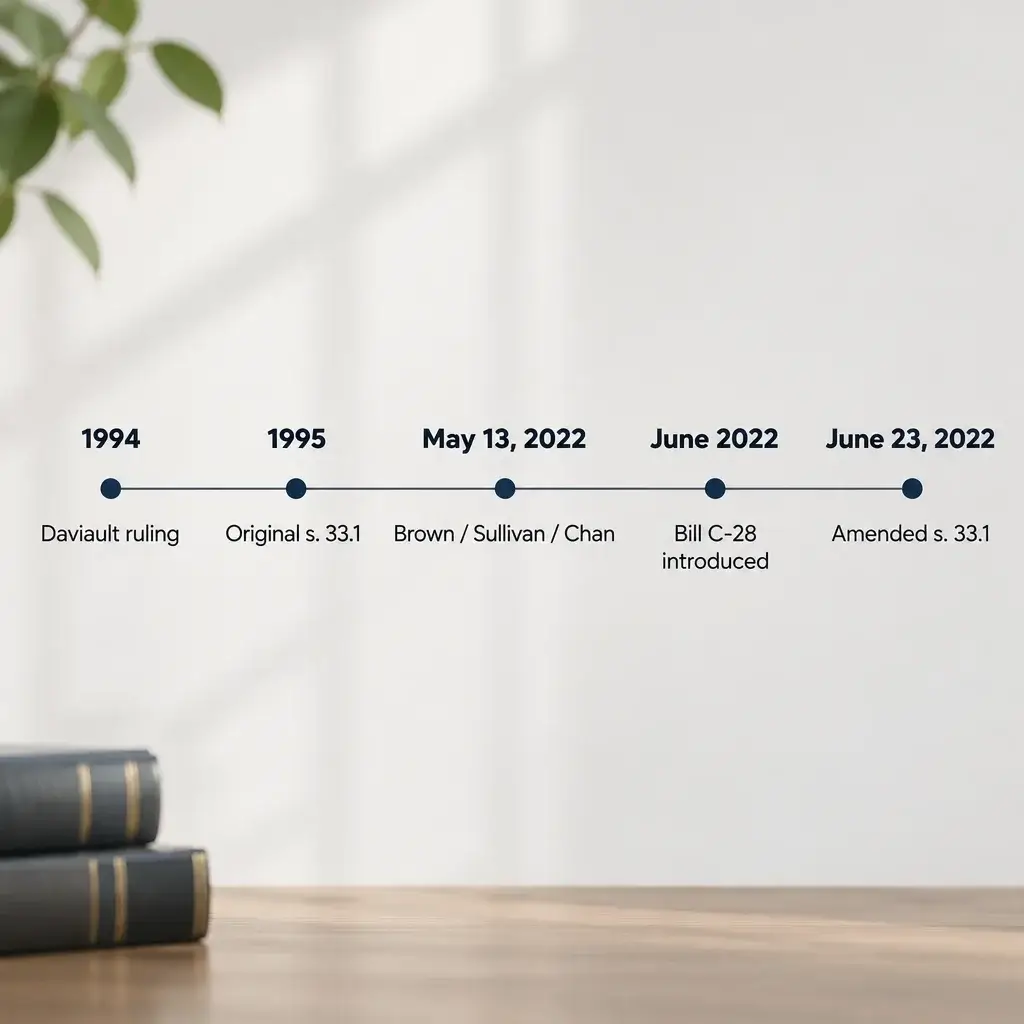
The legal timeline: Daviault, section 33.1, Brown, Sullivan and Chan, and Bill C-28
The modern timeline starts with R. v. Daviault in 1994 . In that case, the Supreme Court recognized that in very rare circumstances, extreme intoxication akin to automatism could be relevant to offences of general intent .
Parliament then enacted the original section 33.1 in 1995 . Its purpose was to block self-induced extreme intoxication as a defence for certain violent offences involving interference or threat of interference with another person’s bodily integrity .
The next major milestone came on May 13, 2022 when the Supreme Court released R. v. Brown, R. v. Sullivan, and R. v. Chan . Those decisions held the former section 33.1 unconstitutional .
Parliament responded almost immediately with Bill C-28, which was introduced in June 2022 and received royal assent on June 23, 2022 . That amendment rewrote section 33.1 to try to address the Charter defects identified by the Court .
Timeline at a glance
| Year / date | Event | Why it matters |
|---|---|---|
| 1994 | R. v. Daviault | Recognized a narrow route for extreme intoxication akin to automatism |
| 1995 | Original s. 33.1 enacted | Parliament restricted the defence for violent offences |
| May 13, 2022 | R. v. Brown and R. v. Sullivan; R. v. Chan | Supreme Court struck down the old law |
| June 2022 | Bill C-28 introduced | Fast legislative response to the Court’s ruling |
| June 23, 2022 | Bill C-28 received royal assent | New s. 33.1 came into force |
What the Supreme Court of Canada said in R. v. Brown and R. v. Sullivan and Chan
R. v. Brown Canada is the lead case on the constitutional issue. The Supreme Court held that the former section 33.1 could convict a person of a violent offence without requiring proof of the voluntary act and fault for that offence itself, which violated sections 7 and 11(d) of the Charter .
Brown matters because it did not say ordinary drunkenness is a defence. The Court dealt with the rare case of extreme intoxication akin to automatism and said Parliament had chosen an unconstitutional shortcut in the old section 33.1 .
In Sullivan and Chan, the Supreme Court Canada intoxication rulings addressed similar issues in two Ontario cases. The Court again concluded that the former section 33.1 could not stand, even though the factual paths in those prosecutions were different .
The short legal point from these cases is clear. The state cannot sidestep voluntariness and the required fault element for the violent offence by simply pointing to self-induced intoxication and stopping there .
Anyone looking for a quick Rv brown case brief should take away four points. The issue was constitutionality, the holding was that the old section 33.1 was invalid, the reasoning turned on Charter sections 7 and 11(d), and the practical result was a new legislative response through Bill C-28 .
Why the old section 33.1 was struck down
The former section 33.1 was struck down because it allowed conviction without proper proof of the essential elements of the violent offence. In plain English, the law treated the earlier choice to consume intoxicants as enough to substitute for the voluntary act and mental fault usually required for the offence charged .
Section 7 of the Charter protects against conviction contrary to basic principles of fundamental justice, and section 11(d) protects the presumption of innocence . The Supreme Court held the old law offended both because it let the Crown secure conviction without proving the accused voluntarily committed the prohibited act with the required level of fault for that offence .
A short worked example shows the problem. If the offence charged is assault, the criminal law normally requires proof that the accused applied force intentionally, directly or indirectly, without consent . The old section 33.1 let the law bypass that analysis once self-induced extreme intoxication was in play .
That constitutional defect created immediate pressure for Parliament to respond. The legal system still had to balance Charter protections for the accused with public protection in violent cases, especially those involving women and children .
How section 33.1 works now after Bill C-28
The current S 33.1 Criminal Code does not simply ban the defence across the board. It tries to impose liability where the accused departed markedly from the standard of reasonable care by consuming intoxicants in circumstances where the risk of extreme loss of control and resulting harm was reasonably foreseeable .
The new law focuses on criminal negligence rather than using intoxication alone as a substitute for guilt. That is the key change after Bill C-28 and the core answer to how extreme intoxication Canada law works today .
The foreseeability inquiry is objective. The court asks what a reasonable person in the accused’s circumstances would have foreseen about the risk created by consuming the intoxicant, not what the accused later says they personally expected .
The statutory language also ties the risk to harm to another person. Parliament’s amendment uses the concept of bodily harm that is not trivial or transitory in the negligence analysis tied to section 33.1 .
Your result still depends on the evidence and on how courts interpret the amended section in later cases. I would not treat any summary online as a substitute for reviewing the current statutory text, the latest appellate decisions, and the full evidentiary record in the case .
Old vs. new section 33.1: side-by-side comparison
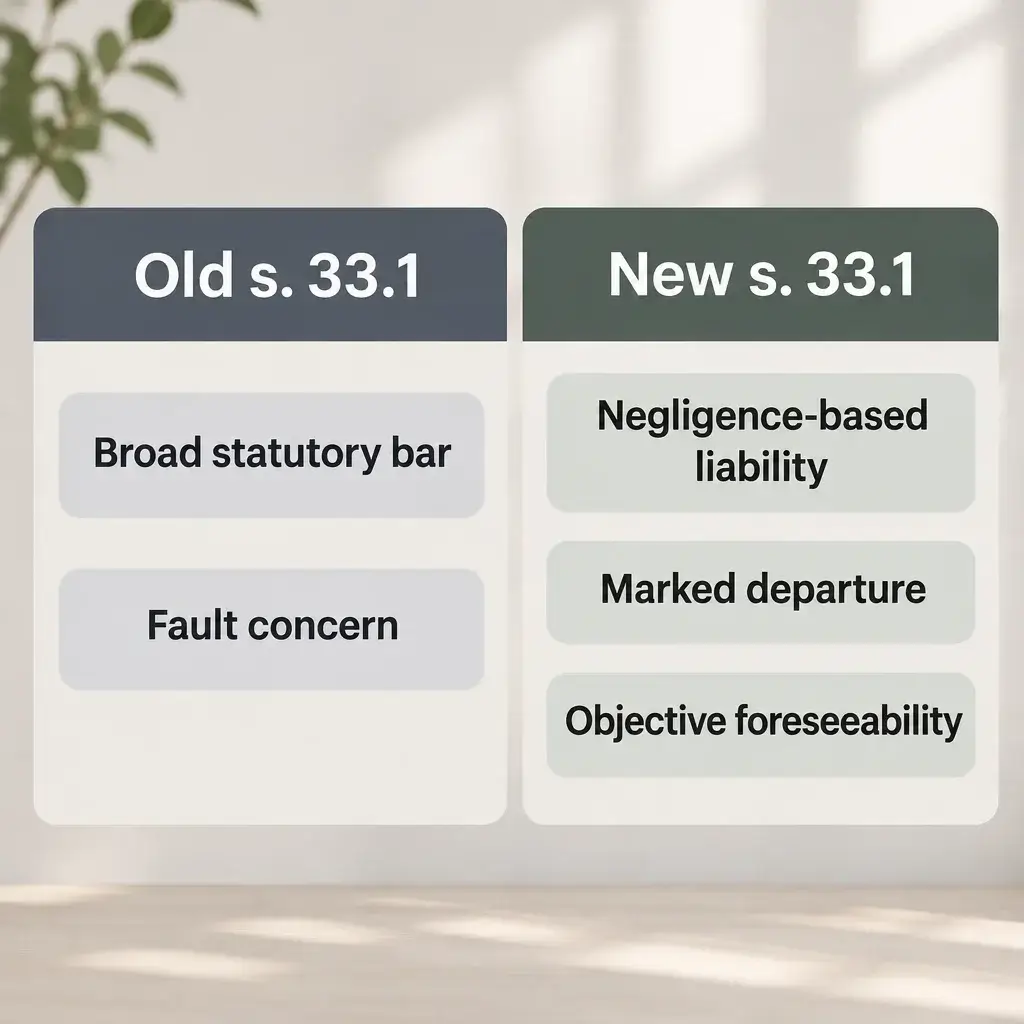
The old and new versions of section 33.1 share the same policy target but use different legal routes. The old version broadly blocked the defence; the new version tries to ground liability in a negligence-based foreseeability analysis .
| Feature | Old s. 33.1 | New s. 33.1 after Bill C-28 | Why it matters |
|---|---|---|---|
| Basic approach | Broad statutory bar on the defence in covered violent offences | Negligence-based liability tied to foreseeable risk from consuming intoxicants | Parliament tried to cure the Charter problem |
| Fault logic | Earlier consumption effectively substituted for fault on the offence | Focus shifts to marked departure and objective foreseeability | Designed to avoid conviction without proper fault analysis |
| Voluntariness concern | Did not adequately preserve voluntariness principles | Responds to the Supreme Court’s concern in Brown | Central Charter issue |
| Foreseeability | Not the core structure of the old provision | Reasonable foreseeability is central | Makes the analysis evidence-heavy |
| Charter status | Struck down in 2022 | Current law in force since June 23, 2022 | This is the operative provision now |
| Practical effect | Easier statutory path to conviction, but unconstitutional | Narrower and more technical litigation under negligence principles | More room for expert and factual disputes |
What must be proven: burden of proof and expert evidence

Extreme intoxication claims are rare and evidence-heavy. In practice, they usually require expert evidence linking the substance use to a state akin to automatism, because self-report alone is rarely enough to establish loss of voluntariness .
Courts commonly look for toxicology, pharmacology, psychiatry, or other specialized evidence about what was taken, when it was taken, in what amount, and how that substance can affect behavior and awareness .
The burden issue has two layers. The accused must usually point to evidence capable of supporting the defence, and the trier of fact then assesses the whole record under the current law, including section 33.1 where it applies .
The safest plain-English point is this. No one should assume a memory gap proves extreme intoxication, and no one should assume saying “I blacked out” resolves the issue, because the legal question is loss of voluntary control supported by reliable evidence .
Courts may reject evidence that is too thin, too speculative, or disconnected from the alleged automatism. Weak points often include vague self-reporting, missing timing evidence, no reliable dosage history, and no expert explanation connecting the intoxicant to the claimed state .
Observed behavior can cut both ways. Evidence that a person moved purposefully, spoke coherently, hid evidence, fled, or responded to events may be argued against automatism, though the significance of any conduct depends on the full context and the expert record .
Does alcohol alone count? What about drugs, prescribed medication, and mixed substances?
Alcohol alone is a difficult basis for an extreme intoxication claim. Canadian courts have long treated the doctrine as exceptional, and the closer the facts look to ordinary drunkenness, the less likely the evidence will support a state akin to automatism .
Drugs or mixed substances can raise different evidentiary issues because potency, interaction, dosage, and known side effects may be more complex. That does not make the defence easy, but it changes what experts may need to explain about mechanism and foreseeability .
Prescribed medication can also raise distinct issues. A case may involve self-induced consumption, a medication reaction, or a combination of prescribed and non-prescribed substances, and those paths are not legally identical .
Involuntary intoxication is different from self-induced extreme intoxication. If a person unknowingly ingests a substance, is drugged without consent, or has an unexpected reaction in circumstances that were not self-induced, section 33.1 may not frame the issue in the same way .
That is why involuntary intoxication should not be collapsed into the same box as the self-induced intoxication defence. The legal questions change depending on whether the intoxication was chosen, foreseeable, or imposed from outside .
What charges are involved: assault, sexual assault, manslaughter, and impaired driving
The doctrine is most often discussed in relation to violent general-intent offences such as assault and sexual assault. Those offences sit close to the policy concern that drove both the original section 33.1 and Bill C-28 .
Extreme intoxication may also be argued in cases involving very serious violence, but the availability of the argument depends on the offence structure, the facts, and the current case law. No serious charge should be analyzed from headlines alone .
Manslaughter needs careful treatment because it sits at the edge of debates about unlawful act offences, fault, and intoxication doctrine. Anyone dealing with that issue should read current appellate authority closely rather than relying on one-line summaries .
Impaired driving is not the usual home of this doctrine. Impaired driving offences have their own statutory framework, and this page is mainly about violent-offence litigation around automatism-like intoxication, not the separate law of operating a conveyance while impaired .
Public intoxication Canada searches usually point to a different legal problem altogether. Public intoxication is commonly dealt with under provincial or municipal rules, not as the same issue as the extreme intoxication defence in a violent Criminal Code prosecution .
How foreseeability and criminal negligence are tested in practice
Foreseeability under the new law is not a gut feeling test. The court looks at whether a reasonable person in the accused’s circumstances would have foreseen the risk created by consuming the intoxicant and the risk of causing bodily harm while in a state of extreme intoxication .
Criminal negligence in this context means a marked departure from the standard of care of a reasonable person. That is a serious fault standard, not mere carelessness or bad judgment .
Known potency can matter. If a person consumes a substance with strong warnings, uncertain composition, or a known risk of severe behavioral effects, the Crown may argue foreseeability is easier to establish .
Prior adverse reactions can matter too. If someone previously had a dangerous reaction to the same drug or combination, that history may be relevant to what a reasonable person in those circumstances would have foreseen .
Mixing substances can also matter because interactions may increase unpredictability and risk. A court may consider evidence about dosage, timing, prior experience, and whether warnings were ignored .
A useful illustration is the difference between an unexpected reaction to a prescribed dose taken as directed and a deliberate choice to combine large amounts of intoxicants despite known risks. Those examples do not decide any case, but they show why foreseeability is fact-specific and evidence-driven .
Extreme intoxication, automatism, and NCRMD: what is the difference?
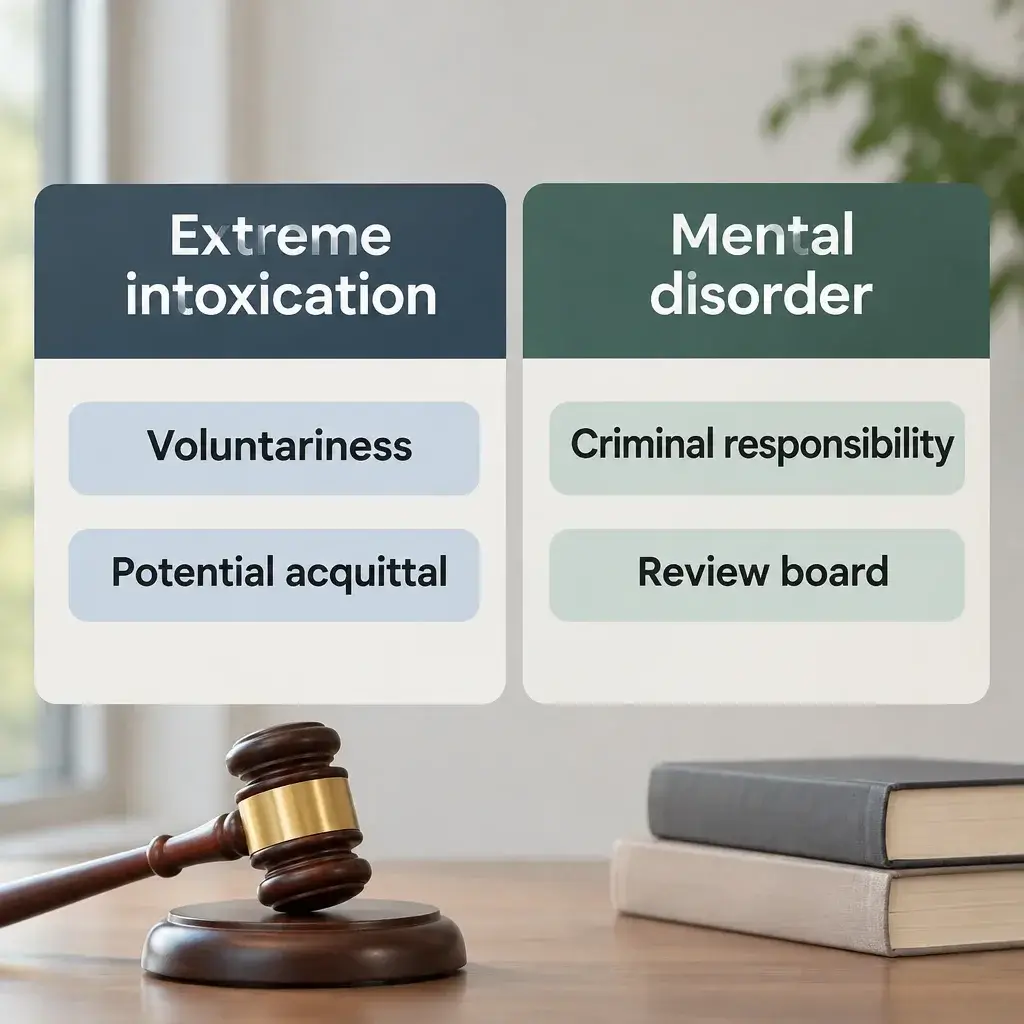
Automatism is a legal concept about involuntary action. A person in automatism is said to be acting without conscious voluntary control, which is why extreme intoxication is often described as a state akin to automatism .
NCRMD, short for not criminally responsible on account of mental disorder, is different because it deals with a mental disorder recognized by law, not simply intoxication. The source of the condition is a major dividing line between these doctrines .
The practical consequences can also differ. Non-mental-disorder automatism may lead to an acquittal if established and not blocked by section 33.1, while NCRMD can lead to review board jurisdiction rather than a standard conviction or acquittal outcome .
Automatism vs. NCRMD
| Issue | Extreme intoxication / automatism-like claim | NCRMD |
|---|---|---|
| Source of condition | Intoxication said to produce a state akin to automatism | Mental disorder within the legal test |
| Core issue | Voluntariness and awareness | Capacity and criminal responsibility due to mental disorder |
| Main legal conflict | Whether section 33.1 blocks the defence and whether automatism is proven | Whether the NCRMD standard is met |
| Typical consequence if successful | May result in acquittal where the defence is legally available | May result in NCRMD finding and review board oversight |
How a case is litigated when extreme intoxication is raised
The litigation usually starts like any other serious charge, with arrest or summons, release or bail, and disclosure from the Crown. From there, the file becomes expert-driven very quickly if intoxication or automatism may be in issue .
The defence will want early disclosure about witness observations, video, medical records, statements, toxicology, and scene evidence because those details may support or undermine voluntariness, timing, and substance use .
Expert retention is often the next major step. The defence may consult toxicologists, psychiatrists, pharmacologists, or other specialists to assess whether the available science can support a state akin to automatism and address foreseeability under the amended section 33.1 .
Pre-trial litigation can follow if expert admissibility, disclosure gaps, Charter issues, or the legal availability of the defence must be argued before the trial proper. Procedure varies by province and by whether the case is judge-alone or jury .
At trial, the dispute is usually sharpest around three points. First, whether the accused was truly in an automatism-like state; second, whether the evidence is scientifically reliable; and third, whether section 33.1 still imposes liability through the criminal-negligence pathway .
If there is a jury, the instructions matter a great deal because the trier of fact must understand the difference between ordinary intoxication and extreme intoxication, and how the statutory negligence analysis fits into the verdict path .
If the defence succeeds and is legally available, the result may be an acquittal rather than a reduced conviction. If the Crown or defence believes the trial judge made an error of law, either side may have appeal rights depending on the posture of the case .
Gender-based violence, survivor concerns, and the policy debate
The policy debate is intense because these cases often arise in the context of violence against women and children. Survivor advocates have argued that any room for the defence may deepen trauma, create public confusion, and undermine confidence in the justice system .
Constitutional and defence-side arguments focus on a different principle. They say the criminal law cannot convict a person of a violent offence without proof that meets Charter standards on voluntariness, fault, and the presumption of innocence .
Bill C-28 was Parliament’s attempt to respond to both concerns at once. It aimed to preserve accountability in dangerous self-induced intoxication cases while avoiding the constitutional flaw found by the Supreme Court of Canada intoxication rulings in Brown, Sullivan, and Chan .
The result is a law that remains contested. Supporters say it better protects the public; critics say the amended wording will still generate difficult constitutional and evidentiary disputes .
FAQ
What is the intoxication defense in Canada?
There is no broad intoxication defence that excuses crime in general. The narrow issue is whether intoxication was so extreme that it created a state akin to automatism, and section 33.1 now limits that argument in violent cases .
Is intoxication a full defense in Canada?
No. Ordinary drunkenness or being high is not a full defence to violent crime, and even extreme intoxication is only potentially relevant in rare cases with strict legal and evidentiary limits .
Can being drunk be a defence to assault or sexual assault?
Ordinary intoxication is not a defence to assault or sexual assault. The only narrow debate is over extreme intoxication akin to automatism, and even that is heavily constrained by section 33.1 after Bill C-28 .
What did the Supreme Court decide in R. v. Brown?
The Court held the former section 33.1 unconstitutional because it allowed conviction without proper proof of voluntariness and fault for the violent offence itself, contrary to sections 7 and 11(d) of the Charter .
When was Bill C-28 passed?
Bill C-28 received royal assent on June 23, 2022 .
What was the outcome of R. v. Daviault?
The Supreme Court recognized in 1994 that in rare cases of extreme intoxication akin to automatism, intoxication could be relevant even to a general-intent offence .
Does alcohol alone ever amount to extreme intoxication?
It is a difficult argument and not the same as ordinary drunkenness. The doctrine is exceptional, and courts require evidence of an automatism-like state, not just proof of heavy drinking or memory loss .
Who has to prove extreme intoxication in court?
The exact burden framework depends on the stage of the case and the issue being decided, but the claim is evidence-heavy and usually requires reliable expert support. No one should assume the defence can be raised successfully on self-report alone .
Can extreme intoxication apply to impaired driving charges?
That is not the usual framework. Impaired driving has its own statutory structure, and the extreme intoxication doctrine is mainly discussed in relation to violent offences involving bodily integrity .
What is the difference between involuntary intoxication and self-induced extreme intoxication?
Involuntary intoxication means the person did not choose the substance use in the relevant sense, such as being drugged unknowingly. Self-induced extreme intoxication involves voluntary consumption and engages section 33.1 in a different way .
What happens if the defence succeeds?
Where the defence is legally available and established, the result may be an acquittal. That is different from NCRMD, which can lead to review board consequences rather than a standard acquittal .
Is public intoxication the same issue as the extreme intoxication defence?
No. Public intoxication is generally a separate provincial or municipal issue, while extreme intoxication is a narrow Criminal Code doctrine about voluntariness, fault, and section 33.1 .
Key takeaways
- Extreme intoxication in Canada is a rare doctrine, not a general excuse for crime .
- Ordinary drunkenness, being high, blackout evidence, or poor memory do not equal automatism .
- R. v. Daviault opened the narrow doctrine in 1994, and Parliament responded with section 33.1 in 1995 .
- The Supreme court of canada intoxication cases in May 2022 struck down the old section 33.1 as unconstitutional .
- Bill C-28 became law on June 23, 2022 and rewrote section 33.1 around criminal negligence and foreseeability .
- These cases turn on expert evidence, statutory interpretation, and careful factual analysis, not slogans about intoxication .
If intoxication, automatism, or section 33.1 may matter in a real case, speak with a criminal defence lawyer quickly so disclosure, medical records, and expert issues can be assessed early. That matters more than any headline summary or Rv daviault case summary you find online.