

 Based on 116 Verified Google Reviews

Most people searching can you go to jail for assault want one straight answer. Yes. Assault can lead to jail in Canada, but jail risk depends on the exact charge, the injuries, any weapon, your record, the relationship between the people involved, and how strong the evidence is.
If you have been charged, get legal advice early. A guilty plea, a no-contact breach, or one bad text can change the case fast. This is general information, not legal advice for your situation.
Direct answer: can you go to jail for assault in Canada?
Yes, you can go to jail for assault in Canada. Assault under the Criminal Code can be prosecuted in several forms, from basic assault under s. 266 to aggravated assault under s. 268, and the charge type drives the sentencing range and the custody risk .
A first offence does not automatically mean jail. In lower-level common assault cases with no injury, no weapon, no prior record, and no breach of release, non-custodial outcomes can be legally available, but nobody should assume jail is off the table .
The biggest mistake is treating every assault charge the same. A shove in an argument, an assault with a weapon, a domestic allegation with visible injury, and an aggravated assault are all prosecuted very differently because the Crown and the court will focus on harm, risk, background, and public safety .
Assault jail time in Canada: quick comparison table by charge
The maximum sentence tells you the legal ceiling, not the likely outcome. In Canada, many assault offences are hybrid, which means the Crown can choose summary or indictable procedure, and that election affects the maximum penalty .
| Charge | Code section | Plain-English meaning | Crown election | Maximum penalty | Non-jail outcomes sometimes possible | Custody risk |
|---|---|---|---|---|---|---|
| Assault | s. 266 | Intentional force without consent, or threat/attempt by act or gesture | Hybrid | Up to 2 years less a day on summary, or up to 5 years on indictment | Yes, depending on facts | Lower to moderate |
| Assault with a weapon or causing bodily harm | s. 267 | Assault involving a weapon, imitation weapon, or bodily harm | Hybrid | Up to 2 years less a day on summary, or up to 10 years on indictment | Sometimes, in lower-end cases | Moderate to high |
| Aggravated assault | s. 268 | Wounding, maiming, disfiguring, or endangering life | Indictable | Up to 14 years | Rare compared with lower assault charges | High |
| Assaulting a peace officer | s. 270 | Assault against a peace officer engaged in duties | Hybrid | Up to 2 years less a day on summary, or up to 5 years on indictment | Sometimes, fact-specific | Moderate to high |
| Sexual assault | s. 271 | Assault of a sexual nature | Hybrid | Maximum varies by mode and circumstances; legal advice is urgent because related provisions can change exposure | Sometimes, but highly fact-specific | Moderate to very high |
| Domestic assault | Usually charged under existing assault sections | Assault in an intimate-partner context | Depends on underlying charge | Depends on underlying charge | Sometimes, but release terms are often stricter | Moderate to high |
People also search assault how many years in jail, assault how long in jail, or aggravated assault how much jail time. The right answer is that maximums are fixed by statute, but actual sentences turn on the facts, the offender, the injuries, the evidence, and the sentencing principles the judge must apply .
What counts as assault in Canada?

Assault in Canada is broader than most people think. Section 265 includes intentionally applying force without consent, attempting or threatening by an act or gesture to apply force if the other person has reasonable grounds to believe you can carry it out, and in some situations accosting or impeding someone while openly carrying a weapon .
Physical injury is not required for every assault charge. A push, grab, slap, attempted punch, or threatening movement can be enough if the Crown can prove the legal elements beyond a reasonable doubt .
Words alone are usually not enough by themselves. Words combined with conduct, movement, gesture, proximity, or present ability can support an assault allegation because the law looks at whether the other person reasonably believed force would follow .
Evidence in assault cases usually comes from several sources, not one checklist. Police and Crown may rely on complainant statements, witness statements, 911 recordings, body-worn camera, surveillance video, text messages, photos, medical records, and statements by the accused .
The lowest assault charge: common or simple assault
The lowest general assault charge is usually what people call common assault or simple assault. In Canadian charging language, that is usually just assault under s. 266 of the Criminal Code .
Simple assault Canada searches usually mean lower-level force or threat cases. Common examples are a shove, slap, wrist grab, drink thrown with force, attempted punch that misses, or a threat-plus-gesture incident where no injury is proved .
Even a low-level assault charge can become more serious fast. Prior convictions, allegations involving an intimate partner, release breaches, a vulnerable complainant, or damaging messages after the event can all push the case toward harsher bail terms or harsher sentencing positions .
Simple assault vs assault with a weapon vs bodily harm vs aggravated assault
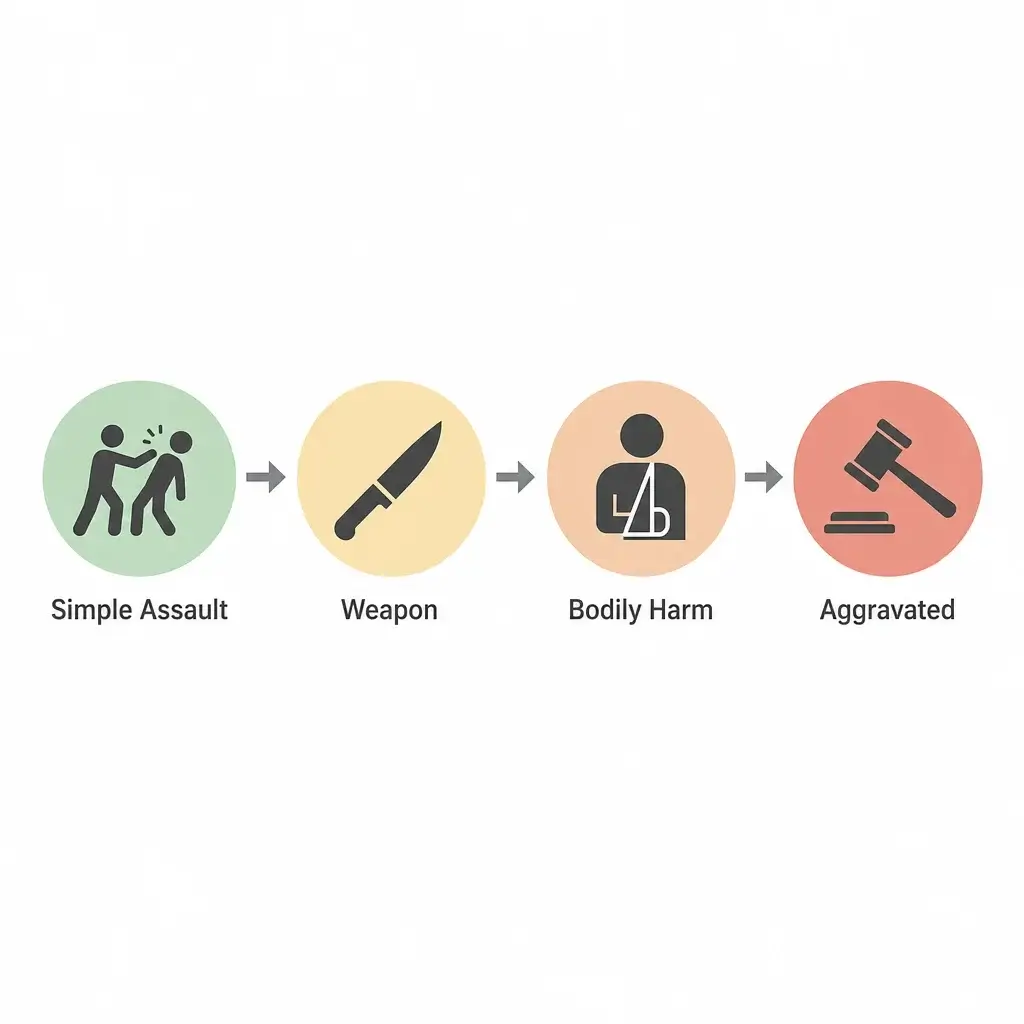
The legal difference comes down to force, harm, and danger. Basic assault covers non-consensual force or threat-based conduct, assault with a weapon adds a weapon or imitation weapon, assault causing bodily harm adds injury, and aggravated assault covers wounding, maiming, disfiguring, or endangering life .
Bodily harm is a technical legal term, not just any discomfort. In Canadian criminal law, it generally means injury that interferes with health or comfort and is more than merely transient or trifling .
Aggravated assault is much more serious than simple assault. The label applies where the injuries or danger reach the highest level in the ordinary assault framework, which is why can you go to jail for aggravated assault gets a much more urgent answer than can I go to jail for simple assault .
Police language does not decide the final result. The Crown, the defence, and the court will focus on what can actually be proved about the act, the injuries, the weapon, and the context .
Will a first-time assault charge lead to jail?
A first-time assault charge in Canada does not automatically lead to jail. For lower-level common assault with no injury, no weapon, no prior record, and no breach, outcomes such as withdrawal, peace bond, discharge, probation, or a fine may be possible depending on the province, the facts, and the Crown position .
A first-time offender can still go to jail. That risk rises sharply if the allegation involves serious injury, a weapon, strangulation allegations, a child, a vulnerable complainant, a peace officer, intimate-partner violence, or a breach of release .
The facts that usually reduce jail risk are concrete and practical. They include no criminal record, no prior violence, no release breach, minor or no injury, stable employment, counselling steps, supportive references, early legal representation, and weaknesses in the Crown’s proof .
The facts that usually increase jail risk are just as concrete. They include a prior record, prior domestic history, visible injuries, weapon use, threatening post-incident texts, alcohol or drug-fuelled violence, witness corroboration, video evidence, and non-compliance with bail or release conditions .
If you are searching can you go to jail for first time assault or do first-time offenders go to jail in Canada, the honest answer is this: sometimes yes, often no in lower-level cases, but nobody can predict your result without the disclosure, your record, and the full facts .
Likely outcomes by real-life scenario
A bar fight case often turns on video, intoxication evidence, and who started what. Where there is a punch, minor injury, and no weapon, the charge may stay at simple assault or move to bodily harm if the injuries are medically significant .
A mutual fight does not automatically cancel the case. Canadian assault law still asks whether each use of force was unlawful, whether consent applies in that setting, and whether one person went beyond what the law permits .
A domestic argument with no visible injury can still lead to a criminal charge and strict no-contact terms. Domestic assault is usually prosecuted under the regular assault sections, but intimate-partner context often makes release, housing, and parenting issues much harder .
A domestic allegation with visible injury carries more custody risk because the evidence usually broadens. Photos, medical notes, neighbour observations, 911 audio, child witnesses, and prior messages often become central in those files .
A threat-only incident can still produce an assault charge if there was an act or gesture and a present ability to carry it out. If the allegation is words alone with no physical movement or surrounding conduct, the Crown may face a harder proof case .
An assault on a peace officer is treated more seriously because of the victim’s role and the public-interest concerns. Even where the facts are disputed, those files usually need legal advice early because release terms, Crown positions, and sentencing submissions can be tougher .
A school, youth, or minor-related allegation can become more serious because vulnerability matters at sentencing. The Criminal Code does not create one simple rule for how much jail time for assault on a minor, but age and vulnerability can be aggravating factors .
A weapon displayed but not used can still support a more serious charge if it was part of the assaultive conduct. A bottle, knife, tool, or imitation firearm can change both the charge and the risk analysis even without major physical injury .
What happens after you are charged with assault?

The process usually starts with arrest, release, or a summons. From there, the case moves to first appearance, disclosure, possible election if the charge is hybrid, negotiation, motions, trial or plea, and then sentencing if there is a finding of guilt or a guilty plea .
A no-contact order means exactly that. Texting the complainant, messaging through friends, or asking someone else to pass along an apology can create new criminal exposure because breaching release conditions is its own serious problem .
You should not try to get the complainant to recant or drop the case. In Canada, the Crown controls the prosecution, and contact about the allegations can damage bail, create fresh evidence, or lead to witness-interference concerns .
A guilty plea has immediate legal consequences. It can affect your criminal record, immigration status, travel, employment, professional licensing, family court positions, and the sentence you face, so it should never be rushed just to end the stress .
What to do in the first 24 hours after an assault charge

Follow every release condition exactly as written. If the paper says no contact, no attendance, or stay away from an address, that is the rule until a court changes it .
Preserve evidence right away because some evidence disappears fast. Screenshots, call logs, ride-share receipts, GPS data, photos, witness names, and timeline notes can all matter, and some private businesses overwrite surveillance within days or weeks depending on their system .
Do not delete messages or post about the case online. Deletions can look bad, and posts, comments, or apology messages can become Crown evidence even when they were written in panic .
Write down your own account while memory is fresh and keep it for your lawyer. Details like timing, lighting, distance, injuries, witness locations, and who said what first are often much clearer in the first 24 hours than months later .
Urgent legal help matters even more if the case involves domestic allegations, immigration consequences, weapons, serious injury, police complainants, a prior record, or any alleged breach. Those facts can change bail risk, trial strategy, and plea options very early .
Can assault charges be dropped in Canada?
A complainant cannot personally drop a criminal assault charge. In Canada, the Crown decides whether the prosecution continues, resolves, or is withdrawn .
A complainant’s wishes can still matter, but they are not decisive. The Crown may continue despite a recantation if there is other evidence, public-interest concerns, or reliability concerns about the change in story .
Charges can be withdrawn or reduced for legal reasons, not just personal preference. Weak identification, inconsistent statements, self-defence evidence, lack of intent, missing witnesses, Charter issues, or poor prospects of conviction can all affect the Crown decision .
Evidence quality is usually the turning point. Where the only proof is one account with major contradictions and no supporting evidence, the defence may have more room than in a case with video, admissions, injuries, and neutral witnesses .
What evidence is needed for assault?
There is no fixed checklist of evidence required for an assault conviction. The Crown must prove the offence beyond a reasonable doubt, and some cases turn almost entirely on credibility and reliability .
A complainant’s evidence alone can sometimes be enough if the judge believes it beyond a reasonable doubt. Canadian criminal law does not require video, medical records, or independent witnesses in every assault case .
Independent evidence can still change everything. Video, neutral witnesses, medical records, scene photos, 911 calls, timestamps, and admissions often make a case much stronger or much weaker .
Your own messages can become key evidence very quickly. Apologies, angry follow-up texts, voice notes, deleted-message patterns, and social media posts are common exhibits in assault prosecutions .
People searching what evidence is needed for assault or even what evidence is needed for a battery are usually looking for certainty. The real answer is that the court weighs all the evidence together, and one strong piece can matter more than ten weak ones .
Best defences to an assault charge
The best defence depends on the facts, not the internet label on the charge. Common defence themes include self-defence, defence of another, identity, accident, lack of intent, consent in limited circumstances, credibility problems, motive to lie, and Charter issues .
Self-defence can apply where force was used for protection and the response was legally reasonable in the circumstances. The court looks at the surrounding facts, including the threat, size difference, history, weapons, and whether there were alternatives .
Identity is often a real issue in chaotic cases. Poor lighting, intoxication, cross-complaints, crowded scenes, and delayed reporting can all weaken identification evidence .
Threat-based assault cases can fail if the Crown cannot prove present ability or a reasonable fear that force would follow. That is one reason why words alone are not always enough .
Charter issues can matter where police statements, searches, detention, or access-to-counsel problems affect the admissibility of evidence. Those arguments are highly fact-specific and should never be assumed from online summaries .
Bail, release conditions, and no-contact orders

Not every charged person goes to a bail hearing. Some people are released by police with conditions, while others are held for a judicial interim release hearing because the police oppose release or the case raises greater concerns .
Common assault release conditions often include no contact, no attendance at a home or workplace, weapons prohibitions, reporting terms, and sometimes counselling or sobriety-related terms. Domestic files often carry stricter residence and communication limits .
A release condition can be as important as the charge itself in day-to-day life. It can affect where you live, whether you can see your children, how you work, and whether a simple text creates a new criminal file .
Breaching release usually makes the case worse. Separate charges, a tougher bail position, and a worse sentencing picture are all real risks if a court finds non-compliance .
Can you avoid jail or avoid a criminal record?
Some assault cases can resolve without jail, and some can resolve without a conviction record. The possible paths may include withdrawal, stay, peace bond, discharge, conviction with probation or fine, conditional sentence where legally available, or jail .
A conviction for assault usually gives you a criminal record. A withdrawal, stay, or peace bond is different because those outcomes do not themselves create a conviction, though police records and court records can still exist .
A discharge can avoid a criminal conviction record, but it is not available in every case and should never be assumed. Courts look at whether a discharge is in the accused’s best interest and not contrary to the public interest .
A peace bond is often set for 12 months , but it is not the same as the charge being proven false. It is a recognizance-based resolution and may come with conditions even though it is not a criminal conviction .
Avoiding jail does not mean avoiding consequences. Even non-custodial outcomes can affect travel, immigration, work, professional licences, family matters, and reputation .
Fingerprints, mugshots, and record suspension after withdrawal or discharge
Being charged can create police records even without a conviction. Fingerprints, photographs, occurrence records, and court records may exist from the charge stage onward .
A withdrawal or discharge does not always mean automatic deletion of fingerprints and mugshots. Record-destruction and non-conviction removal practices vary by police service and agency, so people often need to make a request or application after the case ends .
A record suspension is different from non-conviction record removal. Record suspensions deal with convictions through the Parole Board of Canada, while withdrawn charges, stays, and discharges raise different police-record questions .
If record impact matters for work, border travel, or immigration, get advice on the exact outcome and the exact agency holding the record. The practical answer often depends on the police service, CPIC reporting, and the final disposition .
Domestic assault, sexual assault, minors, and peace officers: when assault gets treated more seriously
Domestic assault is usually not a separate Criminal Code offence. It is usually an assault charge under the regular sections, but intimate-partner context often affects release conditions, Crown policy, and sentencing positions .
Sexual assault cases carry different stigma, proof issues, and sentencing risk from ordinary assault files. They need immediate legal advice because the surrounding legal issues, evidence rules, and possible penalties can be much more serious .
Assaults involving children, vulnerable adults, or authority-related victims can be treated more seriously at sentencing because vulnerability and abuse of trust are recognized aggravating features in criminal law .
Assault on a peace officer usually brings higher practical jail risk than a routine common assault because the public-interest concerns and aggravating features tend to be stronger. That does not decide the result, but it changes the stakes early .
Assault vs battery in Canada
Battery is not the usual Canadian Criminal Code charge label. Canadian law generally uses assault, which is why people searching assault and battery time in jail or can you go to jail for assault and battery are usually looking for Canadian assault law .
U.S. websites often separate assault and battery, or use felony and misdemeanor language. That framework does not map neatly onto Canada, so American content can mislead Canadian readers about jail risk, records, and court process .
If you are comparing battery vs assault, the safe Canadian answer is simple. In Canada, start with the Criminal Code assault sections instead of U.S. battery articles .
Simple decision tree: how to estimate your custody risk
You can roughly sort assault cases by a few key facts. This is educational only, not a prediction of your own case .
Lower custody risk usually starts with common assault under s. 266, no injury, no weapon, no prior record, no breach, no domestic context, and meaningful defence issues or evidentiary weakness .
Moderate custody risk usually appears where there is bodily harm, a weapon allegation, a domestic history, stronger Crown evidence, prior non-violent record, or poor post-incident conduct like damaging texts .
Higher custody risk usually means aggravated assault, serious injuries, endangering life, a child or vulnerable complainant, a peace officer complainant, release breaches, or a significant violent record .
The fastest way to use this decision tree is to ask six factual questions. Was anyone injured. Was any weapon involved. Is this domestic. Is there a prior record. Is there a breach. Is there strong defence evidence like video or independent witnesses .
Glossary of assault terms
Assault, s. 266 means the basic offence of applying force without consent, or threatening or attempting force in the legal sense .
Bodily harm means an injury that is more than merely transient or trifling and interferes with health or comfort .
Aggravated assault means wounding, maiming, disfiguring, or endangering life under s. 268 .
Hybrid offence means the Crown can elect summary procedure or indictment, which affects maximum penalty and procedure .
Peace bond means a court order or recognizance with conditions, often used to resolve some cases without a conviction .
Discharge means a finding of guilt without a registered conviction, available only where the law and the facts permit .
No-contact order means you must not directly or indirectly communicate with the named person unless the order is changed .
FAQ
What is the lowest charge for assault in Canada?
The lowest general assault charge is usually common assault, often called simple assault, charged as assault under s. 266 .
Will I go to jail for first-time assault in Canada?
Not automatically. A first-time common assault case may resolve without jail, but serious facts, injuries, weapons, domestic context, or a prior record can still lead to custody .
Can assault charges be dropped in Canada?
The complainant cannot drop them personally. The Crown decides whether to continue, reduce, resolve, or withdraw the charge .
What is the most common punishment for assault?
There is no single standard sentence. Common assault can result in anything from withdrawal or a peace bond to probation, fine, discharge, or jail depending on the facts .
What is the punishment for simple assault in Canada?
Simple assault is still a criminal charge. The legal maximum is up to 2 years less a day on summary or up to 5 years on indictment , but many lower-level first-offence cases are argued on a non-custodial basis .
How long do you go to jail for aggravated assault in Canada?
Aggravated assault carries a maximum of 14 years . Actual jail time depends on the injuries, the circumstances, your record, and the sentencing findings in the case .
Does aggravated assault have a mandatory minimum?
Not every aggravated assault case has a mandatory minimum sentence. Minimums depend on the exact offence and circumstances, so this needs to be checked against the current charge and current law before anyone answers for a real case .
What is the best defence for assault?
There is no universal best defence. Self-defence, identity, credibility problems, accident, lack of intent, and Charter issues can all matter depending on the evidence .
What happens if I plead guilty to assault?
You move straight to a conviction or other formal resolution process, and the plea can affect record consequences, sentence, travel, immigration, and employment. Do not plead guilty just to get the case over with without legal advice .
Is battery more serious than assault in Canada?
Battery is not the standard Canadian Criminal Code label. Canadian readers should usually analyze the case under assault law instead of U.S. battery categories .
What is level 2 assault?
Level 2 assault is not standard Canadian Criminal Code language. People often mean assault causing bodily harm or assault with a weapon, but the real answer depends on the exact charge wording .
Is aggravated assault a felony in Canada?
Canada does not use felony and misdemeanor terminology. Aggravated assault is an indictable offence with a maximum of 14 years .
Does assault have a time limit in Canada?
Timing rules depend on whether the matter proceeds summarily or by indictment and on the exact procedural stage. Because limitation discussions are technical and charge-specific, get advice on the current law for the exact offence before relying on a deadline .
Jail is possible on any assault charge, but the real question is how your exact facts change the risk. Early legal advice can affect release conditions, evidence preservation, Crown negotiations, and record consequences. If you are charged with assault, domestic assault, assault with a weapon, or aggravated assault, get a confidential case review quickly rather than guessing from U.S. websites or message boards.