

 Based on 116 Verified Google Reviews


A new allegation can create jail risk before any trial. In a probation violation domestic assault situation, the problem is usually not just the new charge. It can also be an alleged breach of probation, and sometimes a breach of bail or another release order at the same time. This is general Canadian information, not legal advice on your case.
Early legal advice matters here because the wording of the order controls a lot. A criminal defence lawyer can review the probation order, any release conditions, the new allegation, and the next court date before you make the situation worse.
Quick answer: yes, a domestic assault allegation can put your probation at risk
Yes. A domestic assault allegation can put probation at risk if the alleged conduct would break a condition in the order, such as keep the peace and be of good behaviour, no contact, abstain from alcohol, stay away from an address, or report as directed .
Yes. A judge can order detention before any conviction if the arrest, release concerns, or alleged breaches justify it, and a bail hearing is typically held within 24 hours or as soon as feasible after arrest .
No. The allegation does not automatically prove the breach, revoke probation, or guarantee jail, because the result depends on the exact order, the facts, the record, and local Crown and court practice in Canada .
How a domestic assault allegation can affect probation in Canada
Probation is affected when the alleged incident matches conduct prohibited by the order. In domestic assault Canada cases, that often means the Crown says the new allegation shows you failed to keep the peace and be of good behaviour, or that you also broke a no-contact, residence, abstinence, curfew, or counselling condition .
The wording of the order matters more than the label on the police paperwork. A person can face consequences tied to probation even while the new domestic violence charges Canada matter is still unresolved, because the court can look separately at whether an existing court order was obeyed .
Probation orders usually contain standard conditions and sometimes special ones. Common terms include report to probation as directed, notify about address or job changes, do not possess weapons, attend counselling, and avoid a named person or place .
New charge vs breach of probation vs breach of bail: what is the difference?
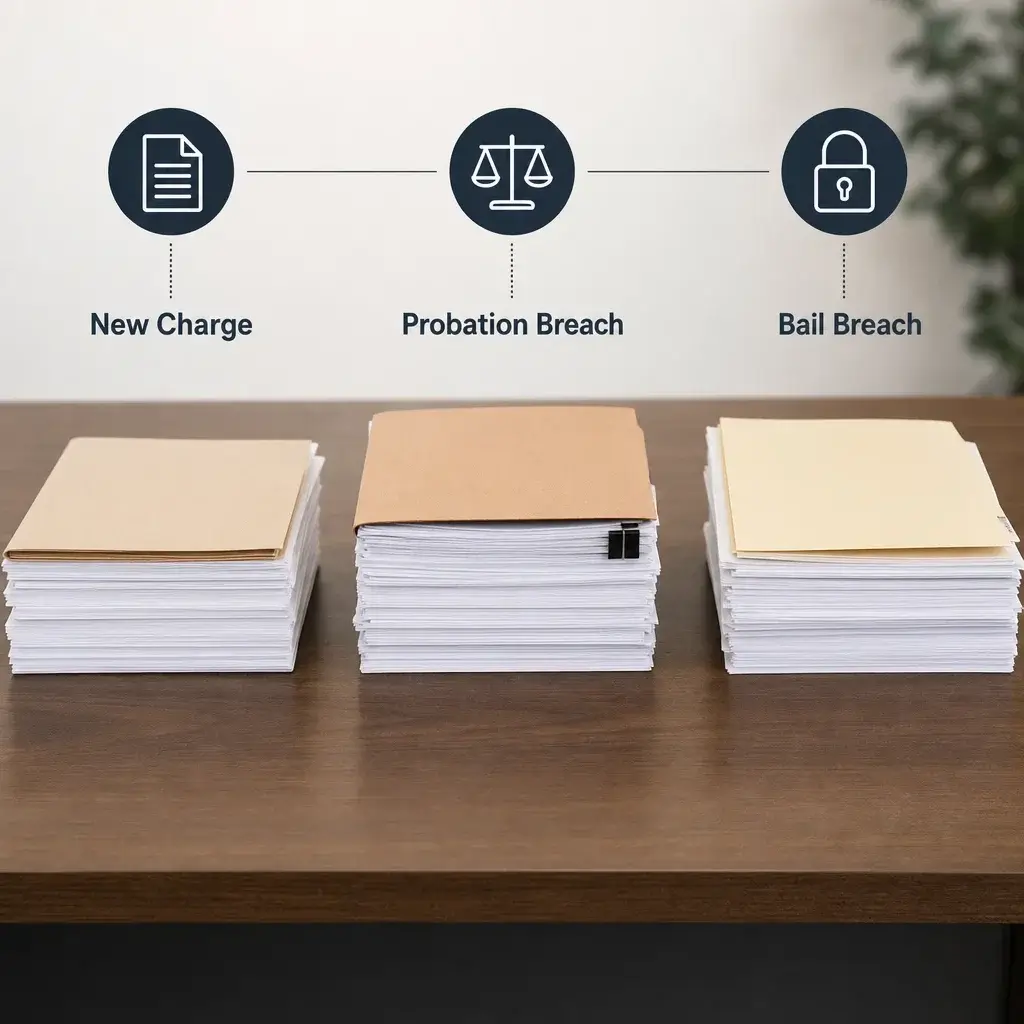
These are three different legal problems, even when they come from one incident. The new domestic assault allegation is the substantive offence claim, the breach of probation is the claim that you disobeyed a probation order already in force, and the breach of bail is the claim that you broke conditions in a release order, undertaking, or recognizance .
One event can trigger all three at once. If a person on probation has a no-contact term and an abstinence term, then allegedly attends the partner’s home after drinking, police may investigate domestic assault, allege breach of probation for contact or drinking, and allege breach of bail if similar release terms already existed .
| Issue | What it is | What must be shown | Why it matters |
|---|---|---|---|
| New domestic assault charge | A new criminal allegation tied to the incident | Evidence of the alleged assault offence | Can lead to bail conditions, trial, plea, or sentence if convicted |
| Breach of probation | Alleged failure to follow an existing probation order | Proof of the order, knowledge of it, and conduct said to break it | Can create separate criminal exposure and worsen release and sentencing risk |
| Breach of bail or release | Alleged failure to follow release terms on another matter | Proof of the release order and the alleged non-compliance | Can affect detention, future release, and credibility before the court |
What happens after arrest for domestic assault when you are already on probation

The process usually moves fast at the start. Police attend, investigate, ask for statements, decide whether to arrest or charge, review existing orders, and then either release the person with conditions or hold the person for a bail hearing, typically within 24 hours or as soon as feasible .
Being on probation can make release harder. The court may treat an alleged repeat of similar conduct, or any sign of non-compliance with earlier orders, as a reason to look more closely at public safety, attendance in court, and confidence in release conditions .
Domestic violence charges Ontario and other provinces often come with strict release terms. Common conditions include no contact with the complainant, no attendance at the home or workplace, weapons bans, curfew, abstinence, reporting, and limited exceptions for counsel or child arrangements if a court order allows them .
The complainant cannot override the order by text or phone. If a no-contact term exists, private consent from the other person does not cancel it, and answering a single message can still create a fresh allegation of breach .
Can you go to jail before being convicted?
Yes. Jail can happen before conviction through arrest, denial of release, or detention after an alleged breach, and that pre-trial detention is different from a final sentence after a finding of guilt .
No. A first-time domestic assault charge Canada case does not automatically lead to jail before trial or after trial, because courts still look at the actual allegation, injury, prior record, prior compliance, release plan, and the wording of existing orders .
Yes. Even without a conviction on the new allegation, the court can still focus on alleged non-compliance with probation or bail terms when deciding release, because obeying court orders is treated as a serious issue in Canadian criminal courts .
What evidence can be used to allege a probation violation?

The evidence can come from several sources, not just one witness. Police observations, 911 recordings, complainant statements, neighbour statements, photos, medical records, texts, social media messages, call logs, admissions, probation records, and proof that you attended a prohibited place can all matter .
The court will also look at the paperwork behind the order. The Crown usually needs the probation order itself and proof that the accused was bound by it, because the exact wording of the condition is central to any breach allegation .
Hearsay can become an issue in these proceedings, but the rules are not identical in every procedural setting. That is why the safer answer is practical: do not assume a weak statement will stay out, and have counsel review disclosure line by line before deciding how strong the breach case really is .
Digital evidence can matter more than people expect. Doorbell footage, ride-share receipts, GPS-style location records, timestamps, and screenshots may support or undermine claims about contact, attendance, drinking, or timing .
What standard of proof applies?
The criminal trial on a domestic assault Criminal Code charge uses proof beyond a reasonable doubt .
The analysis around alleged non-compliance can be more complicated than a trial standard stated in one sentence. In Canada, the exact procedural route matters, so you should not rely on U.S. terms like “preponderance of the evidence” when dealing with domestic violence Criminal Code Canada issues or alleged probation breaches .
The practical point is this: the new charge, the bail decision, and any breach-related consequences do not all work the same way. A lawyer needs to identify which hearing is happening, what order is in force, what proof rules apply there, and what the Crown is actually asking the court to do .
Step-by-step: how probation consequences unfold after a new domestic assault allegation

The sequence usually starts the same day as the allegation. Police investigate the incident, check CPIC or court records for probation and bail terms, and decide whether the facts support one or more new charges or breach allegations .
The release issue usually comes next. The accused may be released by police on conditions or held for a bail hearing within 24 hours or as soon as feasible, and being on probation can affect how strict those conditions are .
The first court date follows quickly, then the disclosure process begins over the next days or weeks. Disclosure can include officer notes, statements, photographs, recordings, and copies of the probation or release orders the Crown says were breached .
Defence work often starts before any trial date is set. Counsel can review the wording of every order, test whether contact was truly prohibited, examine whether identity or timing is in dispute, and look at whether a variation application is needed for parenting, housing, or communication issues .
Resolution usually takes weeks or months, not days. The case may move toward a bail variation, negotiations, a peace bond discussion where legally available, trial, plea, or another outcome depending on the evidence and the local Crown position .
Common probation and bail conditions that overlap in domestic assault cases
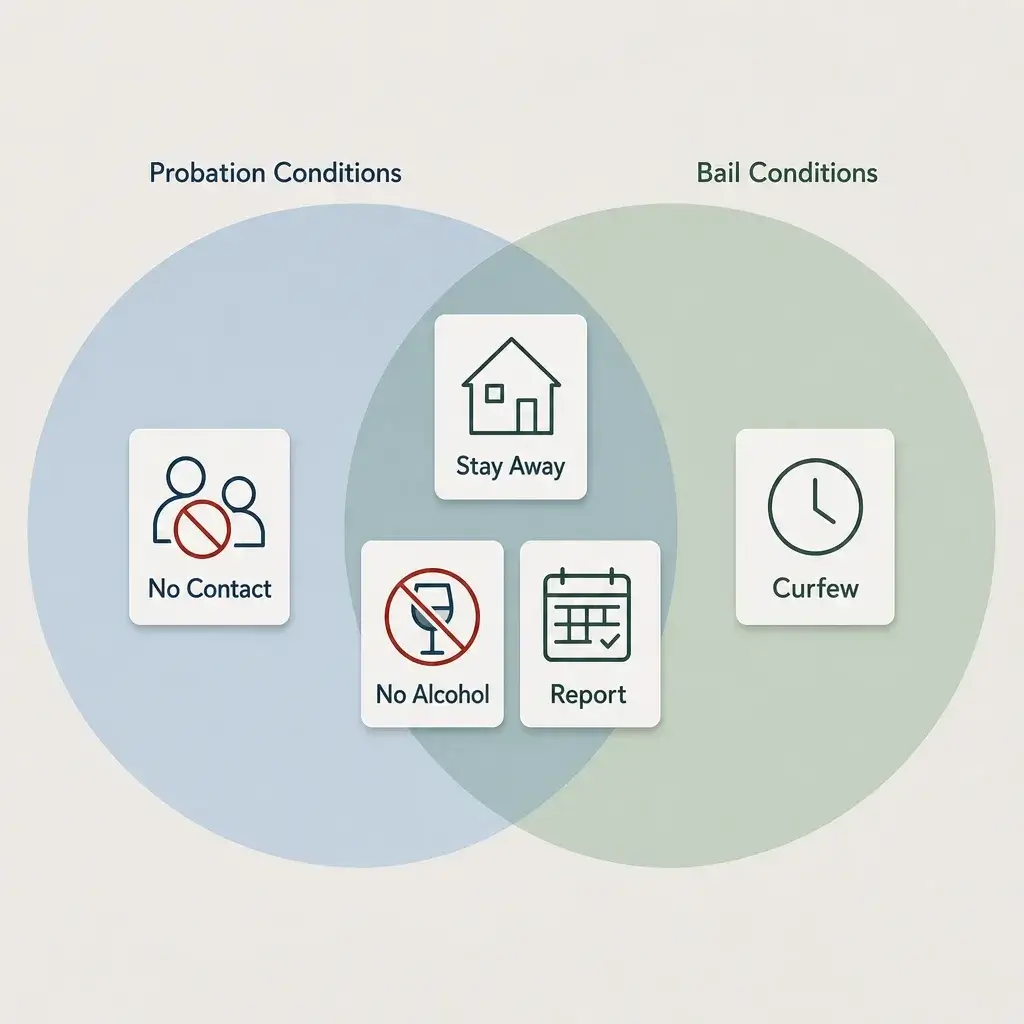
The overlap is where people get into the most trouble. Common terms in domestic violence charges Canada matters include no contact, stay away from the home, stay away from work, do not possess weapons, abstain from alcohol or drugs, keep the peace, obey curfew, report as directed, and attend counselling .
One action can breach more than one order at once. Going back to the home, replying to a text, or drinking before contact with a prohibited person can create separate allegations under both probation and bail terms if both orders contain similar wording .
The safest habit is to compare every order line by line. Read the probation order, release order, undertaking, recognizance, family court terms if any exist, and any later variation, because one document may allow something that another still forbids .
A practical checklist helps avoid accidental double breaches:
- Get a copy of every active order
- Highlight all no-contact terms
- Highlight all stay-away addresses
- Check alcohol, drug, curfew, and weapons terms
- Check whether there are exceptions for counsel, child access, or third-party contact
- Follow the strictest term until a court formally changes it
Should you talk to police or your probation officer?
If police want a statement, the safer general advice is to speak to a criminal defence lawyer first. You have the right to silence when police want to question you about a criminal allegation, and trying to explain the incident without legal advice can create evidence against you .
Cooperation does not mean giving a full narrative on the spot. Identifying yourself and following lawful process is different from volunteering details about what happened, who called whom, whether you drank, or why you returned to an address .
Do not ignore your probation reporting duties. The order may require reporting as directed, and some files also involve expectations from probation staff, so the exact reporting obligation has to be checked against the actual order and the local practice immediately .
Do not discuss the facts casually by text, email, social media, or through friends or relatives. Third-party messages can still become evidence, and using another person to pass messages may itself be treated as indirect contact if the order prohibits it .
Can probation be varied instead of revoked, and what helps avoid jail?
Sometimes the focus is not revocation but damage control through release planning or condition changes. Depending on the procedural setting, counsel may seek continued release, a variation of no-contact terms, structured parenting contact, separate residence arrangements, or treatment-focused conditions instead of custody .
Strong practical factors can help the defence argument, even though they never guarantee the result. A stable alternate address, employment, a surety where applicable, counselling already started, treatment for alcohol use, childcare planning, and a record of past compliance can all matter in a release or variation discussion .
Prior convictions and prior non-compliance usually make the risk worse. If the allegation looks similar to past violence, or if the person has already breached orders before, the Crown will often argue that stricter conditions or detention are necessary .
Self-started counselling is not a magic fix, but it can help provide context. Judges and Crowns may treat early counselling, anger management, or substance treatment as more meaningful when it is part of a realistic plan backed by housing, supervision, and strict compliance going forward .
What is domestic assault in Canada?
Domestic assault is not always a separate offence name in the Criminal Code. In domestic assault Canada cases, the charge is often one of the ordinary assault offences, but the domestic or intimate-partner context affects bail, Crown policy, and sentencing treatment .
Basic assault in Canadian criminal law generally means applying force intentionally to another person without consent, attempting or threatening by an act or gesture to apply force, or accosting while openly carrying a weapon or imitation weapon .
Yes, domestic violence is a crime in Canada when the conduct fits a Criminal Code offence. The law usually prosecutes the underlying offence, such as assault, uttering threats, criminal harassment, sexual assault, or mischief, rather than a single stand-alone offence called domestic violence in every case .
Relatively minor physical conduct can still lead to a charge. Pushing, grabbing, slapping, blocking a doorway in some fact patterns, or creating fear through a threatening act can all trigger serious legal consequences depending on the evidence .
Related charges often filed with domestic assault allegations
Police often lay more than one charge from the same incident. Common related allegations include uttering threats, assault causing bodily harm, assault with a weapon, aggravated assault, sexual assault, mischief, criminal harassment, forcible confinement, and breach-type offences tied to probation or release orders .
The charge selection depends on the evidence police say they have. Visible injuries, alleged choking, weapons, damage to property, prior threats, and the presence of children can all affect how seriously the case is treated at the charging and bail stage .
Domestic cases are often treated more seriously than an ordinary argument between strangers because the court may see a continuing relationship, repeated contact, and access to the home as ongoing risk factors .
Sentencing risk for domestic assault and breach of probation
There is no single sentence for domestic assault in Canada. Sentencing depends on the exact offence, whether the Crown proceeds summarily or by indictment where that choice exists, the injuries, prior record, probation status, weapons, children, and compliance history .
Being on probation at the time of the alleged offence is usually harmful at sentencing. Courts often treat offending while already under a court order as an aggravating factor because it suggests earlier supervision did not deter the conduct .
For simple assault prosecuted by indictment, the maximum penalty is 5 years’ imprisonment .
For simple assault prosecuted summarily, the maximum penalty is 2 years less a day imprisonment and/or a fine of $5,000 .
For failing to comply with a probation order, the maximum penalty is 4 years’ imprisonment on indictment, or on summary conviction 2 years less a day imprisonment and/or a fine of $5,000 .
There is not one general mandatory minimum sentence for every domestic violence charge in Canada. If you are searching what is the minimum sentence for domestic violence in Canada, the more accurate answer is that minimums depend on the exact offence, and many domestic assault cases turn on offence-specific ranges, aggravating factors, and the facts proved in court .
A first-time allegation does not guarantee no jail, and it does not guarantee jail either. If you are asking will I go to jail for first-time assault in Canada or will I go to jail for first-time domestic assault in Canada, the honest answer is that injury level, prior history, order breaches, and the overall facts matter more than the label “first time” alone .
Can the complainant drop the charges?
Usually no. In Canada, the complainant does not control whether domestic violence charges Canada proceed, because police lay charges and the Crown decides how to move the prosecution forward .
A recantation does not automatically end the case. If the complainant later says they want the matter withdrawn, the Crown can still continue if it believes there is a reasonable prospect of conviction and the prosecution serves the public interest, though local phrasing and policy can differ by province .
The complainant’s wishes can still matter in practice, but they are only one factor. If there are injuries, recordings, admissions, independent witnesses, or documented prior incidents, the case may continue even if the complainant wants contact or reconciliation .
No-contact orders still apply until changed by a court. Even if the complainant asks to see you or asks police or Crown to drop the matter, you must obey the current probation and bail terms until they are formally varied .
Can no-contact or release conditions be changed?
Sometimes yes, but only through a formal process. Courts can vary release conditions in appropriate cases, especially where the issue is housing, parenting, work access, or a need for controlled communication, but you must not breach the existing terms while waiting for the hearing .
The request usually works better when there is a clear plan. Separate sleeping arrangements, third-party child exchanges, contact only by parenting app, communication only through counsel, or limited exceptions for family court matters may be easier to assess than a vague request to “go back to normal” .
No one should assume approval is easy. In domestic violence charges Ontario files and across Canada, the Crown and the court will look closely at safety concerns, prior compliance, the relationship history, and whether the proposed change is workable in real life .
Possible defences and resolution options
Domestic assault cases can be defended in several ways depending on the evidence. Common issues include identity, credibility, reliability, self-defence, defence of others, accident, lack of intent where the offence requires it, and simple failure of proof beyond a reasonable doubt .
Some cases resolve without a trial, but there is no universal shortcut. Depending on the province, the record, the injuries, and Crown policy, possible resolutions can include withdrawal, peace bond discussions, or alternative measures where legally available and factually appropriate .
Domestic cases are often screened more strictly than other minor assault matters. If you are searching can domestic violence charges be dropped in Canada, the practical answer is that they sometimes resolve without a conviction, but not because the accused or complainant can demand it .
A peace bond is not an automatic option and should not be treated as one. Where it is available, a peace bond commonly runs up to 12 months .
Illustrative scenario: one domestic incident, three legal risks
One incident can create three files at once. Imagine a person is already on probation for an unrelated matter with conditions to keep the peace, avoid an ex-partner, and abstain from alcohol, then police attend a dispute with a current partner after messages, drinking, and a return to an address the person was supposed to avoid .
Police may see three separate problems in that single night. They may investigate a new domestic assault allegation, say the return to the address breached probation, and also allege a breach of bail if another release order already barred contact or alcohol .
The defence analysis starts with documents, not assumptions. Counsel would check who exactly was covered by the no-contact term, whether the address matched the prohibited place, whether there is proof of drinking, whether the statements are consistent, and whether any digital records support a different timeline .
The next urgent step would usually be release management. That can mean planning an alternate residence, preserving messages and video, stopping all direct and indirect contact, and deciding whether a bail variation or other early application is needed to deal with parenting or housing problems lawfully .
Immediate steps to protect yourself after a domestic assault allegation while on probation
The safest first step is strict compliance. Stop all direct and indirect contact immediately if any order prohibits it, even if the other person starts the contact .
The next step is document collection. Get copies of the probation order, bail or release order, undertaking, recognizance, and any earlier no-contact or family court terms, because you cannot follow what you have not actually read line by line .
The third step is evidence preservation. Save texts, call logs, screenshots, emails, doorbell footage, security video, receipts, ride-share records, work records, and witness names, and do not delete or edit anything .
The fourth step is a private timeline for your lawyer. Write down dates, times, addresses, who was present, what was said, whether alcohol is alleged, how police arrived, and what orders you believed were active while the facts are still fresh .
The fifth step is silence about the facts until you get advice. Do not try to coach witnesses, do not ask the complainant to fix it, and do not send apology messages that could be read as admissions .
The sixth step is fast legal review. If you are on probation, early advice can help identify the real risks in the charges, the reporting obligations, the no-contact terms, and whether any variation application is needed before another alleged breach occurs .
Canada-wide guidance, province-specific practice
The Criminal Code framework is federal, but practice is not identical across Canada. Police procedures, Crown policies, court scheduling, courthouse culture, and local terminology can differ by province and even by region .
Ontario examples are useful, but they are not universal. Domestic violence charges Ontario often follow local screening and release practices that may look different from what a person sees in Alberta, British Columbia, or another province .
U.S. probation-revocation language can mislead Canadians badly. If you are dealing with what happens if you violate probation in Canada, use Canadian legal advice tied to your exact order, province, and court location, not online material from another country .
FAQ
Can a domestic assault allegation violate probation in Canada?
Yes. It can if the alleged conduct would break a probation term such as keep the peace, no contact, stay away, abstain, or another specific condition in the order .
Can I go to jail before I am convicted?
Yes. Pre-trial detention can happen through arrest, denial of bail, or detention tied to alleged breaches, and it is separate from any final sentence after trial or plea .
What is the difference between breach of probation and breach of bail?
A breach of probation alleges disobedience of a probation order already in force. A breach of bail alleges disobedience of release conditions such as an undertaking, recognizance, or release order .
What happens if I violate probation in Canada?
You can face a new criminal allegation for failing to comply with the order, tougher release conditions, detention risk, and a worse position on sentencing if you are later convicted of another offence .
Can domestic violence charges be dropped in Canada?
Not simply because the complainant wants that result. Police and Crown control the prosecution decision, although the complainant’s wishes may still be one factor in how the file proceeds .
Can I contact my partner if they want to talk to me?
Not if a court order says no contact. Their consent does not cancel your probation or bail terms, and even one reply can trigger another alleged breach .
Should I talk to police if I am on probation?
The safer general approach is to get legal advice first. You should not ignore lawful process, but you do not have to give a full statement about the allegation without counsel .
Can no-contact conditions be changed?
Sometimes. A court can vary conditions through a formal application, but you must obey the current terms unless and until the court changes them .
Will a first-time domestic assault charge automatically lead to jail?
No. First-time status does not automatically mean jail or no jail. The actual risk depends on the allegation, injuries, prior compliance, and any probation or bail concerns .
What evidence is used to prove a probation violation?
Possible evidence includes the probation order, proof you were bound by it, police notes, statements, recordings, photos, texts, location records, and anything else said to show the condition was broken .
If you are already on probation, the immediate job is simple: obey every order exactly, preserve evidence, and get the orders reviewed fast. That is usually the difference between one problem and three.