

 Based on 116 Verified Google Reviews

“Assault on a police officer with a deadly weapon” is not the Canadian Criminal Code’s exact charge name. In Canada, the allegation generally falls under assaulting a peace officer with a weapon or imitation weapon, under section 270.01. The distinction matters: the Crown does not have to prove that an object was “deadly.”
Quick answer: Section 270.01 covers an assault described in section 270(1) where the accused carries, uses, or threatens to use a weapon or imitation weapon, or causes bodily harm. It is a hybrid offence, meaning the Crown can proceed summarily or by indictment. The maximum imprisonment on indictment is 10 years. An injury is not required for the weapon branch.
What assault on a police officer with a deadly weapon means in Canada
An assault can involve intentional force without consent, or certain attempts or threats to apply force. Under section 265, a threatening act or gesture must involve an apparent present ability to carry it out, or cause the other person reasonably to believe that ability exists. Physical injury is not necessary. An accidental bump, by itself, is not an intentional assault.
The peace officer offences add requirements concerning the person assaulted and the circumstances. The usual police-duty allegation concerns a peace officer acting in the execution of duty. Other branches cover assault intended to resist a lawful arrest or detention, and certain assaults connected with executing legal process. Section 270(1) sets out these different routes.
The Criminal Code sections and maximum penalties
The offence family separates basic assault, weapon or bodily-harm allegations, and aggravated assault. The following provisions appear in the Criminal Code. “Hybrid” describes the Crown’s choice of prosecution route, not a prediction about the sentence.
| Provision | Offence and distinguishing feature | Prosecution route | Maximum imprisonment |
|---|---|---|---|
| Section 270(1) | Assaulting a peace officer, including the duty-related and other specified branches | Hybrid | Indictment: 5 years; summary: 2 years less a day |
| Section 270.01(1)(a) | During the underlying assault, carrying, using, or threatening to use a weapon or imitation weapon | Hybrid | Indictment: 10 years; summary: 2 years less a day |
| Section 270.01(1)(b) | Causing bodily harm during the underlying assault | Hybrid | Indictment: 10 years; summary: 2 years less a day |
| Section 270.02 | Wounding, maiming, disfiguring, or endangering the life of the protected person | Indictable only | 14 years |
The general summary-conviction penalty also permits a fine of up to $5,000, or both a fine and imprisonment, unless another law provides otherwise. These are legal ceilings, not starting points or usual sentences. The charge wording and the Crown’s election determine which sentencing framework applies.
What the Crown must prove
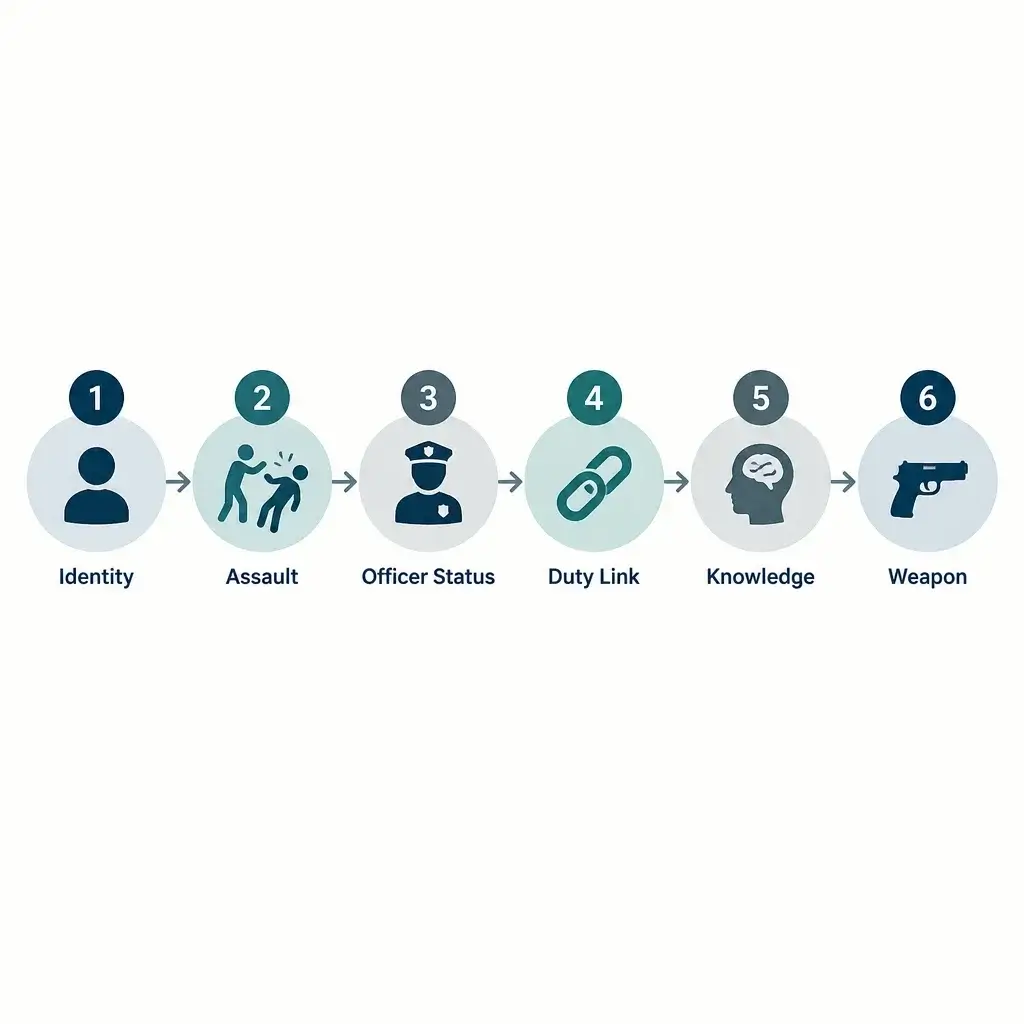
The Crown must prove every essential element beyond a reasonable doubt. For a duty-related weapon allegation, the proof generally follows this sequence:
- Identity: The accused was the person involved, rather than someone misidentified in a crowded or confused scene.
- An assault: The accused intentionally applied force without consent, or committed another legally recognized form of assault.
- Protected status: The complainant was a peace officer, public officer, or another person protected by the applicable branch.
- The duty connection: For the usual duty-based allegation, the officer was acting in the lawful execution of duty.
- The required knowledge: The accused knew the relevant officer status, with issues such as wilful blindness or recklessness assessed under the applicable law.
- The weapon element: During the assault, the accused carried, used, or threatened to use a weapon or imitation weapon.
The Crown does not need to prove the weapon branch if it instead establishes the bodily-harm branch of section 270.01. A weakness in weapon evidence may therefore affect the charge without ending the prosecution. The underlying assault and any alleged injury still require separate analysis.
Knowledge of officer status can be inferred from circumstances rather than an admission. A uniform, marked cruiser, verbal identification, and the accused’s responses can support that inference. Plainclothes encounters, poor visibility, and conflicting identification evidence can make the issue more disputed.
Who qualifies as a peace officer
“Peace officer” is broader than “police officer.” The definition in section 2 includes police officers, police constables, and specified correctional personnel, among other categories. Some categories depend on the person’s particular functions. A job title alone does not settle every case.
A private security guard is not automatically a peace officer. However, other branches of the assault provisions can protect someone assisting an officer or address an assault intended to resist a lawful arrest. The legal authority being exercised matters alongside the person’s occupation.
What counts as a weapon or imitation weapon
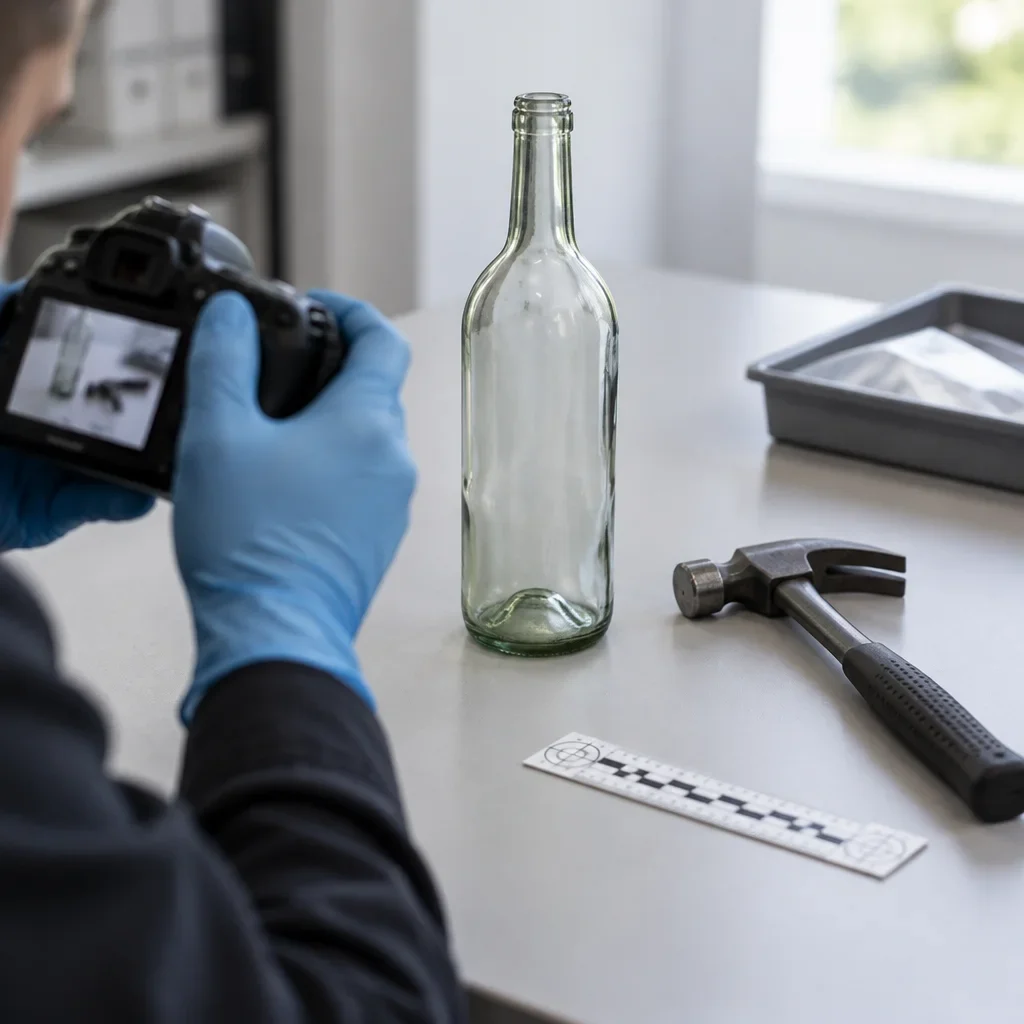
An everyday object can qualify as a weapon because of its design, use, or intended use. The definition in section 2 includes things used, designed, or intended to cause death or injury, or to threaten or intimidate someone. The prosecution does not need a separate finding that the object was “deadly.”
A bottle, tool, bat, or vehicle can become a weapon in context. A bottle carried home as groceries is different from a bottle deliberately swung at someone. Words, movement, distance, grip, and the surrounding events help establish the object’s role.
Carrying can matter even without a strike or threat. Section 270.01(1)(a) expressly includes carrying a weapon or imitation weapon while committing the underlying assault. That does not make every object in a pocket a weapon. The Crown must still establish the object’s legal character and the remaining offence elements.
Imitation weapons
An imitation weapon can support this charge even if it cannot fire or cause the injury it appears capable of causing. The statutory branch expressly includes imitation weapons. Whether the object was carried, used, or threatened during an assault remains a separate proof issue.
Duty status, lawful arrest, and unlawful detention
Being scheduled “on duty” is not the complete legal test. For the usual duty-related branch, the issue is whether the officer was acting in the lawful execution of duty during the encounter. An off-duty officer can undertake police duties, while an on-duty officer’s particular actions can still face legal challenge.
An unlawful arrest or detention can affect whether the Crown proves the duty element. It may also raise issues under the Canadian Charter of Rights and Freedoms. However, an unlawful police action does not automatically erase every possible assault or weapons charge. The conduct and the particular offence must be examined separately.
How prosecutors prove the assault and the weapon allegation

Assault evidence can include officer testimony, civilian witnesses, body-worn video, cruiser recordings, CCTV, photographs, and medical records. There is no universal requirement for a video or an independent witness. A court can convict on testimony it accepts as proving the case beyond a reasonable doubt.
Weapon evidence must connect the object to the allegation, not simply show that an object existed. Relevant material can include:
- Video showing how the object was carried or moved.
- Witness descriptions of its appearance and use.
- Police seizure records and photographs.
- Fingerprints, DNA, or other forensic findings where relevant.
- Injuries consistent or inconsistent with the alleged object.
- Words allegedly spoken during the encounter.
- Evidence showing whether an apparent firearm was an imitation.
The absence of a recovered weapon does not automatically defeat the charge. Witness testimony or video may establish what was involved. Conversely, recovering a tool near the scene does not, by itself, prove that the accused carried it during an assault.
Missing footage, obstructed views, inconsistent accounts, and poor lighting can affect reliability. Intoxication can also affect a witness’s perception or memory. These issues require evidence-based analysis; they do not automatically create reasonable doubt or excuse the accused’s conduct.
Sentencing, minimum punishment, and first offenders
Sections 270, 270.01, and 270.02 do not prescribe mandatory minimum imprisonment. That does not mean the minimum practical consequence is a fine, or that a first offender will avoid jail. Available sentencing options depend on the offence, prosecution route, statutory restrictions, and proven facts.
A first offender can receive jail for assaulting a peace officer with a weapon. Courts assess the weapon’s role, injuries, danger created, prior record, personal circumstances, rehabilitation, and other relevant factors. The absence of a record matters, but it does not remove the seriousness of a weapon allegation.
Sentencing for these offences gives particular weight to denunciation and deterrence under section 718.02. A guilty plea, demonstrated remorse, treatment, and compliance with release conditions can be relevant. Ordinary voluntary intoxication is not a reliable route to a reduced sentence or a defence.
The sentence for assault with a weapon against a civilian follows a different offence provision. Section 267 is hybrid and carries a maximum of 10 years on indictment. The shared maximum does not make civilian and peace officer cases interchangeable; their elements and sentencing context differ.
For someone facing this allegation, a confidential consultation can focus on the charge wording, release terms, and weapon evidence. I offer free consultations to review those immediate issues and explain the next court steps. This guide provides general information, not advice about a particular charge.
Common defences and disputed elements
A defence may challenge identity, intent, the alleged assault, officer status, lawful duty, or the weapon evidence. Accidental contact is different from intentional force. An object’s presence is different from proof that it was a weapon or imitation weapon carried during the assault.
A defence does not always require proving an alternative version of events. The Crown retains the burden of proving guilt beyond a reasonable doubt. Cross-examination, reliable recordings, and contradictions within the prosecution evidence can matter even when the accused does not testify.
Self-defence and excessive police force
Self-defence can arise where a person reasonably believes force is being used or threatened, acts defensively, and responds reasonably in the circumstances. Section 34 governs that defence. The assessment includes the threat, available alternatives, weapons, physical circumstances, and proportionality.
Police enforcement encounters have an additional restriction. Under section 34(3), self-defence generally does not apply to force used for lawful enforcement, unless the accused reasonably believes the other person is acting unlawfully. Alleged excessive force therefore requires careful analysis. Disagreeing with an arrest is not, by itself, self-defence.
Bail, release, and the first court steps
Release is legally possible after an assault police officer charge, but it is not guaranteed. Police may release the accused, or hold them for a bail hearing. A court considers attendance, public safety, and confidence in the administration of justice when applying the bail framework.
The charge name alone does not determine who bears the bail burden. Reverse-onus provisions can apply because of additional circumstances, such as an indictable allegation committed while already on release for another indictable offence. Section 515 sets out the applicable categories. Weapon restrictions and existing court orders also require close review.
Release conditions can restrict contact, locations, weapons possession, or other conduct. The written order controls. A complainant’s agreement does not cancel a no-contact condition, and a pending request to change conditions does not suspend them.
The first court appearance is generally a procedural step, not the trial. Counsel obtains disclosure, reviews the evidence, addresses outstanding release issues, and considers available elections or resolution discussions. Disclosure can include recordings, officer notes, witness accounts, and forensic material.
Publication bans
A bail hearing can be subject to a publication ban under section 517. When the accused requests the statutory ban, the justice must make the order. It restricts publication of specified hearing information; it does not automatically hide the accused’s identity or make the entire case confidential.
Charge reductions, plea discussions, and diversion
Resolution discussions can address a withdrawal, a plea to a different offence, or an agreed sentencing position. Weak weapon evidence, disputed duty evidence, injury evidence, rehabilitation, and the accused’s record can influence those discussions. A negotiated outcome requires a proper factual and legal basis.
A lesser assault offence may remain available even if the weapon allegation is not proved. Depending on the charge and findings, that can arise through a plea agreement or a verdict on a legally included offence. Removing the weapon allegation does not necessarily remove the underlying assault.
Diversion and peace bonds are not automatic alternatives to prosecution. Crown screening policies, public safety concerns, the strength of the evidence, and the alleged violence affect whether either can be considered. A weapon allegation can materially limit these options.
Consequences beyond imprisonment
A conviction can affect employment, professional licensing, background checks, and international travel. The consequence depends on the position, regulator, destination, and record involved. An outstanding charge and a conviction are different legal statuses, but either may trigger questions in a regulated occupation.
Immigration consequences can arise for non-citizens, including permanent residents. The Immigration and Refugee Protection Act links serious criminality to factors that include an offence’s maximum punishment and the sentence imposed. Immigration status should therefore be identified before any plea decision, not treated as an issue to address afterward.
Weapons prohibition orders can also apply. Sections 109 and 110 govern mandatory and discretionary prohibitions in specified circumstances. The offence, prosecution route, findings, and criminal history affect the analysis; the charge label alone does not describe every consequence.
Police can require fingerprints and photographs for qualifying charges under the Identification of Criminals Act, including hybrid offences. Release paperwork may contain a separate identification appointment. An acquittal or withdrawal does not itself mean every police record is automatically destroyed.
Related offences compared
Basic assault is the least aggravated form of assault, but it remains a criminal offence. Section 266 addresses ordinary assault, while the surrounding provisions distinguish weapons, bodily harm, aggravated injury, and protected-person circumstances.
| Offence | Protected person or context | Weapon required | Injury required | Main distinction |
|---|---|---|---|---|
| Ordinary assault, section 266 | Any person | No | No | Basic assault without an added weapon or injury element |
| Assaulting a peace officer, section 270 | Persons and circumstances specified by the provision | No | No | Officer status, duty, or another specified connection matters |
| Peace officer assault with a weapon, section 270.01(1)(a) | Underlying assault covered by the peace officer provision | Weapon or imitation weapon | No | Carrying, using, or threatening to use it during the assault |
| Peace officer assault causing bodily harm, section 270.01(1)(b) | Underlying assault covered by the peace officer provision | No | Yes | Injury interfering with health or comfort beyond the transient or trifling level |
| Aggravated assault of a peace officer, section 270.02 | Underlying assault covered by the peace officer provision | No | Specified aggravated harm | Wounding, maiming, disfiguring, or endangering life |
| Resisting or obstructing a peace officer, section 129 | Officer acting in the execution of duty, or someone lawfully assisting | No | No | Wilful resistance or obstruction; assault need not be proved |
| Assault with a weapon, section 267(a) | Any person | Weapon or imitation weapon | No | Does not require the peace officer duty connection |
Resisting arrest and assaulting an officer are not synonyms. Conduct can raise allegations under both provisions, but the Crown must prove each charged offence. Whether an arrest was lawful can be important to that analysis.
Sample charge wording and why it matters
A simplified example is: “While committing an assault on a peace officer engaged in the execution of duty, the accused carried a weapon, namely a metal bar.” This illustrates the carrying branch, not official or exhaustive charge wording. It does not assert that anyone was struck or injured.
The words “carried,” “used,” “threatened to use,” and “caused bodily harm” identify different allegations. Counsel should compare the information or indictment with the disclosure, rather than relying only on an abbreviated offence label on release papers.
FAQ: false accusations, police statements, and immediate steps
Responding to a false allegation
A false allegation still requires a lawful, evidence-focused response. Preserve messages, photographs, recordings, clothing, and witness contact details. Keep original files and write a private chronology for counsel. Do not confront the complainant, approach witnesses to coordinate accounts, or post a competing account online.
Speaking to police after a charge
The right to silence generally allows an accused person to decline investigative questions, subject to specific legal obligations. The Charter also protects the right to retain and instruct counsel on arrest or detention. Statements offered to explain an innocent account can still become prosecution evidence; obtain advice before discussing the allegation.
Priorities during the next 24–72 hours
- Read every release condition and note all court and identification appointments.
- Preserve existing evidence without editing, deleting, or publishing it.
- Give counsel the locations of cameras whose recordings may be overwritten.
- Record witness contact details without asking anyone to change an account.
- Keep photographs and records of any injuries or medical treatment.
- Provide all existing release, probation, and weapons orders for review.
- Have counsel assess disclosure, bail issues, and the exact charge wording.
Release conditions remain binding until lawfully changed. If a condition creates a practical problem involving housing, work, or family contact, the response is a legal variation process, not an informal workaround.
A weapon allegation deserves close attention to the evidence, not assumptions about the outcome. A confidential consultation can start with the release papers, the alleged object, and the next court date. The first task is to understand exactly what the Crown must prove.