

 Based on 116 Verified Google Reviews

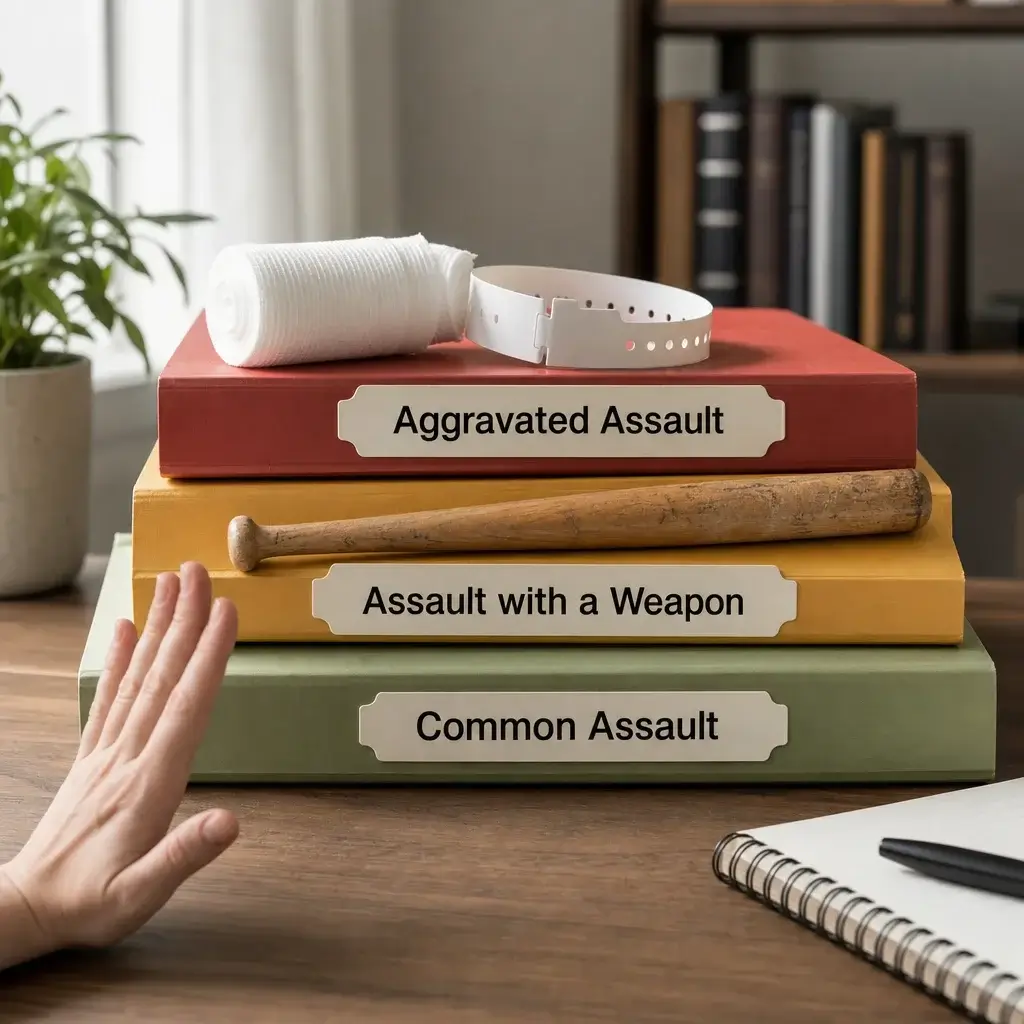
Aggravated assault Canada searches usually start in the wrong place. Canada does not use assault and battery the way many U.S. websites do, and the charge label on your paperwork is only the starting point.
Assault charges in Canada at a glance: the short answer
Canadian assault law usually works on a ladder: the general definition of assault is in s. 265 of the Criminal Code, common assault is charged under s. 266, assault with a weapon or causing bodily harm is under s. 267, and aggravated assault is under s. 268 . The seriousness usually turns on four things: what happened, whether a weapon was involved, how serious the injuries were, and whether the Crown proceeds by summary conviction or indictment where the offence is hybrid .
An aggravated assault charge in Canada is one of the most serious assault charges because it alleges the complainant was wounded, maimed, disfigured, or had their life endangered under s. 268 . That is worse than common assault and worse than assault causing bodily harm. Outcomes vary by the facts, the province, the criminal record, the medical evidence, and the release history. This is general information, not legal advice on your own case.
The assault ladder in Canada: simple assault, assault with a weapon or bodily harm, and aggravated assault
The three core levels most people mean by types of assault charges in Canada are common assault, assault with a weapon or causing bodily harm, and aggravated assault . Common assault is the lowest level on this ladder. It still matters. It can involve a push, slap, grab, strike, or a threatening act that puts someone in immediate fear of force.
Simple assault in Canada usually refers to the s. 266 charge built on the s. 265 definition . Assault causing bodily harm in Canada and assault with a weapon are grouped together in s. 267 . Aggravated assault under s. 268 is the top level in this guide because it requires much more serious harm: wounding, maiming, disfiguring, or endangering life .
Some sources talk about four or more assault offences because the Code also has sexual assault, assaulting a peace officer, and unlawful causing bodily harm as separate or related offences . This guide stays focused on the main ladder people usually ask about after an arrest or charge.
Comparison table: sections 265, 266, 267 and 268 explained side by side
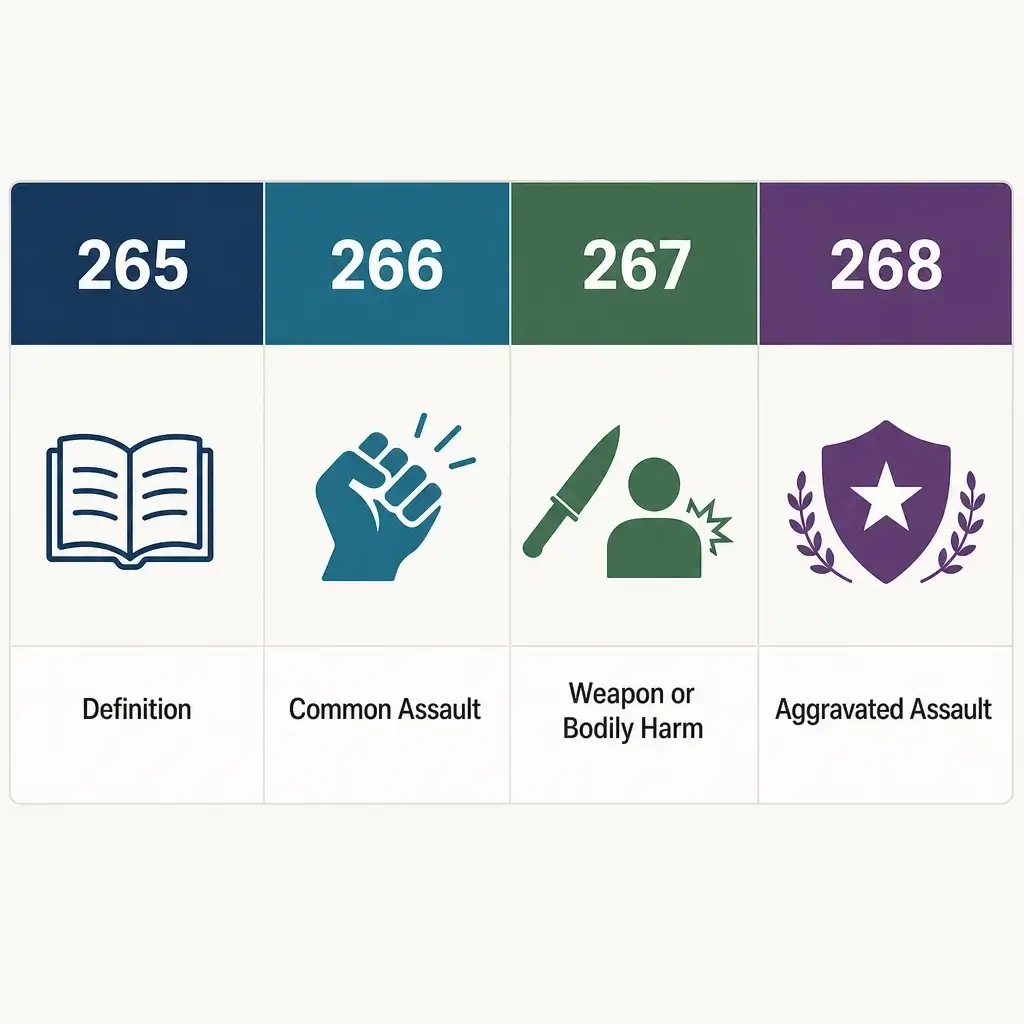
The quickest way to understand an assault case in Canada is to separate the definition section from the charge sections. Section 265 defines assault. Sections 266, 267, and 268 create the charge labels most people see in court paperwork .
| Section | Common label | What the Crown must prove in plain English | Typical example | Injury level | Offence type | Maximum penalty* |
|---|---|---|---|---|---|---|
| s. 265 | Definition of assault | Force applied without consent, or an attempt/threat by act or gesture with present ability, or accosting while openly carrying a weapon or imitation weapon | Raising a fist and moving in to strike, or grabbing someone without consent | No injury required | Definition section | Not a stand-alone penalty section |
| s. 266 | Assault / common assault / assault criminal code 266 | An assault within s. 265, charged as the basic offence | Slap, shove, punch without proven bodily harm | No bodily harm required | Hybrid | Up to 5 years on indictment |
| s. 267 | Assault with a weapon or causing bodily harm / assault causing bodily harm Criminal Code / assault with a weapon Criminal Code | An assault plus either weapon use, imitation weapon use, or bodily harm | Punch causing a fracture, or striking with a bottle | Bodily harm or weapon element | Hybrid | Up to 10 years on indictment |
| s. 268 | Aggravated assault Canada / aggravated assault Criminal Code | An assault that wounds, maims, disfigures, or endangers life | Life-threatening stabbing, permanent scarring, severe crushing injury | Very serious harm | Indictable | Up to 14 years |
*Maximums are not typical outcomes. Summary-conviction maximums and procedure details can change with Code amendments, so the current Criminal Code text should always be checked on the date of the case.
What counts as assault in Canada?
Assault under s. 265 is broader than most people think. It includes applying force to another person without consent, directly or indirectly, and it does not require an injury . A push, grab, spit, slap, or throwing an object that hits someone can qualify if the contact was intentional and without consent.
You can be charged with assault without physical contact. Section 265 also covers attempting or threatening by an act or gesture to apply force if the other person has reasonable grounds to believe you can carry it out at that moment . That is why lunging, raising a fist at close range, or moving in with a weapon can lead to a charge even if no blow lands.
Words alone are usually not enough for assault. The law normally needs an act, gesture, or surrounding conduct showing present ability to carry out the threat . Pure insults, angry texts, or vague future threats may fit other offences in some cases, but they are not automatically assault.
Section 265 also includes accosting or impeding someone while openly carrying a weapon or an imitation weapon . That is one reason the same event can move from common assault to a more serious charge once the police focus on a knife, bottle, bat, tool, or imitation firearm.
Is battery a charge in Canada? Myth vs law
Battery vs assault in Canada is mostly a terminology problem. In Canada, the Criminal Code generally uses the word assault, not a separate everyday criminal charge called battery .
| Myth | Law in Canada |
|---|---|
| Assault and battery are separate standard charges | Canadian criminal law usually charges assault, assault with a weapon, assault causing bodily harm, or aggravated assault |
| Battery is more serious than assault | That question usually comes from U.S. sources, not Canadian charge labels |
| You should search U.S. “assault and battery charges in Canada” guides | Cross-border guides often mix up the terminology and can mislead Canadian readers |
People still say assault and battery Canada in conversation because U.S. TV, movies, and websites use those terms constantly. If your paperwork says CC 266, s. 267, or s. 268, you are dealing with Canadian Criminal Code assault offences, not a U.S.-style battery charge.
What is assault causing bodily harm in Canada?
Assault causing bodily harm in Canada means the assault caused bodily harm as that term is used in Canadian criminal law. Bodily harm means any hurt or injury that interferes with the health or comfort of the complainant and is more than merely transient or trifling . That definition is the line between ordinary minor contact and legally meaningful injury.
The jump from common assault to s. 267 often happens because of the injury evidence. Cuts needing treatment, a broken nose, concussion symptoms, a fracture, or pain and bruising serious enough to be more than minor can support a bodily-harm allegation, depending on the evidence . The exact diagnosis, timing, photos, and medical records matter.
The difference between assault and assault bodily harm Canada is not just that someone says they were hurt. The Crown still has to prove the assault itself, then prove the resulting injury crossed the bodily-harm threshold . Minor redness that fades quickly may support common assault but not bodily harm. A fracture or significant lingering impairment points in the other direction.
Psychological injury can be legally complicated. In some cases, mental or emotional injury may qualify if the evidence shows a real interference with health or comfort that is more than transient or trifling, but that issue is fact-specific and usually needs stronger proof than a simple claim of stress .
What is aggravated assault in Canada?

The aggravated assault definition in Canada is an assault that wounds, maims, disfigures, or endangers the life of the complainant under s. 268 . That is why aggravated assault is treated as more serious than assault causing bodily harm Canada. The law is focused on the level of harm, not just on whether force was used.
A wound usually means a breaking of the skin or an external injury of that kind, though the legal meaning depends on the evidence and case law . Maiming points to serious impairment of a body part or function. Disfigurement points to lasting or significant damage to appearance. Endangering life means the injury created a real danger to life, not just a painful injury .
Examples can include severe stabbings, major fractures with permanent impact, life-threatening bleeding, lasting facial scarring, or injuries requiring urgent intervention to avoid death . But labels are not automatic. Police may lay one charge early, then medical records can move the case up or down later.
Aggravated assault is worse than common assault and worse than assault with a weapon or causing bodily harm. It is one of the most serious non-sexual assault charges in the Code, and it carries a maximum penalty of 14 years .
How police and the Crown choose s. 266 vs s. 267 vs s. 268: a practical decision tree
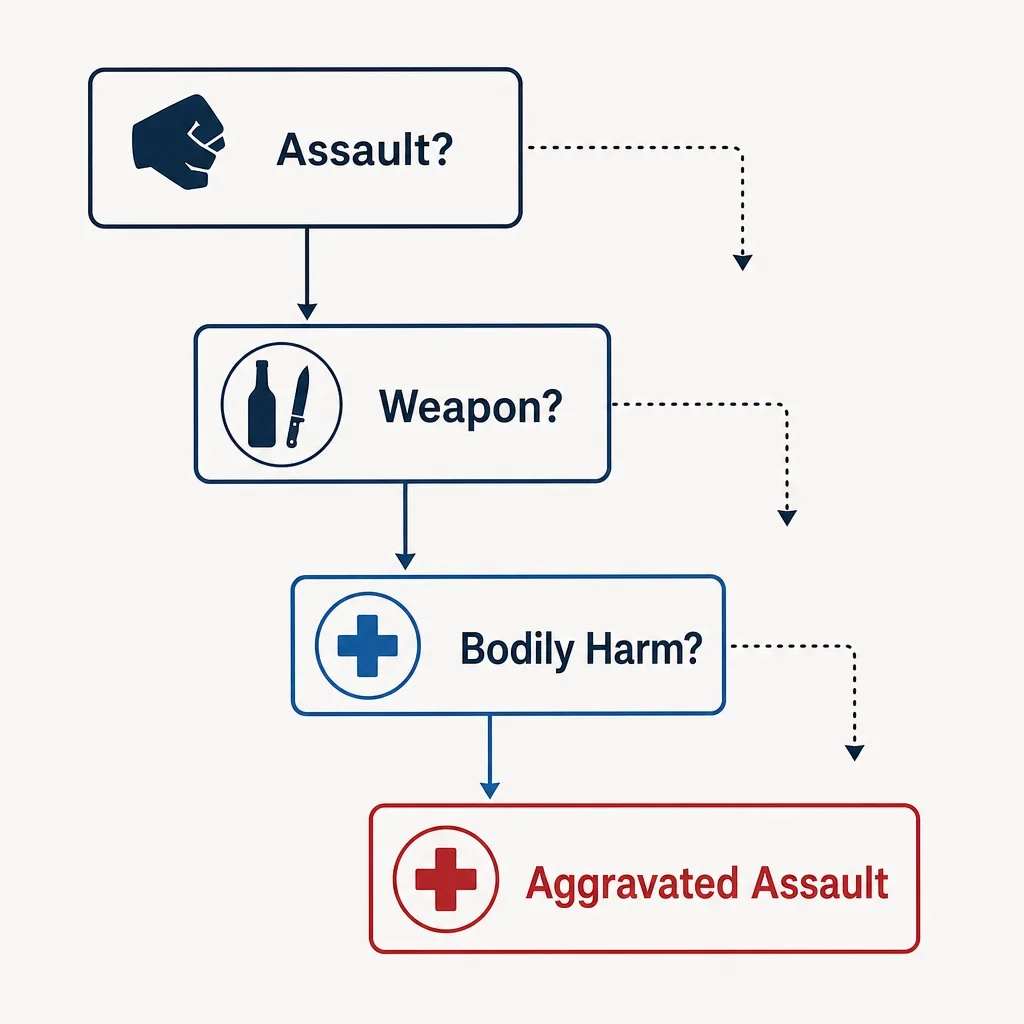
The charge usually follows a simple sequence. First, the police ask whether there was intentional force, or an attempt or threatening act that fits s. 265 . If the answer is no, it may not be an assault charge at all.
If there was an assault, the next question is whether a weapon or imitation weapon was involved. If yes, s. 267 may apply even without a major injury . A bottle, knife, bat, tool, chair, or imitation weapon can change the charge level.
If there was no weapon issue, the next question is whether the complainant suffered bodily harm. If the injury is more than transient or trifling, the case may move from s. 266 to s. 267 . Hospital records, x-rays, treatment notes, and photos often become central here.
If the injuries amount to wounding, maiming, disfigurement, or endangering life, the case may move to s. 268 aggravated assault . Early charge wording is not always final. Serious assault files can change as doctors assess the injuries.
A practical decision tree looks like this:
- Was there force without consent, or a threatening act with present ability?
- If yes, was a weapon or imitation weapon involved?
- If yes, s. 267 is in play even before major injury is proven .
- If there was injury, did it amount to bodily harm?
- If the injury was much more serious, did it wound, maim, disfigure, or endanger life?
- If yes, s. 268 is in play .
What the Crown must prove: legal elements vs sentencing factors
For guilt, the Crown must prove the legal elements of the offence beyond a reasonable doubt. That usually means proving the act itself, identity, lack of consent where required, and the added bodily-harm, weapon, or aggravated-harm element depending on the section charged . Sentencing is a separate stage. It asks how serious the offence was and what punishment is fit after guilt is established.
For common assault, the core issue is usually whether intentional, non-consensual force happened, or whether there was an act or gesture causing immediate fear of force . For assault causing bodily harm Criminal Code cases, the Crown must also prove bodily harm. For aggravated assault, the Crown must prove the much higher harm level in s. 268 .
Sentencing factors are different. Injury severity, weapon use, prior record, probation or bail breaches, intimate-partner context, victim impact, remorse, treatment steps, and rehabilitation efforts may affect sentence even if they are not all elements of the offence . The same fact can matter at both stages, but for different reasons.
What evidence is needed for assault charges in Canada?

An assault prosecution does not require video, and it does not always require medical records. A case can proceed on the complainant’s evidence alone if the court accepts it beyond a reasonable doubt . But corroboration can matter a great deal in real files.
Common evidence includes witness statements, 911 calls, police notes, accused statements, text messages, social media messages, surveillance footage, scene photos, body-worn camera where used, medical charts, diagnostic imaging, and expert evidence on injuries . In a simple assault case, the file may turn almost entirely on credibility and reliability.
Visible injury is not required for a simple assault Canada charge. The force itself is enough if the Crown proves it . By contrast, bodily-harm and aggravated-assault cases usually rise or fall on medical detail: what the injury was, when it appeared, how long it lasted, and whether it created permanent or life-threatening consequences.
Charge level can shift when the evidence shifts. New hospital records, better photos, independent witnesses, or proof of weapon use can move the case up the ladder. Weak medical proof, conflicting statements, or an injury that heals quickly can move it down .
Objective foreseeability of bodily harm: why it matters in serious assault cases
Canadian courts may ask whether bodily harm was objectively foreseeable from the unlawful act. In plain English, that means whether a reasonable person would see bodily harm as a foreseeable risk of what was done, not whether the accused predicted the exact injury that happened .
That point matters because the Crown does not usually need to prove an intent to cause the precise fracture, scar, or concussion that followed. The legal focus is often on the intentional assault plus the injury that resulted, judged through ordinary common sense about risk .
Objective foreseeability is not the same as aggravated assault. Bodily harm under s. 267 uses a lower injury threshold than wounding, maiming, disfigurement, or endangering life under s. 268 . A hard punch that foreseeably causes significant injury may support s. 267 even if no one intended the exact medical outcome.
Common defences to assault charges in Canada
There is no single defence that fits every assault file. The available defence depends on the charge section, the witnesses, the injury evidence, the relationship between the parties, and what happened before and after the incident .
Identity is a common issue where the event was chaotic, fast, dark, or affected by alcohol or poor vantage points . If the Crown cannot prove who applied the force, the charge can fail even if everyone agrees a fight happened.
Credibility and reliability are often central in an assault case in Canada. Inconsistent statements, missing messages, delayed reporting, motive to exaggerate, or independent contradictions can affect proof . That does not mean the allegation is false. It means the Crown still has to prove it.
Accident can matter where the contact was not intentional. Assault generally requires intentional force, not pure clumsiness or misfortune . In other files, the defence may be that the act happened but the injury is overstated, which can matter a lot in the difference between s. 266, s. 267, and s. 268.
Self-defence, defence of another, consent in limited settings, and Charter issues can also arise. None is automatic. Each depends on the facts, and serious charges should be reviewed by defence counsel who can match the evidence to the actual legal test.
Consent and self-defence: when they work and when they do not
Consent has limits in Canadian assault law. A person may consent to some physical contact, but Canadian law does not treat consent as a blanket defence to intentionally inflicted bodily harm in a fistfight or similar violence . The more serious the injury, the harder it is to rely on consent.
Self-defence is a reasonableness-based defence. The court looks at what threat was perceived, whether the act was for the purpose of defending or protecting, and whether the response was reasonable in the circumstances . That is more demanding than simply saying, “I felt threatened.”
Proportionality and context matter. The size difference between the parties, whether a weapon was present, whether retreat was possible, the speed of events, and what each person did before and after can all matter to the analysis . In close cases, video, 911 audio, and injury patterns can be decisive.
Penalties and sentence exposure for assault, assault with a weapon, bodily harm, and aggravated assault
The statutory maximums tell you the ceiling, not the likely outcome. Common assault under s. 266 carries a maximum of 5 years on indictment, assault with a weapon or causing bodily harm under s. 267 carries a maximum of 10 years on indictment, and aggravated assault under s. 268 carries a maximum of 14 years . Those numbers do not tell you whether jail is likely in a given case.
There is no safe way to answer aggravated assault sentence Canada or assault Canada sentence with one number. Real outcomes depend on injury level, weapon use, domestic context, prior record, guilty plea or trial result, breaches of release terms, rehabilitation evidence, and the local court’s treatment of comparable cases . I would never promise a sentence result from a charge label alone.
A first-time assault charge does not automatically mean jail, and it does not automatically avoid jail. Lower-level common assault cases can sometimes end in non-custodial outcomes. Serious bodily harm, weapon use, repeated violence, intimate-partner context, or breach history increases sentencing risk significantly .
Aggravated assault Canada minimum sentence queries often assume there is always a mandatory floor. Mandatory minimum rules change over time and can be offence- and circumstance-specific, so the current Code and current case law must be checked on the date of the charge. What can be said safely is that aggravated assault is treated as a very serious indictable offence with major jail exposure .
Charge labels like assault with a weapon sentence Canada or aggravated assault Canada sentence are only shorthand. The sentencing judge looks at the proven facts, not just the heading on the information.
If you are charged in Toronto, Brampton, Scarborough, Oshawa, Newmarket, Vaughan, Etobicoke, or elsewhere in Ontario, get the disclosure reviewed before making assumptions about sentence exposure. A confidential case review can explain the charge section, release terms, evidence issues, and realistic defence strategy.
First-time assault charges in Canada: when jail is possible and when other outcomes may happen
Being a first offender helps, but it does not control the result. Courts usually treat a clean record as a mitigating factor, yet injury level and surrounding facts can outweigh it in violent cases .
For common assault, the realistic range of outcomes can include a withdrawal, peace bond, discharge where legally available, suspended sentence with probation, or jail in more serious fact patterns . For assault causing bodily harm, assault with a weapon, or aggravated assault, non-jail outcomes become harder as the injuries and risk increase.
Domestic or intimate-partner allegations can narrow practical resolution options. Even a first-time domestic assault charge in Canada may attract stricter release terms, no-contact clauses, weapons conditions, and less flexibility from the Crown because public-safety concerns are front and centre .
Conditional sentences, discharges, and peace bonds are legal categories with specific rules. Their availability depends on the exact offence, the Crown position, the facts, and current law. No article should promise them in advance.
Can assault charges be dropped, reduced, or resolved by peace bond?
The complainant does not personally “drop” a criminal charge once police have laid it. In Canada, the Crown decides whether to continue, reduce, stay, or withdraw the prosecution .
That said, assault charges can sometimes be reduced or withdrawn if the evidence is weak, the injury is less serious than first believed, witnesses become unreliable, or a peace bond is accepted as an appropriate public-interest resolution . Those outcomes are fact-specific. They are not entitlements.
A recantation does not automatically end the case. The Crown may still proceed if there is other evidence such as 911 audio, photos, admissions, texts, witnesses, or medical records . In more serious injury cases, especially aggravated assault with a weapon in Canada or life-endangering allegations, lighter resolutions are usually harder to obtain.
What happens after an assault arrest in Canada?
The usual process is arrest or release at the scene, then paperwork, then fingerprints and photographs if required, then an undertaking or bail process, then a first court appearance, disclosure, elections where applicable, resolution discussions, and finally trial or sentence if the case is not resolved earlier . Exact procedure can vary by province and courthouse, but the Criminal Code is federal.
Release conditions matter immediately. No-contact orders, stay-away clauses, abstain terms, reporting terms, and weapons prohibitions can be imposed at the front end of the case . In domestic assault files, people are often removed from the home or barred from returning while the case is pending.
A short post-arrest checklist looks like this:
- Read every release condition carefully .
- Do not contact the complainant if no-contact terms apply .
- Keep screenshots, texts, photos, video, and names of witnesses .
- Attend fingerprint and court dates exactly as directed .
- Get the disclosure reviewed before deciding how to proceed .
An assault arrest can affect work, parenting arrangements, travel, immigration status, and professional licensing even before the case ends . That is one reason the post-arrest stage matters as much as the final trial stage.
Domestic assault and abuse charges in Canada
There is generally no separate Criminal Code offence called domestic assault Canada. The charge is usually common assault, assault causing bodily harm, assault with a weapon, or aggravated assault, with the domestic or intimate-partner context treated as part of the facts .
That context can affect bail, no-contact terms, firearms conditions, Crown screening, and sentence. Courts treat intimate-partner violence seriously, and the practical consequences can be stricter even when the section number is still CC 266 or s. 267 .
Abuse charges Canada is a broad phrase, not one single offence. Physical abuse may fit assault charges. Emotional abuse by itself is not automatically a stand-alone assault charge, though some conduct may fit other offences depending on the facts, such as threats, harassment, coercive conduct, or breaches of court orders .
If you search domestic violence charges Canada, the key point is this: the same physical act can carry extra practical consequences when it happens in an intimate-partner or family setting. Release terms and resolution options often become stricter.
Local wording vs federal law: what CC 266 and other charge labels mean
CC 266 usually means section 266 of the Criminal Code, the offence commonly called assault . You may also see “s. 266,” “CCC 266,” or similar shorthand on paperwork, dockets, or police forms.
Section 265 is the definition section. Section 266 is the basic assault charge. Section 267 covers assault with a weapon or causing bodily harm. Section 268 covers aggravated assault . That is why 266 cc Canada law searches are really asking what level of assault appears on the document.
Local references like Ontario, Alberta, or Nova Scotia do not change the core federal law. Procedure may vary by courthouse, but the Criminal Code sections are federal across Canada .
Does assault give you a criminal record in Canada?
An assault conviction can give you a criminal record whether the offence is prosecuted summarily or by indictment . The charge level, the result, and whether there is a conviction matter. A discharge, where legally available and actually imposed, is different from a conviction.
A record can affect employment checks, travel, immigration matters, professional licensing, family-court issues, volunteer roles, and housing applications . The exact impact depends on the person’s status and the type of screening involved.
That is one reason readers should not focus only on jail. Even a lower-level first-time assault charge Canada file can carry long-term consequences if it ends in a conviction.
FAQ
Will I go to jail for first-time assault in Canada?
Not always, and not never. First-offender status helps, but jail can still be possible if the facts involve serious injury, a weapon, domestic context, repeated violence, or breaches of release terms .
What is the lowest charge for assault in Canada?
The lowest charge on the main assault ladder is usually common assault under s. 266 . The legal definition behind it comes from s. 265.
What are the three levels of assault in Canada?
The main three are common assault under s. 266, assault with a weapon or causing bodily harm under s. 267, and aggravated assault under s. 268 .
Can assault charges be dropped in Canada?
They can be withdrawn, stayed, or reduced in some cases, but the decision belongs to the Crown, not the complainant .
Can the victim drop assault charges in Canada?
No. A complainant can change or clarify their evidence, but they do not control the prosecution once the police have laid the charge .
What evidence is needed for assault?
The Crown often relies on witness evidence, statements, messages, photos, 911 recordings, surveillance, and medical records where injury is alleged . Video is helpful, not mandatory.
What is considered aggravated assault in Canada?
An assault is aggravated under s. 268 when it wounds, maims, disfigures, or endangers life .
What is an example of assault causing bodily harm?
A punch that causes a broken nose, concussion symptoms, or a fracture can be an example, depending on the evidence proving both the assault and the injury threshold .
What is the penalty for aggravated assault in Canada?
The offence carries a maximum of 14 years . The actual sentence depends on the proven facts and the offender’s circumstances.
What is the sentence for assault with a weapon in Canada?
There is no single standard sentence. Section 267 carries a maximum of 10 years on indictment , but real outcomes depend on the weapon, injuries, record, context, and other sentencing factors.
Does assault give you a criminal record?
A conviction can, yes . A discharge, where legally available and imposed, is different.
What does charge CC 266 mean?
It usually means section 266 of the Criminal Code, the basic assault charge .
Is battery a real charge in Canada?
Not usually as a standard Criminal Code charge label. Canadian law generally uses assault terminology instead .
What is the difference between assault and battery in Canada?
In Canadian criminal law, the real distinction usually does not exist the way U.S. sources describe it. Canadian cases are generally charged as assault offences under the Criminal Code .
Key takeaways
- Section 265 defines assault. Section 266 is common assault. Section 267 is assault with a weapon or causing bodily harm. Section 268 is aggravated assault .
- The biggest dividing lines are weapon use and injury severity .
- Bodily harm means more than transient or trifling injury .
- Aggravated assault means wounding, maiming, disfiguring, or endangering life .
- U.S. assault and battery language can confuse Canadian readers .
If you are dealing with CC 266, s. 267, or s. 268 paperwork, the next step is not guessing from Google. It is getting the charge wording, release terms, and disclosure reviewed carefully. What does the Crown actually have, and what does that mean for your case?