

 Based on 116 Verified Google Reviews


Assault probation is possible in Canada, but a first offence does not guarantee it. The charge, injuries, criminal record, and surrounding facts all affect the available sentence.
Probation means following a court order in the community. It can accompany a suspended sentence, a conditional discharge, or certain other sentences. It is not the same as bail, and it does not always avoid a criminal conviction.
Assault probation: the direct answer
A court can order probation for some assault offences when the law permits that sentencing route. The judge must consider the offence, the person’s circumstances, rehabilitation, deterrence, and public safety. A prosecution involving serious injury or weapon use raises different sentencing concerns from an isolated push without injury.
There is no reliable single answer to the “most common punishment” for assault without defining the offence and circumstances. Common assault, aggravated assault, and sexual assault have different legal consequences. Probation, a discharge, a fine, and imprisonment are not interchangeable outcomes.
A first-time assault charge does not automatically mean jail. It also does not establish entitlement to probation. A person without prior convictions can still receive custody for a serious assault. Conversely, an eligible lower-level case may support a community-based resolution.
Assault types and their sentencing consequences
Assault generally includes intentionally applying force without consent. It can also include certain attempts or threats involving an apparent present ability to apply force. An injury is not required for common assault.
Common assault, sometimes called simple assault, is the basic assault offence. Assault with a weapon and assault causing bodily harm fall under a more serious provision. Aggravated assault involves wounding, maiming, disfiguring, or endangering someone’s life.
Sexual assault involves an assault in circumstances of a sexual nature. Its sentencing rules depend on the offence charged, the complainant’s age, Crown election, and other statutory requirements. It should not be treated as common assault with a different label.
Domestic assault describes the relationship context, rather than a single separate offence covering every incident. Assault against an intimate partner is an aggravating sentencing factor. Assaulting a peace officer is a separate offence, with additional offences addressing bodily harm, weapons, and aggravated conduct.
Canada does not use a universal “assault 1 versus assault 4” classification. Nor is there one complete list of four assault types. The exact Criminal Code offence matters more than an informal label.
Side-by-side comparison of probation availability
The table separates legal possibility from sentencing concerns. Possible does not mean expected, and probation can follow custody rather than replace it. Statutory restrictions and the proven facts still govern the available sentence.
| Charge or context | Can probation be possible? | Facts supporting a community-based argument | Facts supporting custody | Conditions that may be considered |
|---|---|---|---|---|
| Common assault | Yes, through an available sentencing route | Isolated conduct, limited harm, no record, documented rehabilitation | Repeated violence, threats, prior breaches, vulnerable complainant | Reporting, no contact, counselling |
| Assault causing bodily harm | Yes, in legally appropriate cases | Limited role, rehabilitation, circumstances reducing culpability | Serious or lasting injury, repeated blows, prior violence | Reporting, treatment, no contact |
| Assault with a weapon | Yes, in legally appropriate cases | Circumstances reducing culpability and a supported rehabilitation plan | Dangerous weapon use, threats, planning, injury | No contact, weapons restrictions, treatment |
| Aggravated assault | Possible through an available route, including after eligible custody | Exceptional mitigating circumstances require careful assessment | Life-endangering conduct, permanent injury, serious violence | Close supervision, no contact, treatment |
| Sexual assault | Requires offence-specific analysis; not a blanket yes | Legally relevant mitigation and an available sentencing route | Serious harm, abuse of trust, child complainant, statutory restrictions | No contact, treatment, tailored activity restrictions |
| Domestic assault | Yes, depending on the underlying offence | Supported rehabilitation and a workable safety plan | Pattern of abuse, intimidation, prior breaches | No contact, address restrictions, appropriate programming |
| Assaulting a peace officer | Yes, depending on the offence and circumstances | Limited harm and relevant mitigation | Injury, weapon use, repeated violence | Reporting, counselling, weapons restrictions |
These are sentencing considerations, not outcome predictions. The distinctions between common assault, bodily harm, weapons, aggravated assault, and sexual assault come from separate Criminal Code provisions.
Jail exposure is not the same as an expected sentence
When prosecuted by indictment, common assault carries a maximum of five years’ imprisonment. Assault with a weapon or causing bodily harm carries a maximum of ten years. Aggravated assault carries a maximum of fourteen years. These are statutory ceilings, not starting points or forecasts.
Some assault offences are hybrid, meaning the Crown can proceed summarily or by indictment. That election affects sentencing exposure and procedure. Sexual assault penalties require separate analysis because the offence and complainant’s age can change the applicable rules.
First-time assault charges and sentencing factors
Having no prior record supports a sentencing argument based on rehabilitation. It does not erase the seriousness of the conduct. Judges also consider the degree of force, injury, relationship, vulnerability, and whether the violence was repeated or planned.
A prior record matters through its relevance, not just its existence. Recent violence and previous failures to obey court orders can raise public-safety concerns. An unrelated, dated conviction presents a different sentencing issue from repeated assault convictions.
Defence sentencing materials can address concrete mitigating circumstances:
- No prior convictions or a limited, dated record.
- An early guilty plea and genuine acceptance of responsibility.
- Counselling, treatment, or other documented rehabilitation.
- Compliance with release conditions.
- Stable housing, employment, and community support.
- Appropriate restitution for documented losses.
These factors inform an individual sentence; none creates a right to probation.
Alcohol is not a general excuse for assault. A treatment plan can address an identified substance-use problem, but intoxication does not cancel the harm. Likewise, being insulted does not by itself justify violence. Remorse and restitution may matter without requiring the complainant to forgive the conduct.
Self-defence is primarily a question of criminal responsibility, not a reason to sentence a guilty person more lightly. If the legal defence succeeds, there is no conviction for that allegation. If a case resolves on an admitted factual basis, those accepted facts govern sentencing.
How probation is sought through the court process
Probation is considered through resolution discussions and sentencing, not simply requested from a probation officer. Defence counsel first reviews disclosure, the legal elements, available defences, and the Crown’s position. A guilty plea should not be treated as a shortcut to a promised community sentence.
The process can include:
- Disclosure review: Examine statements, recordings, medical evidence, and other material.
- Defence assessment: Identify factual disputes and legal issues.
- Resolution discussions: Explore an appropriate charge, agreed facts, or a non-trial resolution.
- Sentencing preparation: Gather treatment records, support letters, and relevant personal information.
- Plea or trial: Establish whether there is a finding of guilt.
- Sentencing: Present submissions about the lawful sentence and workable conditions.
A court may also order a pre-sentence report to obtain information about the person’s circumstances and supervision needs.
A joint submission means the Crown and defence propose the same sentence. Judges give joint submissions substantial deference, but the court retains its sentencing role. An agreement between lawyers is not permission to disregard the final court order.
Bail and probation happen at different stages
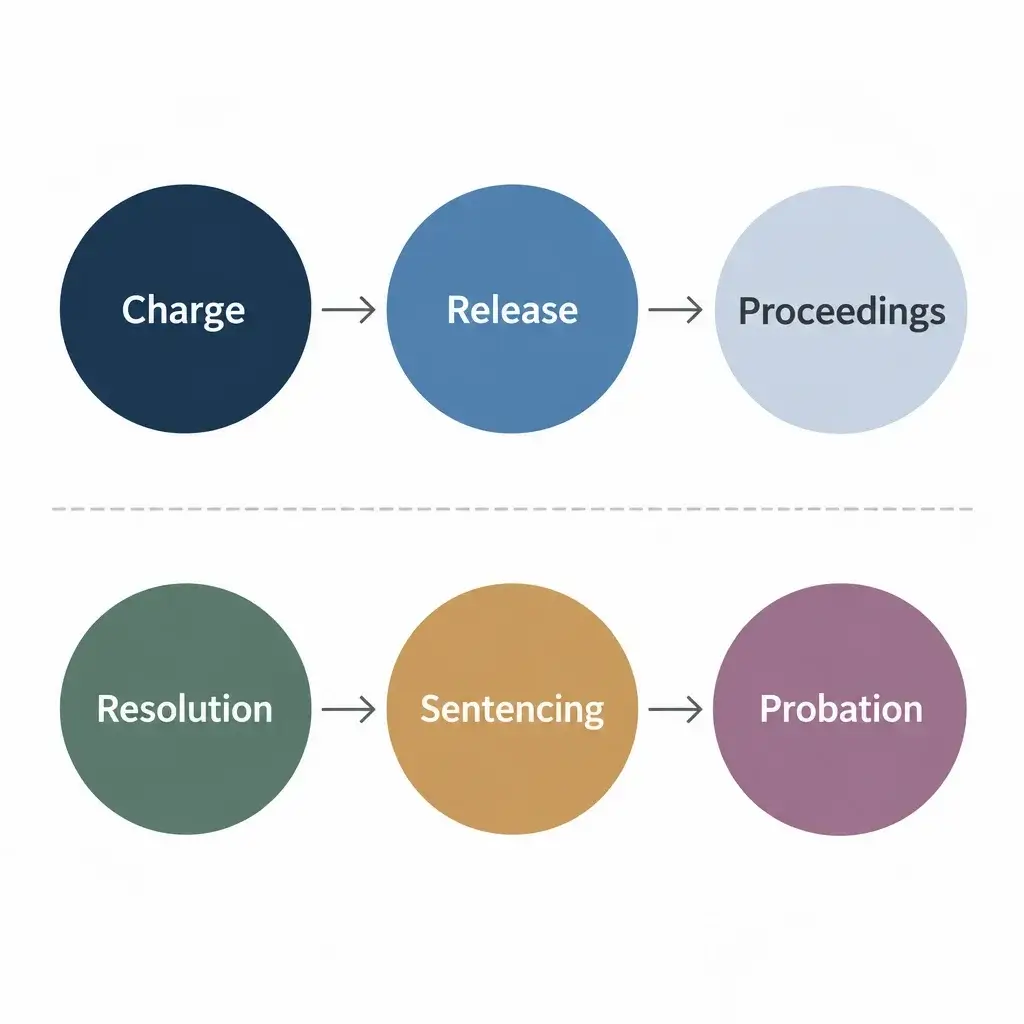
Bail and other release conditions regulate conduct while a criminal case is pending. Probation follows a finding of guilt through an available sentencing or discharge route. Similar-looking no-contact conditions can therefore have different legal sources and breach consequences.
A simplified timeline separates the stages:
- Charge or arrest: The allegation enters the criminal process.
- Release decision: Police or a court may impose lawful release conditions.
- Court proceedings: Disclosure, negotiations, and any trial take place.
- Resolution: Charges may end without a finding of guilt, or guilt may be established.
- Sentencing or discharge: The court decides the legally available outcome.
- Probation: Supervision begins when the order legally takes effect; custody can affect its start.
Common release conditions after an assault charge
Release conditions must respond to legally relevant risks rather than operate as advance punishment. Depending on the order, they can include:
- No direct or indirect contact with named people.
- Staying away from specified homes, workplaces, or other locations.
- Residence, reporting, or curfew requirements.
- Restrictions involving weapons.
- Alcohol or drug restrictions where legally justified.
These conditions are not automatic in every assault case.
An intimate-partner allegation can create immediate housing and parenting problems because release terms may prohibit contact or returning home. A complainant’s invitation does not override those terms. A lawful change must occur through the appropriate release-variation process.
The same broad distinction applies to a first-time assault charge in Ontario and an assault charge in British Columbia. Federal criminal law governs the offence, while provincial administration and local procedures affect scheduling and supervision. A charge does not automatically mean detention until trial.
Common probation conditions in Canada
Every probation order includes keeping the peace and being of good behaviour, appearing before the court when required, and specified notification duties. Those duties include advance notice of a name or address change and prompt notice of employment or occupation changes.
Additional conditions depend on the order and their legal basis. They can include:
- Reporting to a probation officer as directed.
- No contact with specified people.
- Staying away from identified places.
- Counselling or participation in appropriate programming.
- Legally authorized treatment requirements.
- Alcohol, drug, or weapons restrictions.
- Community service within statutory limits.
- Other reasonable conditions connected to public protection and reintegration.
Conditions must be tailored rather than copied into every assault sentence. A sexual-assault case may raise issues involving work, volunteering, internet use, or access to particular settings. A curfew or activity restriction also needs a lawful connection to the case and sentencing purpose.
A no-contact condition can prevent ordinary co-parenting communication. If communication through a named third party or another limited exception is needed, the order must permit it. Shared children, shared housing, or reconciliation do not create an unwritten exception.
Probation officers, reporting, and the first appointment

A probation officer supervises compliance, makes referrals, monitors progress, and reports concerns. The officer does not decide whether the assault charge should have resulted in guilt. The court order defines the legal obligations.
The first appointment generally covers the order, contact information, reporting arrangements, and required programming. The officer may discuss housing, employment, treatment needs, and barriers to compliance. Identification, a copy of the order, and relevant appointment information can help organize that discussion.
There is no single national reporting schedule for everyone on probation. Frequency and method depend on the order, supervision assessment, provincial practice, and lawful directions. Reporting may involve in-person appointments or other authorized contact. The actual order and directions control.
A probation officer can exercise discretion that the order expressly gives them. That is different from rewriting a court condition. For example, directing reporting appointments does not give an officer unrestricted authority to cancel a no-contact term.
How long assault probation can last
A probation order cannot remain in force for more than three years. Within that ceiling, the judge determines the term using the offence, circumstances, and sentencing objectives. The maximum is not a standard sentence for assault.
Probation can accompany imprisonment of no more than two years under the applicable Criminal Code sentencing provision. Where probation follows custody, its commencement rules matter. A person should not assume the probation period has expired simply because time passed after sentencing.
Probation compared with other sentencing outcomes
Probation does not identify the whole disposition. A conditional discharge with probation differs fundamentally from a suspended sentence with probation. The former does not result in a conviction; the latter does. Eligibility restrictions still apply.
| Outcome | Plain-language meaning | Conviction? | Relationship to probation |
|---|---|---|---|
| Absolute discharge | A finding of guilt followed by discharge without conditions | No conviction | No probation attached to the absolute discharge |
| Conditional discharge | A finding of guilt followed by discharge subject to probation | No conviction, unless later legal proceedings change the disposition | Probation conditions must be followed |
| Suspended sentence | A conviction where the court suspends passing sentence and orders probation | Yes | Probation forms part of the disposition |
| Fine | A financial penalty imposed after conviction | Yes | Can be combined with probation where authorized |
| Jail sentence | Imprisonment | Yes | Can be followed by probation within statutory limits |
| Conditional sentence | A sentence of imprisonment served in the community under strict conditions | Yes | Not the same as probation; separate eligibility rules apply |
These distinctions come from the Criminal Code’s sentencing provisions. A conditional sentence is not simply “probation at home,” and a discharge is not an acquittal.
Restitution is also distinct from a fine. It addresses qualifying losses suffered by another person, while a fine is a punishment payable under the sentence. Paying compensation does not purchase withdrawal of an assault charge.
Withdrawals, stays, diversion, and peace bonds
The complainant cannot personally drop an assault charge. The Crown controls whether the prosecution continues, subject to its legal duties and court processes. A complainant’s wishes may matter, but they do not determine the result.
Charges can be withdrawn or stayed where the applicable evidentiary or public-interest assessment supports that outcome. Defence submissions can identify missing evidence, reliability concerns, legal defences, or an appropriate alternative resolution. Pressuring a witness to change their account creates separate legal risks.
Diversion may be available in eligible cases, with requirements determined by the applicable program. Successful completion can lead to a resolution without a conviction. Diversion requirements are not automatically probation conditions.
A peace bond is a preventive court order, not an assault conviction. An assault prosecution may sometimes resolve with a peace bond and withdrawal of the charge. That requires an appropriate legal basis and agreement to the resolution; it is not an entitlement.
Domestic assault prosecutions can also be withdrawn or resolved without trial, but safety and public-interest concerns remain central. A reconciliation request does not cancel the prosecution or any existing no-contact order.
Defences to an assault allegation
There is no single best defence for assault. The evidence may raise identity, whether force was intentional, whether consent existed within legal limits, accident, self-defence, or defence of another person. Credibility and reliability can also determine whether the Crown proves its case.
Self-defence requires more than saying the other person started the argument. The law examines the perceived threat, the defensive purpose, and whether the response was reasonable in the circumstances. Consent also has important limits, particularly where serious harm is intended or caused.
A Charter issue can affect the admissibility of evidence or another remedy where the legal requirements are met. It does not automatically end a prosecution. Assessing these issues comes before treating probation as the only possible objective.
Breaching probation and changing conditions
Failing to comply with probation without reasonable excuse can result in a separate criminal charge. Missed reporting, prohibited contact, attending a barred address, or failing an enforceable program requirement can create additional exposure. An allegation must still be proved through the criminal process.
A breach can lead to arrest, a new release decision, and further punishment if guilt is established. It can also affect an existing suspended sentence or conditional discharge through the applicable legal process. The original assault disposition does not simply disappear.
Treat the written condition as binding until it is lawfully changed. Permission from a complainant does not cancel a no-contact order. A practical difficulty with childcare, work, or treatment should be addressed through the proper process, not an informal exception.
Probation conditions can sometimes be varied by the court under the Criminal Code. Changed employment, relocation, treatment needs, or an overbroad restriction may provide a basis for an application. A probation officer’s administrative directions cannot replace a required court variation.
Records, employment, immigration, and family consequences
Probation following a conviction does not erase the conviction when supervision ends. A conviction remains part of the criminal record unless a lawful process changes how it is maintained or disclosed. A record suspension is separate from completing probation.
A charge is not a conviction, but non-conviction police and court information can still exist. There is no single expiry date for every assault-related record. Disclosure depends on the disposition, record type, applicable law, and kind of background check.
A discharge avoids a conviction but does not mean every record immediately disappears. Employment checks, professional licensing, and vulnerable-sector screening can involve different rules. The precise disposition matters more than simply saying someone “got probation.”
Immigration and travel consequences depend on status, the offence, the sentence, and the destination country’s law. A community sentence does not guarantee freedom from immigration consequences or admission to the United States. Sexual-offence convictions can also engage separate registration rules, depending on the applicable legal requirements.
Family proceedings can consider violence and safety independently of the criminal sentence. Probation and no-contact terms may affect parenting arrangements and exchanges. A family arrangement does not authorize conduct prohibited by a criminal order.
Hypothetical examples: facts that change the analysis
An isolated push without injury: No prior record, no weapon, and documented rehabilitation can support an argument for a community-based outcome. The Crown must still prove the allegation, and any discharge or probation proposal must meet the legal requirements.
An intimate-partner allegation involving shared children: Even without visible injury, the relationship context raises safety concerns. A proposed resolution must address contact, housing, and parenting exchanges without creating unworkable or unsafe conditions. Reconciliation alone does not settle those issues.
An intoxicated fight causing bodily harm: Injury increases the seriousness of the case. Treatment may address alcohol-related risk, but it does not undo the harm. Medical evidence, the degree of force, and each person’s role affect the legal and sentencing analysis.
A weapon allegation with limited injury: Limited injury does not make weapon use legally insignificant. What the object was, how it was used, and whether threats accompanied it affect culpability and the sentencing position.
A sexual assault allegation: The conduct alleged, complainant’s age, relationship, and exact offence determine the available sentencing routes. Common-assault comparisons cannot establish whether a discharge, conditional sentence, or probation-based resolution is legally available.
If no-contact terms, injury allegations, a weapon, or immigration concerns complicate the case, contact our office for an assessment. We can explain how disclosure review, release conditions, available resolutions, and sentencing preparation fit together. No responsible assessment can promise probation from the charge label alone.
Frequently asked questions
Probation for an assault charge in Canada
Yes, probation can be possible through a legally available sentencing route. The exact charge, proven facts, record, and statutory restrictions determine what the court can consider.
Jail for a first-time assault charge
A first offence does not automatically require jail or guarantee probation. Serious injury, weapon use, intimate-partner abuse, and other aggravating circumstances can support imprisonment despite no prior record.
The lowest-level assault charge
Common assault is the basic assault offence. It does not require proof of bodily harm, but it remains a criminal charge with potentially serious consequences.
Conditions attached to assault probation
Mandatory conditions include keeping the peace and specified court-attendance and notification duties. Reporting, no-contact terms, counselling, and other restrictions depend on the actual order.
Combining probation with jail
Probation can accompany imprisonment of no more than two years under the applicable sentencing provision. It is therefore possible to receive custody followed by community supervision rather than one or the other.
A complainant asking to drop the charge
A complainant can express their wishes, but cannot personally withdraw the prosecution. The Crown decides whether to continue under the applicable legal and public-interest standards.
Probation and a criminal record
A suspended sentence with probation involves a conviction. A conditional discharge with probation does not. Completing supervision does not turn a conviction into a discharge.
Breaching or changing probation
An unjustified failure to comply can lead to a separate charge. Conditions may be changed through a lawful court process, but private agreement does not override the order.
Crimes that can result in probation
Probation can be available for eligible property, assault, and other offences. There is no universal list of crimes that “usually get probation”; offence-specific restrictions and individual sentencing facts control.
Before accepting a proposed resolution
Compare the complete outcome, not just whether it avoids immediate jail. A conviction, discharge, conditional sentence, and probation order can carry very different obligations and consequences.
Contact our office before accepting a resolution or assuming a condition is flexible. The useful next step is an assessment of the evidence, the available legal routes, and the exact proposed terms.
This guide provides general information about Canadian criminal law, not legal advice about a particular charge or court order.