

 Based on 116 Verified Google Reviews

The assault trial process is usually longer and more procedural than people expect. Most assault cases in Canada do not move straight from a charge to a trial date. This guide gives general legal information, not advice for your specific case.
Assault Trial Process in Canada at a Glance
The full process usually runs through investigation, charge, release or a bail hearing, first court dates, disclosure, pre-trial steps, possible resolution discussions, trial, verdict, sentencing, and sometimes appeal. Some cases end earlier by withdrawal, stay, guilty plea, or another lawful resolution, so not every file goes through every stage.
A simple timeline looks like this:
- Police investigate a complaint.
- A person may be arrested, charged, or compelled to attend court by summons or appearance notice.
- The accused is released on conditions or kept for a bail hearing.
- The case appears in court for disclosure and scheduling.
- Lawyers and the Crown deal with pre-trial steps.
- The case may resolve or proceed to trial.
- The judge, or a judge and jury in eligible cases, gives a verdict.
- If there is a finding of guilt, sentencing follows right away or on a later date.
- Appeal rights may exist, but deadlines are strict and court-specific.
A compact flowchart looks like this:
Report or investigation → charge → release or bail hearing → first appearance → disclosure → pre-trial steps → resolution or trial → verdict → sentencing → possible appeal
The broad sequence is similar across Canada, but Ontario procedure, court forms, and scheduling terms can differ from other provinces. Court level, charge severity, and whether the Crown proceeds by indictment or summary process can also change the path.
What Counts as Assault? Charge Types That Change the Process
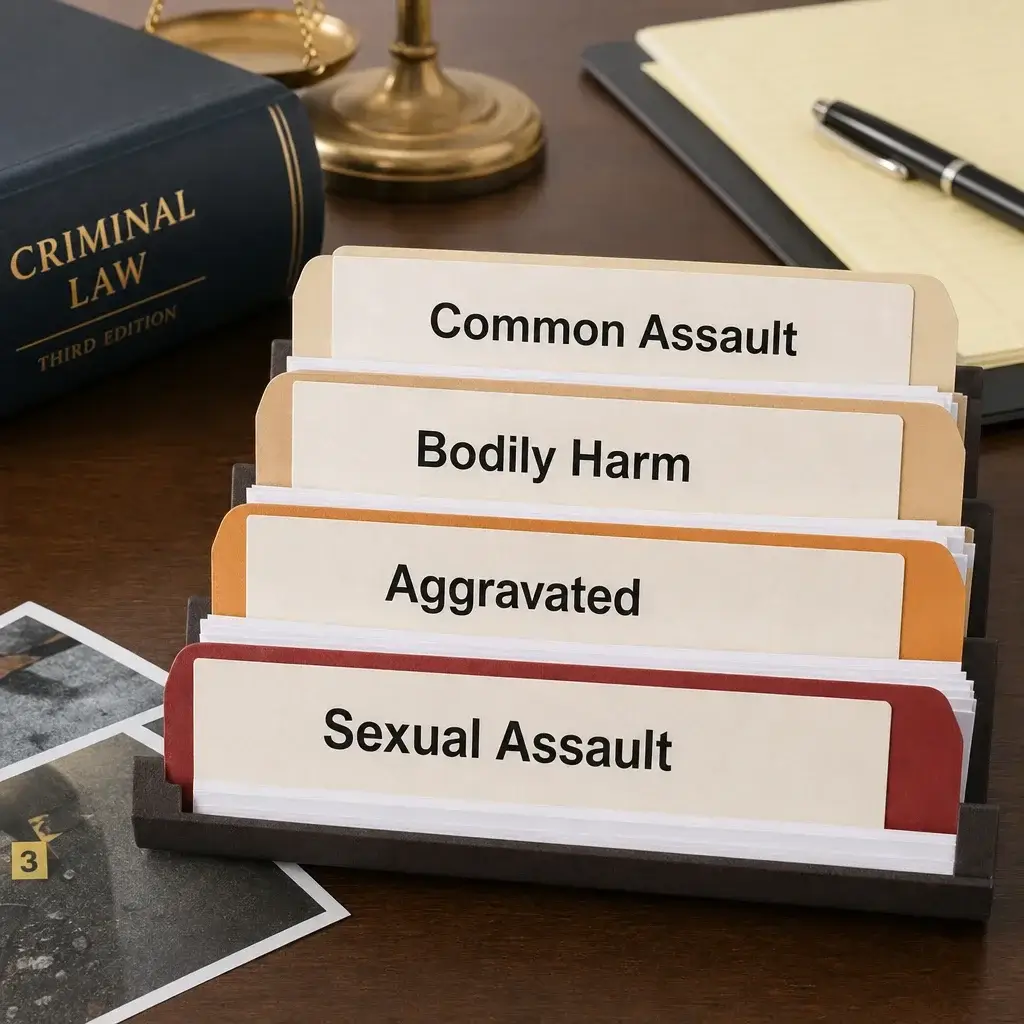
Assault is not one single charge label in practical court use. Common assault, assault causing bodily harm, aggravated assault, and sexual assault are different offences or offence categories, and the seriousness of the allegation can affect court level, mode of trial, and sentencing exposure.
Common assault is often what people mean by simple assault. It generally covers applying force without consent, attempting to apply force, or threatening by an act or gesture when the other person has reasonable grounds to believe force will follow. That is the lowest-level assault charge people usually mean, but the exact charge and any lesser included offence depend on the facts and the law in that case.
Assault causing bodily harm alleges an assault that causes bodily harm. Aggravated assault alleges wounding, maiming, disfiguring, or endangering life. Sexual assault applies assault law in a sexual context, and the key trial issues often include consent, credibility, and what evidence is legally admissible.
The process is broadly similar across charge types, but more serious charges are more likely to involve election issues, superior court procedure, a preliminary inquiry where legally available, or a judge and jury. Those details depend on the exact charge and current procedural rules.
Common Assault Charge Types and How the Process May Differ
| Charge type | What it generally alleges | Process differences that may matter |
|---|---|---|
| Common or simple assault | Non-consensual force, attempted force, or threatening conduct | Often proceeds more simply, but still may involve release conditions, disclosure, pre-trial, and trial if disputed. |
| Assault causing bodily harm | Assault plus bodily harm | Greater seriousness can affect court level, election, and sentencing exposure. |
| Aggravated assault | Wounding, maiming, disfiguring, or endangering life | Usually treated as a much more serious case with more complex procedure. |
| Sexual assault | Assault in a sexual context | Consent, section 276, section 278, privacy, publication bans, and testimonial aids may arise. |
Before Trial: Investigation, Charge, Arrest, Summons, and Bail

A police investigation can begin with a 911 call, a witness report, medical information, digital evidence, or a direct complaint to police. Police may take statements, collect photos, seek records, seize devices where lawful, and decide whether to lay a charge based on the evidence they have.
An arrest means a person is taken into custody. A charge means police formally allege that a Criminal Code offence was committed. A person can be charged after arrest, but some people are charged without being held and are released with paperwork requiring a future court appearance.
A summons or appearance notice is a document telling the accused when to come to court. An undertaking or release order sets conditions after release. Conditions may include no-contact terms, not attending certain places, reporting requirements, or weapons restrictions.
A bail hearing decides whether the accused stays in custody or is released pending trial. The law requires a bail hearing within about 24 hours, or as soon as possible if a justice is available.
A surety is a person who promises to supervise the accused and help ensure court attendance and compliance with conditions. A no-contact order matters immediately because even indirect communication, including messages through other people or social media, can become a separate breach allegation.
The complainant does not control the prosecution decision alone. A complainant can tell police or the Crown what they want, but the Crown decides whether to continue, withdraw, or stay charges based on the evidence, public interest, and legal test.
Early Court Dates: First Appearance, Second Appearance, CPT, and JPT
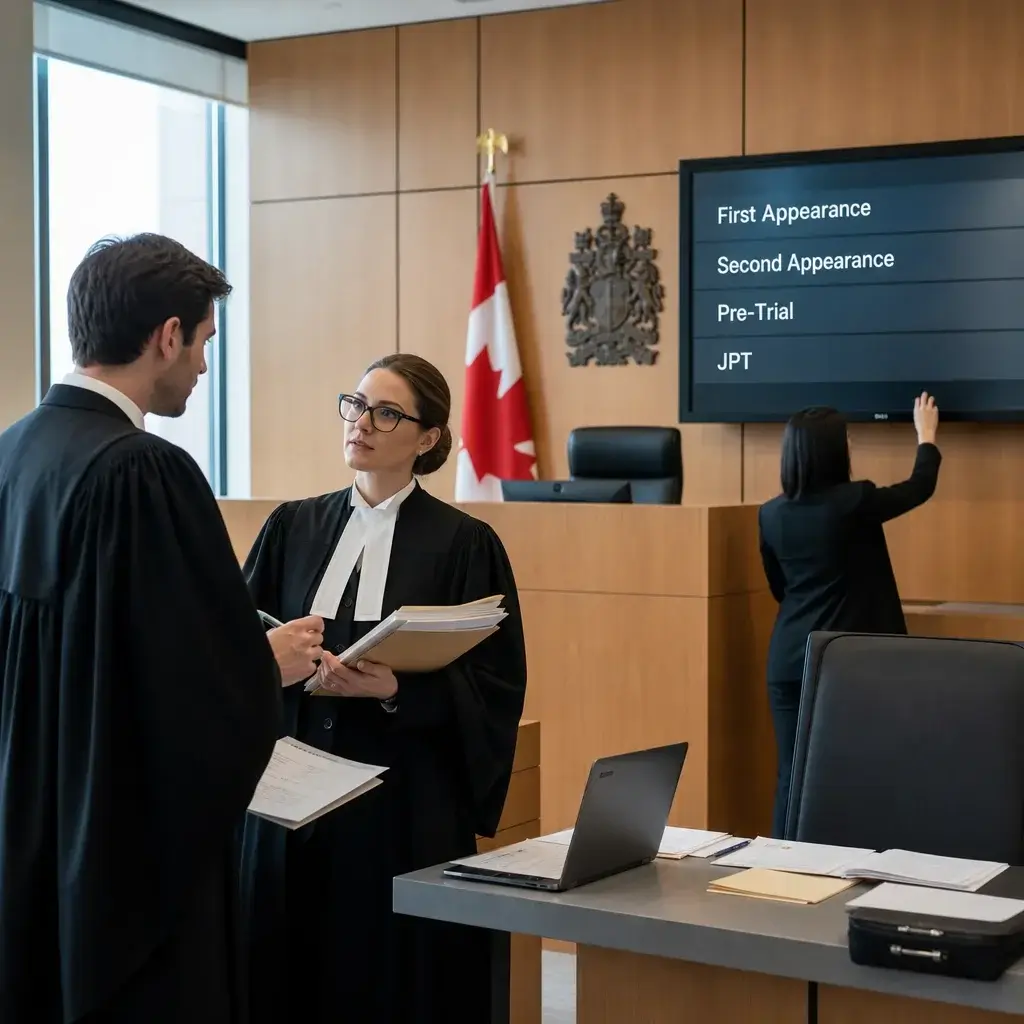
The first appearance is usually administrative. The court checks whether the accused has a lawyer, whether disclosure has been provided, and what date should come next. It is usually not the day witnesses testify about the incident.
A second court appearance in Ontario often deals with disclosure updates, whether counsel has been retained, whether the accused is electing mode of trial where required, and whether the matter should be set for a pre-trial or another step. The exact sequence depends on the charge and the court.
A pre-trial is a meeting or conference about case management, not the trial itself. In Ontario, it can be used to identify issues, estimate trial time, discuss admissions, disclosure problems, witness needs, and whether the matter may resolve without a trial.
CPT and JPT are court acronyms that can be confusing because usage can vary by court and region. In Ontario criminal practice, JPT commonly means judicial pre-trial, which is a meeting with a judge to discuss issues, scheduling, and possible resolution without hearing evidence on guilt. CPT may be used locally to mean Crown pre-trial or another court-specific scheduling term, so the exact meaning should be confirmed on the notice of appearance or with counsel in that courthouse.
Universal vs province-specific points
| Step or term | Broadly similar across Canada | Can vary by province or court |
|---|---|---|
| Arrest and charge | Yes | Local police and release practices differ. |
| Bail hearing | Yes | Scheduling and release forms can differ. |
| First appearance | Yes | Administrative flow differs by courthouse. |
| Judicial pre-trial | Common concept | Naming and timing differ. |
| CPT acronym | No | Meaning may be court-specific. |
| Trial mode and court level | Governed by offence and election rules | Application differs by charge and province. |
What Happens at Each Court Date
| Court step | What usually happens |
|---|---|
| First appearance | Counsel status, disclosure update, next date. |
| Second appearance | Disclosure follow-up, plea position, election or scheduling issues. |
| Crown pre-trial or similar | Crown and defence discuss issues, witnesses, and possible resolution. |
| Judicial pre-trial | Judge helps narrow issues and manage the file. |
| Preliminary inquiry | Limited screening hearing in eligible cases, not a full trial. |
| Trial date | Evidence is heard and the judge, or judge and jury, decides the case. |
| Sentencing date | Penalty is decided after a finding of guilt, sometimes the same day. |
Will the Case Go to Trial or Resolve Earlier?
Many criminal files resolve before trial, but assault cases go to trial when the facts are disputed, identity is contested, intent is challenged, consent is at issue in sexual assault, or credibility is the main battleground. A trial is more likely when the Crown and defence disagree on what actually happened.
Lawful non-trial outcomes can include a guilty plea, a withdrawal, a stay of proceedings, and in some cases a peace bond or diversionary resolution where legally available. Those options are not automatic, and they depend on the charge, injuries, record, public interest, Crown policy, and the evidence.
Assault charges can be dropped in Canada, but not simply because the complainant asks for it. The Crown must decide that withdrawal or a stay is proper on the evidence and in the public interest.
People should be careful about discussing settlement or resolution without legal advice. Statements made during the process can affect how the file is assessed later. This is one reason private legal advice matters early.
How Long Does an Assault Case Take?
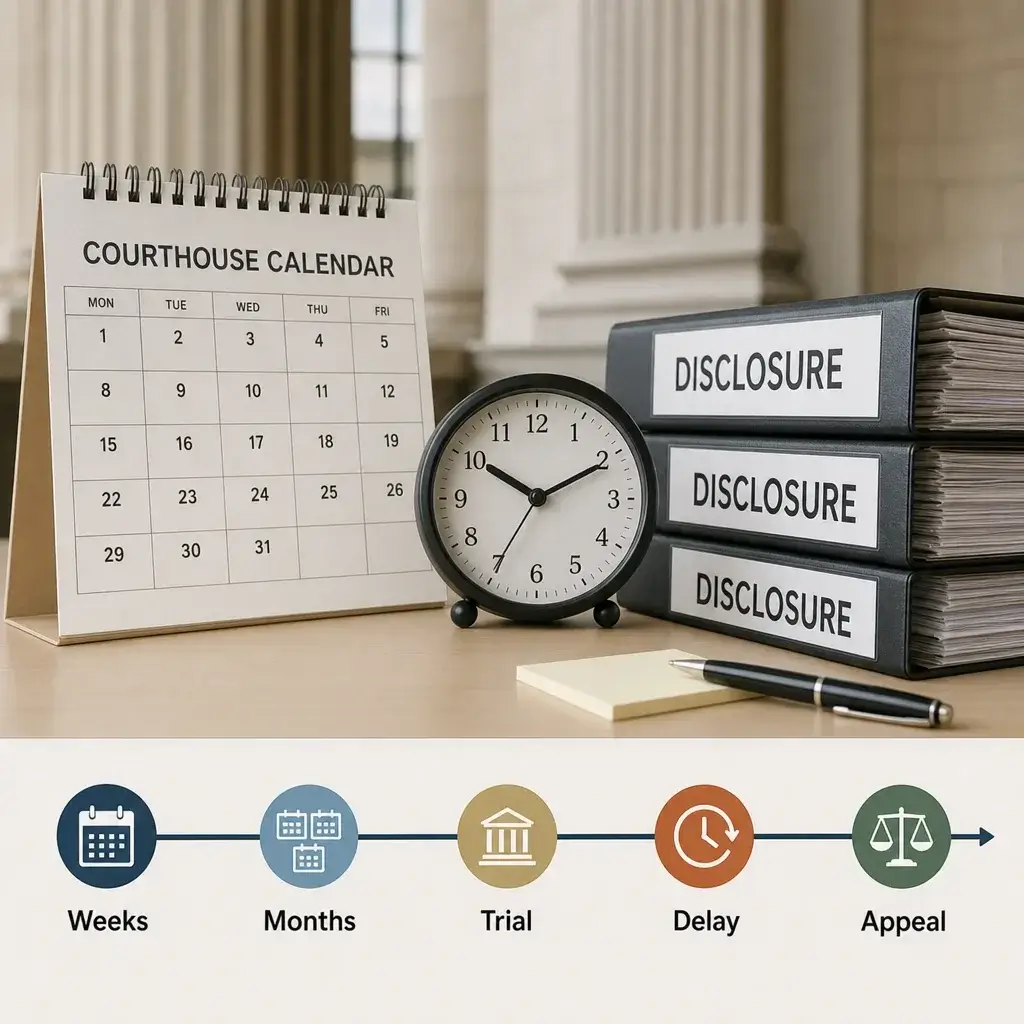
An assault case often takes several months to more than a year from charge to final resolution, and complex files can take longer. The biggest timing factors are disclosure, witness availability, court backlog, expert evidence, Charter applications, and whether there is a preliminary inquiry.
The period from first appearance to meaningful pre-trial work is often measured in weeks to months because disclosure has to be gathered, reviewed, and sometimes corrected or supplemented. A case cannot be responsibly set down for trial until the parties know what evidence exists and how long the hearing will take.
How long after a preliminary hearing is trial in Canada varies widely, but months of delay are common and a 6 to 12 month gap is not unusual in busier courts. The timeline depends on the court’s calendar, the number of witnesses, whether the matter is in superior court, and whether legal applications have to be heard first.
Without a preliminary inquiry, trial scheduling may be shorter, but it is still variable. A one-day simple assault trial usually moves faster than a multi-witness sexual assault trial with records applications, testimonial-aid issues, or interpreter needs.
Adjournments are common when disclosure is late, a witness is unavailable, counsel changes, an accused is not produced from custody, or the court needs more time than originally estimated. Delays do not always signal weakness in the case. They often reflect logistics and fairness concerns.
Preliminary Inquiry, Mode of Trial, and Court Level
A preliminary inquiry is a limited hearing in certain eligible indictable cases. It is not a full trial, and it does not decide guilt or innocence in the final sense. Its traditional function is to test whether there is enough evidence to commit the accused to trial on the charge before a higher court process continues.
Mode of trial means whether the case is heard in provincial court, superior court, by judge alone, or by judge and jury where the law allows that choice. Those options depend on the specific offence, the Crown’s election where applicable, and the accused’s election rights.
A judge and jury is not available in every assault case. More serious charges are more likely to raise that possibility, while less serious matters may stay in provincial court before a judge alone. Exact eligibility is charge-specific and should be confirmed for the actual offence.
If there is a preliminary inquiry, the evidence heard there is narrower than a full trial record. Witnesses may testify, but the hearing is a screening stage with a limited purpose, not the final determination of the case.
What Evidence Is Needed for an Assault?
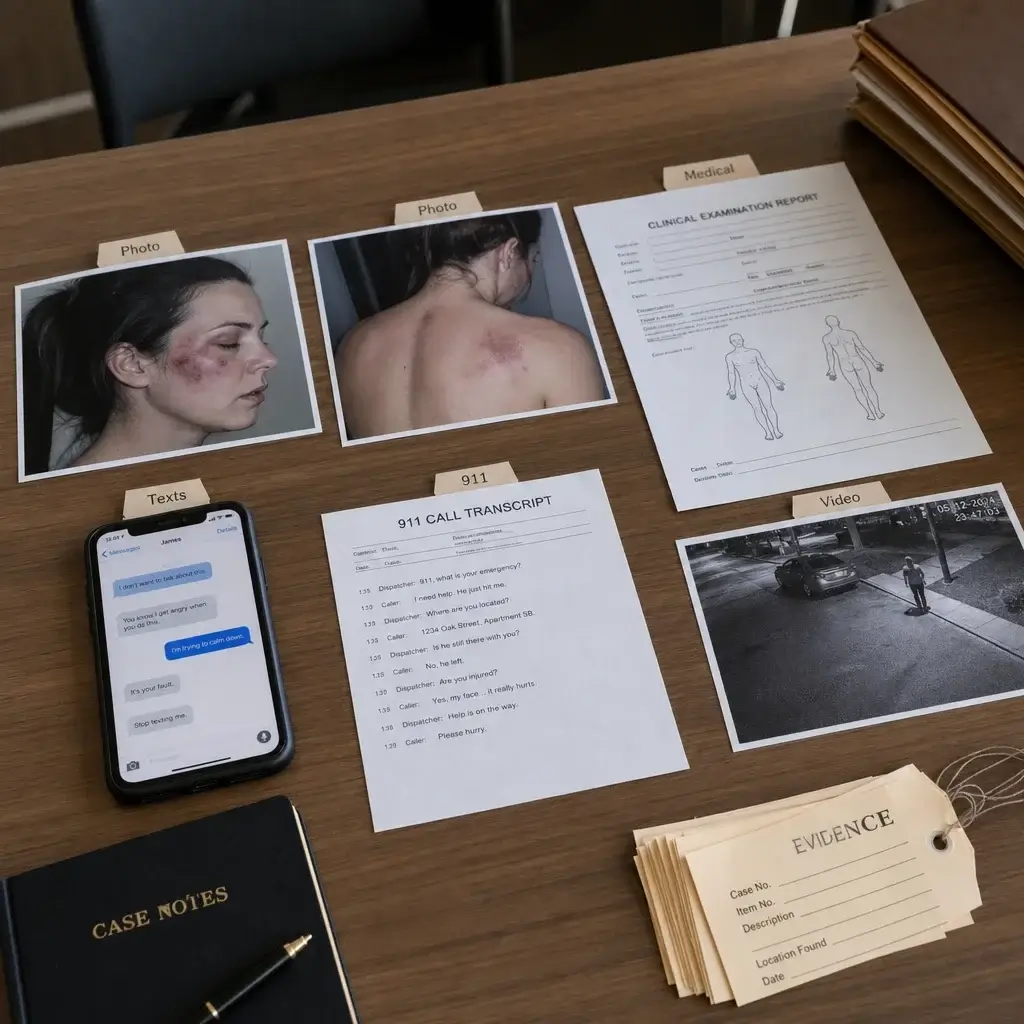
There is no fixed checklist of evidence required in every assault case. Some cases are proved mainly through witness testimony, while others rely heavily on photos, medical records, recordings, texts, surveillance video, or admissions.
Common evidence in an assault case can include the complainant’s testimony, eyewitness accounts, police observations, body-worn or surveillance video, 911 calls, medical records, photographs of injuries, text messages, emails, social media messages, and statements by the accused. The weight of each item depends on reliability, relevance, and admissibility.
What the Crown has to prove in an assault case is the actus reus and the mental element for the offence charged. In plain language, the Crown must prove the prohibited act happened and that the accused had the required state of mind. For common assault, that usually means proving an intentional application of force without consent, or another form of assault recognized by law.
What the Crown has to prove in a sexual assault case includes the assaultive act in a sexual context and the absence of consent. Depending on the defence raised, the court may also have to assess whether any claimed belief in consent has an air of reality and is legally available on the evidence.
Beyond a reasonable doubt is the criminal burden of proof. It does not mean absolute certainty, but it is much higher than suspicion or probability. If the judge or jury has a reasonable doubt after considering the whole evidence, the accused must be found not guilty.
What Evidence Can Be Used, and What May Be Excluded
Relevant evidence is not automatically admissible. Courts can exclude evidence because of hearsay rules, unfair prejudice, irrelevance, privilege, improper character use, or because admitting it would undermine trial fairness.
Hearsay usually means an out-of-court statement offered for its truth. Some hearsay is excluded, and some may be admitted under recognized exceptions or legal principles. Whether a statement comes in often depends on necessity, reliability, and the exact purpose for which it is offered.
Prior bad acts and character evidence are tightly controlled because they can distract from the real issue and tempt a judge or jury to reason unfairly. The law generally resists deciding a case on the basis that someone is a bad person rather than on proof of the charged event.
Unlawfully obtained evidence can become the subject of a Charter application. If a court finds a serious rights breach, the evidence may be excluded after a separate legal analysis. That is one reason side motions and trial applications can add major delay.
In sexual assault cases, a complainant’s prior sexual activity is not automatically admissible. Section 276 of the Criminal Code restricts use of sexual history evidence, especially where it is offered to support myths that a person was more likely to consent or less worthy of belief.
Therapy, counselling, medical, school, and other private records are not automatically open to the defence in a sexual assault case. Section 278 applications govern access to many private records, and a judge has to decide whether the legal threshold for production is met.
A publication ban can protect the identity of a complainant, witness, or justice participant in certain cases, including many sexual offence matters. The scope of the ban and whether it is automatic or requested can depend on the type of case and the governing rule.
What Happens During the Trial: The 5 Stages and the 7 Steps Explained
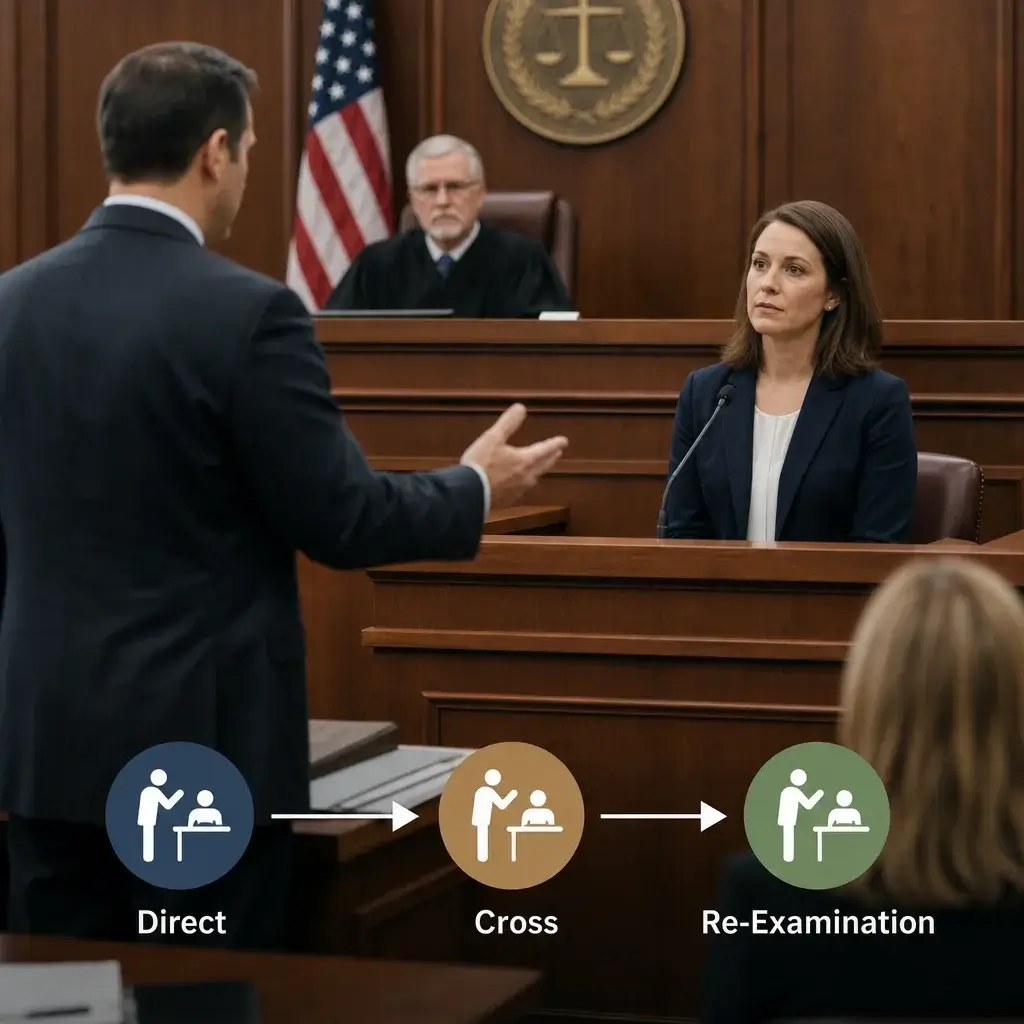
Different sources count stages differently, so both versions can be correct as long as the sequence is clear. The assault trial process itself is easier to understand when broken into either 5 stages or 7 steps.
The 5 stages of trial can be explained like this:
- Opening of the case and preliminary matters.
- Crown evidence.
- Defence evidence, if any.
- Closing submissions, or jury charge in a jury trial.
- Verdict.
The 7 steps of a trial can be explained in more detail like this:
- Preliminary matters and housekeeping.
- Crown opening.
- Crown witnesses in direct examination.
- Cross-examination of Crown witnesses, with re-examination if needed.
- Defence case, if any.
- Closing arguments.
- Verdict.
Direct examination is when the side who called the witness asks open questions to let that witness tell their evidence. Cross-examination is when the other side tests that evidence, credibility, memory, perception, bias, and prior statements. Re-examination is limited follow-up by the side who first called the witness to deal with new issues raised in cross.
In a judge-alone trial, the judge decides both law and fact. In a jury trial, the judge explains the law and the jury decides guilt on the facts, applying the legal instructions they are given.
Who Testifies and How Credibility Is Assessed
Witnesses in an assault or sexual assault trial can include the complainant, police officers, eyewitnesses, medical professionals, forensic witnesses, digital evidence custodians, experts where needed, and other civilian witnesses. The exact witness list depends on what facts are actually disputed.
The accused may testify, but there is no obligation to do so. The burden stays on the Crown to prove guilt beyond a reasonable doubt, and the accused does not have to prove innocence.
Credibility is not decided by confidence alone. Judges assess consistency, plausibility, internal logic, ability to observe, memory, motive, surrounding evidence, and whether a witness made prior inconsistent statements. A calm witness can be wrong, and an emotional witness can still be truthful.
Common myths distort public expectations. Delayed reporting, fragmented memory, continued contact after an incident, lack of visible injury, or no eyewitness does not automatically prove or disprove an allegation. Judges are supposed to assess the evidence without relying on those stereotypes.
Cross-examination can be especially difficult for survivors because it involves detailed questioning in a formal setting, often about painful events, memory gaps, prior statements, or private conduct. The court process can feel repetitive and stressful even when the questioning stays within legal limits.
Sexual Assault-Specific Issues: Consent, Privacy, and Testimony Supports
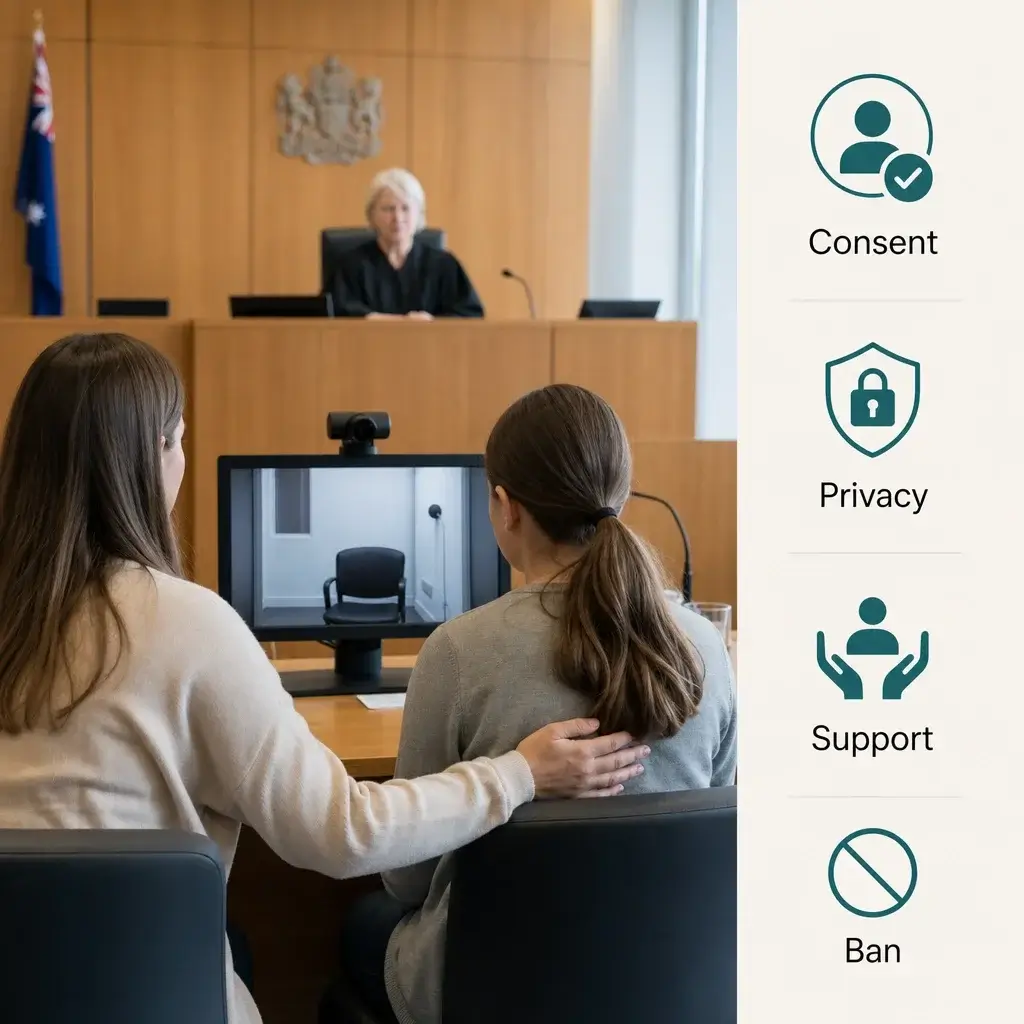
Consent in a sexual assault trial is a legal question, not just a personal label. In plain language, the court looks at whether the complainant voluntarily agreed to the sexual activity in issue at the time, based on the evidence and the law. The exact legal test is fact-specific.
An honest but mistaken belief in consent is a defence concept that can arise in some sexual assault cases, but it is not available simply because the accused says they misunderstood. Its availability depends on the evidence and the governing legal rules, including whether there is an air of reality to the claim.
Section 276 limits use of sexual history evidence. Section 278 governs access to many private records. Those two rules are central in the sexual assault trial process because they deal with myths, privacy, and fairness.
Testimonial aids are tools that can help a witness give evidence. They can include a support person, a screen, closed-circuit television, or other arrangements authorized by the court. Availability depends on the witness, the type of case, and the judge’s ruling.
A publication ban can restrict the public release of identifying information. That protection matters because court is open to the public, and a ban can reduce the risk of public identification in sexual offence cases.
If the accused is self-represented in a sexual offence case, special rules or court-appointed questioning arrangements may be considered to protect fairness and reduce direct personal confrontation in some circumstances. The exact protection depends on the law and the stage of the case.
Victim services and witness support programs can help with court orientation, safety planning, referrals, and practical preparation. In Ontario, courthouse-based victim and witness supports may be available, but the exact program name and local availability should be confirmed in the relevant court region.
What If the Complainant Does Not Want to Testify or Cannot Attend?
The case does not belong to the complainant alone. The prosecution can continue, reassess, or end the case based on the evidence and public interest, even if the complainant no longer wants to participate.
If the complainant does not want to testify, the Crown may seek time to speak with them, review the file, consider subpoena steps, or decide whether the case can proceed with other admissible evidence. A complainant’s reluctance does not automatically end the prosecution.
If the complainant cannot attend court, the matter may be adjourned, the Crown may ask for enforcement of a subpoena, or the prosecutor may reassess whether the case is still provable. The outcome depends on why the witness is unavailable and what other evidence exists.
Safety concerns, childcare issues, travel problems, health needs, and fear of testifying should be raised early with victim services, the Crown, or counsel. Early notice can matter because testimonial aids, scheduling changes, or publication-ban issues often need court approval before the trial date.
What to Expect on the Day of Trial
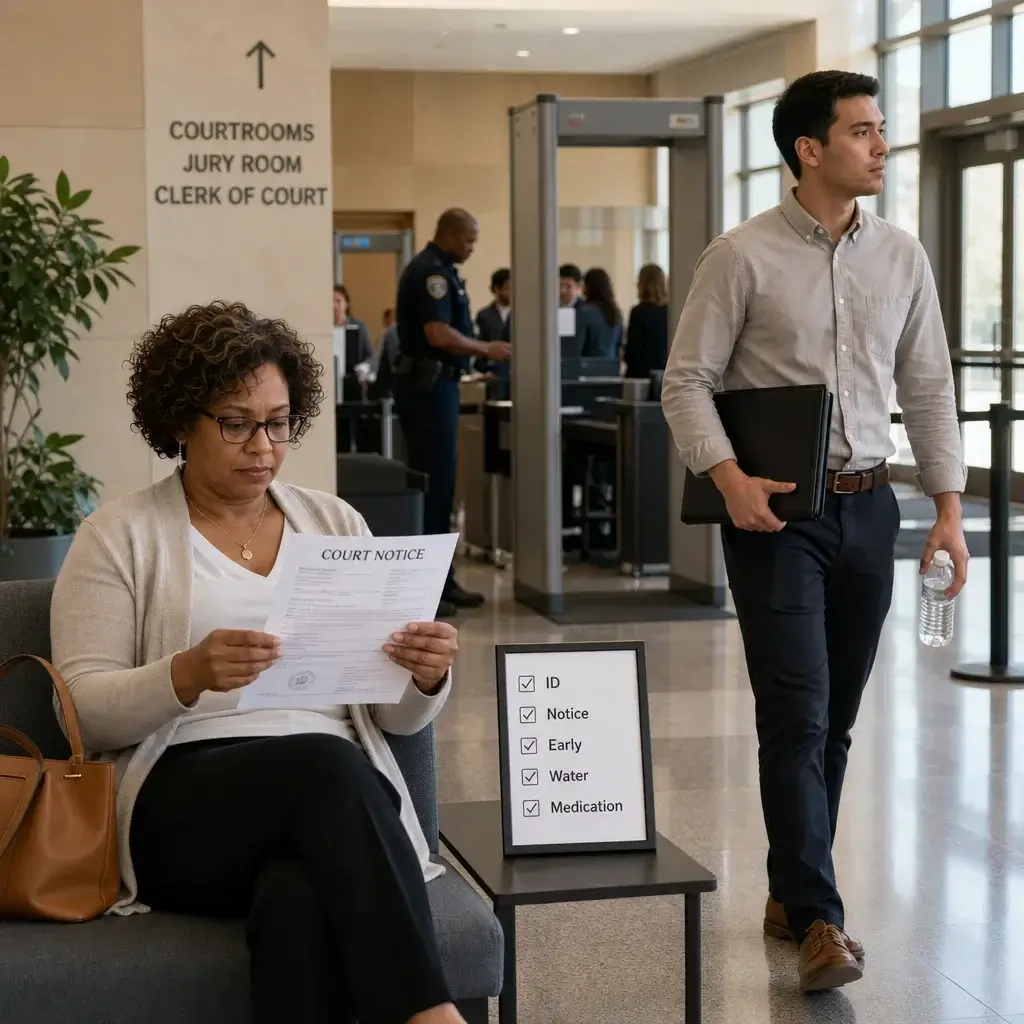
Court days usually involve waiting, security screening, last-minute scheduling issues, and possible delay even when a matter is listed to start that morning. Arriving about 30 to 60 minutes early is a practical rule in most courthouses because security lines, room changes, and lawyer meetings can take time.
Witnesses and survivors should usually bring photo ID, their court notice or subpoena, glasses or medication they may need, a phone charger, and contact information for a support person or victim services worker. Water may be allowed, but each courthouse has its own security practices.
Accused persons should usually bring their release paperwork, their next court notice, any lawyer contact information, and enough time for courthouse security and check-in. They should also review all release conditions beforehand because accidental contact or attendance in a prohibited place can create new legal trouble.
Neutral, respectful clothing is the safest choice for any participant. Court is formal, and appearance should not distract from the evidence.
Witnesses should not discuss their testimony with other witnesses if they have been told not to. In many cases, witnesses wait outside the courtroom until called so their evidence is not influenced by what others have said.
Trial-day checklist
- Bring ID and the court notice or subpoena.
- Arrive 30 to 60 minutes early.
- Dress neatly and conservatively.
- Bring needed medication, glasses, and phone charger.
- Ask court staff where to wait if you are unsure.
- Do not post about the case on social media.
- Do not discuss your evidence with other witnesses if instructed not to.
Verdict, Sentencing, and What Happens Next
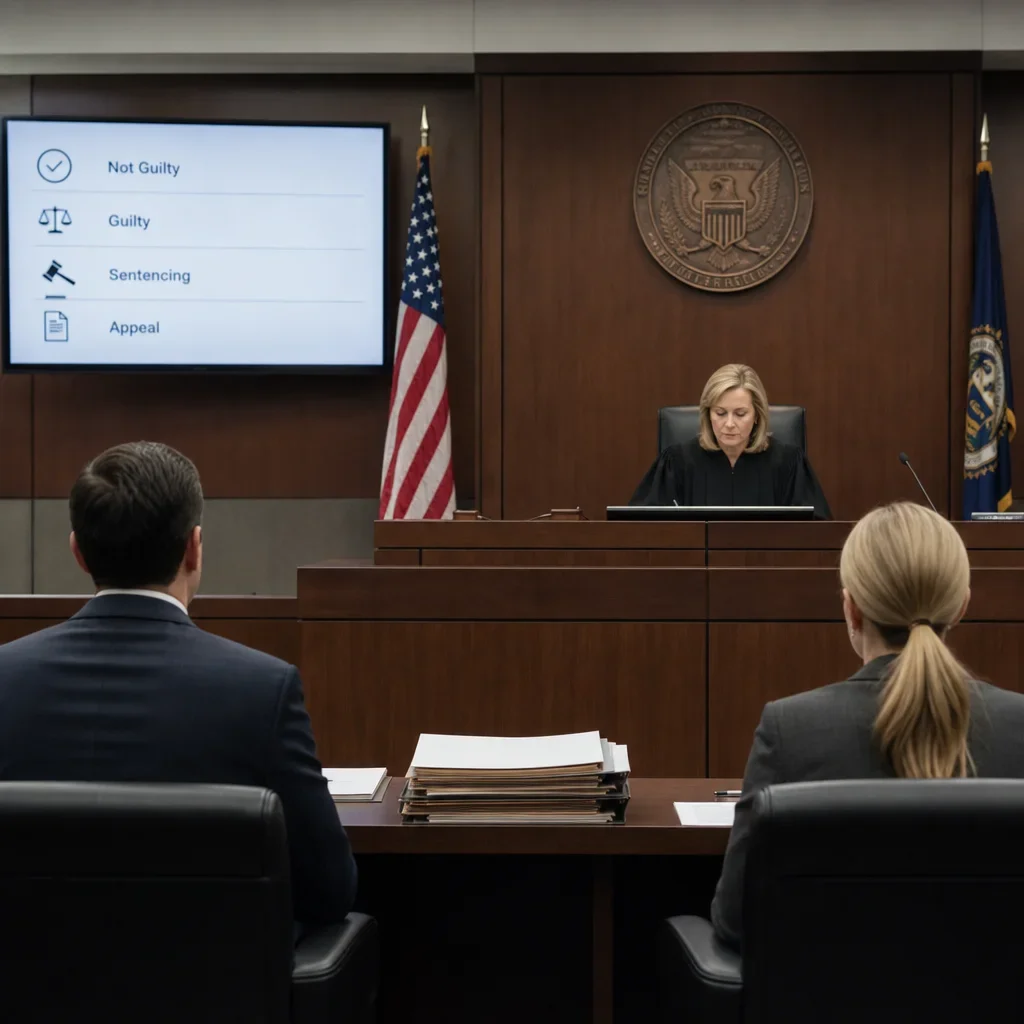
A not guilty verdict means the Crown did not prove the charge beyond a reasonable doubt. A guilty verdict means the court found the offence proved. In everyday use, people also say acquittal for a not guilty outcome after trial.
Sentencing can happen the same day, but it is often scheduled for a later date so the court can receive submissions, victim impact material where applicable, background information, and any reports needed. The sentence depends on the offence, the facts, injuries, prior record, aggravating and mitigating factors, rehabilitation, deterrence, and public safety.
Possible sentencing outcomes in assault cases can include an absolute or conditional discharge where legally available, probation, a fine where legally permitted, restitution where applicable, a conditional sentence where the law allows it, custody, no-contact terms, weapons prohibitions, DNA orders, or registration consequences in eligible sexual offence cases. Availability depends on the exact offence and current law.
Will a person go to jail for first time assault in Canada is the wrong question if asked as a yes-or-no rule. Jail is possible in some first-offence assault cases, but it is not automatic. The likely range of outcomes depends on the charge, injuries, use of weapons, record, surrounding circumstances, and any aggravating or mitigating factors.
Sentencing outcomes differ sharply between common assault and more serious allegations like aggravated assault or sexual assault. A first-time offender with a lower-level assault is in a different legal position from a person convicted of a serious injury case or a sexual offence carrying major ancillary consequences.
Appeals, NCR or Unfit Findings, and Breaches of Court Orders
Either side may have appeal rights, but appeals are limited to legal grounds allowed by the Criminal Code and the court structure. Appeal deadlines are strict, usually measured in days or weeks rather than months, and the exact deadline depends on the court and the type of appeal.
A finding that an accused is unfit to stand trial means the person cannot meaningfully participate in the proceedings at that time. An NCR finding means not criminally responsible on account of mental disorder. Those outcomes can move the case into a review board process instead of a standard verdict-and-sentence path.
Breaching a no-contact order, release condition, probation order, or other court order can lead to new charges, arrest, stricter release terms, or enforcement consequences even after the original assault case ends. Court orders should be read carefully because small mistakes, including indirect contact, can matter.
If a breach creates a safety issue, survivors and witnesses should report it promptly and seek support planning. Protective steps can involve police, victim services, or legal help depending on the type of order that was broken.
Key Terms Glossary
Accused: the person charged with the offence.
Complainant: the person said to have been assaulted.
Crown: the public prosecutor representing the state.
Bail hearing: the hearing that decides release or detention before trial.
Surety: a person who supervises the accused under release terms.
No-contact order: a condition prohibiting direct or indirect contact.
Disclosure: the Crown’s package of evidence and information provided to the defence.
Election: the choice of trial mode where the law permits one.
Preliminary inquiry: a limited hearing in eligible indictable cases.
Pre-trial: a case-management meeting before trial.
CPT: often means Crown pre-trial in some courts, but local usage should be confirmed.
JPT: usually means judicial pre-trial.
Direct examination: first questioning of a witness by the side who called them.
Cross-examination: questioning by the opposing side to test the evidence.
Beyond a reasonable doubt: the high criminal burden of proof.
Verdict: the decision of guilty or not guilty.
Sentencing: the process of deciding the penalty after guilt is found.
Appeal: a review by a higher court of certain legal or factual issues permitted by law.
FAQ
What happens in the assault trial process in Canada?
The usual path is investigation, charge, release or bail hearing, first court dates, disclosure, pre-trial steps, possible resolution discussions, trial, verdict, sentencing, and sometimes appeal. Not every case goes through every step.
What are the 5 stages of trial?
A useful 5-stage model is opening matters, Crown evidence, defence evidence if any, closing submissions or jury charge, and verdict. Different sources may label the stages a little differently.
What are the 7 steps of a trial?
A more detailed 7-step version is preliminary matters, Crown opening, Crown witnesses, cross-examination and re-examination, defence case if any, closing arguments, and verdict.
What evidence is needed for an assault?
There is no fixed checklist. Cases may be proved by testimony alone, or by a mix of testimony, photos, medical evidence, 911 calls, texts, video, and other surrounding evidence.
Can assault charges be dropped in Canada?
Yes, but the complainant does not decide that alone. The Crown decides whether to continue, withdraw, or stay the charge.
Will I go to jail for first time assault in Canada?
Jail is possible in some cases, but it is not automatic. The outcome depends on the charge, injuries, record, and other sentencing factors.
What is the lowest charge for assault?
People usually mean common or simple assault. The exact charge and any lesser included offence still depend on the facts and the law.
How long does court take in Canada for an assault case?
Many assault cases take several months to more than a year. Complex files can take longer.
How long after preliminary hearing is trial in Canada?
The gap is often measured in months. In busy courts, 6 to 12 months is not unusual, but timing varies widely.
What happens at a pre-trial in Ontario?
A pre-trial usually deals with issues, disclosure, witnesses, admissions, scheduling, and whether the case might resolve. It is not the trial itself.
What is a CPT in court?
CPT often means Crown pre-trial in some courts, but the acronym can be local. The exact meaning should be confirmed in that courthouse.
What does JPT mean in court?
JPT usually means judicial pre-trial, a meeting with a judge to manage the case and discuss issues before trial.
What happens if the complainant does not want to testify?
The Crown may reassess the case, seek an adjournment, consider subpoena steps, or proceed with other admissible evidence if possible. The case does not automatically end.
Can the defence access therapy or medical records in a sexual assault case?
Not automatically. Private records may require a section 278 application and a judge’s order.
What support can a survivor get while testifying?
Possible supports include a support person, a screen, closed-circuit television, a publication ban, and referral to victim or witness services. Availability depends on the case and the court’s ruling.
When to Get Legal Help or Support
Anyone charged with assault should get legal advice early, especially after arrest, before major court dates, before discussing resolution, or if release conditions are hard to follow. Witnesses and survivors should seek support early if they have safety concerns, need privacy protections, or may need testimonial aids.
If you are trying to understand your next court date, disclosure status, release conditions, or trial process, speak to a criminal defence lawyer for case-specific advice. If you are a complainant or witness, a victim services program or courthouse support worker can often help explain the process and available protections.