

 Based on 116 Verified Google Reviews
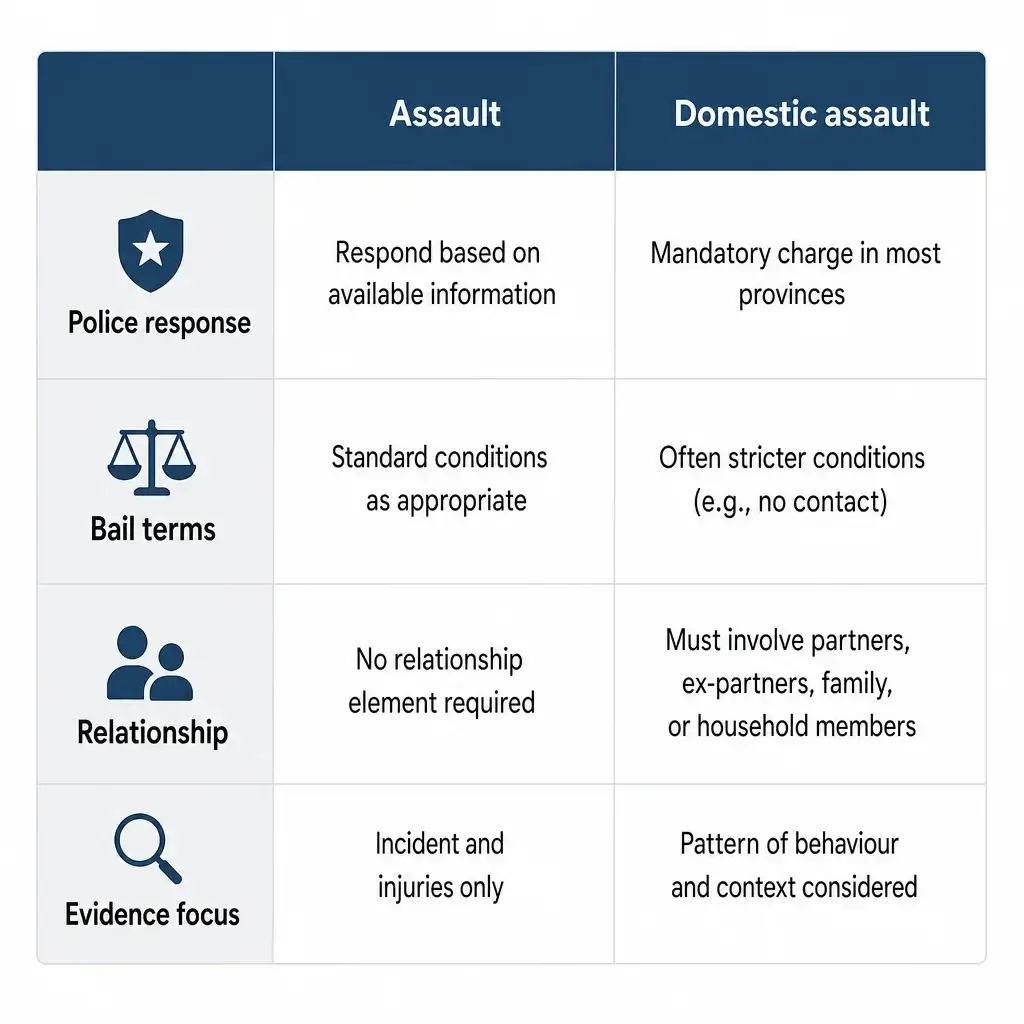
The difference between assault and domestic assault is usually not a different core assault rule. In Canada, the domestic part is the relationship context, and that can change arrest decisions, bail terms, prosecution approach, and sentencing consequences.
If you are searching the difference between assault and domestic assault because you or a family member was charged, the first thing to understand is simple. A domestic allegation can trigger stricter no-contact terms, removal from the home, and a Crown process that does not stop just because the complainant wants it over.
Assault vs. domestic assault: the short answer
In Canada, assault is defined in section 265 of the Criminal Code. “Domestic assault” is usually a way of describing an assault allegation involving an intimate or family relationship, not a stand-alone Criminal Code offence with different basic assault elements.
That means the underlying allegation may still be common assault, assault with a weapon, assault causing bodily harm, or aggravated assault. What changes is the domestic classification. That classification can affect police release, bail, contact with the complainant, access to the home, Crown screening, and how the court views the case at sentencing.
Side-by-side table: assault vs. domestic assault in Canada
| Issue | Assault | Domestic assault | Why it matters |
|---|---|---|---|
| Basic offence law | Usually charged under the general assault provisions of the Criminal Code | Usually the same assault provisions, but in a domestic relationship context | The legal building blocks may be the same, but the process often is not. |
| Relationship requirement | No domestic relationship required | Allegation involves a spouse, partner, ex, co-parent, or similar relationship, depending on the case context | The relationship can change bail and prosecution treatment. |
| Injury required | No visible injury is required for assault | No visible injury is required here either | A no-mark case can still lead to a charge. |
| Police response | Can range from release to bail court, depending on facts | Often treated with closer attention to safety and separation issues | Early release terms can be stricter. |
| Bail terms | Conditions depend on risk and facts | No-contact and no-attendance terms are common | You may be kept out of your home before trial. |
| Contact with children | Not always affected directly | Parenting contact can be limited by release terms or related family-court issues | Criminal and family issues can overlap fast. |
| Crown approach | Standard screening and prosecution decisions | Domestic cases may be handled with specialized screening or court practices in some jurisdictions | The complainant usually does not control continuation of the case. |
| Evidence focus | Proof of the assault allegation | Proof of the assault plus proof of the domestic relationship context | Texts, history, and living arrangements may matter more. |
| Collateral consequences | Record, employment, travel, licensing concerns | All of those, plus home access, parenting, and firearm issues can be more immediate | The practical fallout is often wider. |
| Resolution options | Trial, plea, withdrawal, peace bond, sometimes diversion depending on facts | Same broad categories, but access depends heavily on local policy and risk concerns | Domestic context can narrow the realistic options. |
Searchers also use phrases like simple assault domestic or domestic assault charge. In Canada, those labels usually describe context rather than a separate offence name.
What counts as assault in Canada?
Assault in Canada does not require a punch or an injury. Section 265 of the Criminal Code covers intentional application of force without consent, an attempt or threat to apply force if the person has, or causes the other person to believe on reasonable grounds that they have, the present ability to carry it out, and accosting or impeding someone while openly carrying a weapon or imitation weapon.
That is why the lowest level of assault is still serious. People often call it common assault or simple assault. In Canadian usage, those terms are usually used to describe the basic assault category, not a separate battery-style offence.
Words alone are not always enough. But words combined with a raised fist, a blocked doorway, a lunge, or other conduct showing immediate ability can support an assault allegation. A text sent from somewhere else may be threatening, but it does not automatically prove assault under section 265 just because the words were upsetting.
What makes an assault charge domestic?

A case becomes domestic because of who the complainant is in relation to the accused. The key issue is not whether the alleged force was different. The key issue is whether the relationship puts the allegation into an intimate or family setting.
A practical checklist helps. If the allegation involves a current spouse, common-law partner, dating partner, former dating partner, separated spouse, or co-parent, the case may be treated as domestic. In some cases, other family or household relationships also matter, but the exact category can depend on local practice and related legislation.
Examples make the line clearer. A shove during an argument between strangers is assault, but not domestic assault. A shove during an argument between separated spouses or co-parents may be treated as domestic because of the relationship. A threat during a breakup can also be analyzed through a domestic lens if the surrounding facts show an intimate relationship and an assault-type allegation.
Relationship examples that commonly raise a domestic classification
Current spouses and common-law partners are the clearest examples. Former spouses and separated partners can also fall into the domestic category because the relationship history does not disappear when people move out.
Dating relationships matter too. That can include current partners and former dating partners, especially where the file shows a continuing emotional, personal, or parenting connection.
Co-parents are a frequent flashpoint. Even if two people never married, shared parenting can be enough to put the allegation into a domestic context.
A roommate is different. If there was no intimate or family relationship, the case may stay an ordinary assault rather than a domestic one, though the facts still control.
Domestic assault, domestic violence, family violence, spousal abuse, and battery
Domestic violence vs assault is not a clean one-to-one comparison. In Canada, domestic violence and family violence are broader umbrella terms. They can include assault, threats, harassment, controlling behaviour, property damage, and family-law concerns that may or may not produce a Criminal Code charge.
Battery is where cross-border confusion starts. Domestic assault vs battery is mostly a US search issue, because battery is not the standard Canadian Criminal Code label for the basic offence. The same is true of domestic assault and battery as a phrase. Canadians usually deal with assault charges, not assault-and-battery charges.
Felony, misdemeanor, and fourth-degree labels also come from US systems. Canada generally uses summary and indictable procedure, and many assault offences are hybrid, meaning the Crown can choose the mode of proceeding.
Types and levels of assault in a domestic context
People ask about the three levels of assault in Canada because quick summaries online are inconsistent. The main categories most people need to know are common assault, assault with a weapon, assault causing bodily harm, and aggravated assault.
Common assault is the lowest level of assault in ordinary language. It covers the basic section 265 conduct without the added elements of a weapon, bodily harm, or wounding, maiming, disfiguring, or endangering life.
Assault with a weapon involves using, carrying, or threatening to use a weapon or imitation weapon during the assault. Assault causing bodily harm involves bodily harm, which means hurt or injury that interferes with the health or comfort of the person and is more than merely transient or trifling. Aggravated assault is the most serious standard assault category and involves wounding, maiming, disfiguring, or endangering life.
Any of those allegations can arise in a domestic setting. Aggravated domestic assault is usually a descriptive phrase, not a separate Canadian offence label by itself. The domestic relationship changes context, not the core legal category.
How domestic assault cases are usually handled differently
Domestic files are often handled more tightly at the front end. Police may be slower to treat the matter as a simple misunderstanding because separation, safety, and repeat-contact concerns are built into the domestic context.
The complainant usually cannot simply drop the charges. In Canada, the prosecution decision belongs to the Crown, not the complainant. A complainant’s wishes can still matter as part of the evidence picture, but they do not end the case on their own.
Some jurisdictions use specialized domestic violence courts or Crown screening practices. That is a process difference, not a different assault definition. It can affect how quickly disclosure is reviewed, what positions are taken on release, and whether peace bond or diversion discussions are realistic.
Bail, no-contact orders, moving out, and contact with children

The first real shock in a domestic assault charge is usually the release terms. Common conditions include no contact with the complainant, no attendance at the home, work, or school, no weapons, reporting requirements, and rules about communication through third parties only if specifically allowed.
A domestic assault charge can keep you out of your home before trial. That can happen even if your name is on the lease or title, because the criminal court focuses first on release risk and alleged victim protection.
Children can be affected even when they were not part of the allegation. A no-contact term with the other parent can disrupt parenting exchanges, school pickups, and day-to-day communication unless the release order creates a safe exception.
Breaching release conditions is a separate criminal problem. Even a text meant to apologize can create a new charge if the order says no contact. I tell people not to guess what the order means. Read every line and have a lawyer review it fast. This is general information, not advice on your own charge.
Penalties and sentencing: does domestic assault mean jail?
Jail is possible for assault or domestic assault, but it is never automatic and never ruled out just because this is a first charge. The result depends on the charge level, the facts, injuries, prior record, any breaches, the complainant relationship, and the Crown’s position.
In Canada, the procedure matters. Assault offences are commonly prosecuted either summarily or by indictment, depending on the offence and the Crown election. That is the Canadian framework, not domestic assault misdemeanor or is domestic assault a felony. Those US labels do not map neatly onto Canadian criminal law.
Domestic context can matter at sentencing because relationship-based violence may be treated as aggravating. That does not create a guaranteed jail outcome, and it does not guarantee a non-custodial one either. Other outcomes can include probation, fines, counselling conditions, or a criminal record, depending on the offence and resolution.
Penalties matrix: what changes and what does not
| Issue | Non-domestic assault | Domestic assault context | Why it matters |
|---|---|---|---|
| Core offence category | Common assault, assault with weapon, bodily harm, aggravated assault | Usually the same categories | Domestic context does not replace the underlying charge. |
| Risk of jail | Depends on offence seriousness, record, facts, injuries, and breaches | Same legal starting point, but domestic context can make sentencing stricter | Relationship violence can be treated as more aggravating. |
| Criminal record impact | Possible on conviction | Same, plus added fallout in parenting and living arrangements | The record issue can spill into family court and housing. |
| Probation conditions | Possible | Also possible, often with no-contact or counselling-type terms | The court may focus on separation and risk management. |
| Firearm consequences | Possible depending on charge and result | Often a more immediate concern in domestic files | Weapons restrictions can start early and last longer. |
Evidence in domestic assault cases

Most domestic cases rise or fall on the evidence package, not on whether a stranger saw it happen. Common evidence includes the complainant’s statement, the accused’s statement, 911 audio, police notes, body-worn video where used, scene photos, medical records, neighbour observations, texts, social media messages, and prior communications.
No independent witnesses does not end the prosecution. Many domestic assault cases turn on credibility, consistency, timing, physical observations, and whether outside details support or undermine the story.
Police reports, 911 calls, photos, texts, and witness statements each do different jobs. A 911 call can capture tone and immediacy. Photos can show injury, the lack of visible injury, or scene disorder. Texts can help prove relationship context, threats, apology language, or motive to fabricate.
Generalized scenario helps here. We see cases where nobody else was in the home, but one side has photos taken within minutes, location data, and messages before and after the argument. The legal fight then becomes not just who says what, but whether the surrounding evidence fits one version better than the other.
Can a case proceed without injury or independent witnesses?
Yes. You can be charged with domestic assault without causing an injury, and the absence of a witness does not stop the case by itself. Assault law does not require a bruise, a cut, or a hospital record in every case.
Threats and gestures can also matter. A raised fist from arm’s length away, a lunge during an argument, or blocking a doorway while threatening immediate force can support an assault allegation if the present ability element is there. A rude insult alone is not enough, and a remote text threat may raise other issues without automatically proving assault.
Defences in assault and domestic assault cases
The available defence depends on the facts, not the label domestic. Common defence themes include denial, identity, no assaultive act, lack of intent, self-defence, defence of another, consent in limited legally recognized situations, credibility problems, reliability problems, and Charter issues where the facts support them.
Self-defence in a domestic file is often more complex than people expect. The court can look at who started the force, whether the response was reasonable in the circumstances, the history between the parties, proportionality, and what other options existed in the moment.
Domestic context can create more evidence, not just more allegations. Prior messages, prior conflict, injuries on both parties, delayed reporting, and inconsistent statements can each help or hurt either side. That is why broad online advice is risky. A lawyer needs the actual disclosure, not just one side’s summary.
Peace bonds, diversion, and other possible resolutions
Some domestic assault cases resolve without a trial, but no single path is guaranteed. Depending on the facts, the record, injuries, safety concerns, and local Crown policy, possible resolutions can include withdrawal, peace bond discussions, diversion-type measures where available, or plea resolutions.
A peace bond is not an acquittal. It is a court order to keep the peace and obey conditions, and it may be used in some cases as part of a negotiated resolution. Whether that option is realistic depends heavily on the file and the jurisdiction.
Collateral consequences beyond the criminal charge
A domestic assault charge can affect more than the criminal court date. Release terms can change where you live, when you see your children, how you communicate with a co-parent, and whether you can return to collect property.
Employment and licensing can be affected by charges, conditions, or a record. Travel can also become harder, especially after a conviction. Immigration issues can be serious for non-citizens, but the exact impact depends on status and the final result, so specific immigration advice should come from counsel in that area.
Firearms are a separate practical concern. Weapons-related release terms, surrender issues, and later prohibition consequences can arise even in files where no weapon was allegedly used.
What to do after an assault or domestic assault charge
The safest first step is to obey every release condition exactly. Do not contact the complainant directly or through friends unless the order clearly allows it. Do not go back to the home to “sort things out” unless the order or police process permits it.
The next step is evidence preservation. Save texts, call logs, photos, video, social media messages, ride records, GPS or location data, and the names of any witnesses. Write out a timeline while events are fresh. Dates, times, and sequence points matter later.
Early legal advice matters because domestic files move quickly on release, disclosure review, and strategy. If you are facing an assault or domestic assault allegation, a defence lawyer can review the relationship classification, bail terms, evidence, and possible resolutions. This is general information, not legal advice for your situation.
Myth vs. fact
Myth: The complainant can just drop the charges. Fact: The Crown controls whether the prosecution continues.
Myth: No injury means no assault. Fact: Assault does not require visible injury.
Myth: Domestic assault is always a separate charge from assault. Fact: In Canada, it is usually the same underlying assault law in a domestic relationship context.
Myth: First-time assault means you will not go to jail. Fact: A first offence does not guarantee jail and does not guarantee avoiding jail.
Myth: Domestic assault and battery mean the same thing everywhere. Fact: Battery is mainly a US term and does not map neatly onto Canadian Criminal Code wording.
Myth: No witnesses means the case must fail. Fact: Domestic cases often proceed on statements, surrounding evidence, and credibility findings.
FAQ
What is the difference between common assault and domestic assault?
Common assault usually means the basic assault category. Domestic assault usually means that same kind of allegation, but involving a spouse, partner, ex, or similar domestic relationship.
Is domestic violence the same as assault in Canada?
Not exactly. Domestic violence is a broader label that can include assault, threats, harassment, and other conduct in an intimate or family setting.
Is domestic assault a separate Criminal Code offence?
Usually, no. In Canada, it is generally an assault allegation treated in a domestic relationship context rather than a separate offence name with different basic elements.
Can you be charged with domestic assault without leaving a mark?
Yes. Visible injury is not required for an assault charge.
Can words or threats alone be assault?
Sometimes, but not always. Words plus immediate ability, gestures, or conduct can amount to assault, while words alone may not.
Can the complainant drop domestic assault charges?
No. The complainant can express a view, but the Crown decides whether the case continues.
Will I go to jail for first-time assault in Canada?
Jail is possible, but not automatic. The outcome depends on the charge, facts, injuries, record, bail conduct, and other circumstances.
Can a domestic assault charge keep me out of my home?
Yes. No-attendance and no-contact release conditions can keep you away from the home before trial.
Can a domestic assault charge affect my children or parenting time?
Yes. Release terms and related family-court issues can interfere with contact, exchanges, and communication with the other parent.
What is the difference between domestic assault and battery?
In Canada, battery is not the usual offence label. People searching domestic assault vs battery are often seeing US terminology that does not fit Canadian law neatly.
Is domestic assault a felony or misdemeanor?
Those are US terms. In Canada, assault cases are dealt with through summary or indictable procedure, depending on the offence and Crown election.
What does domestic assault 4th degree mean?
That is generally a US classification, not a standard Canadian one. If your case is in Canada, the more useful question is which assault category was charged and what release terms are in place.
The short takeaway is this. The domestic label usually changes the process more than the basic assault definition. If the case involves an ex, a current partner, or a co-parent, compare the release terms, the evidence, and the relationship classification early, not just the wording on the information.