

 Based on 116 Verified Google Reviews
Most people think a second time domestic assault charge in Canada means the result is already decided. It does not. What it does mean is that bail, Crown screening, and sentencing risk are usually treated more seriously than a first allegation. This is general information, not advice on your charge.
What a second time domestic assault charge in Canada means
A second domestic assault charge Canada readers search for usually means a new assault allegation in a domestic setting, not a separate Criminal Code offence called “domestic assault.” Common domestic assault Canada cases are prosecuted under the assault provisions in the Criminal Code, with the relationship affecting release, Crown policy, and sentence submissions. Common assault is in section 266, assault with a weapon or assault causing bodily harm is in section 267, and aggravated assault is in section 268.
Domestic violence is a crime in Canada because conduct such as assault, uttering threats, criminal harassment, forcible confinement, sexual assault, mischief, and breach offences are criminal offences whether they happen between strangers or intimate partners. The domestic context matters because courts and Crowns treat intimate-partner allegations as a public-safety issue, especially where there is prior history, children, or alleged breaches. Uttering threats is section 264.1, criminal harassment is section 264, and failure to comply with a release order is section 145.
A “second time” label can mean three different things, and the difference matters. It may mean a second allegation on a new date, a second prosecution after an earlier case, or a case where there is already a prior conviction. A prior conviction usually has the clearest effect at sentencing, but prior allegations, prior breaches, and prior no-contact history can still affect bail and how the Crown views risk.
The seriousness of a second time domestic assault charge in Canada depends on concrete features, not the label alone. The main drivers are the exact charge, whether there was bodily harm, whether a weapon is alleged, whether children were present, whether the Crown proceeds summarily or by indictment, and whether there is a prior criminal record. I can’t predict an outcome without the disclosure, and every case turns on its own facts.
Does a prior charge, conviction, discharge, peace bond, or diversion count as a second offence?
A prior charge is not the same as a prior conviction. If someone was charged before and the case was withdrawn, stayed, or resulted in an acquittal, that does not create a prior conviction record. It may still matter in a bail hearing or risk assessment if the Crown says there is a pattern, but it is not the same legal category as a finding of guilt.
A prior conviction usually matters most for sentencing and often for bail. A sentencing judge can treat a prior assault conviction, prior domestic violence conviction, or prior breach conviction as aggravating context if it is relevant and proved by the record. That does not decide the new case, but it can change the Crown position on jail, probation, and no-contact terms.
A discharge is not the same as a conviction, but it is not the same as a withdrawal either. An absolute discharge is generally removed from the usual criminal record repositories after 1 year, and a conditional discharge after 3 years. Even so, a past discharge can still come up in some screening, police, or court contexts depending on access and timing.
A peace bond is not a criminal conviction. A peace bond is a court order to keep the peace and follow conditions, often for up to 12 months. It can still matter because a prior peace bond in a domestic context may affect how the Crown reads risk, and a breach of the peace bond can itself lead to a separate charge.
Diversion or alternative measures do not amount to a conviction, but they are not invisible. Depending on the province and the program, police and Crown records may still show that the person previously completed a domestic-violence-related resolution. That can affect screening and negotiations even where it does not create a prior conviction.
| Prior event | Is it a conviction? | Can it affect bail or sentence? |
|---|---|---|
| Prior charge only | No | Yes, sometimes, as background or risk context |
| Prior conviction | Yes | Yes, directly and strongly |
| Absolute or conditional discharge | No conviction | Yes, in some contexts, but differently from a conviction |
| Peace bond | No | Yes, especially if domestic history is relevant |
| Diversion / alternative measures | No | Yes, sometimes for screening and risk assessment |
| Withdrawn or stayed charge | No | Sometimes, but not as a conviction record |
First offence vs second offence domestic assault: what usually changes
A second domestic assault charge Canada case usually faces stricter scrutiny at release. Crown counsel is more likely to focus on protection of the complainant, public safety, and compliance history where there was a prior domestic file or earlier breach. That can mean tougher no-contact terms, a stronger position against returning home, or a more contested bail hearing.
A first-time domestic assault charge Canada file may still be prosecuted seriously, but repeat allegations usually reduce the Crown’s comfort with informal or trust-based arrangements. Prior no-contact violations, prior probation breaches, or a prior domestic pattern often matter as much as whether the new matter is called a second offence. Those facts can shape release terms and sentence submissions.
A second allegation also tends to raise the importance of documentation. Text messages, screenshots, 911 calls, body-worn video where available, medical records, and witness statements become more important because the Crown will look for corroboration and context, especially if the parties have a history of prior calls to police. Injuries are not required for assault, but surrounding evidence often matters more in repeat domestic violence charges Canada cases.
| Issue | First allegation | Second allegation or prior domestic history |
|---|---|---|
| Bail scrutiny | Serious | Usually stricter |
| No-contact terms | Common | Often broader and more strictly enforced |
| Return home | Sometimes addressed early | Often harder without a formal variation |
| Counselling / PAR discussion | May arise | Usually more guarded and fact-specific |
| Sentencing exposure if convicted | Depends on charge and record | Prior record or breaches can aggravate |
| Criminal record impact | Serious | Usually more serious with prior findings |
| Employment / immigration concern | Real | Often more urgent with repeat history |
What charges may be laid in a second domestic assault case
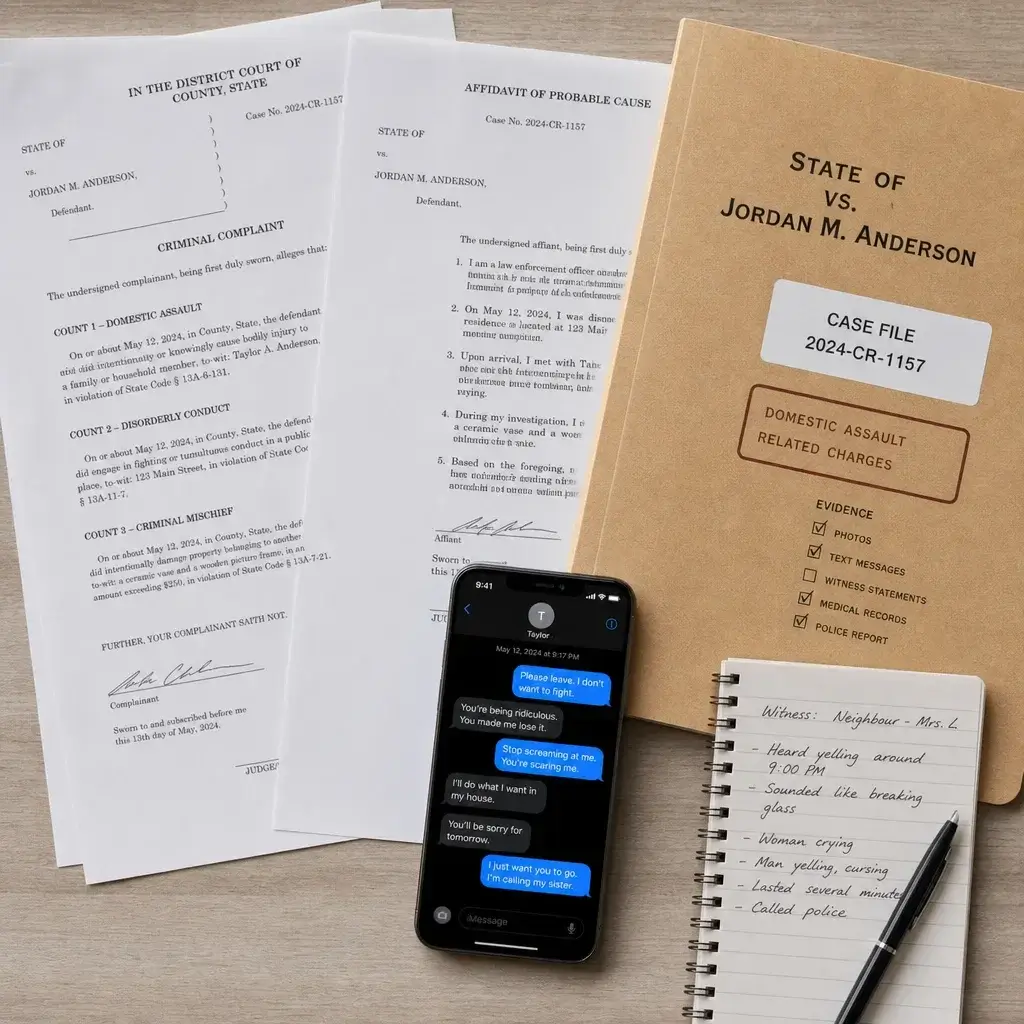
The phrase domestic violence Criminal Code Canada is shorthand for a group of offences, not one stand-alone offence. Police may lay common assault, assault causing bodily harm, assault with a weapon, aggravated assault, uttering threats, criminal harassment, forcible confinement, sexual assault, mischief, or failure to comply. Common assault is prosecuted under section 266, forcible confinement under section 279(2), mischief under section 430, and sexual assault under section 271.
The alleged conduct drives the charge more than the relationship label. Pushing, slapping, grabbing, throwing objects, damaging a phone, repeated unwanted calls, threatening messages, blocking someone from leaving, or an allegation of choking can all lead to different counts depending on the facts. The level of injury, any weapon, and any allegation involving strangulation or confinement usually raise the stakes.
Breach charges are common in repeat domestic assault charges Ontario and across Canada. If there was already a no-contact term, curfew, or release order, police may add a separate section 145 offence for failing to comply. That is often as important as the new assault count because courts treat disobedience of release orders seriously.
What to do in the first 24 to 72 hours after a second domestic assault charge

The first job is to read every line of the release papers and obey them exactly for the first 24 to 72 hours. If the paperwork says no direct or indirect contact, that means no calls, no texts, no email, no social media, and no messages through friends or family. Trying to “work it out” informally can create a fresh breach allegation.
The safest next step is to use the right to silence and speak to a criminal lawyer before giving a statement. In Canada, a detained person has the right to retain and instruct counsel without delay under section 10(b) of the Charter, and the right to silence is a basic protection recognized by the courts. Basic identification is one thing. Explaining the facts to police without advice is another.
Preserving evidence early can matter more than people think. Save screenshots, call logs, photos, videos, receipts, location data, work schedules, childcare schedules, medical records, and earlier court paperwork. Digital material can disappear quickly, and metadata can matter later when disclosure is reviewed.
A private timeline prepared for counsel helps anchor the defence from the start. Write down dates, times, witnesses, who was present, whether anyone had been drinking, whether there were prior messages, whether children were home, and whether police attended before. Keep it private for your lawyer. Do not post it online and do not send it to the complainant.
If there will be a bail hearing, line up practical support immediately. A surety may be needed in some cases, and that person is someone who supervises your release and can be ordered to pledge money to the court. Bail hearings are generally heard within 1 to 3 days of arrest if the person is not released by police.
Here is the short checklist:
1. Read the undertaking, recognizance, or release order carefully. 2. Obey no-contact and no-attendance terms exactly. 3. Do not send messages through third parties. 4. Do not discuss the facts with police after asking for counsel. 5. Preserve texts, photos, video, and location records. 6. Write a private timeline for your lawyer. 7. Identify defence witnesses and documents. 8. Prepare bail support if a hearing is coming. 9. Stay off social media about the case. 10. Speak to a criminal defence lawyer quickly.
Bail, release conditions, no-contact orders, and returning home
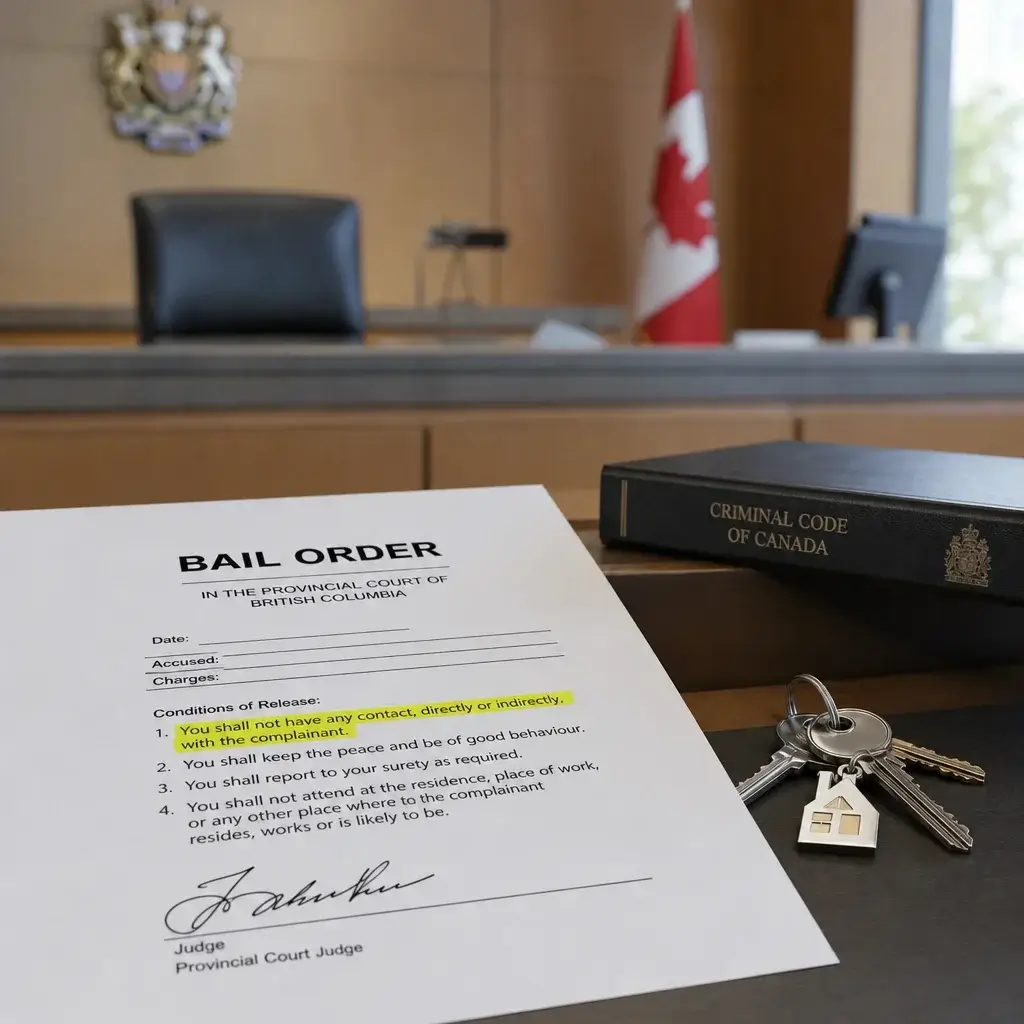
Release can happen at the police station or in court. Some people are released by police on an undertaking or recognizance with conditions, while others are held for a bail hearing, also called judicial interim release. The form of release usually depends on the allegations, record, prior compliance history, and whether the police say there is a safety concern.
Common conditions in domestic assault charges Canada cases are specific and restrictive. They often include no direct or indirect contact with the complainant, no attendance at the home, work, or school, no possession of weapons, surrender of firearms where ordered, abstain from alcohol or non-prescribed drugs, keep the peace and be of good behaviour, report to police or a bail program, counselling, and sometimes a curfew. Every condition matters because any breach can become a new charge.
A complainant cannot simply cancel a no-contact order by consent. If a court order, undertaking, or recognizance bars contact, private agreement does not override it. Contact exceptions, child-access terms, or a return-home arrangement usually need a formal variation through the court.
Returning home after a second domestic assault charge is usually harder where there is prior domestic history or a prior breach. The Crown will often argue that separation is needed to lower the risk of further conflict. In practice, child exchanges, property pickup, or communication about parenting often need structured terms through counsel or court.
Prior breaches can change the entire bail picture. A past violation of no-contact, curfew, probation, or a peace bond gives the Crown a concrete basis to argue that less restrictive release did not work before. That does not decide release, but it is a real factor in whether a surety, tighter terms, or detention is sought.
Can domestic violence charges be dropped in Canada?
Domestic assault charges dropped is a phrase people search, but the complainant usually does not control that decision. In Canada, the Crown decides whether to continue, withdraw, stay, or resolve a charge based on the available evidence and the public interest. That is especially true in domestic violence charges Canada cases.
If the complainant wants the case dropped, the Crown may still continue. The prosecutor may review the 911 call, police notes, photos, medical records, witness evidence, text messages, and prior statements to decide whether there is still a reasonable prospect of conviction under the applicable Crown standard. A recanting witness does not automatically end the case.
Trying to pressure or persuade a complainant to withdraw can make things much worse. It can lead to new allegations such as obstruction-related conduct, witness interference concerns, or a straightforward breach of no-contact terms. Even one text or indirect message can become its own problem.
The role of the Crown in a domestic violence case is not to act for either party personally. Crown counsel acts on behalf of the public and assesses safety, proof, prior history, and the legal strength of the case. Having prosecuted, I look at domestic files the way the other side will: where is the proof, where are the inconsistencies, and is there a Charter issue that affects admissibility.
What evidence matters most in a repeat domestic assault case

The strongest repeat-case evidence is usually the evidence created closest in time to the allegation. That includes 911 recordings, police notes, body-worn or in-car video where available, photos of injuries or the scene, medical records, neighbour evidence, messages, emails, social media posts, and admissions. Those items often shape both bail and trial strategy.
Prior incidents are not automatically admissible to prove guilt on the new charge. They may arise for bail, sentencing, or context arguments, but using past misconduct to prove present guilt is a legally controlled issue. Similar-fact or prior-discreditable-conduct evidence has strict admissibility rules, and it is not automatic.
The absence of visible injury does not end a domestic assault Canada case. Assault can be proved without bruising or medical treatment if the Crown alleges intentional non-consensual force. At the same time, the absence of injury can still matter when I examine credibility, sequence, and whether the surrounding evidence fits the allegation.
Digital evidence should be preserved early because timing often matters. Message threads, deleted calls, shared-calendar entries, ride receipts, GPS records, and building-access logs can support or contradict the police theory. Disclosure often arrives in stages, and I review it for gaps, missing downloads, and whether police preserved the right material.
Defences to a second domestic assault charge
There is no single defence that fits every second domestic assault charge in Canada. The defence depends on the disclosure, the statements, any injuries, the history between the parties, and the digital record. Common defence themes are denial, self-defence, accident, identity, lack of proof, inconsistent statements, and Charter arguments about how evidence was obtained.
Self-defence can apply if the accused used force for a defensive reason and the response was reasonable in the circumstances. In Canada, self-defence is governed by section 34 of the Criminal Code. Whether it applies depends on the full context, including who started the confrontation, what each person believed, and whether the force used was proportionate.
Reasonable doubt often comes from inconsistency, not drama. If the 911 call, body-camera account, neighbour statement, text messages, and courtroom testimony do not line up, that matters. In some cases, the strongest defence is not proving an alternative story but showing the Crown cannot prove its own version beyond a reasonable doubt.
Charter issues can matter where police entered a home, seized a phone, obtained statements, or detained someone unlawfully. Section 8 protects against unreasonable search and seizure, section 9 against arbitrary detention, and section 10(b) protects the right to counsel without delay. If evidence was obtained in breach of the Charter, I may challenge whether it should be excluded.
Consent is not a broad answer to assault in domestic cases. Canadian assault law does not treat consent as a blanket defence to intentional force causing bodily harm, and context matters even for lower-level force issues. This is one area where careless online advice causes real harm.
Court process after arrest: timeline from release to trial or sentence
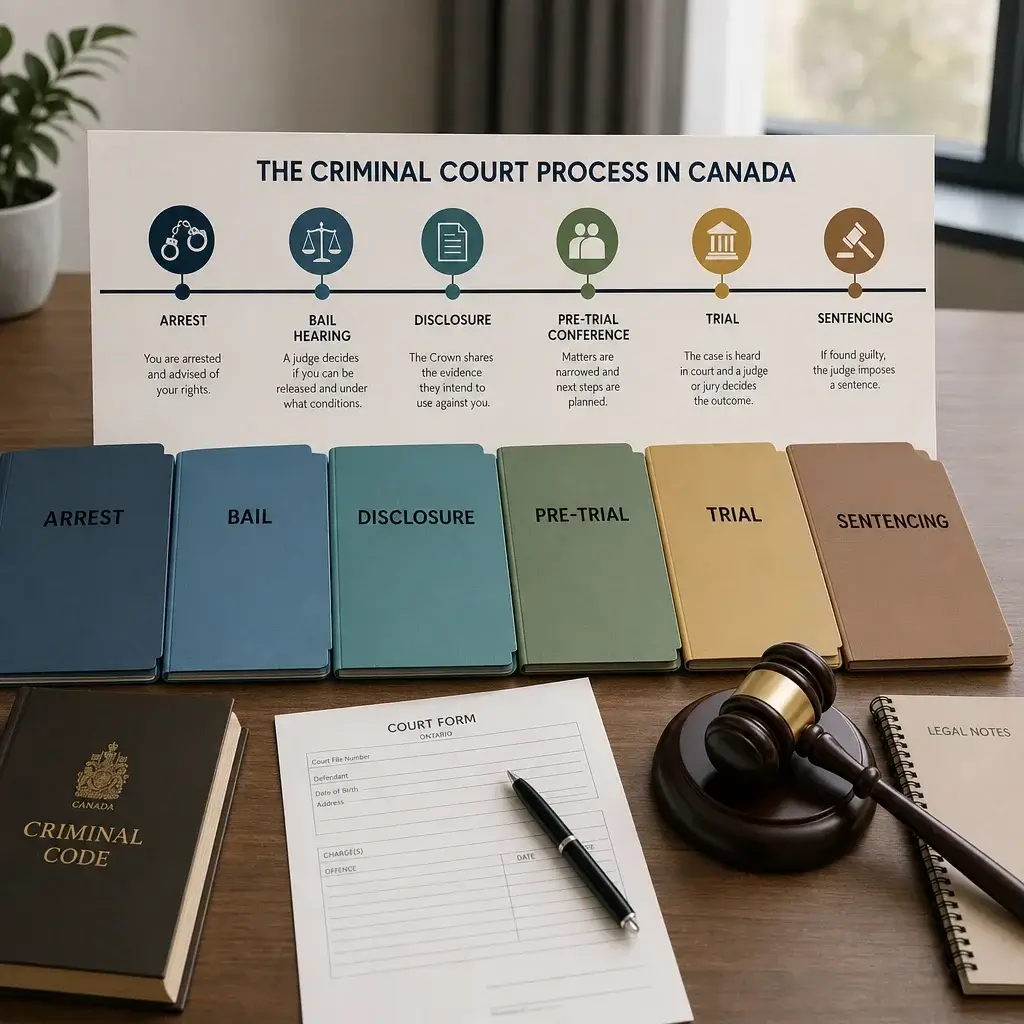
Most cases move through a set sequence even though timing varies by province and court. The usual steps are arrest or summons, release or bail, first appearance, disclosure, Crown resolution discussions, possible judicial pre-trial or Crown pre-trial, trial if needed, and sentencing if there is a finding of guilt or plea. A criminal matter can take roughly 6 to 18 months to resolve, and longer if it goes to trial in a busy court or has heavy disclosure.
The first appearance is usually administrative. It tells the court whether counsel is retained, whether disclosure has been received, and what the next date should be. It is not usually the day the evidence is argued in full.
Disclosure is the package of police reports, witness statements, photos, recordings, and other evidence the Crown provides. I review the disclosure for weak points, missing pieces, contradictions, and any Charter problem. Without the disclosure, no responsible lawyer can predict the outcome.
Resolution discussions happen after disclosure is reviewed. In a domestic case, they may include bail variations, no-contact exceptions for parenting, counselling steps, peace-bond discussions, or plea discussions depending on the facts. A peace bond is not an acquittal and not a conviction, but in some cases it becomes part of the discussion.
Trial is where witnesses testify and are cross-examined under oath. That is where credibility, reliability, digital evidence, prior statements, and police conduct are tested. If there is a conviction or guilty plea, sentencing follows and the court looks at the offence, record, breaches, aggravating factors, and any rehabilitative material.
| Stage | What happens | What the accused should do |
|---|---|---|
| Arrest / summons | Charge is laid | Say little, ask for counsel |
| Release / bail | Conditions are imposed or argued | Follow conditions exactly |
| First appearance | Scheduling and status | Ensure disclosure is requested |
| Disclosure review | Evidence is provided | Have counsel review it carefully |
| Crown discussions | Resolution options explored | Do not assume early offers define the case |
| Motions / trial prep | Legal issues and witness planning | Preserve evidence and attend court |
| Trial | Evidence is tested | Follow counsel’s advice on testimony |
| Sentencing | If there is a plea or conviction | Provide relevant background material |
Sentencing for domestic assault in Canada: jail, probation, fines, and treatment

There is no single domestic assault Canada sentence. The sentence depends on the underlying offence, the injuries, the record, whether there were children present, whether a weapon was involved, whether there were prior breaches, and whether the Crown proceeds summarily or by indictment. There is also no universal minimum sentence for domestic violence in Canada across all domestic assault cases.
Common assault under section 266 carries a maximum of 2 years less a day on summary conviction or 5 years if prosecuted by indictment. Assault with a weapon or assault causing bodily harm under section 267 carries a maximum of 2 years less a day on summary conviction or 10 years by indictment. Aggravated assault under section 268 carries a maximum of 14 years.
A second domestic assault conviction is generally treated more seriously than a first. That does not create one fixed jail term. It means the court is more likely to hear Crown submissions about denunciation, deterrence, protection of the complainant, and the accused’s prior compliance history. Prior no-contact breaches and prior probation breaches can be as damaging as the earlier assault record itself.
Possible sentencing outcomes can include a discharge where legally available, a suspended sentence with probation, a fine in limited contexts, a conditional discharge where legally available, an intermittent jail sentence in appropriate cases, a custodial sentence, probation, counselling, and no-contact terms. Some outcomes are not legally available for some charges or some record situations, so the charge and the record matter.
Section 718.2 of the Criminal Code directs sentencing judges to consider abuse of an intimate partner or family member as an aggravating factor. That is one reason domestic violence charges Canada cases are sentenced differently from a bar fight or stranger assault with similar physical facts.
| Charge type | Criminal Code | Maximum penalty |
|---|---|---|
| Common assault | s. 266 | Summary: 2 years less a day; Indictment: 5 years |
| Assault with a weapon / assault causing bodily harm | s. 267 | Summary: 2 years less a day; Indictment: 10 years |
| Aggravated assault | s. 268 | Indictment: 14 years |
| Uttering threats | s. 264.1 | Summary: 2 years less a day; Indictment: 5 years |
| Criminal harassment | s. 264 | Summary: 2 years less a day; Indictment: 10 years |
| Failure to comply with release order | s. 145 | Penalty depends on the subsection charged |
If you are asking what is the minimum sentence for domestic violence in Canada, the careful answer is this: there is no universal minimum for the broad category people call domestic violence. Some specific offences may have their own rules, but domestic assault as a category does not carry one standard minimum sentence. I would need the exact charge and disclosure to speak meaningfully about sentencing exposure.
Can you be charged twice for the same offence in Canada?
Most people using this phrase are really asking about two different domestic incidents, not one event charged twice. A new allegation on a different date can lead to a new charge even if the parties are the same. Multiple charges can also arise from one incident if the police allege assault, threats, and breach together.
Being prosecuted again after a final outcome for the exact same offence is a different legal issue. Canada has protections against being tried twice after a final acquittal or conviction for the same matter, but that is not the same as facing a new charge for a later incident. The legal doctrines are technical, so this is one of those questions where the exact procedural history matters.
How prior record, prior breaches, children, and domestic history affect the case
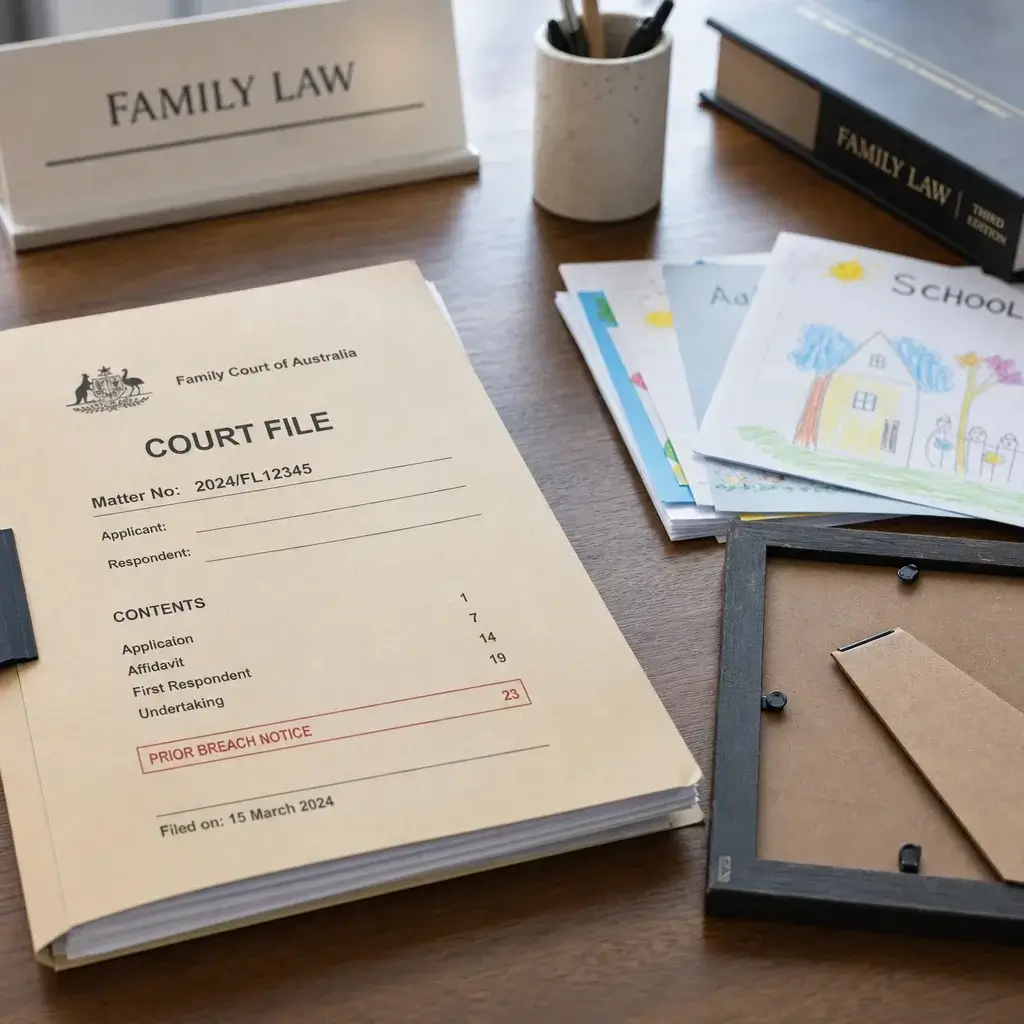
Prior breaches can be as serious as the new assault allegation. If someone has a history of violating no-contact orders, probation, release terms, or peace bonds, the Crown will usually rely on that history in bail and sentencing. A court sees breach conduct as evidence about whether orders are likely to be followed.
Children in the home can change both the criminal case and the family-law picture. If children were present, exposed to the incident, or caught in the aftermath, that can become an aggravating factor at sentence and may trigger involvement from child protection authorities such as the Children’s Aid Society in Ontario. Criminal court release terms and parenting arrangements can conflict, which is why coordinated legal advice is often needed.
Prior domestic history may also affect how witnesses are examined and how risk is argued. It does not automatically prove the new charge, but it can shape the Crown position on detention, contact restrictions, counselling, and sentence submissions. That is especially true where the new file includes prior police attendance, repeated 911 calls, or previous allegations of choking, threats, or confinement.
Immigration, work, travel, firearms, and professional licence consequences
A domestic assault allegation can affect much more than the court case itself. A pending charge may show up on police checks or employment screens depending on the type of check and the setting. A conviction can affect employment, vulnerable-sector work, professional regulation, security clearances, and reputation.
Immigration consequences can be serious for non-citizens. Charges and convictions may affect temporary status, permanent residence issues, admissibility, or future applications, but the result depends on the exact offence, the sentence, and the person’s immigration category. Anyone who is not a Canadian citizen should get immigration advice alongside criminal defence advice.
US travel can also be affected by assault-related records or admissions. Border issues are not decided by the Canadian criminal court, and American authorities apply their own admissibility rules. That is why even a resolution that avoids jail can still carry cross-border consequences.
Firearms and licences can be affected at the release stage and later. Some accused persons are ordered not to possess weapons as a bail term, and firearms may have to be surrendered if the order requires it. Separate federal firearms rules and licence consequences may also come into play depending on the facts and the final result.
Can counselling, PAR, peace bonds, or alternative resolutions help in a repeat case?
Counselling can help as part of a release plan or sentencing package, but it does not make a case disappear. Courts and Crowns may look more favourably on documented treatment, anger counselling, substance counselling, or relationship programming where it is relevant and genuine. It is not a defence, and it is not a guarantee of any result.
Partner Assault Response, often called PAR, exists in some provinces as a structured domestic-violence program used in certain court outcomes or family-law contexts. It is not automatically available in every repeat case, and eligibility depends on local practice, the allegations, and the Crown position. Homefront-style domestic violence courts are local examples, not Canada-wide rules.
A peace bond may sometimes be discussed as a resolution, but it is not available on demand and it is not a conviction. Peace bonds commonly run for up to 12 months. In a repeat domestic file, the Crown may be less willing to consider that route if there is injury, a prior conviction, or a record of breaches.
FAQ: quick answers
What is a second time domestic assault charge in Canada?
It usually means a new domestic assault allegation after an earlier domestic file, allegation, or conviction. It is not a separate stand-alone offence name in the Criminal Code.
What is the sentence for domestic assault in Canada?
There is no single sentence. It depends on the exact charge, the injuries, the record, the procedure, and any prior breaches.
How long is jail time for domestic violence in Canada?
There is no fixed jail term for the broad category people call domestic violence. Jail exposure depends on the underlying offence and aggravating factors, and some cases do not result in jail while others can.
Can domestic violence charges be dropped in Canada?
The complainant usually cannot drop them personally. The Crown decides whether to continue, withdraw, stay, or resolve the case.
Can I contact the complainant if they agree?
Not if your release papers say no contact. Private agreement does not cancel a court order or release condition.
Can I return home after a domestic assault charge?
Only if your release terms allow it or the order is formally changed. Do not go back home on your own if there is a no-attendance term.
Does a prior charge count as a second offence?
Not in the same way as a prior conviction. A prior charge is background; a prior conviction usually has the clearest legal effect at sentencing.
Does a peace bond count as a criminal conviction?
No. A peace bond is not a criminal conviction, though it can still matter in later bail or Crown screening.
Will I go to jail for first-time assault in Canada?
Not automatically. Jail depends on the exact offence, the facts, and the person’s record. A repeat offence or prior breaches usually raises the risk.
Can you be charged twice for the same offence in Canada?
A new incident can lead to a new charge. Being prosecuted again after a final result for the exact same offence is a different legal issue.
What happens if I breach a no-contact order?
You can be arrested and charged with a separate breach offence. That new charge can also make your bail position worse on the original case.
Can counselling or PAR help with a second domestic assault case?
Sometimes as part of bail planning or sentencing material. It is not a defence and it does not guarantee a withdrawal or other outcome.
Speak with a criminal defence lawyer quickly
The earliest mistakes in a second time domestic assault charge in Canada case are usually contact mistakes, statement mistakes, and breach mistakes. I review the disclosure, examine the release terms, and look for weak points in the Crown’s case, including credibility problems and Charter issues. If you are dealing with a new domestic assault charge in Toronto, Brampton, Scarborough, Oshawa, Newmarket, or elsewhere in Ontario, the immediate step is simple: obey the order, preserve the evidence, and speak to a criminal lawyer before you say more.