

 Based on 116 Verified Google Reviews

A false domestic assault charge can still lead to arrest, removal from your home, and a no-contact order. I have prosecuted and defended these cases, and the first point is simple: do not try to fix it yourself.
Immediate action plan if you are facing false domestic assault charges
False allegations can trigger criminal court consequences in the first 24 to 72 hours, so the safest first steps are practical and disciplined.
- Use your right to silence. Section 7 and section 10 of the Charter protect your right to silence and your right to speak to counsel. You do not have to give a full statement because you are innocent. I can’t predict an outcome without the disclosure.
- Ask to speak to a lawyer right away. If police arrest or detain you, they must give you a reasonable opportunity to contact counsel without delay. Early advice matters because one bad statement can shape the whole file.
- Do not contact the complainant. A friendly text, apology, or request to recant can become evidence, or a breach issue if there is an undertaking or release order in place. Family members should not act as go-betweens unless a lawyer confirms contact is permitted.
- Obey release terms exactly. Domestic assault charges in Ontario often come with no-contact and no-attendance conditions. The complainant cannot waive a court order by saying contact is fine.
- Preserve evidence immediately. Save full text threads, call logs, emails, DMs, photos, location data, CCTV, and witness names before anything disappears. Do not delete, crop, edit, or annotate messages.
- Write a timeline while memory is fresh. Record dates, times, locations, who was present, and what happened before and after the allegation. Small timing details can matter later when I review disclosure and test credibility.
- List witnesses and third-party records. Neighbours, ride-share receipts, work logs, condo cameras, and school pick-up records can all matter if they fix the timeline.
What happens after a domestic assault allegation in Ontario
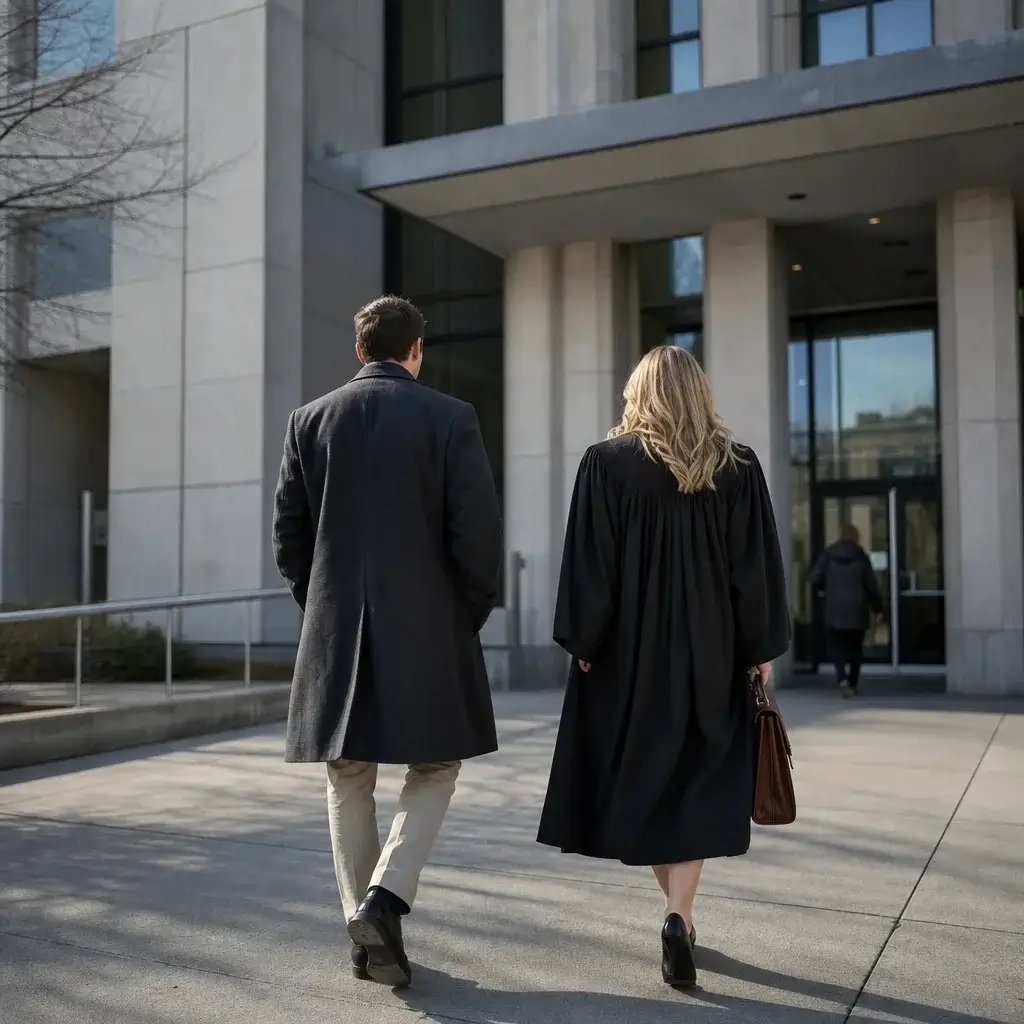
A domestic complaint can lead to an investigation, arrest, release terms, a first court date, disclosure, and then months of case management even if you say the allegation is false.
Police do not need to decide who is telling the truth beyond a reasonable doubt at the scene. They act on reasonable grounds to believe an offence occurred. That is why a person who is falsely accused of domestic assault can still be arrested.
A bail hearing is generally heard within 24 hours or as soon as practicable after arrest. If police release you instead, they may do so on paperwork that sets conditions before the first court appearance.
The common release tools sound similar but they are not the same:
| Term | What it means | Why it matters |
|---|---|---|
| Undertaking | A police release document with conditions | You stay out of custody, but you must follow every term exactly |
| Release order | A court order releasing you, often after a bail hearing | The judge or justice sets conditions that can be stricter |
| Bail / judicial interim release | The process of getting released while the charge is pending | It may involve a surety, cash terms, or a detailed release plan |
Common bail conditions in domestic assault files include no contact, no attendance at the home or workplace, not possessing weapons, and sometimes limits on contact with children pending family arrangements. Every case turns on its own facts, the alleged relationship, the risk concerns raised, and the release plan available.
Should you speak to police, hand over your phone, or answer questions?

Being innocent does not make it wise to give a statement without legal advice.
Police can require basic identification in some situations, but they cannot require you to volunteer a narrative just because they ask. Once you start explaining, you can lock yourself into details before you have seen the disclosure, the 911 call, the notes, or the messages police already have.
Your phone can hold helpful evidence and damaging evidence at the same time, so do not casually consent to a device search. If police ask for your phone, ask what authority they are relying on, and speak to counsel before consenting where that is possible. Do not delete anything. Deletion can create a different problem and may destroy material that helps your defence.
If police arrive at your home, you do not have to consent to a search just because they ask. If they have a warrant, read it if you can, do not obstruct, and note what they took. Section 8 of the Charter protects against unreasonable search and seizure, and search issues can matter in domestic cases where devices, clothing, or household items are seized.
Passwords and compelled device access are accuracy-sensitive issues, so I keep the general advice simple: do not guess, do not lie, do not destroy evidence, and get legal advice on the specific demand being made.
How to preserve evidence that can actually help your defence

The best evidence in a false domestic violence case is usually evidence that fixes time, context, and sequence.
Start with the complete communication record, not selected screenshots. Full text threads, email chains, social media DMs, call logs, voicemails, and video calls can show tone, timing, prior plans, and what happened before and after the complaint.
Save original files where possible because metadata matters. The date created, sender and recipient identifiers, file name, device source, and upload history can help authenticate a message, photo, or video later. A cropped screenshot is weaker than the original source file plus the full thread.
Preserve digital and third-party records quickly because some systems overwrite data. Condo cameras, store CCTV, ride-share records, delivery logs, smart-doorbell footage, and workplace access records may not stay available for long. If a business has footage, your lawyer can consider a preservation request.
Create a dated evidence log so the material stays organized. Include what the item is, where it came from, the date and time, whose device or account it came from, and whether you exported or backed it up. Chain of custody is a simple idea: be able to explain what the file is and how it got from the source to court.
Police material can also help the defence once it is disclosed. That may include the 911 audio, dispatch records, officer notes, body-worn camera footage, booking video, photographs, and witness statements. I review disclosure for omissions, timing gaps, and context the initial police narrative may miss.
Evidence preservation checklist
- Save full text threads, not excerpts
- Export emails with headers if possible
- Preserve call logs and voicemails
- Back up photos and videos in original format
- Note witness names and contact details
- Save location history, ride-share, and work attendance records
- Identify possible CCTV or smart-home footage quickly
- Keep medical, counselling, or treatment records only if they are relevant and lawfully available
- Do not alter, crop, relabel, or annotate originals
- Do not ask anyone to delete material or change a statement
How false domestic assault cases are defended

A defence is not limited to proving a complete fabrication.
The issue may be a false allegation, an exaggeration, self-defence, accident, lack of intent, mutual struggle, mistaken identity, or a simple failure of proof. Assault can be committed without causing injury, and the Crown still has to prove the act, the identity of the accused, and the required intent beyond a reasonable doubt.
Credibility and reliability are often central. I compare the complainant’s first account, later statements, texts, 911 call, body-worn camera footage, medical records, and independent witnesses to see whether the timeline holds together. An inconsistency does not automatically mean someone is lying, but a contradiction can matter if it goes to the core issue.
911 calls and police video can cut both ways. A frightened voice on a call may support the complaint, but the timing, wording, background sounds, and what is missing can also support the defence. Body-worn camera footage may show injuries, or it may show calm conversation that does not fit the initial narrative. I do not assume the police summary tells the whole story.
Having prosecuted, I look at the file the way the Crown does. I examine where proof is thin, where a Charter challenge may arise, where the search was too broad, and where the timeline falls apart when the surrounding messages are added back in.
What counts as domestic assault in Canada, and what charges may be laid?
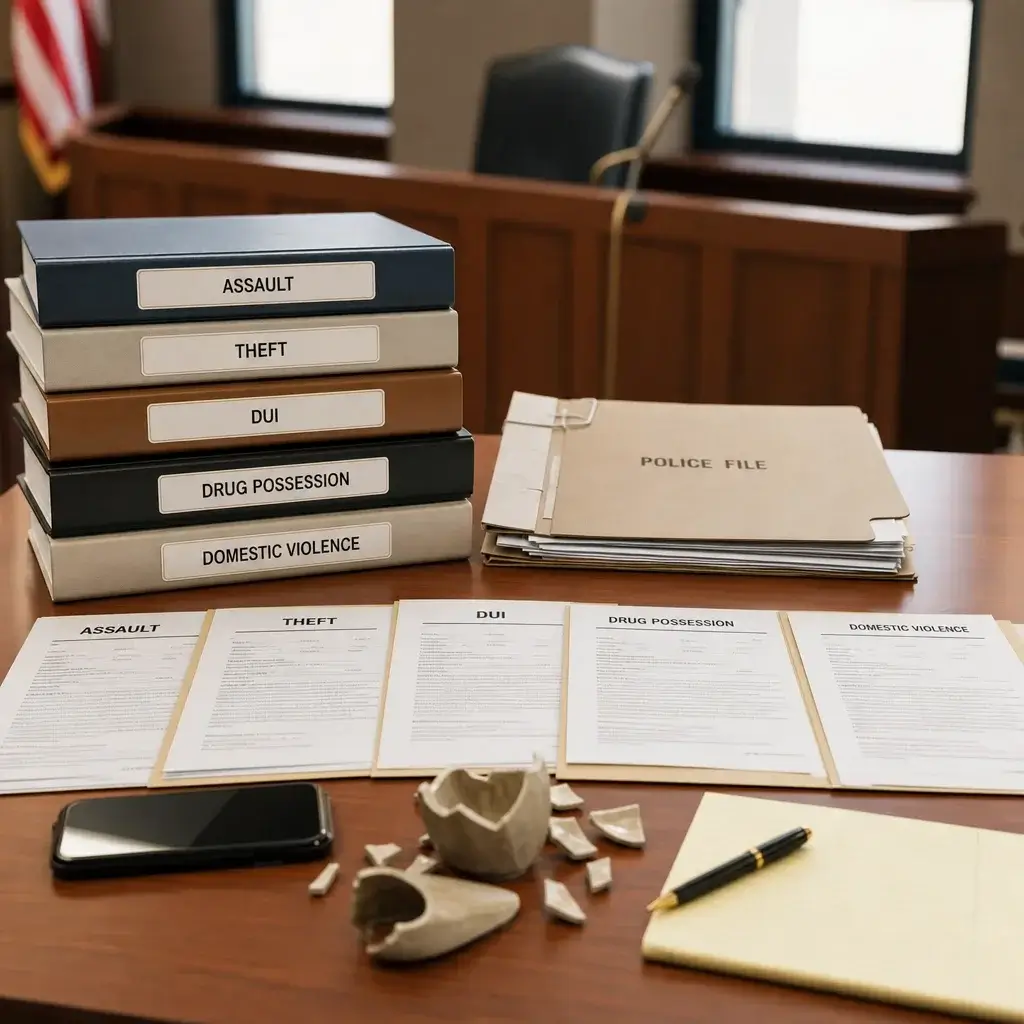
Domestic assault is usually not a separate Criminal Code offence. It is generally an assault allegation in an intimate, dating, or family relationship context.
The domestic context matters because it affects release terms, prosecution approach, and sometimes sentencing consequences. In Ontario, domestic assault charges are commonly screened and managed with a strong focus on safety concerns and no-contact conditions.
Here are common charges that can arise from the same incident:
| Charge type | What it generally involves | Why the domestic context matters |
|---|---|---|
| Assault | Intentional application of force without consent, or an attempt or threat by act or gesture | Often leads to no-contact terms and removal from the home |
| Assault causing bodily harm | Assault that causes more than trivial or transient injury | Injury allegations can affect bail position and resolution discussions |
| Assault with a weapon | Assault involving an object used as a weapon | Household items can become key evidence |
| Uttering threats | Threatening death, bodily harm, or damage in certain forms | Often charged alongside assault after texts or calls are reviewed |
| Criminal harassment | Repeated conduct that causes someone reasonably to fear for safety | Contact after separation can become a separate issue |
| Mischief | Damaging property or interfering with lawful use of property | Broken phones, doors, or household damage often appear in disclosure |
Assault can proceed by summary conviction or by indictment depending on the charge and the Crown’s election. Summary offences commonly carry lower maximum penalties than indictable offences, but the exact maximum depends on the specific offence. I avoid giving sentence numbers without confirming the current Code provision because those figures are accuracy-sensitive and change over time.
Bail, no-contact orders, and how to seek a variation
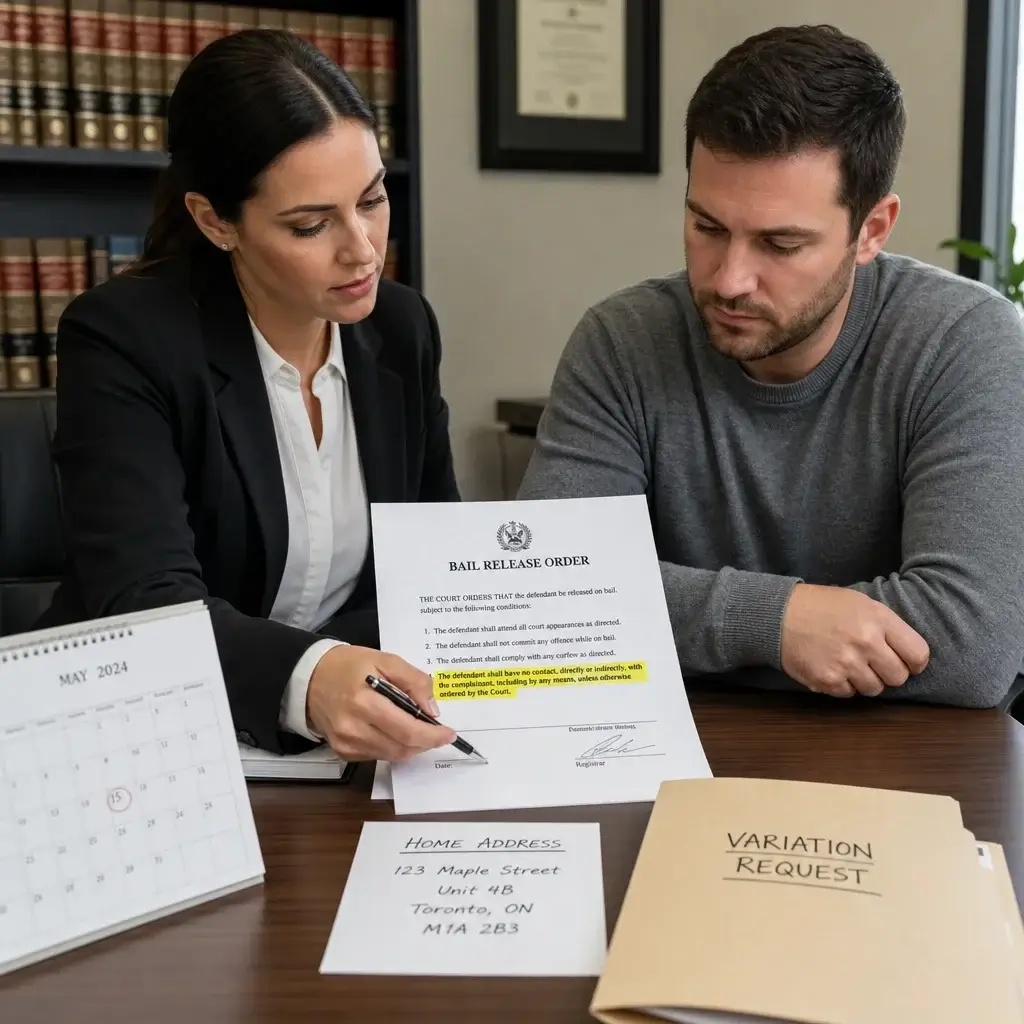
A no-contact order is not optional, and the complainant cannot give you permission to ignore it.
In domestic assault charges in Ontario, release terms often include no direct or indirect contact, no attendance at the home, and weapons restrictions. Indirect contact can include messages through friends or family, social media contact, or passing information through the children.
If the release terms make work, housing, or parenting impossible, the proper route is a variation, not informal contact. A bail variation can sometimes be sought on consent or by a contested application depending on the existing order and the Crown’s position.
What helps a variation request is practical structure. A stable alternate address, a detailed childcare plan, a work need that can be documented, counselling participation where relevant, and a reliable surety can all matter. A surety is a person who agrees to supervise you and report breaches if required by the court.
Mini-checklist for a release plan
- Full address where you will live
- Name and details of any surety
- Work schedule and employer information
- Childcare and parenting logistics
- Transport plan if you cannot attend the usual home area
- Counselling or treatment details if that is part of the proposed plan
- Clear proposal for how accidental contact will be avoided
Can the complainant drop the charges or change their story?
The complainant can give new information, but the decision to continue or stop the prosecution generally belongs to the Crown.
A complainant recanting a domestic assault allegation does not automatically end the case. The Crown may still rely on the original statement, 911 audio, photographs, admissions, officer observations, medical evidence, or other witnesses.
Recantations can create their own credibility problems. The Crown may ask whether the complainant is now minimizing because of pressure, fear, financial dependence, or family dynamics. That is one reason I tell people never to push for a recantation letter or affidavit.
What matters is the total evidence, not just the latest version. I review disclosure to see what independent proof exists and whether the prosecution can actually prove the case. Every case turns on its own facts.
Criminal court vs family court when the allegation is false

Criminal court decides the charge. Family court decides parenting, decision-making, contact, and related child issues.
The same allegation can affect both courts at once, but they are not doing the same job. Obeying a release order in criminal court does not automatically solve the family case, and a family order does not let you breach criminal conditions.
If children are involved, the fallout can be immediate. Parenting exchanges may change, supervised arrangements may be requested, and there may be urgent motions in family court. CAS involvement is fact-specific, not automatic, but domestic allegations involving children or child exposure can trigger child-protection concerns.
| Issue | Criminal court | Family court |
|---|---|---|
| Main purpose | Decide whether a criminal offence is proved | Decide parenting, contact, and child-related arrangements |
| Key early orders | Release order, no-contact, no-attendance, weapons terms | Temporary parenting schedules, exclusive possession, supervised exchanges |
| Main evidence focus | Police disclosure, statements, 911, medical and witness evidence | Best interests of the child, parenting history, safety concerns, practical plans |
| Result of breach | New criminal charge or detention risk | Possible change to parenting orders or credibility impact |
If you are dealing with both systems, coordination matters. I often need to think about the criminal file first because statements made in one court can affect the other.
Employment, immigration, travel, firearms, and professional licensing consequences
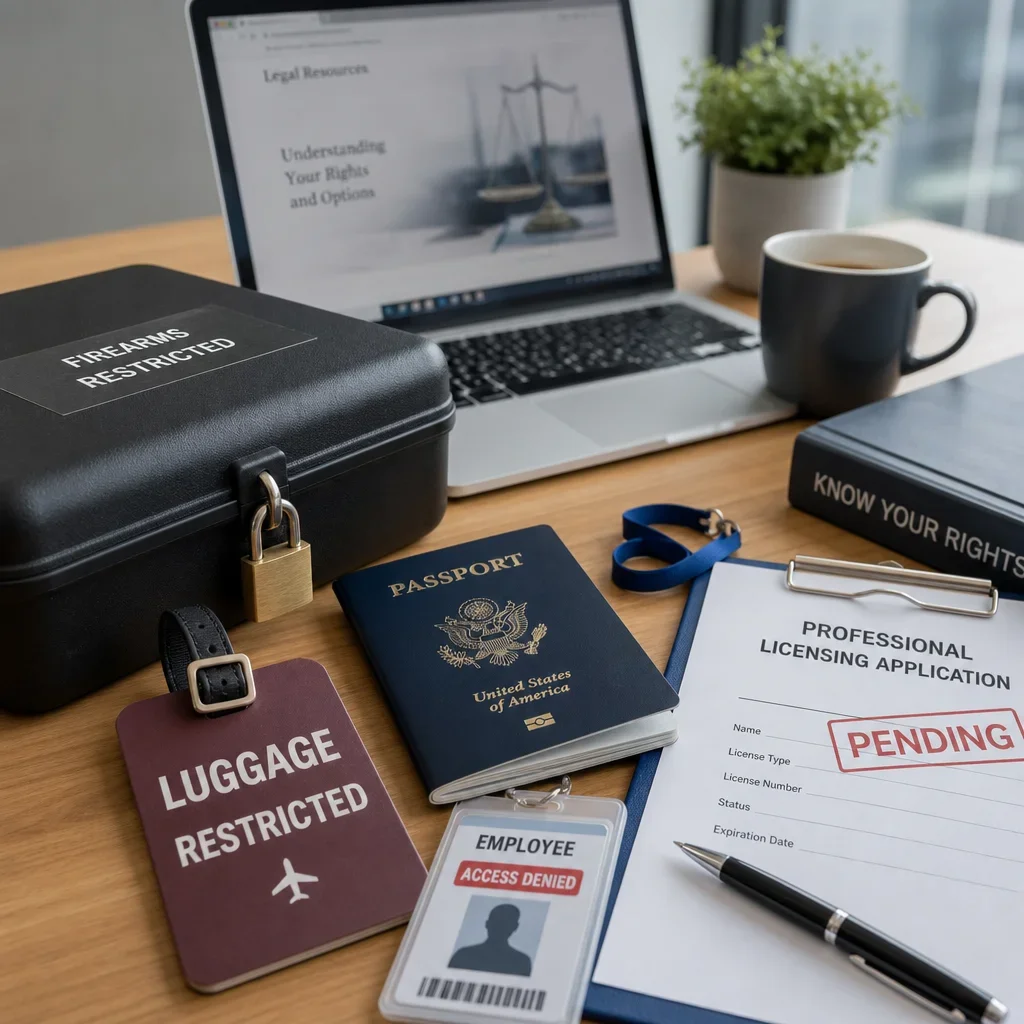
The practical consequences can start before any finding of guilt.
Pending charges and release terms can affect work schedules, access to the home, child-related duties, and employer reporting obligations. Jobs involving vulnerable persons, security clearances, driving, or regulated professions can be especially sensitive to an outstanding domestic assault charge.
Travel can also become difficult. Cross-border travel, including travel to the United States, may be affected by a pending charge, past record, or the way the matter is resolved. I do not overstate border outcomes because they depend on the destination country’s rules and the exact court result.
If you are not a Canadian citizen, you should get immigration-specific advice early. Assault-related charges can have immigration consequences, but the effect depends on the exact offence, the record, and how the case is resolved. This is general information, not advice on your charge.
Firearms issues can arise quickly. Release conditions may bar possession, and existing licences or access to firearms can become an immediate concern depending on the facts and any court orders.
Is a false report a crime? Public mischief, false information, and false 911 calls
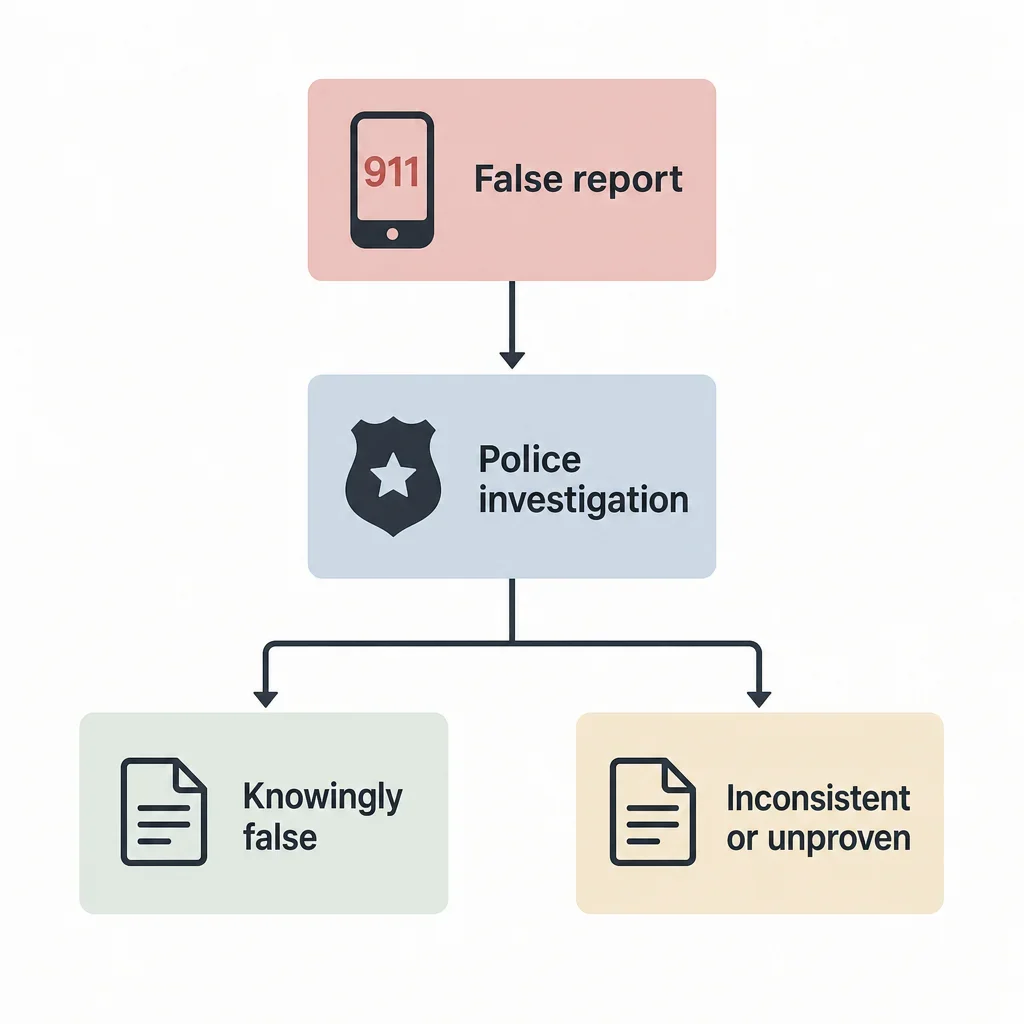
A false allegation does not automatically mean the complainant committed a crime.
The offence most people mean is public mischief under section 140 of the Criminal Code. At a high level, it can apply where someone causes police to enter on or continue an investigation by making a false accusation or doing something similar knowingly.
The key word is knowingly. There is a difference between a provably fabricated police report, a mistaken or inconsistent account, and an allegation the Crown simply cannot prove beyond a reasonable doubt. An acquittal does not, by itself, prove public mischief.
Knowingly providing false information to police or making a false 911 call can also raise separate criminal issues depending on the facts. I avoid listing offence numbers beyond public mischief here because the fit depends on how the allegation was made and what was said.
If you think the complaint was invented, your first priority should still be defending the domestic assault charge, preserving evidence, and reviewing disclosure. Trying to turn the case around too early can distract from the immediate risk: release terms, court dates, and the prosecution you are already facing.
Can you sue or take action against someone for false accusations?
Civil action may exist in some cases, but it should usually be treated as a second issue after the criminal file.
People often ask, “Can I charge someone for making false accusations?” Private citizens do not simply lay a criminal charge because they believe a complaint was false. Police and Crown decisions, and the available evidence, still control that process.
A civil claim such as defamation may be possible in some situations, but those cases depend on provable publication, provable damage, defences that may apply, and timing concerns. Suing too early can complicate your criminal defence strategy and disclosure issues.
Get case-specific advice before taking that step. A criminal acquittal and a civil lawsuit are different things with different legal tests.
Timeline of a domestic assault case: from arrest to trial or resolution
Most domestic assault cases do not end in a week, and a full resolution can take months to over a year depending on the court, disclosure, and whether the matter goes to trial.
A simple timeline looks like this:
- Day 1 to 3: arrest, release, or bail hearing
- First days to weeks: first court appearance and initial disclosure requests
- Weeks to months: disclosure review, Crown pre-trial, defence meetings, possible counselling or case planning
- Months onward: judicial pre-trial if needed, trial scheduling, and any bail variation work
- Later stage: trial, plea, peace bond discussion, diversion discussion where legally available, or sentencing if there is a finding of guilt
The biggest timing factors are the court location, whether the case is in Toronto, Brampton, Scarborough, Oshawa, Newmarket, or elsewhere, the volume of disclosure, whether digital evidence needs to be obtained, and whether the charge proceeds summarily or by indictment. A trial date is usually the main driver of delay.
A Crown pre-trial is a meeting where counsel discuss the allegations, disclosure, legal issues, and possible resolution. It is not a trial. I use that stage to test the prosecution’s theory, identify missing disclosure, and see whether there is a path to narrowing issues.
Common mistakes that hurt a false domestic assault defence
The most damaging mistakes are usually made in the first days.
Red-flag checklist
- Contacting the complainant to “clear it up”
- Using friends or family as go-betweens
- Posting about the case online
- Deleting texts, call logs, or social media messages
- Coaching witnesses or comparing stories
- Venting by text or email after release
- Ignoring an undertaking or release order
- Talking about the facts on recorded jail calls
- Missing court
- Assuming a recantation will end the case
- Discussing cross-allegations directly with the other person
Breach allegations can be easier for the Crown to prove than the original domestic incident if the communication is documented. A single text, location ping, or third-party message can create a new problem.
When to call a criminal defence lawyer and what early help actually looks like
Early help is not about slogans. It is about protecting your position before the file hardens.
I can advise before a police interview, work on release planning, seek changes to bail conditions, preserve evidence, obtain and review disclosure, and identify whether the defence is fabrication, self-defence, accident, mutual struggle, or failure of proof. If there is also a family, immigration, or professional licensing issue, I can tell you where criminal strategy needs to line up with those other files.
Having spent my first three years as a Crown prosecutor, I read the case from both sides. I look for the weak points the prosecution will rely on, and the weak points it may want to avoid discussing.
If you are dealing with false domestic assault charges, the safe next step is to speak to a criminal lawyer before giving a statement, before consenting to device access, and before trying to contact the complainant. We offer free consultations and urgent availability, but every case turns on its own facts and this is general information, not advice on your specific charge.
FAQ
What should I do immediately if I am falsely accused of domestic assault in Ontario?
Use your right to silence, ask for a lawyer, do not contact the complainant, obey any undertaking or release order, and start preserving evidence in the first 24 to 72 hours.
Can I be arrested even if the allegation is false?
Yes. Police can arrest if they believe they have reasonable grounds to think an offence occurred. That is different from proving the charge in court.
Should I give police my side of the story right away?
Not without legal advice. Innocent people can still make statements that are incomplete, emotional, or inconsistent with later disclosure.
Can I text or call the complainant to sort things out?
No if there is a no-contact term, and usually no even before that. The message can become evidence, and it can also lead to a breach allegation.
Can the complainant drop domestic assault charges?
The complainant can provide new information, but the Crown generally controls whether the prosecution continues.
Why would the Crown continue the case if the complainant recants?
Because the Crown may rely on earlier statements, 911 audio, police observations, injuries, texts, admissions, or other independent evidence.
What evidence helps prove a domestic assault allegation is false?
Evidence that fixes the timeline and context is often strongest: full message threads, call records, location data, CCTV, work logs, witness accounts, and disclosure such as 911 audio and officer notes.
How do I preserve text messages and other digital evidence properly?
Save full threads, preserve originals, back up lawfully, avoid editing or deleting anything, and keep a dated list of where each item came from.
How can I change a no-contact order or bail condition?
Through a formal variation process, not by private agreement with the complainant. The proper route depends on the order and the Crown’s position.
What happens if children are involved?
There may be family court issues, parenting changes, and possible child-protection concerns. Criminal and family court do different jobs, and one order does not cancel the other.
Can both partners be charged after the same incident?
Yes. Cross-allegations do happen. If that is your situation, direct or indirect contact is especially risky because it can affect both files.
Is falsely reporting domestic assault a crime in Canada?
Sometimes. Public mischief under section 140 of the Criminal Code may apply to a knowingly false police complaint, but a failed prosecution does not automatically prove the complaint was criminally false.
Can I sue someone for making false domestic assault accusations?
Possibly in some cases, but that is a separate civil issue and should usually wait until the criminal defence strategy is clear.
Can a spouse be forced to testify in a domestic assault case?
Spousal testimony rules are technical and fact-specific in Canada. I would not rely on a blanket online answer. Get advice on the exact relationship, charge, and stage of the case.
How long can a domestic assault case take in Ontario?
Early steps happen in days to weeks, but a full case can take months to over a year depending on disclosure, court backlog, and whether there is a trial.