

 Based on 116 Verified Google Reviews
Assault with intent to rob sentencing guidelines are not a single chart in Canada. Sentence turns on the Criminal Code offence, the proven facts, the weapon evidence, the injuries, the planning, and your record. This page gives general Canadian information, not legal advice on your case.
Quick answer Assault with intent to rob is a robbery-style violent offence. Courts usually treat it as more serious than simple assault and often less straightforward than completed robbery because the Crown still has to prove the intent to steal. The sentence can move sharply depending on whether there was a weapon, bodily harm, planning, a store or dwelling target, prior record, a guilty plea, and whether the facts are closer to robbery, attempted robbery, or a lesser assault-related offence.
What assault with intent to rob means in Canada
Assault with intent to rob means an assault is alleged to have been committed for the purpose of stealing property, even if nothing was actually taken. That is the key difference from completed robbery: the taking may fail, but the Crown says the violence was tied to a planned deprivation of property.
The Criminal Code offence is commonly framed as assault with intent to steal. The exact section number and current wording should be checked against the current Criminal Code before relying on it in a live case.
The offence is not the same as simple assault because the alleged intent to steal increases the moral blameworthiness. It is also not automatically the same as robbery, because robbery usually involves theft plus violence, threats, or violence used to steal or keep stolen property.
Sentencing overview: what the court looks at first
Canadian courts do not use one national guideline document called assault with intent to rob sentencing guidelines. Judges sentence by applying the Criminal Code, general sentencing principles, and comparable case law.
The usual sequence is straightforward. The court identifies the offence, confirms the available mode of proceeding and statutory penalty, checks for any minimum sentence if one exists, and then assesses gravity and moral blameworthiness before weighing aggravating and mitigating factors.
The sentence is driven by real facts, not just the charge label. A planned commercial robbery with a weapon will usually sentence very differently from a brief struggle where intent to steal is inferred but no property is taken.
Statutory maximums and minimums are not the same thing as real-world sentencing ranges. Maximums set the legal ceiling, while comparable cases show how courts usually place less serious, mid-range, and very serious conduct within that ceiling.
Penalty table: maximums, minimums, and related offence comparisons
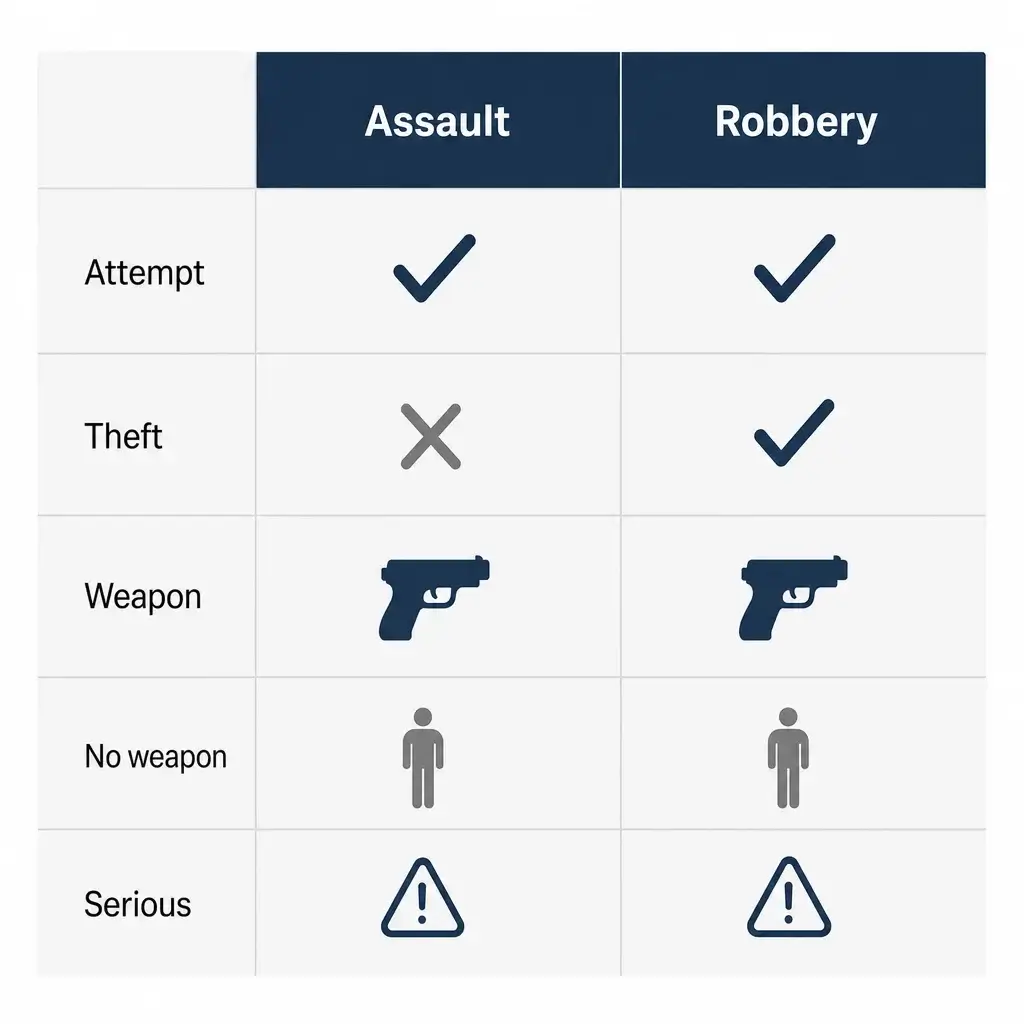
The most reliable way to compare robbery-style offences is side by side. Firearm minimums and some penalty details are technical and should be verified to the current Code and current constitutional case law before use in court.
| Offence | Basic definition | Mode | Maximum penalty | Minimum penalty | Main sentencing drivers |
|---|---|---|---|---|---|
| Assault with intent to rob | Assault committed with intent to steal or rob | Verify current Code treatment before use | Verify current Code maximum before use | No current minimum should be assumed without Code verification | Violence, intent proof, injuries, planning, weapon, record |
| Robbery | Theft with violence, threats, or violence to steal or retain property | Indictable | Life imprisonment under s. 344 should be verified in current Code | No universal minimum should be assumed for all robberies | Weapon, commercial setting, home invasion, record, trauma |
| Robbery with firearm | Robbery involving a firearm | Verify current Code wording and minimums | Life imprisonment should be verified in current Code | Current firearm minimums must be verified before stating them | Firearm use, planning, public risk, prior record |
| Attempted robbery | Attempt to commit robbery without completion | Usually indictable treatment should be verified | Verify current maximum in Code | No minimum should be assumed without verification | Near-completion, weapon, threats, planning |
| Assault | Intentional application of force without consent, or threat with present ability in some cases | Hybrid for common assault | Common assault maximum depends on mode and should be verified in current Code | None for common assault | Injury level, context, record, breach status |
| Theft | Taking or converting property fraudulently | Hybrid or indictable depending on value and type | Theft over and under have different maximums that should be checked in current Code | None in ordinary cases | Value, planning, breach of trust, record |
There is no safe way to answer minimum sentence for robbery in Canada with one number across all robbery cases. Weapon type, offence wording, mode of proceeding, and current constitutional rulings can all change the analysis.
There is also no safe basis to say assault with intent to rob carries a mandatory minimum unless the current Code confirms it. In practice, the bigger question is usually where the conduct falls on the scale between simple assault, attempted robbery, and completed robbery.
What the Crown must prove

The Crown must prove the assault, the intent to steal or rob, the identity of the accused, and the surrounding facts that support that intent. If any one of those elements is not proven beyond a reasonable doubt, the offence is not made out.
The assault element usually turns on intentional force, attempted force, or threatening conduct that causes a person to reasonably fear immediate force. The exact pathway depends on the section charged and the facts alleged.
Intent is often proven indirectly. Courts may infer intent from demands for property, movements toward taking property, disguise, threats, chasing a cash tray, grabbing a bag, statements before or after the event, or coordinated conduct with others.
A completed theft is not required if the charge is assault with intent to rob. The Crown can still proceed if it says the accused used violence for the purpose of stealing but failed to get the property.
Evidence needed for assault in this setting usually includes complainant evidence, eyewitness accounts, surveillance video, phone messages, admissions, injuries, forensic evidence, weapon evidence, and property-related evidence like missing items, dropped merchandise, or cash handling records.
Identification and credibility are often the real battlegrounds. A weak eyewitness identification, poor video quality, inconsistent statements, or missing continuity on physical exhibits can matter as much as the basic legal definition.
Assault with intent to rob vs robbery vs attempted robbery vs theft plus assault vs assault
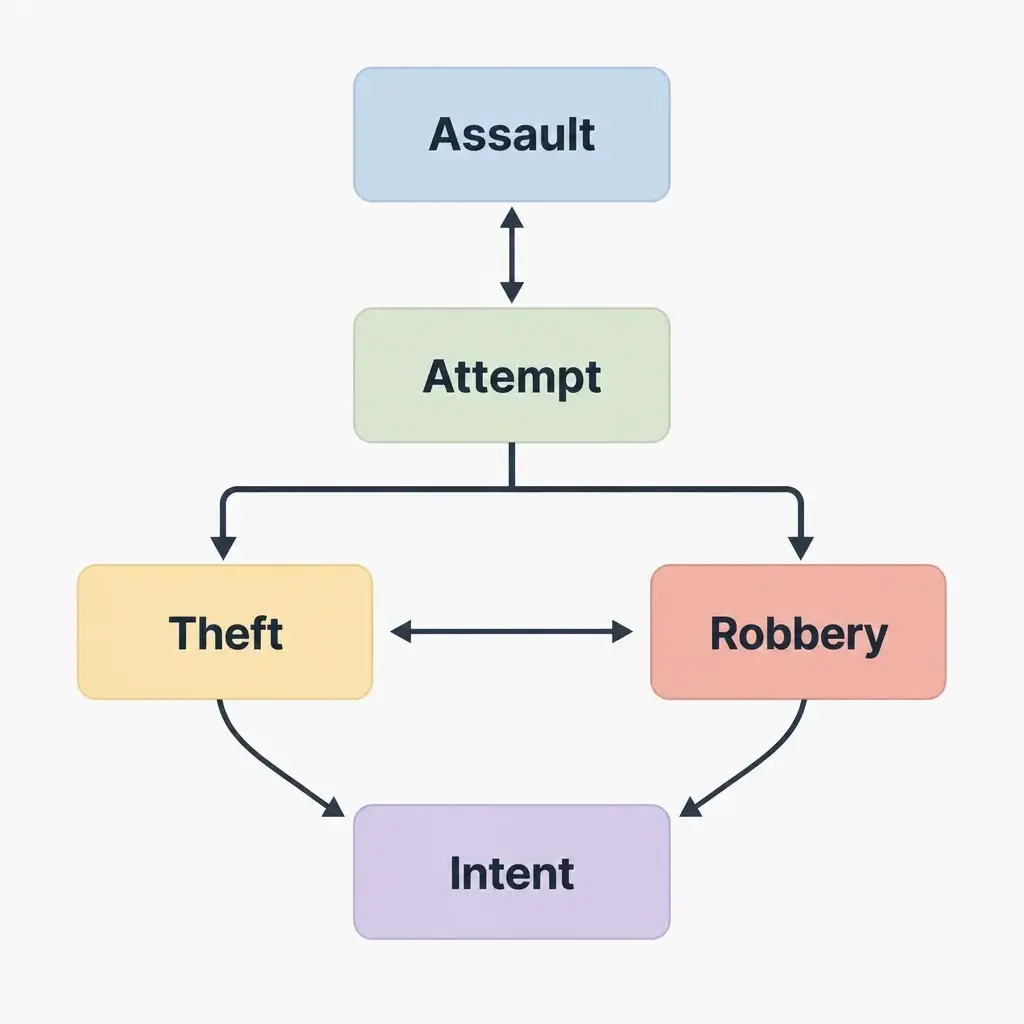
These offences overlap, but they are not interchangeable. The charge matters because the sentence exposure usually rises as the violence, intent to steal, and completion of the taking become easier for the Crown to prove.
| Offence | What the Crown says happened | Property actually taken? | Violence required? | Intent needed | General seriousness |
|---|---|---|---|---|---|
| Assault with intent to rob | Assault committed to steal | No, not necessarily | Yes | Intent to steal or rob | Serious violent/property offence |
| Robbery | Theft with violence or threats | Usually yes, or violence to retain property | Yes | Intent to steal plus robbery conduct | Often more serious than theft or simple assault |
| Attempted robbery | Near-completed robbery that fails | No | Usually threats or force alleged | Intent to commit robbery | Serious, fact driven |
| Theft plus assault | Theft and separate assaultive conduct | Usually yes | Assault may be separate from taking | Theft intent plus assault intent | Can range widely |
| Simple assault | Force or threat without robbery purpose | No | Yes | No theft intent required | Lowest of this group overall |
A failed demand followed by a push, with no property taken, may fit assault with intent to rob or attempted robbery if the Crown can prove the purpose was theft. The same facts may reduce to simple assault if the intent to steal is not proven.
A store confrontation where a person displays a weapon and orders a cashier to hand over cash will usually be treated much more seriously. Even if the till never opens, the weapon, the commercial target, and the fear created can move the case closer to commercial robbery sentencing guidelines by analogy.
An assault during a shoplifting accusation can point in a different direction. If force happens after a theft to escape or keep property, robbery may be alleged; if the link to taking property is weaker, the Crown may proceed on theft plus assault or assault alone.
Robbery vs theft is mostly about force or threats. Robbery vs assault is mostly about the property motive. Attempted robbery sentencing guidelines are also not a fixed chart in Canada, so sentence still turns on how close the conduct came to completed robbery.
How judges assess seriousness: aggravating factors

Weapons, injuries, planning, and victim vulnerability are the factors that most often push sentence up. Courts look hard at both the danger created and the degree of deliberation behind the offence.
Common aggravating factors include: use of a weapon, firearm involvement, imitation firearm used to terrorize, bodily harm, multiple offenders, masks or disguises, targeting a vulnerable victim, prior record, committing the offence while on bail or probation, and repeated incidents.
Commercial robbery sentencing guidelines are not a formal Canadian grid, but robberies aimed at stores, gas stations, taxis, or delivery workers are often treated harshly because workers are exposed to sudden violence in public-facing jobs. Planning and community fear both matter.
Robbery dwelling sentencing guidelines are also not a standalone Canadian chart, but home-invasion style facts usually attract especially serious treatment. Entering or attacking at a home engages personal security in a way courts often see as more intrusive than street or store crime.
Serious violence can outweigh the fact that no property was taken. A failed robbery attempt with severe injury can sentence more harshly than a completed taking with little force.
What can reduce sentence: mitigating factors
A lower sentence usually comes from reduced moral blameworthiness, real rehabilitation, and steps that save court resources or address harm. Mitigating factors do not erase serious violence, but they can still matter.
Common mitigating factors include no prior record, a limited record, an early guilty plea, genuine remorse, restitution where possible, counselling or addiction treatment, stable employment, community support, youthfulness, and less serious or no lasting injuries.
A first offender is not guaranteed to avoid jail in a robbery-style case. Planned violence for the purpose of stealing is treated much more seriously than first-time simple assault in Canada.
The most common punishment for assault depends on the level of assault. Common assault often draws non-custodial outcomes in lower-end cases, while robbery-style violence can move the sentence toward custody even for someone without a record.
Prior record, guilty plea, remorse, rehabilitation, and restitution can all affect sentence because they speak to future risk, acceptance of responsibility, and whether a less restrictive sanction can still meet denunciation and deterrence.
Will a first offender go to jail?
A first offender can go to jail for assault with intent to rob, but jail is not automatic in every case. The strongest drivers are weapon use, injury, planning, commercial or dwelling targets, and whether the facts look close to full robbery.
Weapons and firearm scenarios: unarmed, weapon, imitation weapon, firearm
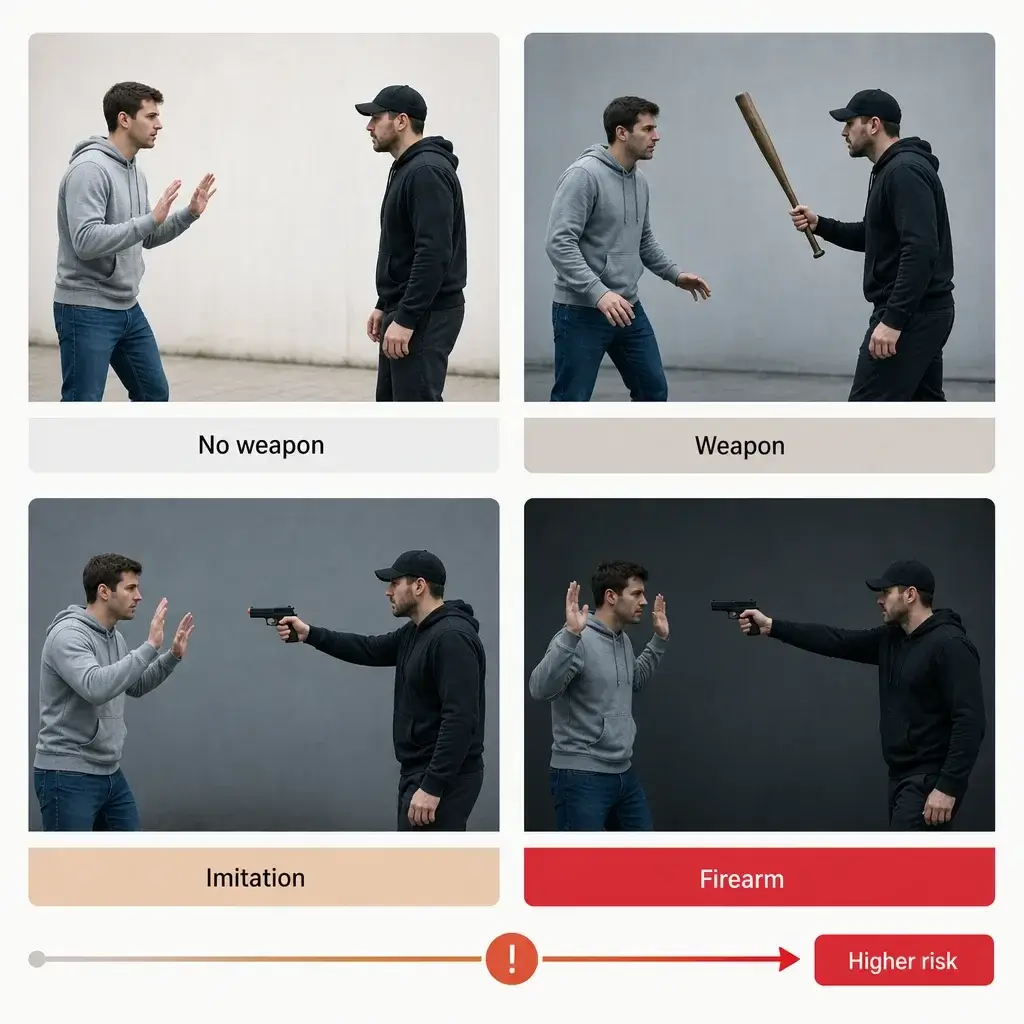
Weapons change both the fear level and the sentencing exposure. Courts treat the perceived risk to the victim as important even if the weapon is not discharged and even if property is never taken.
| Scenario | What usually changes | Sentencing effect | Bail effect |
|---|---|---|---|
| No weapon | Focus stays on force, threats, injury, and intent | Wide range based on violence and planning | Still serious if facts are robbery-like |
| Offensive weapon other than firearm | Increases danger and intimidation | Usually aggravating | Can make release harder |
| Imitation weapon | Victim fear can still be severe | Often treated as aggravating even if not a real gun | Can worsen release position |
| Actual firearm | Triggers the most technical sentencing analysis | May engage special Code rules and possible minimums that require current verification | Often significantly tougher bail landscape |
Minimum sentence for armed robbery in Canada cannot be stated responsibly here without current verification. Firearm minimums have changed over time and have been affected by constitutional litigation and legislative amendments.
An imitation weapon does not usually carry the same legal status as a real firearm, but it can still sharply increase sentence because of the terror it creates. That is why armed robbery sentencing guidelines in practice turn on more than whether a gun was operational.
Bail, record, and immigration consequences

Bail is often harder on robbery-style charges because courts are concerned about public safety, confidence in the administration of justice, and the risk of further violent conduct. Weapons, a criminal record, or an alleged breach usually make release more difficult.
Reverse-onus bail rules can apply in some robbery or firearm situations, but the exact rule depends on the charge wording and current law. That point should be checked against the current Criminal Code before giving case-specific advice.
A conviction can bring much more than jail. Possible collateral consequences include a criminal record, CPIC visibility, employment problems, travel difficulties, probation terms, and weapons prohibitions where the law permits them.
Immigration consequences can be severe for non-citizens because serious criminality analysis in Canada often turns on the offence of conviction, its maximum penalty, and sometimes the actual sentence imposed. That needs immediate immigration advice alongside criminal defence advice.
Assault with intent to rob is not always treated identically to robbery for every consequence, but both are serious violent-property offences. From a practical standpoint, either can create major record and immigration risk.
Youth cases and first-time offenders
Youth cases are governed by the Youth Criminal Justice Act, not the adult sentencing framework. That changes the process, the available sentences, and the weight given to rehabilitation.
Robbery youth sentencing guidelines in Canada are therefore different from adult outcomes. Serious violence still matters, but the analysis is not just a smaller adult sentence.
A youth, a young adult, and a mature adult may face very different sentencing realities on similar facts. Age, record, background, role in the offence, and rehabilitative prospects all carry different weight.
Case examples and realistic sentencing comparisons
Realistic comparisons help more than invented numbers. Canadian courts sentence by facts, so these examples show what tends to pull a case down or up without pretending there is a fixed chart.
A low-end example is a brief shove during a failed demand for a phone, with no weapon, no injury, and no record. If intent to steal is shaky, the case may resolve closer to common assault or attempted theft than to a full robbery-style sentence.
A mid-range example is a planned street confrontation where two people corner someone, demand a wallet, and one punches the complainant. No major injury and no weapon keep it below the most serious range, but planning and numbers push it well above simple assault.
A higher-range example is a convenience-store incident with a masked accused, threats, and an imitation gun. Even if cash is not obtained, the planning, commercial target, and terror imposed can drive a sentence comparable to serious attempted or completed robbery cases.
A dwelling example is an attack at someone’s front door after following them home to get property. Courts usually treat the home setting as especially serious because the victim loses the sense of safety attached to a private residence.
A repeat-offender example is an accused on release for another violent matter who commits a new robbery-style offence. Record, breach status, and community protection concerns all increase sentence and can also affect bail sharply.
Comparable robbery cases may be informative when assault-with-intent cases are sparse, but the comparison has limits. The missing or disputed taking of property can still change the proper sentence.
Common defences and lesser outcomes
The defence often focuses on proof, not labels. Identity, intent, whether there was an assault at all, whether property-taking was actually planned, statement voluntariness, and Charter issues can all matter.
The lowest charge for assault is not something a complainant or accused picks. The outcome depends on what the evidence can actually prove beyond a reasonable doubt.
Possible lesser outcomes can include common assault, assault causing bodily harm, theft, attempted theft, uttering threats, or an acquittal. Which one is legally available depends on the specific charge, the evidence led, and the included-offence rules.
The lowest sentence for theft also has no single answer. In minor cases it may be a discharge if legally available for that offence, a fine, probation, or time served, but discharge availability and other outcomes depend on the actual offence of conviction and statutory limits.
Victims do not personally control whether charges are withdrawn. In Canada, the Crown prosecutor decides whether the case proceeds based on the evidence and the public interest.
FAQ: fast answers to the questions people actually ask
What is assault with intent to rob?
It is an alleged assault committed for the purpose of stealing. Property does not always have to be successfully taken. The Crown still has to prove both the assault and the intent to rob or steal.
What is the minimum sentence for robbery in Canada?
There is no one-number answer for every robbery. Some robbery cases have no mandatory minimum, while firearm cases can engage technical minimum-sentence rules that must be verified against the current Criminal Code and current case law.
Is there a minimum sentence for assault with intent to rob in Canada?
You should not assume there is one without checking the current Criminal Code section for the exact charge. In practice, sentence usually turns more on the violence, weapon evidence, planning, injury, and criminal record.
How long would you get in jail for robbery?
There is no fixed Canadian robbery sentence. A lower-end unarmed case and a planned armed commercial case can be years apart in sentence because courts weigh weapons, injury, record, planning, victim impact, and whether a firearm was involved.
Will I go to jail for first-time assault in Canada?
Not always. Many common assault cases for first offenders resolve without jail, but robbery-style violence is different. If the assault was tied to stealing, involved planning, or used a weapon, custody becomes much more realistic.
What evidence is needed for assault?
Common evidence includes the complainant’s evidence, eyewitnesses, surveillance, injury photos, medical records where relevant, admissions, texts, and physical evidence. In robbery-style cases, the Crown also looks for proof of the theft motive.
Can the victim drop assault charges in Canada?
No. A complainant can tell police or Crown counsel what happened and whether they want the matter to continue, but the prosecution decision belongs to the Crown, not the complainant.
What is the most common punishment for assault?
For common assault, probation, a conditional discharge where legally available, fines, or short custody can all appear depending on the facts. For robbery-style assault, the sentence is often more severe because of the theft motive and public safety concerns.
What is the lowest charge for assault?
Common assault is generally the least serious standard assault offence. Whether that outcome is legally available in a given case depends on the facts, the injuries, and what the Crown can prove.
What is the lowest sentence for theft?
There is no single lowest sentence. Minor theft cases can sometimes result in a discharge where the law permits, a fine, probation, or other non-custodial outcomes. Value, record, breach status, and planning all matter.
How is assault with intent to rob different from robbery?
Robbery usually means the theft and the violence are completed together or violence is used to retain property. Assault with intent to rob focuses on the assault plus the proven purpose of stealing, even if no property is actually taken.
Can you be convicted of a lesser offence instead of assault with intent to rob?
Yes, that can happen if the evidence does not prove the full robbery-related intent but does prove some other offence. Examples may include common assault, theft, attempted theft, or threats, depending on the record and the judge’s findings.
Does this page cover UK guidelines?
No. This page discusses Canadian law only. UK sentencing guidelines use a different structure and should not be used to estimate a Canadian sentence.
When to speak with a criminal defence lawyer
Early advice matters because charge framing, bail, disclosure review, plea decisions, and mitigation work can all affect the result. That is especially true if the case involves a weapon, a prior record, immigration risk, or a youth accused.
A defence lawyer can review the exact charge, the current Criminal Code section, the available lesser-offence arguments, the likely aggravating factors, and any bail or immigration issues. That work is case-specific, so it cannot be done from a general article alone.
If you are facing a first court date, bail hearing, or a decision about plea or trial, get advice on the actual disclosure before making assumptions from online robbery sentencing guidelines.