

 Based on 116 Verified Google Reviews
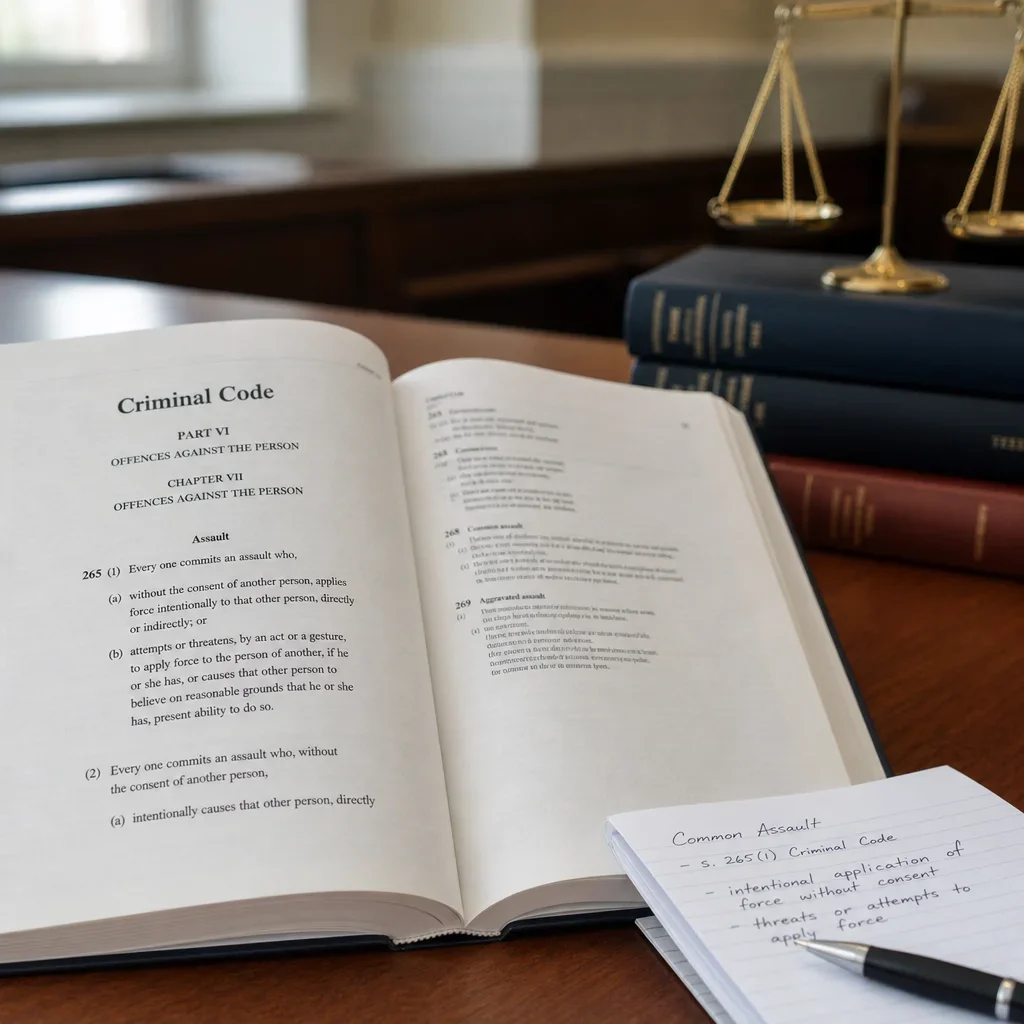
The strongest common assault defence is rarely a slogan. It is the defence the facts can actually support. In many cases, common assault self defence is central, but it is never automatic. This guide explains Canadian law in plain English, with a focus on what the Crown must prove, how self-defence works, what evidence matters, and what usually happens after a charge. It is general information, not legal advice for your case.
What this guide covers: defending a common assault charge in Canada
Common assault is often the lowest-level assault charge, but it is still serious because a conviction can lead to a criminal record, release conditions, and lasting effects on work, travel, and immigration status. This guide focuses on Common assault Canada law, explains where self-defence fits, and shows where cases are won on evidence problems rather than dramatic courtroom arguments.
The best defence depends on the facts, the witnesses, the messages, the video, and whether the force used was lawful in the circumstances. A person charged after a shove, slap, grab, or threatening movement may have a defence based on self-defence, defence of another, accident, identity, consent in a limited context, or reasonable doubt about what really happened.
This article also covers practical points competitors usually skip, including a same-day evidence checklist, real-world scenario analysis, when self-defence fails, and the court process after an assault charge Canada case begins. Preserving footage and messages early matters because some CCTV systems overwrite video in less than 24 hours, while others keep it for days or weeks.
What is common assault in Canada?
Common assault is the basic assault offence in Canadian criminal law, usually discussed through Criminal Code sections 265 and 266. “Simple assault” is a common informal label, but the statute speaks in terms of assault.
Assault includes intentional, non-consensual force against another person, even if the force is minor and even if there is no injury. A push, shove, slap, grab, spit, or unwanted touch can support a charge if it was deliberate and without valid consent.
Assault can also include an attempt or threat of force if the other person reasonably believes force is imminent and the accused has, or appears to have, the present ability to carry it out. That is why words alone are usually not enough, but words plus a movement, raised fist, advancing step, or other act may be.
Accidental contact is different because assault requires intentional application of force, not a mere bump in a crowded hallway. Rude behaviour, insults, and arguments are also not automatically assault unless they cross into force, attempted force, or threatening conduct that creates a reasonable fear of immediate force.
What the Crown must prove for common assault
The Crown must prove the charge beyond a reasonable doubt. That standard applies to identity, the act itself, the intent behind it, and the absence of valid consent where force is alleged.
In a basic force case, the Crown usually has to prove that the accused was the person involved, that force was applied intentionally, and that the other person did not consent in law. In a threat-based case, the Crown must also prove the complainant reasonably believed force was about to happen.
Defences work by attacking one or more of those elements or by raising a lawful justification such as self-defence. A case may fail because the contact was accidental, because the witnesses are unreliable, because the wrong person was identified, or because the accused acted lawfully to stop an attack.
Consent has limits, and not every apparent agreement makes force lawful. Contact inside sports, medical treatment, or ordinary social interaction may be consensual, but force in a fight or domestic confrontation raises a different analysis.
What is the best defence for assault?
The best defense for assault is the one grounded in the evidence, not the one that sounds most forceful. Common assault defence cases are often decided by witness credibility, video, text messages, injuries, and timing.
Self-defence is one of the most important defences, but it is not the only one. Other possible defences include defence of another, accident, lack of intent, mistaken identity, false allegation, lack of proof on consent, and Charter issues where police conduct affects the admissibility of evidence.
Some cases are defended by showing the force was legally justified, while others are defended by showing the Crown cannot prove what happened beyond a reasonable doubt. I tell people not to assume they need one dramatic legal theory. A weak identification case can be stronger than a weak self-defence claim.
Saying “I was defending myself” is not enough on its own. A viable common assault self defence argument usually needs facts that show an actual or perceived threat, a defensive purpose, and a response that was reasonable in the circumstances.
How self-defence works in a common assault case

Self-defence under section 34 of the Criminal Code turns on three core ideas: a reasonable belief that force or a threat of force was being used, an act done for the purpose of defending or protecting, and a response that was reasonable in the circumstances. This is the modern framework often linked to Bill C-26 self-defence reforms.
The law does not require perfect judgment in a split second. Courts assess the full context, including what the accused perceived at the time, how quickly events unfolded, whether there was a way to disengage, and whether the force stopped once the danger passed.
A mistake about the facts can still fit self-defence section 34 if the belief and response were reasonable. That means a person does not lose the defence automatically because the threat turned out to be different from what they honestly and reasonably understood in the moment.
Self-defence is about protection, not punishment, revenge, or settling a score. If force continues after the threat ends, the defence gets much harder to maintain.
When common assault self defence is more likely to succeed
Self-defence is more persuasive when the threat was immediate, the response was limited, and the accused tried to stop or escape rather than continue the fight. Courts look closely at timing, proportionality, and whether the force used matched the danger as it reasonably appeared.
Pushing someone away to create space can fit common assault self defence if it was done to stop an immediate attack or prevent more force. Blocking blows, briefly restraining someone to get free, or stepping in to protect another person can also support a defence if the force was genuinely protective.
Corroboration helps because self-defence claims often turn on credibility. Photos of fresh injuries, witness accounts, 911 recordings, location data, and video can support who started the incident, whether the threat was real, and whether the response stopped once safety was restored.
The fact that the other person was injured does not automatically defeat self-defence. Injury matters because it can bear on reasonableness, but the legal question is not simply who was hurt more. It is whether the accused acted lawfully in the circumstances as they reasonably perceived them.
When self-defence fails
Self-defence usually fails when the force used was excessive, retaliatory, or continued after the threat was over. Chasing someone after they retreat, striking after the other person is down, or returning later for payback undermines the defensive purpose required by the Self-defence Criminal Code analysis.
A pre-emptive strike without an imminent threat can also sink the defence. Fear has to connect to a real and immediate danger, not a vague concern that something might happen later.
Mutual fights complicate the issue because willing participation in an escalating confrontation can make reasonableness harder to prove. Grabbing first or swinging first does not automatically end the analysis, but it can seriously hurt the argument if the facts suggest aggression rather than protection.
Intoxication, anger, and inconsistent statements can damage a self-defence claim because they affect reliability and purpose. A person who tells police, texts friends, and later testifies to three different versions of events creates a credibility problem that the Crown will use heavily.
Defence of another vs self-defence vs defence of property
Defence of another protects another person from force or a threat of force, while self-defence protects you. Both are assessed under the same modern section 34 framework focused on threat, protective purpose, and reasonableness.
Defence of property is a separate legal concept and should not be confused with the right to protect a person. A property dispute does not automatically justify force against another person, and the legal limits are different.
This page focuses on assault charges and personal safety, not on what items to carry or how to use force tactically. In any assault prosecution, courts care about why force was used, whether the threat was immediate, and whether the response went further than necessary.
What evidence helps a common assault self-defence case?

The best evidence is the evidence that preserves the timeline before memories shift and digital records disappear. In a common assault defence, the useful question is not just what exists, but what each item can actually prove.
Text messages, call logs, social media messages, and voicemail can show threats, fear, motive, admissions, or the sequence of events before and after the incident. A message sent minutes after an event can be powerful because it fixes timing and tone close to real time.
CCTV, dashcam, doorbell, and phone video can show who approached first, whether someone had room to leave, how long the force lasted, and whether the response continued after the threat ended. Retention can vary from less than 24 hours to several weeks depending on the system and location, so preservation needs attention right away.
Photos of injuries, torn clothing, damaged property, and the scene can support or undermine claims about immediacy and force. Medical records can also matter because they timestamp treatment and may record what was reported near the time of the event.
Witness names, contact information, and a same-day written timeline can help counsel assess consistency and disclosure issues. Writing your timeline the same day, or within 24 hours if possible, is practical because memory fades quickly.
911 recordings and dispatch records can capture emotion, urgency, background noise, and spontaneous descriptions of who was doing what. Location history, ride-share receipts, bar bills, and store receipts can also place people at a specific place and time.
You should not coach witnesses, delete messages, edit videos, or contact the complainant if release conditions prohibit contact. In domestic or no-contact cases, breaching conditions can create new charges that complicate the assault case.
Evidence map: what each item may prove
| Evidence | What it may prove |
|---|---|
| Texts and messages | Threats, motive, timing, admissions |
| CCTV or phone video | Who started it, distance, chance to leave, duration |
| Injury photos | Consistency with force used, timing, defensive injuries |
| Medical records | Treatment date, reported symptoms, contemporaneous history |
| 911 call | Urgency, fear, immediate account |
| Witnesses | Independent observations, credibility support |
| Receipts and location data | Presence, timeline, movement |
| Written timeline | Memory preservation, sequence of events |
How courts assess reasonable force in real-life scenarios

Reasonable force is judged in context, not in the abstract. Courts may consider factors such as the nature of the threat, the role each person played, size or strength differences, prior threats, weapons, the possibility of retreat, and whether the force stopped once the danger passed.
In a bar fight, self-defence is stronger where someone is cornered, struck first, or trying to disengage, and weaker where the evidence shows mutual escalation or revenge after security intervenes. Video is especially important in bar cases because it may show distance, body language, and who advanced.
In a domestic dispute, the law is the same, but release conditions are often stricter and the evidence can be more complicated because there may be no neutral witnesses. No-contact terms are common on release in domestic-context cases, and the complainant does not control whether the prosecution continues.
In a mutual shoving incident, a brief push to create space can look very different from repeated force after the other person backs away. That is why context, duration, and what happened next matter so much.
In a road-rage confrontation, getting out of a vehicle, approaching, and escalating can hurt a self-defence position unless the facts clearly show an immediate threat and a defensive response. A safe opportunity to leave is not a strict retreat rule in Canada, but it can matter when reasonableness is assessed.
In a defence of another case, the court still asks whether the accused reasonably perceived a threat and used force for a protective purpose. Protecting a child, partner, or stranger may support the defence, but only if the response remained reasonable in the circumstances.
Other defences to common assault besides self-defence
Accident or reflex can be a real defence where the contact was not intentional. Assault requires intentional force, so an involuntary movement, stumble, or reflexive act may undercut the actus reus or the mental element depending on the facts.
Mistaken identity and false allegation are also common in common assault cases, especially where the event was fast, emotional, or poorly lit. A case can turn on whether the complainant actually saw who made contact and whether other evidence supports that identification.
Lack of intent may matter where the act is admitted but its meaning is disputed. An intentional shove is different from raising an arm defensively and making incidental contact while backing away.
Consent can apply in limited settings, but it is not a broad licence for violence. Sports, medical procedures, and ordinary social contact can involve lawful consent, while fights and coercive situations raise very different issues.
Credibility and reliability arguments can be the whole case where there is little physical evidence. Prior inconsistent statements, contradictions with video, omissions in early reports, and motive to exaggerate can all create reasonable doubt.
Charter-based arguments may arise if police conduct affects statements, searches, or other evidence, but those arguments depend on the file and should be assessed by counsel. A narrow trivial-contact point may also arise in rare cases, but de minimis is not a catch-all answer to an assault charge.
How serious is common assault and what are the penalties in Canada?

Common assault is still a criminal offence even when there is little or no injury. A conviction can bring probation, fines, a discharge in some cases, a suspended sentence, or jail depending on the facts, the person’s record, the context, and aggravating features such as breaches or domestic allegations.
Assault under section 266 is generally prosecuted as a hybrid offence. If the Crown proceeds by indictment, the maximum penalty is 5 years’ imprisonment. If the Crown proceeds summarily, the maximum is lower and depends on the current statutory summary conviction framework.
There is no general mandatory minimum sentence for basic common assault. That matters because sentencing is highly fact-specific and first-time accused persons are not sentenced by formula.
A first-time assault charge Canada case does not automatically mean jail, but jail remains possible in more serious situations. Prior record, injuries, breach of release terms, use of a weapon, vulnerability of the complainant, and domestic context can all make the outcome more severe.
Common assault vs assault with a weapon vs assault causing bodily harm vs aggravated assault
The lowest level assault charge is usually what people call common assault or simple assault, which generally involves lower-level force or threatened force without significant injury. The legal and practical stakes rise when the allegation involves a weapon, bodily harm, or life-endangering injury.
| Offence | General description | Injury level | Typical issues | Relative seriousness |
|---|---|---|---|---|
| Common assault | Basic intentional non-consensual force, attempted force, or threatening force | No injury required | Consent, intent, identity, self-defence | Lowest assault category |
| Assault with a weapon | Assault involving a weapon or imitation weapon | Injury may or may not occur | Weapon use, threat level, reasonableness of response | More serious |
| Assault causing bodily harm | Assault that causes bodily harm beyond trifling or transient injury | Physical injury present | Medical evidence, causation, seriousness | More serious |
| Aggravated assault | Assault involving wounding, maiming, disfiguring, or endangering life | Severe injury | Intent, causation, major injury evidence | Most serious |
The defence strategy changes as the allegation becomes more serious. In common assault, the focus is often who started it, whether there was consent, and whether the response was defensive, while more serious charges also depend heavily on injury proof, medical records, and causation.
What happens after you are charged with common assault?

The usual path is arrest or a summons, release or bail, a first court date, disclosure, further appearances, and then either a negotiated resolution or trial. Every case moves on its own schedule, but early steps matter because conditions and disclosure shape what can be done next.
Release may happen at the police station or after a bail hearing. Common conditions can include no-contact, no-go locations, reporting, abstaining from alcohol or drugs, and weapons-related restrictions, though the exact terms depend on the file.
Disclosure is the package of evidence the Crown provides, which may include statements, officer notes, photos, video, and criminal record material where relevant. You should preserve your own evidence early because disclosure does not collect and save every helpful item for the defence.
Domestic-context assault allegations often come with strict no-contact terms, and a complainant cannot simply drop the case by changing their mind. The decision to continue or withdraw rests with the Crown, not with the complainant alone.
Some cases resolve through withdrawal discussions, diversion in appropriate jurisdictions, peace bond negotiations, a guilty plea to an agreed result, or trial. Eligibility for any resolution depends on the facts, the record, injuries, the relationship context, and local Crown policy.
Immediate checklist if you want to rely on self-defence
If you may rely on self-defence, preserve evidence immediately and obey every release condition exactly. Early mistakes can damage a viable defence and create new legal problems.
- Keep all release papers, appearance notices, undertakings, and bail documents.
- Do not contact the complainant if any no-contact term applies.
- Save texts, screenshots, call logs, emails, and social media messages.
- Identify witnesses and keep their contact information.
- Ask counsel to help preserve CCTV, doorbell, dashcam, or business video quickly.
- Photograph injuries, torn clothing, and the scene as soon as possible.
- Write a detailed timeline the same day, or within 24 hours if possible.
- Keep receipts, ride-share logs, and location records that support timing.
- Do not post about the incident online.
- Do not delete, edit, or stage evidence.
A criminal defence lawyer can assess whether common assault self defence is realistically available, whether the evidence supports another defence better, and how to avoid breaches while the case is ongoing.
Can a common assault charge be resolved without trial?
Yes, some common assault cases can be resolved without a trial, but no particular result is automatic. Depending on the facts, the record, the injuries, and local practice, possible paths may include withdrawal discussions, diversion-type resolutions, peace bond discussions, a guilty plea, or trial.
A self-defence position does not automatically block resolution talks. In some files, the defence uses early evidence problems or credibility weaknesses to press for a non-trial outcome, while in others the case must be tried because the facts are sharply disputed.
A peace bond can sometimes resolve a case without a criminal conviction, but it is not available in every file and it is not the same as being found not guilty. Any peace bond discussion should be assessed carefully because terms, admissions, and record consequences need proper advice on the specific case.
Collateral consequences: record, work, travel, and immigration
A common assault charge can matter long before any sentence because release conditions, court dates, and police records can affect daily life. A conviction can affect employment screening, professional licensing, family law positions, travel, and immigration status.
Travel consequences are real because foreign border officials make their own entry decisions. No lawyer should promise that a person with an assault record will or will not be admitted to another country.
Immigration consequences can be serious, but they depend on the person’s status and the exact result in criminal court. Anyone who is not a Canadian citizen should get criminal and immigration advice together before making major decisions in the case.
Questions about what you can legally carry or use for self-defence in Canada
The legality of carrying or using an item for self-protection depends heavily on the item, the purpose for carrying it, and the circumstances of use. This page is about defending an assault charge, not about recommending what to carry.
Canadian self-defence law looks at the threat, the purpose of the act, and whether the response was reasonable. That legal analysis is separate from giving shopping or tactical advice, and no one should treat a blog post as permission to carry a particular device.
FAQ
What is the best defense for assault?
The best defence is the one the evidence supports. Self-defence is common, but some cases are stronger on identity, accident, consent, credibility, or reasonable doubt.
Can you self defend yourself if someone hits you in Canada?
Yes, self-defence can apply if you reasonably believed force was being used or threatened, acted for a defensive purpose, and your response was reasonable in the circumstances. It is not a licence for revenge.
Do you have to retreat before using self-defence in Canada?
There is no simple rule that you must retreat in every case. But if a safe way to leave existed, that fact can matter when a court decides whether the force used was reasonable.
Does pushing someone away count as self-defence?
It can. A brief push to create space or stop an immediate attack may support self-defence if it was proportionate and ended when the danger ended.
Does grabbing first ruin a self-defence claim?
Not automatically. But grabbing first can hurt the defence if the evidence suggests you were escalating rather than protecting yourself or someone else.
Does it matter if the other person was injured?
Yes, but it is not conclusive. Injury may affect how a court views reasonableness, yet self-defence can still apply if the force used was lawful in the circumstances.
What evidence helps prove self-defence in an assault case?
Video, texts, witnesses, 911 calls, injury photos, medical records, and a clear timeline are often the most useful. The best evidence is usually the evidence that shows who started the incident, how immediate the threat was, and whether the response stopped once safety was restored.
What is the sentence for common assault in Canada?
There is no single standard sentence. Outcomes range from discharge or non-custodial sentences in some cases to jail in more serious cases, and the maximum on indictment under section 266 is 5 years.
Will I go to jail for first-time assault in Canada?
Not automatically. First-time offenders can still face serious consequences, and jail is possible in some cases depending on the facts, injuries, record, breaches, and surrounding circumstances.
Can domestic assault charges be dropped if the complainant wants them dropped?
Not just because the complainant asks. The Crown decides whether the prosecution continues.
Can a common assault charge affect immigration, travel, or employment?
Yes. Even a basic assault allegation or conviction can affect screening, border decisions, and immigration status, so those issues should be raised early with counsel.
What happens after a common assault charge in Canada?
The case usually moves through release, first court, disclosure, ongoing appearances, and then resolution discussions or trial. Conditions and evidence preservation matter from day one.
When to contact a criminal defence lawyer
You should speak to a criminal defence lawyer as soon as possible after arrest, release, or learning you are under investigation. Early advice helps with disclosure, release-condition compliance, evidence preservation, and deciding whether self-defence is genuinely available on your facts.
If you meet with counsel, bring your release papers, any disclosure, screenshots, photos, witness names, and a written timeline. Those basics can change how a common assault defence is assessed. If your case is in Toronto, Brampton, Scarborough, Oshawa, Newmarket, or elsewhere in Ontario, the safest next step is a confidential legal consultation focused on your actual file, not general internet advice.