

 Based on 116 Verified Google Reviews


Assault by choking in Canada does not require visible neck injuries. The Crown must still prove the charged offence beyond a reasonable doubt. The exact charge matters: different provisions carry different penalties and require different proof.
What assault by choking means in Canada
Assault by choking means an allegation of assault involving choking, suffocating or strangling another person. It can involve pressure on the neck or other interference with breathing. The Criminal Code expressly addresses this conduct under section 267(c). Not every allegation involving neck contact establishes that offence.
An assault includes intentionally applying force to another person without consent. That definition appears in section 265 of the Criminal Code. For a choking-specific charge, the Crown must also prove the conduct required by that provision. A description such as “grabbed my neck” needs examination against the complete evidence.
The wording on the charging document determines the legal starting point. An allegation involving sexual assault or an intention to overcome resistance to another offence can engage different provisions. This guide gives general information. I cannot assess a particular charge without reviewing the disclosure, meaning the evidence provided by the Crown.
Which Criminal Code section applies
Section 267(c) addresses choking, suffocating or strangling while committing an assault. Section 246 addresses different conduct and intent: overcoming resistance to enable or assist an indictable offence. These provisions are not interchangeable.
| Criminal Code provision | What it addresses | Important distinction |
|---|---|---|
| Section 265 | Defines assault, including intentional force without consent. | It supplies the underlying definition, rather than a separate sentencing provision. |
| Section 266 | Punishes common assault. | A basic assault allegation does not require proof of choking or bodily harm. |
| Section 267(c) | Assault in which a person “chokes, suffocates or strangles” another person. | Bodily harm is not a separate required element of this paragraph. |
| Section 246 | Includes attempts to choke, suffocate, strangle or otherwise disable someone, with intent to enable or assist an indictable offence. | The additional intent to facilitate an indictable offence is essential. |
| Section 272 | Includes sexual assault involving choking, suffocating or strangling the complainant. | The Crown must establish sexual assault and the additional alleged conduct. |
A non-sexual neck-compression allegation may support an assault-by-choking charge. An allegation of choking to facilitate another indictable offence may engage the overcoming-resistance provision. Choking during an alleged sexual assault can engage the sexual-assault provision. The facts, not the everyday label “strangulation charge,” determine the legal analysis.
A charging document, called an information, can contain more than one count. Related allegations may include uttering threats, assault causing bodily harm, forcible confinement, sexual assault or breaching an existing order. Each count requires its own proof; multiple counts do not automatically mean multiple convictions for the same conduct.
Choking, strangling and the assault categories
No, choking and strangling are not identical medical terms. Choking can describe an internal airway blockage. Strangulation describes external neck compression affecting airflow or blood flow. Suffocation concerns deprivation of oxygen. Canadian criminal legislation uses all these terms, so legal analysis cannot rest on casual wording alone.
The familiar “three levels of assault” describes a broad hierarchy, not every possible assault charge. Common assault is the basic offence. The next category includes assault with a weapon, causing bodily harm, and choking. Aggravated assault involves wounding, maiming, disfiguring or endangering life. Sexual assault has its own related provisions.
No, strangling is not simply another name for common assault. The Code creates a specific choking form of assault with a higher indictable maximum than common assault. Whether the Crown can prove that more serious charge remains a separate question.
Plain-language glossary
- Assault: Intentional force without consent, along with other conduct covered by the statutory definition.
- Choking, strangling and suffocating: Terms describing interference with breathing, neck compression or deprivation of oxygen; the alleged conduct must meet the charged provision.
- Hybrid offence: An offence the Crown can prosecute summarily or by indictment.
- Summary prosecution: The less serious prosecution route, with lower maximum penalties.
- Indictable prosecution: The more serious route, which can affect maximum punishment and trial procedure.
- Disclosure: Relevant prosecution material, including evidence that may assist the defence, subject to lawful limits.
- Surety: A person approved by the court to supervise an accused and pledge money under release terms.
Maximum penalties, jail and discharges
An assault choking charge carries significant sentencing exposure. The maximum depends on the offence and, for hybrid offences, the Crown’s choice of prosecution route. A maximum is a legal ceiling, not a forecast of the sentence in an individual case.
| Offence | Prosecution route | Maximum punishment |
|---|---|---|
| Common assault, section 266 | Hybrid | Indictment: five years’ imprisonment. Summary: two years less a day and/or a $5,000 fine. |
| Assault by choking, section 267(c) | Hybrid | Indictment: 10 years’ imprisonment. Summary: two years less a day and/or a $5,000 fine. |
| Overcoming resistance, section 246 | Indictable | Life imprisonment. |
| Sexual assault involving choking, section 272 | Indictable | Generally 14 years’ imprisonment; life imprisonment where the complainant is under 16. Additional sentencing rules apply to specified circumstances. |
No, a first assault charge does not automatically mean jail. A person must first be found guilty before receiving a sentence. The court then considers the offence, force used, injuries, criminal record, personal circumstances and applicable sentencing rules. Having no record matters, but it does not remove the possibility of custody.
Yes, an assault-by-choking conviction can create a criminal record. A discharge is legally available in principle for the ordinary choking-assault offence because it has no mandatory minimum and its maximum is below the statutory discharge exclusion. Availability is not entitlement.
A discharge requires findings that it serves the accused’s best interests and is not contrary to the public interest. An absolute discharge has no probation terms; a conditional discharge includes probation. Offences punishable by imprisonment for 14 years or life are excluded from discharge eligibility. That distinction matters when comparing choking assault with sexual assault involving choking or overcoming resistance.
An intimate partner relationship is an aggravating sentencing factor where the offender abused that partner. Other relevant factors include repeated violence, threats, harm, children witnessing events, breaches of trust, prior convictions and rehabilitation. I do not give sentencing predictions before understanding the evidence and the person involved.
What the Crown must prove
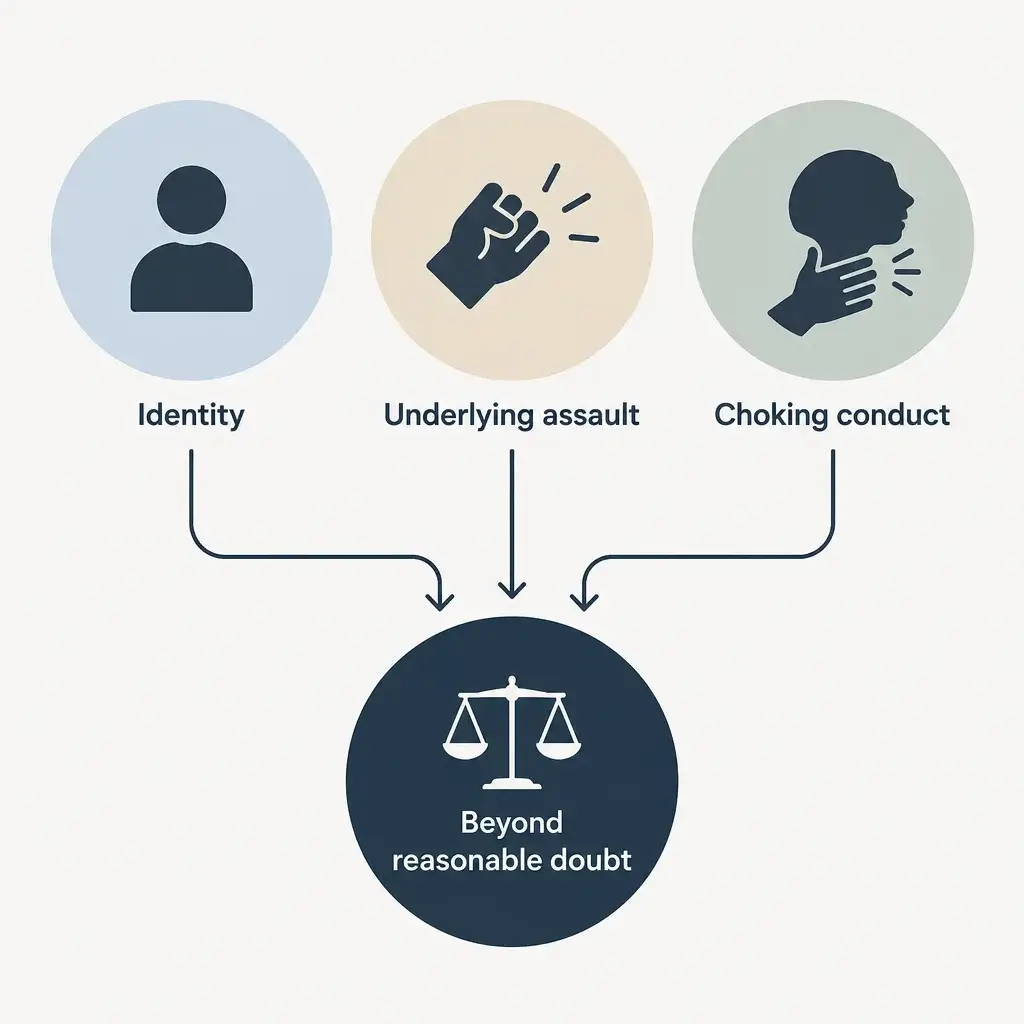
The Crown must prove identity, the underlying assault and the alleged choking, suffocating or strangling beyond a reasonable doubt. The prosecution must establish intentional conduct and the required fault for assault. Accidental contact and deliberate force raise different legal issues.
Visible injuries are not a required element of assault by choking. Nor must the Crown prove unconsciousness or a separate bodily injury to establish that particular form of assault. That does not make medical evidence irrelevant. It can support, qualify or conflict with an account of what happened.
Yes, a choking allegation can be proved without photographs, medical records or another eyewitness. Credible and reliable testimony can establish an offence beyond a reasonable doubt. Equally, an allegation alone does not reverse the burden: the accused does not have to prove innocence.
The elements change when a different choking-related offence is charged. Overcoming resistance requires its additional intent connected to an indictable offence. Sexual assault requires proof of the sexual nature of the assault and the applicable consent and fault requirements. Proof of neck contact does not bypass those elements.
Evidence used in choking and strangulation cases
The evidence can include testimony, recordings, medical observations and electronic records. Relevant material may include:
- The complainant’s statements and emergency-call recordings.
- Police notes and available body-worn camera recordings.
- Photographs taken at different times after the alleged incident.
- Medical records and properly admitted expert evidence.
- Accounts from neighbours, family members or other witnesses.
- Messages, call records, social-media material and alleged admissions.
These items must be assessed for relevance, reliability and admissibility. Their existence does not establish that the allegation is true.
Yes, one witness can be enough in law. Courts distinguish credibility, meaning honesty, from reliability, meaning accuracy. They assess the whole record, including opportunity to observe, memory, material inconsistencies and surrounding evidence. A distressed or imperfect account is not automatically false; confidence is not automatically accuracy.
The Crown must address reasonable doubt even where a judge does not accept the accused’s account. The court cannot decide guilt simply by choosing which person seems more believable. When I read disclosure, I separate evidence supporting the allegation from assumptions filling gaps in it.
Defence evidence preservation checklist
A defence review can identify records at risk of being lost through routine deletion or overwriting. Potentially relevant material includes:
- Complete message threads, with dates and original files.
- Call logs and existing location records.
- Available doorbell, building or vehicle recordings.
- Transportation receipts and other timing records.
- Existing photographs and medical records relating to injuries.
- Names of potential witnesses and what they may have observed.
- A private chronology prepared for discussion with the lawyer.
- Release papers, charging documents and the court date.
Evidence must not be altered, destroyed or obtained through prohibited contact. A lawyer can address lawful preservation and production without turning the accused into an investigator.
Domestic allegations and Crown decisions
Yes, police can lay charges even if the complainant does not want a prosecution. Police make charging decisions, and the Crown controls whether to continue the prosecution. A complainant’s wishes matter, but they do not amount to a right to cancel a charge.
An intimate partner allegation affects safety assessment, release planning and sentencing. Shared housing, children, alleged threats, previous violence and existing orders can all affect the response. An assault-with-choking allegation in Ontario is not a separate offence merely because it is described as “domestic.”
No, a retraction does not automatically end the case. The Crown can assess earlier statements, recordings, medical evidence and the circumstances of the changed account, subject to evidentiary rules. Nobody should pressure a complainant or attempt to arrange a retraction.
Bail, release orders and no-contact conditions
Release may come from police on an undertaking or from a court through a release order. If someone remains detained, a bail hearing determines release or detention pending the case. Bail is not a trial of whether the accused committed the offence.
A detained person must be brought before a justice without unreasonable delay. Where a justice is available, the outside limit is 24 hours after arrest; otherwise, it is as soon as possible. This is a rule about being brought before a justice, not a guarantee of release or a completed bail hearing within that time.
Release conditions can restrict contact, attendance at an address, weapons possession and other conduct connected to identified risks. Conditions must be justified and tailored, rather than imposed simply as punishment. Depending on the order, they can prevent return to a shared home or affect exchanges involving children.
Yes, a no-contact condition can prohibit messages through friends, relatives or children. The complainant’s invitation does not override the order. A change requires the proper legal process, and a family-court arrangement does not itself cancel criminal release conditions. Follow the wording exactly until it is lawfully changed.
Some intimate partner cases involve a reverse onus at bail, meaning the accused must justify release. A previous conviction involving violence against an intimate partner can trigger that rule. Prior history and existing orders therefore belong in the lawyer’s initial bail review.
What happens after arrest: the court process
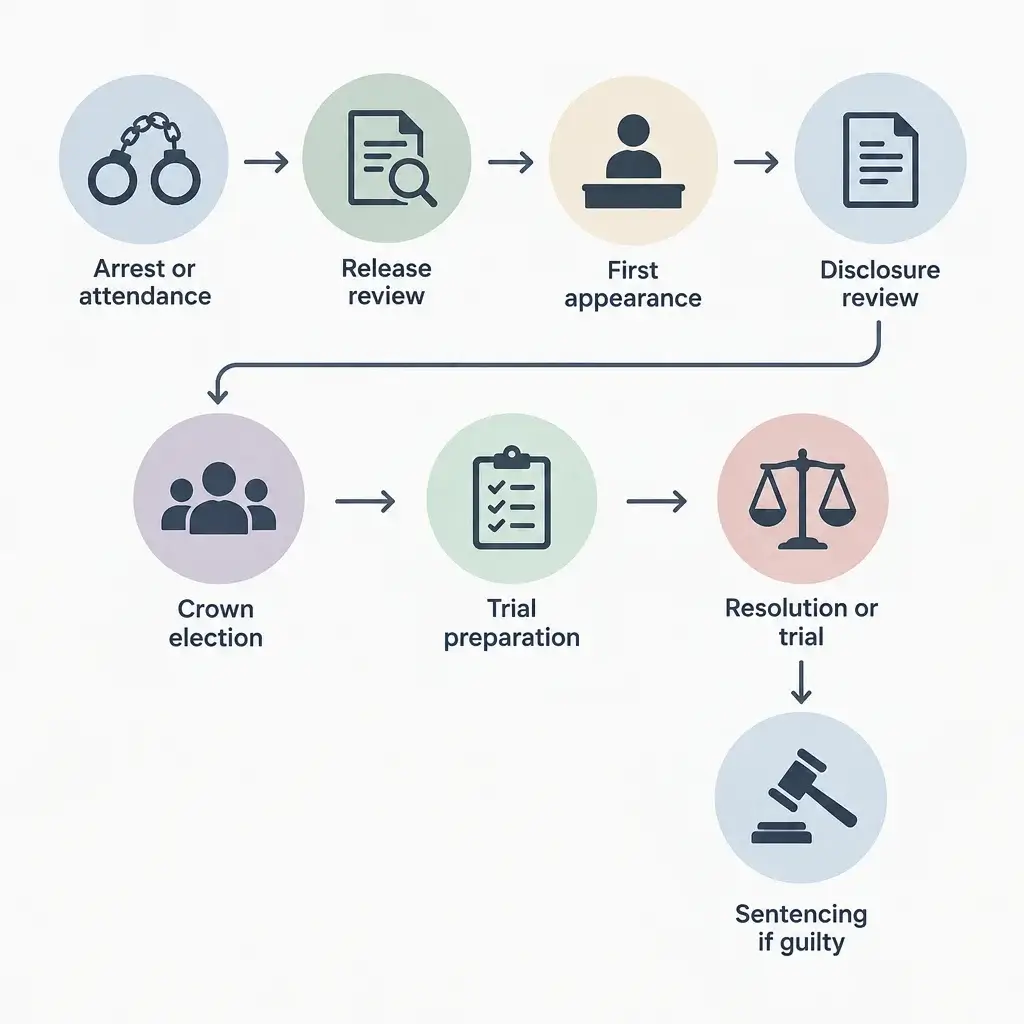
The case moves through release, evidence review and a decision about resolution or trial. The precise route depends on the charge and Crown election. In Ontario, the main stages are:
- Arrest or court attendance. Police may release the accused with paperwork or hold them for a bail hearing. Arrest or detention engages the right to counsel.
- Release review. The undertaking or release order identifies conditions and the next attendance requirement. A breach can create a separate criminal charge.
- First appearance. The court addresses representation, disclosure and scheduling. A first appearance is not automatically a trial or guilty plea.
- Disclosure review. The defence examines statements, recordings and other relevant material, and identifies missing disclosure.
- Crown election and case discussions. The Crown chooses the prosecution route for a hybrid offence. Counsel can discuss evidentiary issues, possible resolutions and trial requirements.
- Trial preparation. The court addresses scheduling and any applications, including Charter issues concerning searches, detention or access to counsel.
- Resolution or trial. A lawful resolution may conclude the case without trial. Otherwise, the Crown presents its evidence and must prove guilt beyond a reasonable doubt.
- Sentencing if guilt is established. The judge considers the offence, applicable law and evidence about the offender’s circumstances.
The ordinary choking-assault offence does not qualify for a preliminary inquiry because its indictable maximum is below 14 years. More serious related charges can follow different procedures. A preliminary inquiry is a screening hearing available only for qualifying indictable offences, not a routine step in every assault case.
The presumptive delay ceilings are 18 months in provincial court without a preliminary inquiry, and 30 months in superior court or provincial court after a preliminary inquiry. These are not promised completion dates. Defence delay is deducted, and exceptional circumstances can affect the analysis.
Withdrawal, reduction and resolution without trial
Yes, a choking charge can legally be withdrawn or resolved without trial. The Crown assesses the evidence, the prospect of conviction and the public interest under Ontario prosecution policy. Witness availability, admissibility, safety concerns and the seriousness of the allegations can affect that assessment.
Potential discussions can concern withdrawal, a plea to a different supported offence, a peace bond or diversion where appropriate. A peace bond is a court order to keep the peace, not a criminal conviction. Diversion addresses a case outside the ordinary trial process through approved measures. Neither is an automatic option for a choking allegation.
No, the complainant cannot personally “drop” a domestic choking charge. Nor does completing counselling require the Crown to withdraw it. Steps taken since the charge can be relevant, but they do not replace an assessment of the evidence and public interest.
Defences and legal issues
A defence depends on the charged elements and the disclosure, not a standard script. Issues that may require examination include:
- Identity: Whether the Crown can prove who committed the alleged act.
- What occurred: Whether the evidence proves choking, another form of force or neither.
- Intent and accident: Whether the conduct and required fault were established.
- Self-defence or defence of another: Whether the statutory requirements, including reasonable action in the circumstances, are met.
- Credibility and reliability: Whether conflicting accounts or objective evidence leave reasonable doubt.
- Charter compliance: Whether unlawful detention, a search or denial of counsel supports a remedy.
Each issue has legal requirements. A Charter breach does not automatically exclude evidence or end a prosecution.
Consent is not a blanket defence to choking allegations. Canadian law limits consent to intentionally inflicted bodily harm, and sexual consent must relate to the sexual activity in question. A person cannot consent while unconscious. A relationship, previous sexual activity or earlier agreement does not settle the legal issue.
Consequences beyond the sentence
Employment consequences can begin before conviction if release conditions prevent attendance at work or a regulated role requires disclosure of charges. A conviction can affect background screening and professional licensing. The effect depends on the job, governing rules and record-check category, not simply the offence label.
A conviction, and some sentences, can affect permanent residents and other non-citizens under immigration law. Foreign travel can also be affected by another country’s entry rules. Immigration status and planned travel should be raised at the first defence meeting; citizenship cannot be assumed from years spent living in Canada.
Firearms restrictions can arise through release conditions, licensing decisions and sentencing orders. Family and parenting arrangements can be affected by no-contact terms or restrictions on attending the home. A criminal release order and a family-court order serve different purposes and must not be treated as interchangeable.
Housing can become an immediate problem when an order prohibits returning to a shared address. The restriction applies even before any finding of guilt. Property ownership, rent payments or the other occupant’s permission do not cancel the condition.
FAQ: immediate concerns after a choking charge
A no-contact order and returning home
Yes, a no-contact or no-attendance condition can stop an accused from going home. Its exact wording controls, including any express exceptions. Do not arrange contact or a return visit outside those terms.
No marks and proof of the allegation
Yes, a prosecution can proceed without visible marks. The choking-assault provision does not require a separate bodily injury, and testimony can provide proof. The Crown still bears the full burden beyond a reasonable doubt.
The maximum sentence for strangulation
There is no single maximum for every strangulation allegation. Ordinary assault by choking carries an indictable maximum of 10 years, while overcoming resistance carries life imprisonment. Sexual-assault allegations require their own penalty analysis.
Choosing a lawyer and preparing for the first meeting
A criminal defence lawyer should assess the charge, release terms and evidence together. My practice is criminal defence only. I have practised criminal law since 2001, beginning with three years as a prosecutor. That background shapes how I examine the Crown’s theory and the proof supporting it.
The initial review should include the charging papers, release order or undertaking, court date and any disclosure already received. Immigration status, firearms, shared housing and parenting restrictions also need early attention. My office is in North York, and I represent clients across Toronto, the GTA and elsewhere in Ontario.
Use the right to remain silent and ask to speak with a lawyer. Do not discuss the allegations with police, the complainant, co-accused or on social media. Follow every release condition and attend every required court date. Before the first appearance, have a criminal defence lawyer review what the charge actually requires the Crown to prove.