

 Based on 116 Verified Google Reviews
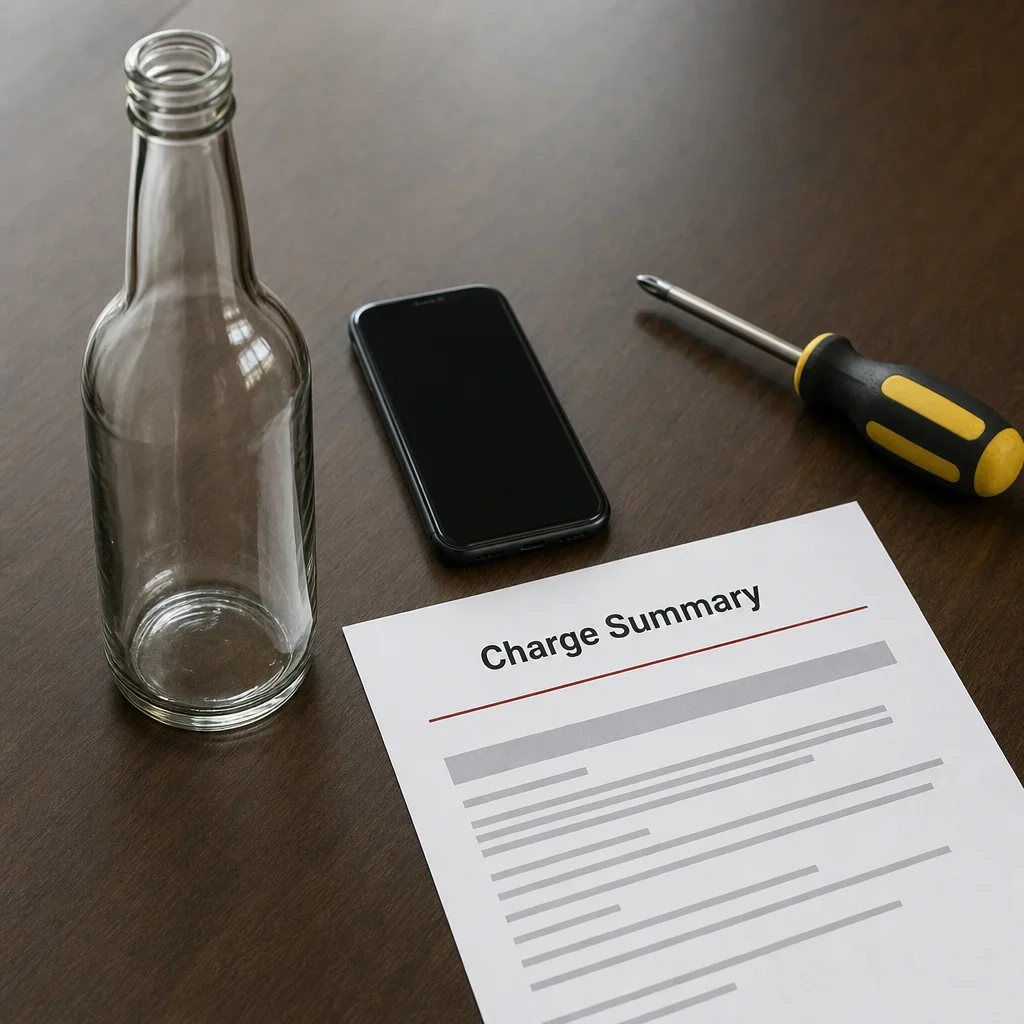
If you searched assault with a weapon charge after an arrest, the first thing to know is this: Canadian law usually speaks about assault with a weapon under the Criminal Code, not the U.S.-style label “assault with a deadly weapon.” This guide explains the Canadian offence, how it compares to aggravated assault, what the Crown must prove, and what usually happens next. This is general information only, not legal advice for your case.
What an assault with a weapon charge means in Canada
In Canada, assault with a weapon generally refers to the section 267 offence of committing an assault while carrying, using, or threatening to use a weapon or imitation of one. That matters because the object does not have to be a gun or knife, and the allegation does not require catastrophic injury.
A person can be charged even where the item was an everyday object, such as a bottle, tool, phone, or vehicle, if the Crown says it was used or threatened as a weapon in the circumstances. The legal focus is the role the object played during the alleged assault, not whether it was sold as a weapon.
Canadian law also separates this offence from aggravated assault under section 268, which is a more serious allegation involving wounding, maiming, disfiguring, or endangering the life of the complainant. That is why people searching for the penalty for assault with a deadly weapon or aggravated assault with a deadly weapon jail time are usually comparing two different levels of offence.
If you searched “assault with a deadly weapon”
In Canada, “deadly weapon” is common search language, but it is not usually the statutory label you should rely on. The Code usually uses weapon or imitation weapon instead.
Assault with a weapon vs assault, bodily harm, and aggravated assault
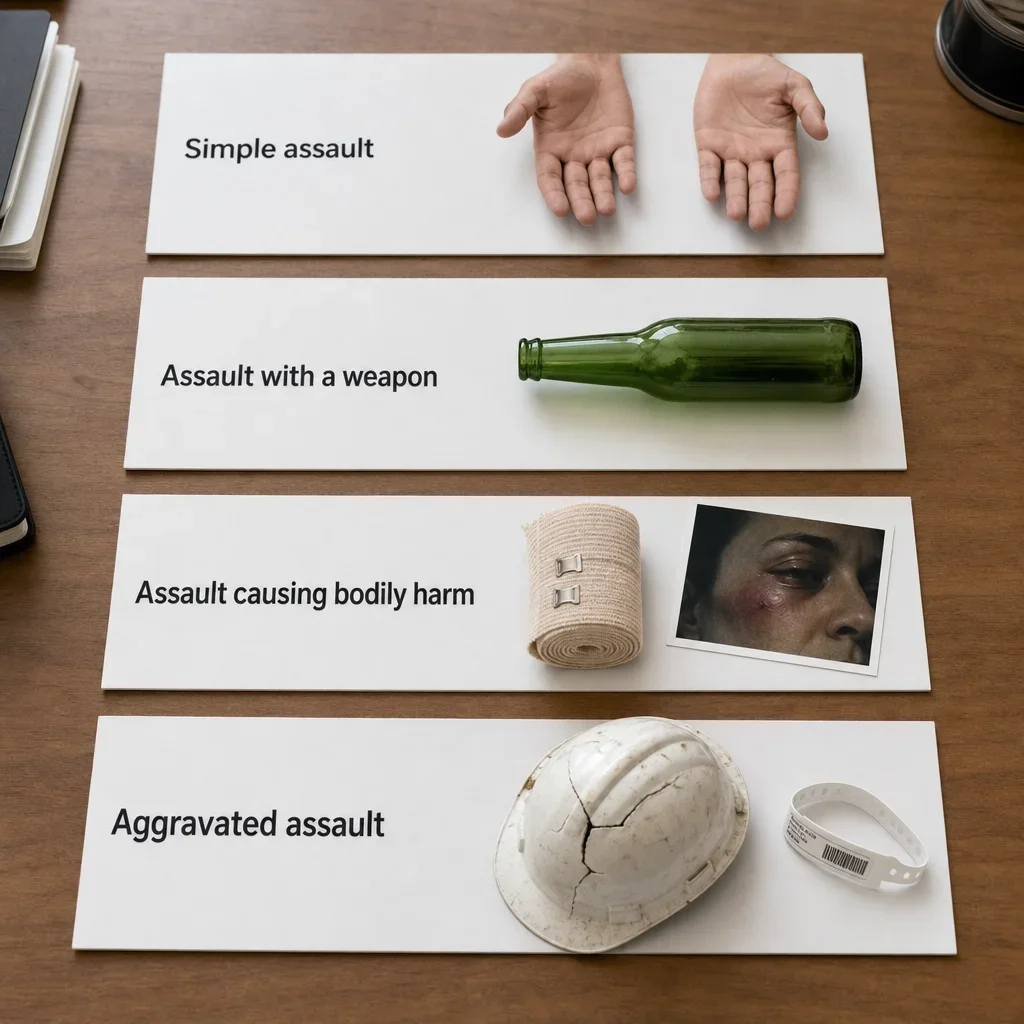
Simple assault is usually the lowest common assault charge in this ladder because it does not require a weapon allegation or bodily harm allegation. It can still be serious, but it usually sits below section 267 and section 268 in gravity.
Assault with a weapon adds the alleged use, carrying, or threatened use of a weapon or imitation weapon during the assault. A threat with an object can matter even if the physical injury is minor or absent.
Assault causing bodily harm focuses on injury that is more than trivial or merely transient. In plain English, the Crown alleges actual bodily harm, even if no weapon was used.
Aggravated assault is the top level in this comparison because the allegation is that the complainant was wounded, maimed, disfigured, or had life endangered. That is why aggravated assault with a deadly weapon punishment searches usually point to cases with much more serious alleged harm.
| Offence | What the Crown alleges | Injury required | Relative seriousness |
|---|---|---|---|
| Simple assault | Intentional application of force, attempt, or threat | No | Lowest in this group |
| Assault with a weapon | Assault plus carrying, using, or threatening to use a weapon or imitation | No | More serious than simple assault |
| Assault causing bodily harm | Assault plus bodily harm | Yes | More serious than simple assault |
| Aggravated assault | Wounding, maiming, disfiguring, or endangering life | Serious harm | Most serious in this group |
A plain example helps. A shove during an argument may be alleged as simple assault. Swinging a bottle during that same argument may lead to an assault with a weapon charge. Breaking someone’s jaw may support bodily harm or aggravated assault, depending on the injury evidence.
Is “assault with a deadly weapon” the same thing in Canada?
In Canada, “assault with a deadly weapon” is usually search language, not the precise Criminal Code offence name. If you are charged here, the paperwork will normally refer to assault with a weapon, assault causing bodily harm, aggravated assault, or another Code offence.
There is also no recognized Canadian offence category called assault with a non deadly weapon as a separate label. The legal question is usually whether the object was a weapon in the circumstances, not whether someone has sorted it into deadly or non-deadly.
An imitation weapon can still matter because section 267 refers to a weapon or an imitation of one. A fake gun, replica, or object made to look real can support the charge if the Crown says it was used to threaten during the assault.
The phrase assault with a deadly weapon penalty can therefore mislead Canadian readers. The better question is whether the allegation fits section 267 or section 268, because those are the sections that drive the charge, procedure, and sentencing exposure.
What counts as a weapon under Canadian law?
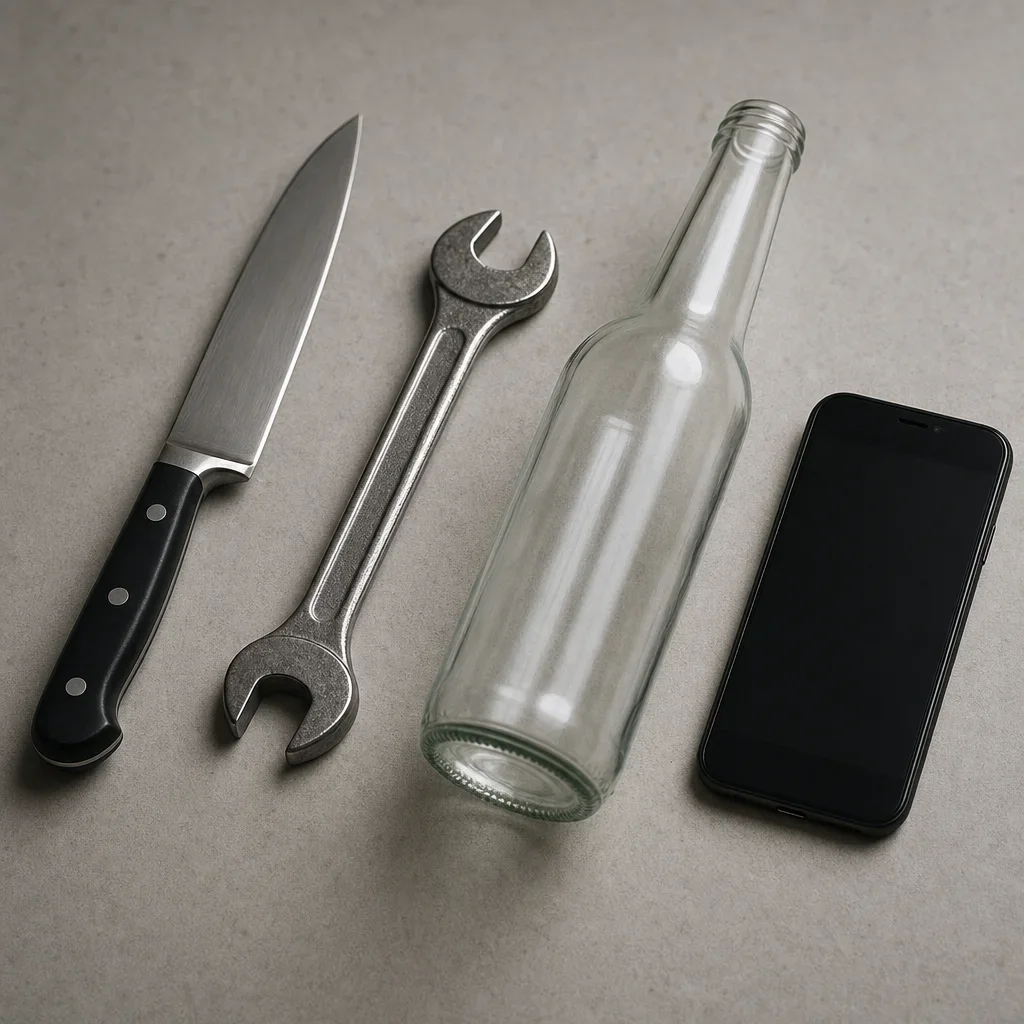
A weapon can include an ordinary object if it was used, designed, or intended to cause injury or to threaten or intimidate during the incident. That is why everyday objects can become central in an assault case.
Examples that may be treated as weapons include a bottle, bat, hammer, kitchen item, cellphone, tool, vehicle, or even a dog used to attack or intimidate. Whether any specific item qualifies depends on the evidence, the way it was used, and the surrounding facts.
An imitation can matter for the same reason. A complainant does not have to show the object was operational if the allegation is that it was used as an imitation weapon during the assault.
The legality of possessing an item is a separate issue from whether it can count as a weapon in an assault case. A lawful household object can still be treated as a weapon if the Crown says it was used that way.
Can you be charged if no one was injured?
Yes. Injury is not required for every assault with a weapon allegation. A threat with a weapon, an attempted strike, or the use of force with an object can lead to a charge even if there are no cuts, bruises, or lasting wounds.
That is because Canadian assault law is not limited to completed injury cases. An intentional application of force, an attempt or gesture coupled with present ability, or a threat that causes the complainant to believe force is about to be used can all matter, depending on the allegation.
A simple example is brandishing a bottle and moving toward someone while threatening to hit them. The Crown may allege assault with a weapon even if the bottle never makes contact. Whether the evidence proves that allegation is a separate question.
What the Crown must prove: a simple checklist for sections 267 and 268
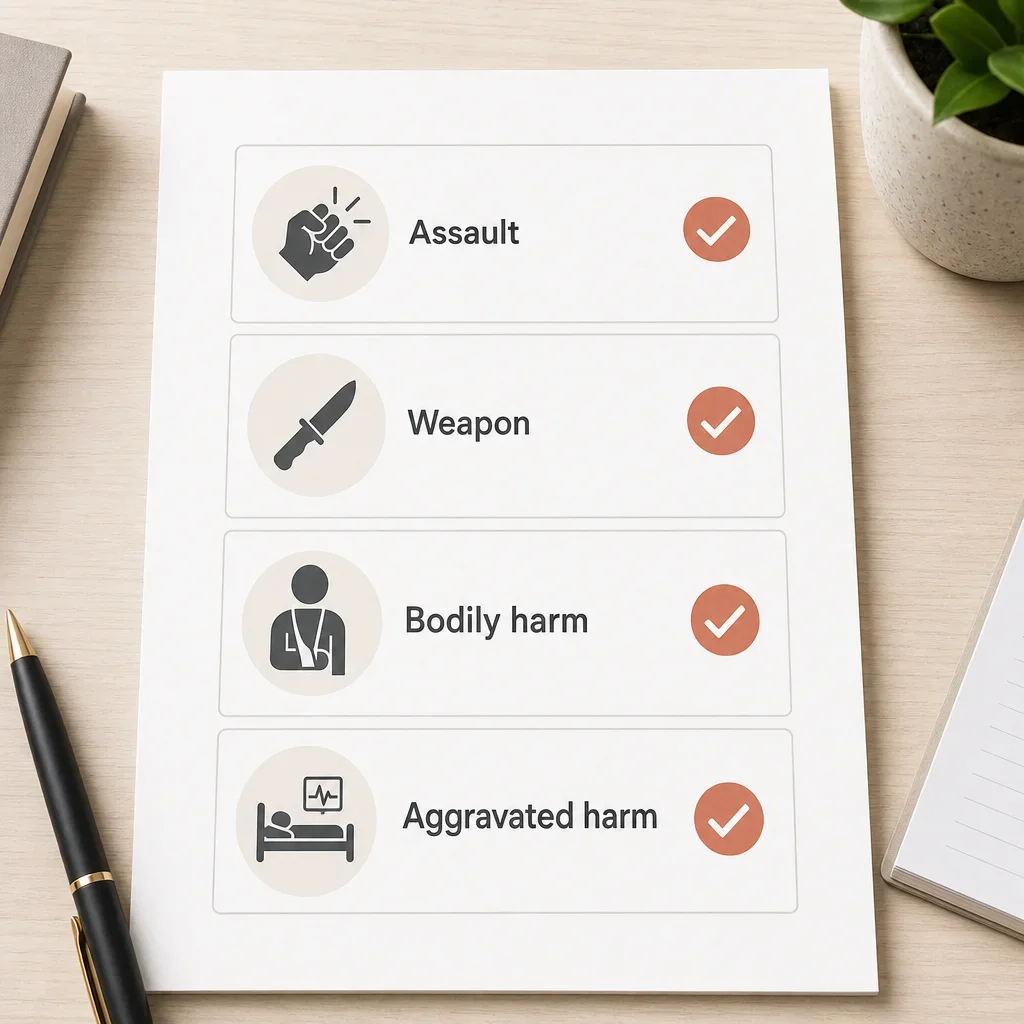
For assault with a weapon under section 267, the Crown must first prove an underlying assault. That usually means proving an intentional application of force, an attempted application of force, or a threat of force that met the legal test.
For the weapon branch of section 267, the Crown must then prove that the accused carried, used, or threatened to use a weapon or imitation while committing the assault. The object, the movements, the words used, and the complainant’s account often become key evidence.
For the bodily harm branch of section 267, the Crown must prove bodily harm as the law defines it, not just fear or anger. Medical records, photos, and testimony often matter here, but there is no universal evidence checklist that every case must have.
For section 267(c) allegations, the Crown must prove choking, suffocating, or strangling as charged. These cases often turn on detailed fact evidence, medical observations, photographs, messages, 911 recordings, and witness accounts.
For aggravated assault under section 268, the Crown must prove an assault plus a much more serious result: wounding, maiming, disfiguring, or endangering life. That is why aggravated assault with a deadly weapon punishment searches should not be answered by quoting only a maximum sentence.
The mental element is usually about intentional force and awareness of the act, not a need to prove the accused wanted the exact final injury. The precise legal analysis can be technical, and it turns on the way the Crown has framed the charge.
The Crown can rely on many kinds of evidence, including witness testimony, surveillance, body-worn video, 911 calls, texts, photos, medical records, admissions, and forensic evidence. One weak point, one contradiction, or one missing link can still matter because the Crown must prove guilt beyond a reasonable doubt.
Choking or strangulation charges under section 267(c)
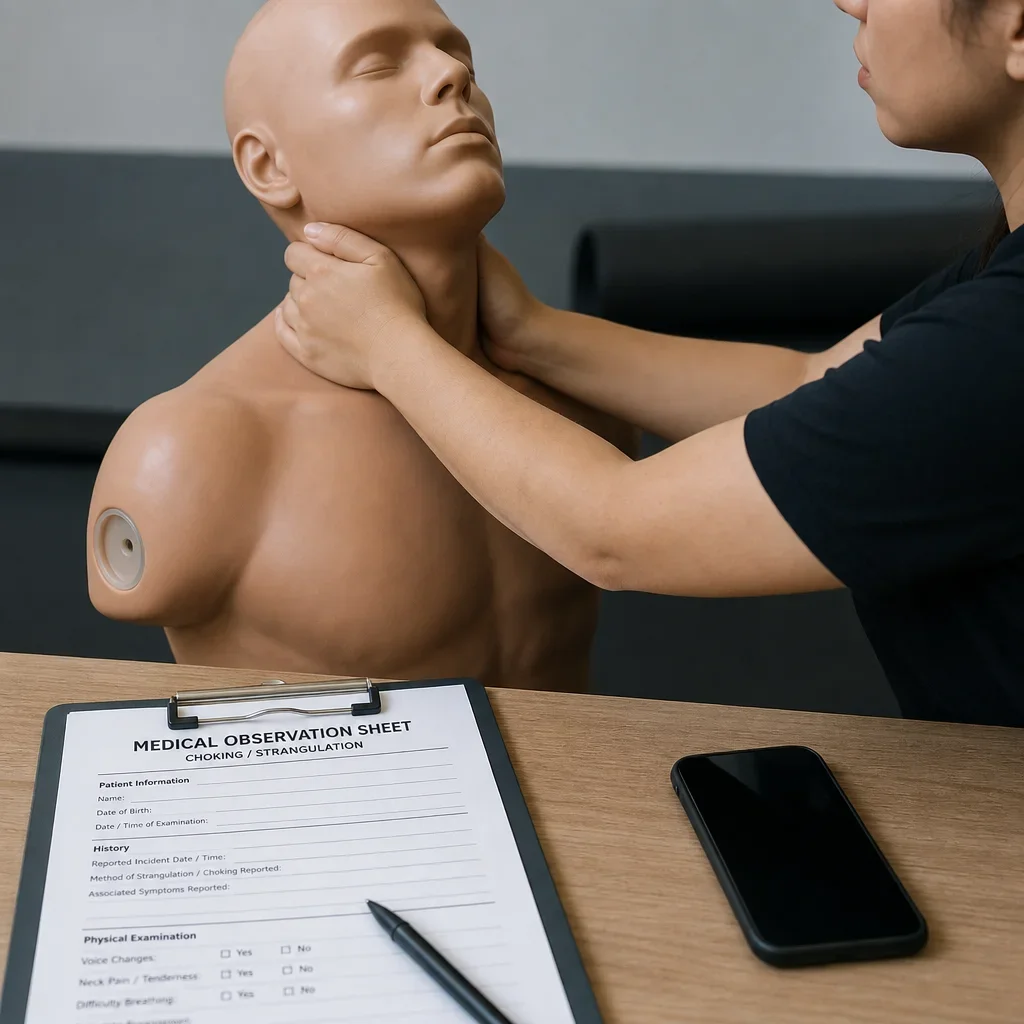
Section 267(c) covers assault by choking, suffocating, or strangling. You may also see searches for CCC 267(c assault by choking) or Section 267(c) Criminal Code of Canada for that reason.
These allegations are treated seriously even when there is no lasting visible injury. External marks can be limited or absent, but the allegation can still support a significant prosecution.
The same facts can overlap with other charges where the Crown alleges bodily harm or life-endangering consequences. In a more severe case, the Crown may consider aggravated assault if the injury evidence supports it.
These charges often arise in intimate partner allegations, but they are not limited to that setting. Release conditions, no-contact terms, and bail issues can become immediate concerns after arrest.
Penalties for assault with a weapon in Canada
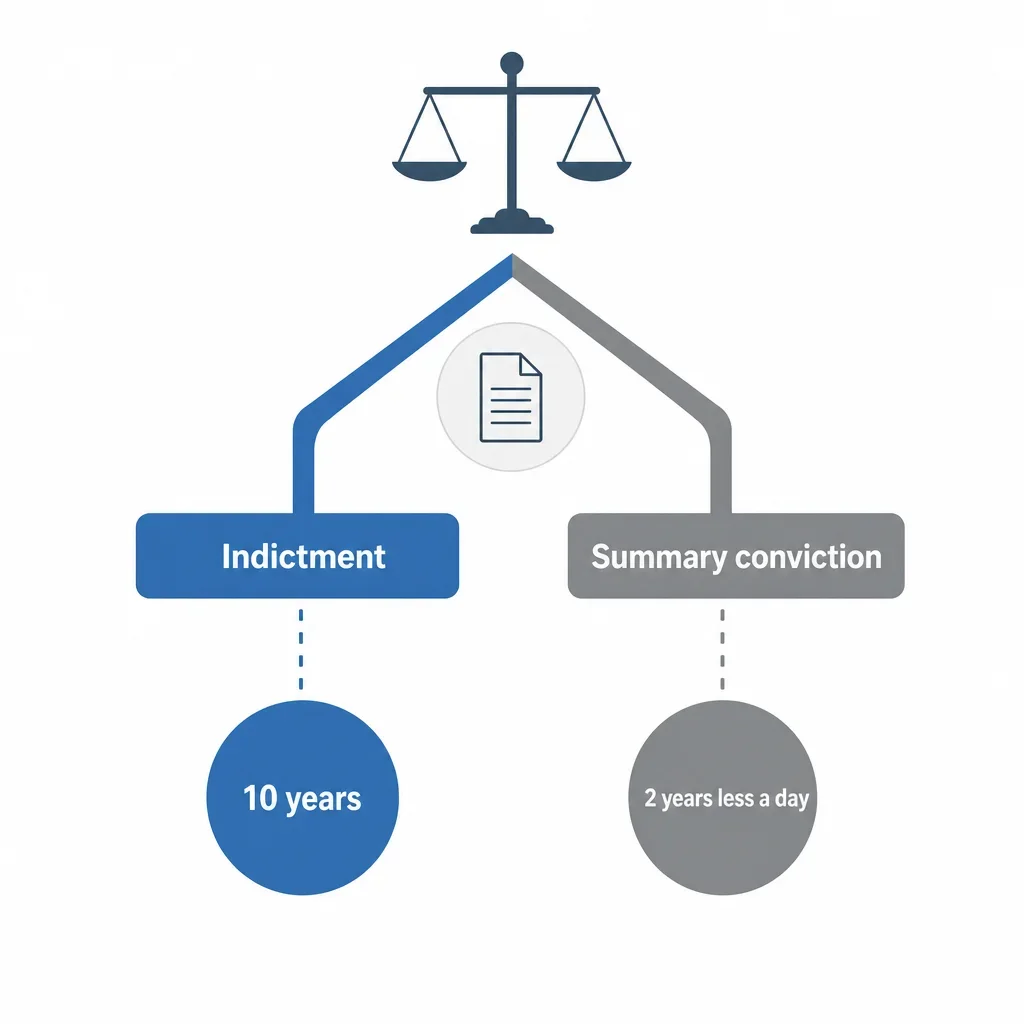
Assault with a weapon is a hybrid offence, which means the Crown can proceed by indictment or by summary conviction. That election affects the procedure and the maximum sentence exposure.
On indictment, the maximum penalty for assault with a weapon is 10 years’ imprisonment. On summary conviction, the maximum is 2 years less a day.
There is no general minimum sentence for assault with a weapon in Canada. That is important because people searching Assault with a weapon minimum sentence Canada or assault with a deadly weapon minimum sentence often assume jail is automatic.
The maximum sentence is not the same as the likely sentence. Real outcomes turn on injuries, the nature of the weapon allegation, prior record, whether the incident happened in a domestic context, whether there was a breach of release, and the strength of any defence.
Aggravating factors can include serious injury, vulnerability of the complainant, use of a highly dangerous object, prior violence, and offending while on release. Mitigating factors can include no record, early responsibility, rehabilitation steps, and a weaker factual case on the weapon allegation.
Penalties for aggravated assault in Canada
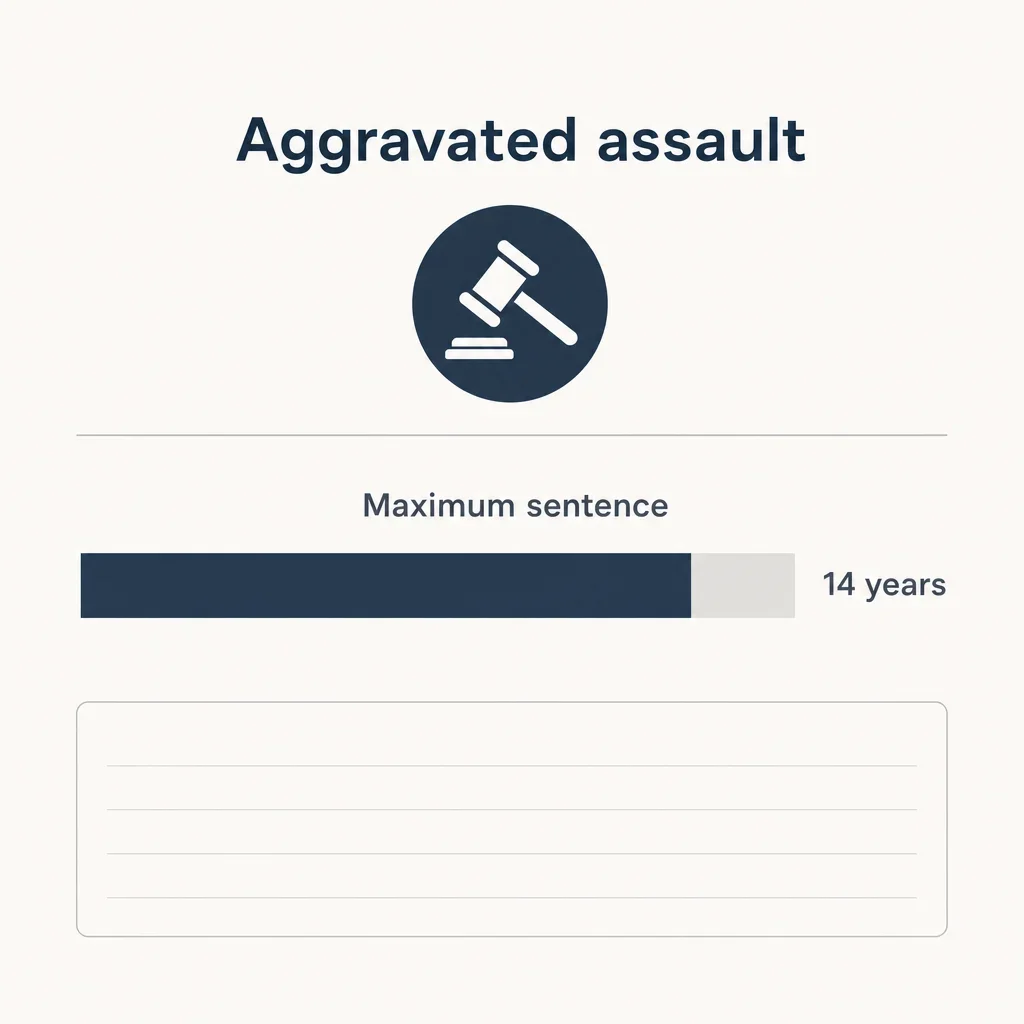
Aggravated assault is an indictable offence. It sits among the most serious non-homicide assault offences because of the level of alleged harm.
The maximum sentence for aggravated assault is 14 years’ imprisonment. There is no general minimum sentence for aggravated assault in Canada.
The phrase jail time for aggravated assault with a deadly weapon needs a careful answer. Jail is a real risk in aggravated assault cases, but there is no honest one-size-fits-all number because sentence turns on the injuries, the circumstances, prior record, and the available defence issues.
A maximum sentence tells you the ceiling, not the expected outcome in your case. I would never answer a first-offence search by throwing out a number without reviewing the disclosure, injuries, record, and context.
Will a first-time offender go to jail?
A first offence does not automatically mean jail, but it does not rule jail out either. Anyone searching Assault with a weapon first offence Canada or aggravated assault with a deadly weapon first offense should be careful about blanket answers online.
Where there is little or no injury, no record, strong mitigation, and a triable issue on the evidence, the sentencing picture can look very different from a case involving choking, a vulnerable complainant, or serious bodily harm. The facts drive the risk.
Where the Crown alleges bodily harm, repeated blows, a dangerous object, intimate partner violence, or breach of a court order, the sentencing exposure becomes more serious even for a first offender. That is why “first offence” is only one factor.
For aggravated assault, jail risk is usually much more significant because the offence itself alleges very serious injury or life-endangering conduct. Still, no lawyer can responsibly promise jail or no jail from a keyword search alone.
Common defences to assault with a weapon and aggravated assault
Self-defence can apply, but it turns on whether the act was reasonable in the circumstances under section 34 of the Criminal Code. The force used, the threat perceived, the history between the parties, and the proportionality of the response can all matter.
Accident or lack of intent can matter where the defence position is that contact was not intentional or the object was not used as the Crown claims. That defence depends heavily on the surrounding evidence.
Mistaken identity is a live issue in some cases, especially where the event was fast, dark, crowded, or captured only partially on video. Identification evidence is not automatically strong because a witness sounds confident.
Consent has limits in assault law and is not a broad answer to serious violence allegations. The legal analysis becomes more restrictive where bodily harm or serious injury is alleged.
Insufficient or inconsistent evidence can create reasonable doubt even where the allegation sounds serious on paper. In practice, cases can turn on contradictions, missing context, unreliable recollection, or incomplete disclosure.
Charter issues and evidence problems that can affect the case
Charter issues can matter if police obtained statements, searches, or evidence unlawfully. The most common concerns usually relate to detention, the right to counsel, search and seizure, and the admissibility of statements.
Disclosure problems can also affect the defence if important materials are missing, delayed, or incomplete. Video gaps, missing notes, late medical disclosure, and unproduced witness statements can all change how a case is assessed.
No one should promise that evidence will be excluded. What a lawyer does at the start is identify whether a Charter breach or evidence weakness can realistically change the case.
What happens after arrest: release, bail, and court process
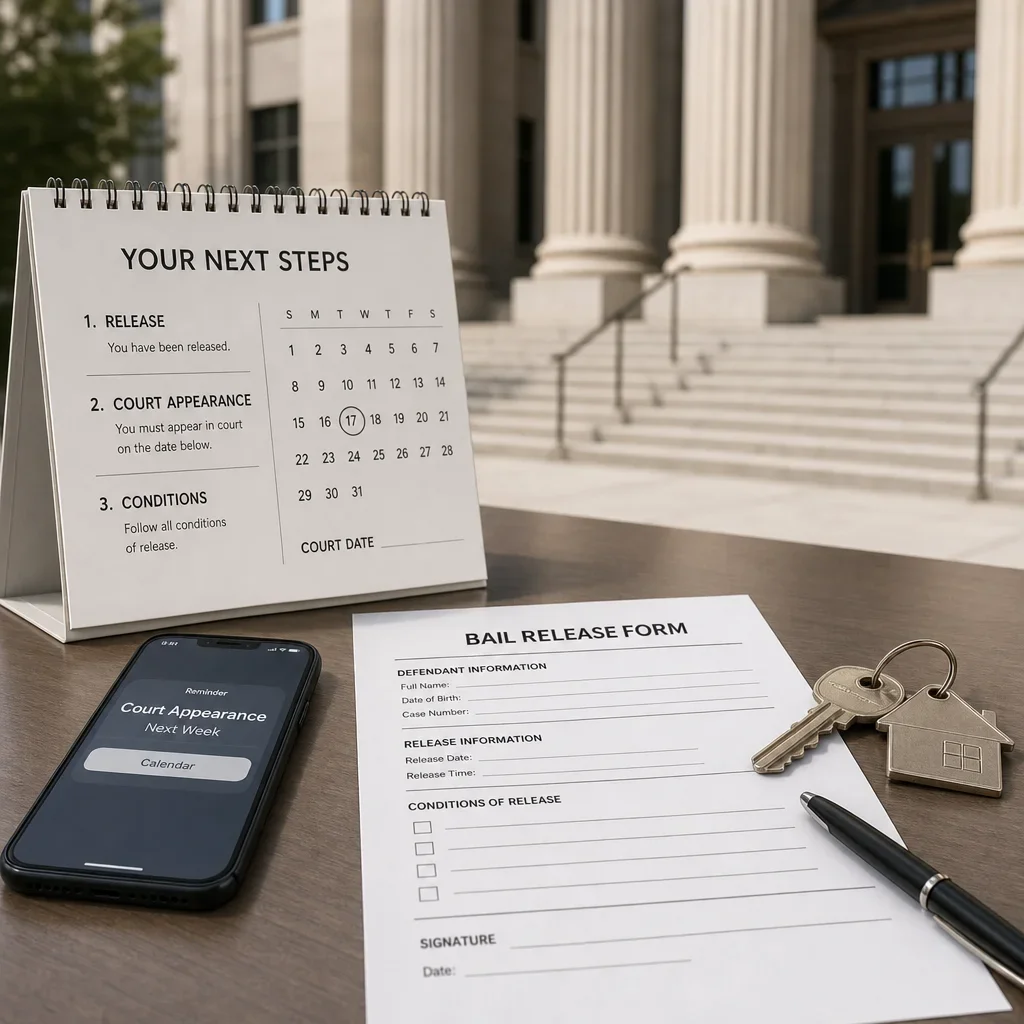
After police contact, the usual path is arrest or a notice to attend, then release by police or a bail hearing, then a first court appearance, disclosure, and later resolution discussions or trial. The exact path depends on the charge, the facts, and the release decision.
Release conditions are common in assault cases. They often include no-contact terms, no-go locations, weapons prohibitions, reporting requirements, or rules about communication through third parties.
A bail hearing may be required if police do not release the accused. Whether there are added bail complications can depend on the allegation, the record, the complainant relationship, and whether the accused was already on a court order.
The first practical step after arrest is to use the right to counsel and avoid discussing the facts with police. The second is to preserve texts, photos, video, and witness information rather than trying to explain the case away yourself.
The third is to follow every release condition exactly. A breach allegation can make an already serious case harder to resolve.
If police have contacted you, if there are bail conditions, if the allegation involves choking, injury, or immigration concerns, get case-specific advice quickly. A lawyer can review the charge, likely sentence range, possible defences, and release terms, but no one can responsibly promise an outcome at this stage.
Short action checklist after police contact
- Use your right to counsel immediately.
- Do not give a statement about the facts.
- Do not contact the complainant if you were told not to.
- Save texts, call logs, photos, video, and location data.
- Write down your memory while it is fresh.
- Follow every release or bail condition exactly.
Can assault charges be dropped, reduced, or resolved without trial?
In Canada, complainants do not personally “drop” criminal charges once laid. The Crown controls the prosecution decision, although the complainant’s evidence and wishes can still affect the case.
Charges can sometimes be withdrawn, stayed, reduced, or resolved by agreement, but that depends on the evidence, the public-interest assessment, and the seriousness of the allegation. No honest lawyer should guarantee that result.
A peace bond or diversion may be possible in some assault cases, but serious injury, weapon allegations, or intimate partner violence allegations can make those outcomes harder to achieve. Whether that path exists is case-specific.
A plea to a lesser offence can also happen where the evidence on the weapon allegation, the injury allegation, or the overall proof is contested. That is one reason disclosure review matters so much.
Criminal record and other consequences beyond jail
A conviction can create a criminal record. For many people, that matters as much as the immediate sentence.
Collateral consequences can include probation terms, weapons prohibition issues, trouble with employment, licensing, professional regulation, family court positions, and international travel. Those effects can last long after the court case ends.
Immigration consequences can be severe for permanent residents, temporary residents, and foreign nationals. If immigration status is in play, the criminal and immigration consequences should be reviewed together.
Some orders, such as weapons prohibitions or DNA orders, can arise in certain cases depending on the offence and the result. The exact consequences depend on the charge proven and the sentence imposed.
Examples: when conduct may be charged as assault with a weapon or aggravated assault
A threatened swing with a bottle during an argument may support an assault with a weapon charge even if no one is cut. The issue would be the threat and the role of the object.
Driving a vehicle at someone to intimidate or strike them may be treated as a weapon allegation because a vehicle can function as a weapon in context. The exact charge can depend on the injuries and the manner of driving.
Setting a dog on someone may also support a weapon-based allegation if the Crown says the animal was used as the means of assault. The factual details would matter closely.
A choking allegation with little visible injury may still support a section 267(c) prosecution. Visible marks are not the only measure of seriousness.
A bar fight involving severe facial injuries may move the case from simple assault or bodily harm toward aggravated assault if the evidence suggests disfigurement or life-endangering harm. Medical evidence often becomes central in that analysis.
Throwing a household object that strikes someone can fit several possible charges depending on intent, injury, and the way the object was used. That is why two cases involving the same object can still lead to different charges.
Using an imitation gun to threaten during an assault may support section 267 because the law refers to an imitation weapon as well as a weapon. A fake object is not automatically a fake case.
FAQ
What is assault with a weapon in Canada?
It is generally the section 267 offence of committing an assault while carrying, using, or threatening to use a weapon or imitation weapon. It can also include related bodily harm or choking allegations under the same section.
Is assault with a weapon worse than assault?
Yes. It is generally treated as more serious than simple assault because of the weapon or imitation weapon element. The sentence still depends on the facts and the offender’s record.
What is the penalty for assault with a weapon in Canada?
It is a hybrid offence. The maximum is 10 years on indictment and 2 years less a day on summary conviction. There is no general minimum sentence.
Is assault with a weapon a hybrid offence?
Yes. The Crown can elect indictment or summary conviction.
Is aggravated assault always indictable in Canada?
Yes. Aggravated assault is an indictable offence.
Will a first-time offender go to jail for assault with a weapon in Canada?
Not automatically. Jail can still happen, especially where there are injuries, choking allegations, a dangerous object, breach allegations, or other aggravating facts.
Can assault charges be dropped in Canada?
Not by the complainant alone. The Crown controls whether charges proceed, are withdrawn, are stayed, or are resolved another way.
Does assault with a weapon give you a criminal record?
A conviction can result in a criminal record. The charge alone is not the same thing as a conviction.
What counts as a weapon under Canadian law?
An object can count as a weapon based on how it was used, intended, or threatened in the circumstances. Everyday objects can qualify.
Can you be charged if nobody was injured?
Yes. Injury is not required for every assault with a weapon case. A threat or attempted use of force with an object may be enough for a charge.
What is the difference between assault causing bodily harm and aggravated assault?
Bodily harm is lower on the scale. Aggravated assault alleges wounding, maiming, disfiguring, or endangering life.
What does section 267(c) mean in Canada?
It refers to assault by choking, suffocating, or strangling. These allegations can be serious even without obvious lasting injury.
When to speak to a criminal defence lawyer
You should get legal advice quickly if police want a statement, if there is a bail hearing coming, if you have no-contact conditions, or if the allegation involves choking, injuries, weapons, prior record, or immigration consequences. Early mistakes can make a hard case harder.
The practical next step is not to guess from a maximum sentence chart. It is to have the charge, disclosure position, release terms, and realistic defence issues reviewed by counsel. If you are also dealing with a simple assault, assault causing bodily harm, or bail issue, those guides may help you understand the bigger picture before court.