

 Based on 116 Verified Google Reviews

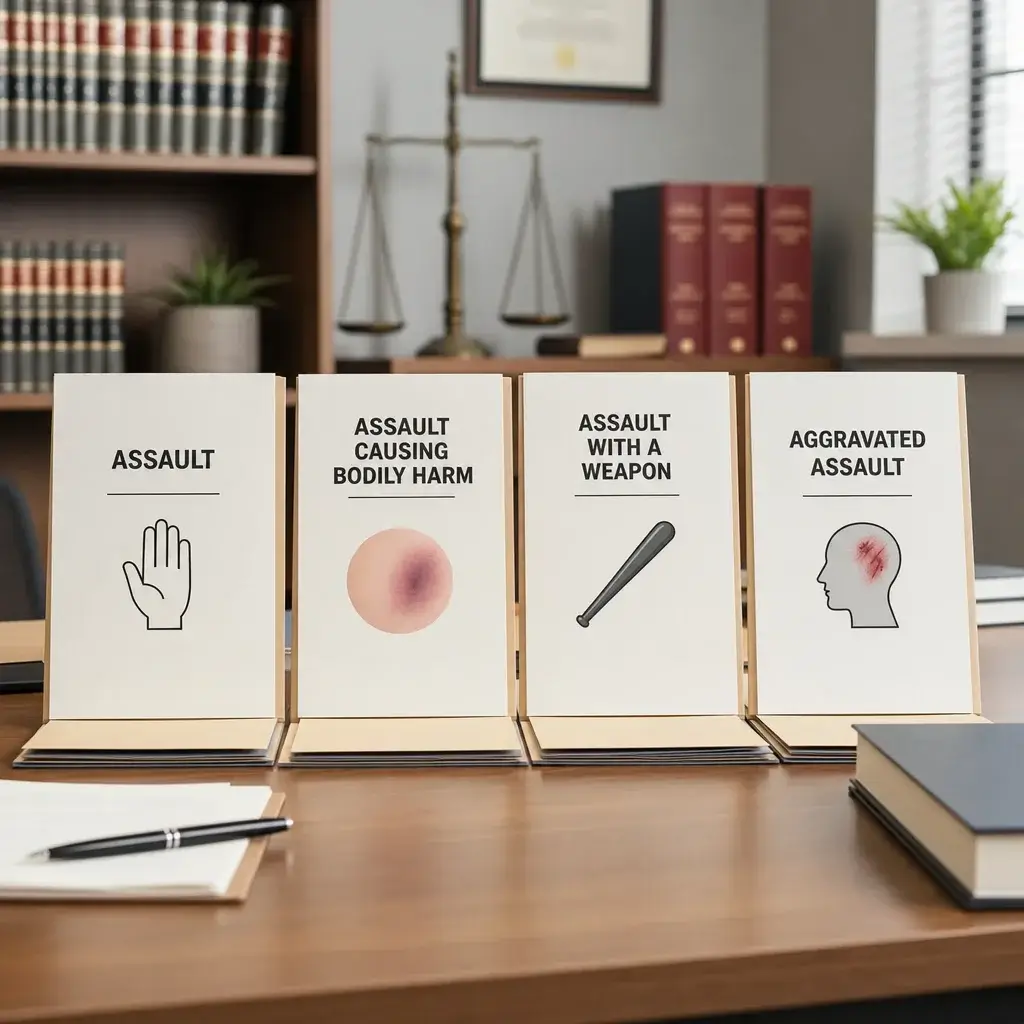
Aggravated assault vs assault in Canada comes down mainly to the level of harm alleged and what the Crown can prove. Basic assault can exist without an injury, while aggravated assault under section 268 of the Criminal Code concerns an assault that wounds, maims, disfigures, or endangers the complainant’s life.
That distinction can affect the charge, release conditions, evidence the Crown relies on, court procedure, and the potential consequences. It does not mean that police, a complainant, or an internet description decides the result: the information, disclosure, medical evidence, and the proof available in court matter.
Assault vs aggravated assault in Canada: the short answer
Assault is the basic category; aggravated assault is the highest assault level in this group because it requires proof of very serious harm or danger to life. An allegation of a push, slap, grab, or immediate threat can be assault even where there is no visible injury, but aggravated assault requires the higher threshold set out in section 268.
It is important to separate the definition from the offence provision. Section 265 of the Criminal Code defines several ways an assault may occur. Section 266 is the provision that makes basic assault punishable.
In practical terms, Canadian law commonly divides these allegations into three levels: basic assault; assault with a weapon, assault causing bodily harm, or choking, suffocating or strangling; and aggravated assault. A charge can be reviewed or changed as further evidence becomes available, particularly where hospital records or imaging clarify the nature of an injury.
The three main assault levels at a glance
The three main assault levels are basic assault, the section 267 middle category, and aggravated assault. The sections, proof required, and maximum penalties differ, although the actual result in any case depends on the evidence and sentencing process.
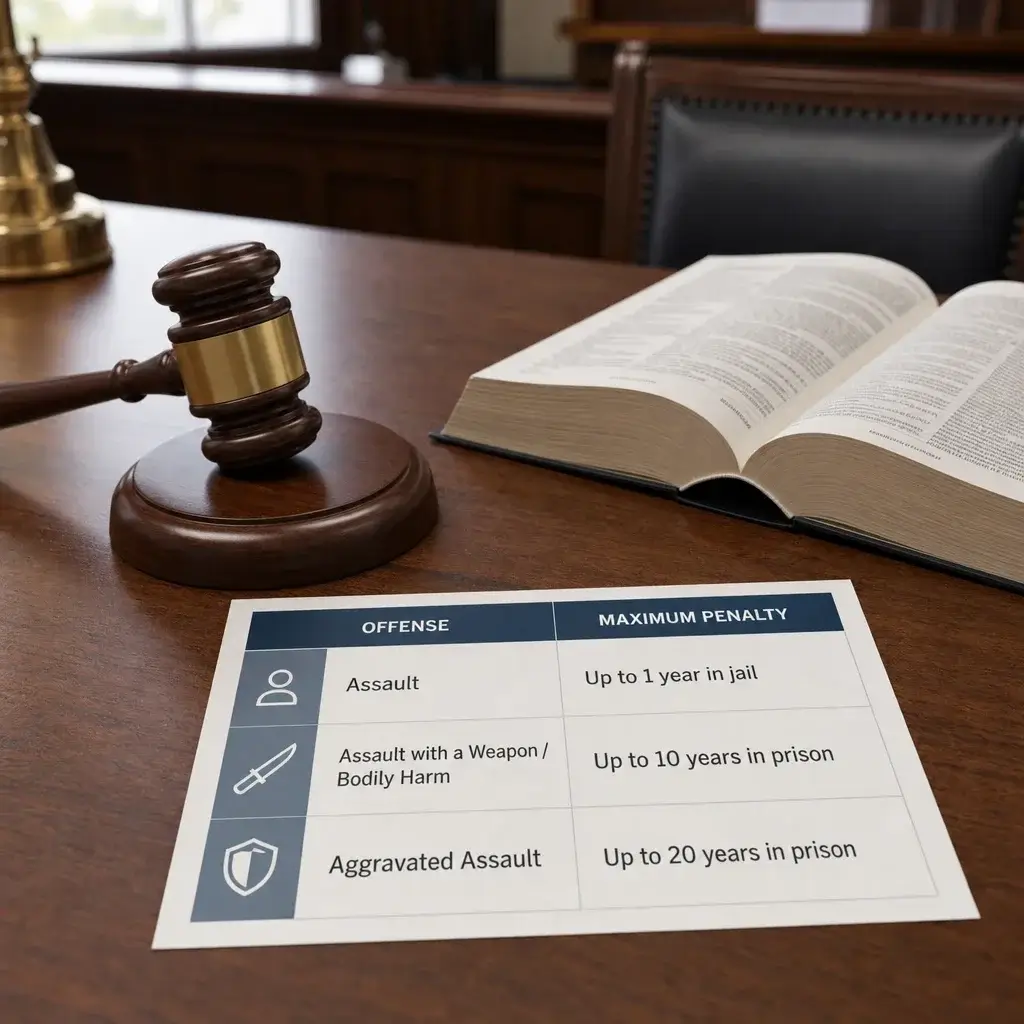
| Charge level | Criminal Code provision | What generally distinguishes it | Prosecution mode | Maximum penalty |
|---|---|---|---|---|
| Basic, common, or simple assault | Section 265 defines assault; section 266 addresses punishment | Intentional non-consensual force, or an act or gesture creating reasonable grounds to fear immediate force; no injury is required | Hybrid | Up to 5 years’ imprisonment if prosecuted by indictment |
| Assault with a weapon, assault causing bodily harm, or choking, suffocating or strangling | Section 267 | A weapon allegation, bodily harm, or the specified choking-type conduct | Hybrid | Up to 10 years’ imprisonment if prosecuted by indictment |
| Aggravated assault | Section 268 | An assault that wounds, maims, disfigures, or endangers life | Indictable only | Up to 14 years’ imprisonment |
The table gives the legal categories, not a prediction of what will happen. For example, an alleged punch may be basic assault if no injury is proven, assault causing bodily harm if it causes a non-trivial injury, or potentially aggravated assault if the Crown can prove the much higher section 268 level of harm.
What counts as assault under Canadian law?
Under the assault definition in Canada, intentional force without consent can be assault, and so can an act or gesture that makes someone reasonably fear immediate force. Physical contact is therefore not always necessary, and injury is not required for a basic assault allegation.
A shove during an argument, grabbing someone’s arm, or spitting can lead to an assault allegation if the required elements are present. Raising a fist while advancing on someone may also be alleged as assault if the circumstances gave that person reasonable grounds to believe an immediate strike could happen. Words alone will not ordinarily establish this form of assault without an accompanying act, gesture, or other immediate circumstance.
“Common assault,” “simple assault,” and “basic assault” are everyday labels for the lower-level offence. Canada does not generally use the U.S. split between “assault” and “battery” in the same way. When people ask about aggravated assault vs battery, the useful Canadian question is usually whether the evidence supports basic assault, section 267 conduct, or aggravated assault.
What makes an assault aggravated?
An assault becomes aggravated only where the Crown can prove that it wounded, maimed, disfigured, or endangered life. A weapon allegation alone does not automatically meet that section 268 threshold.
These are serious statutory concepts. In ordinary language, wounding may involve breaking the skin; maiming generally concerns a lasting deprivation or impairment of a body part or function; disfigurement generally concerns a serious alteration of appearance; and endangering life concerns a real danger to life. The medical facts and the context of the incident matter more than the label used at the scene.
The Crown must also connect the alleged assault to the required injury or danger. A serious medical condition does not by itself establish aggravated assault: the Crown must prove beyond a reasonable doubt both the underlying assault and that the accused’s alleged conduct caused the section 268 harm.
Hospital records, photographs, imaging, surgical notes, expert opinions, witness evidence, and the timing of symptoms can all become important. Consider someone alleged to have struck another person once outside a bar. If the person later has internal bleeding, the legal question is not simply whether the outcome was serious; it includes what happened, whether the blow caused that outcome, and whether the medical evidence proves life endangerment beyond a reasonable doubt.
For a more focused discussion of this charge and its maximum penalty, see aggravated assault sentence Canada.
Assault causing bodily harm vs aggravated assault
Aggravated assault vs assault causing bodily harm is primarily a question of degree. Bodily harm is an injury that interferes with health or comfort and is more than merely transient or trifling, while aggravated assault requires proof of wounding, maiming, disfigurement, or endangering life.
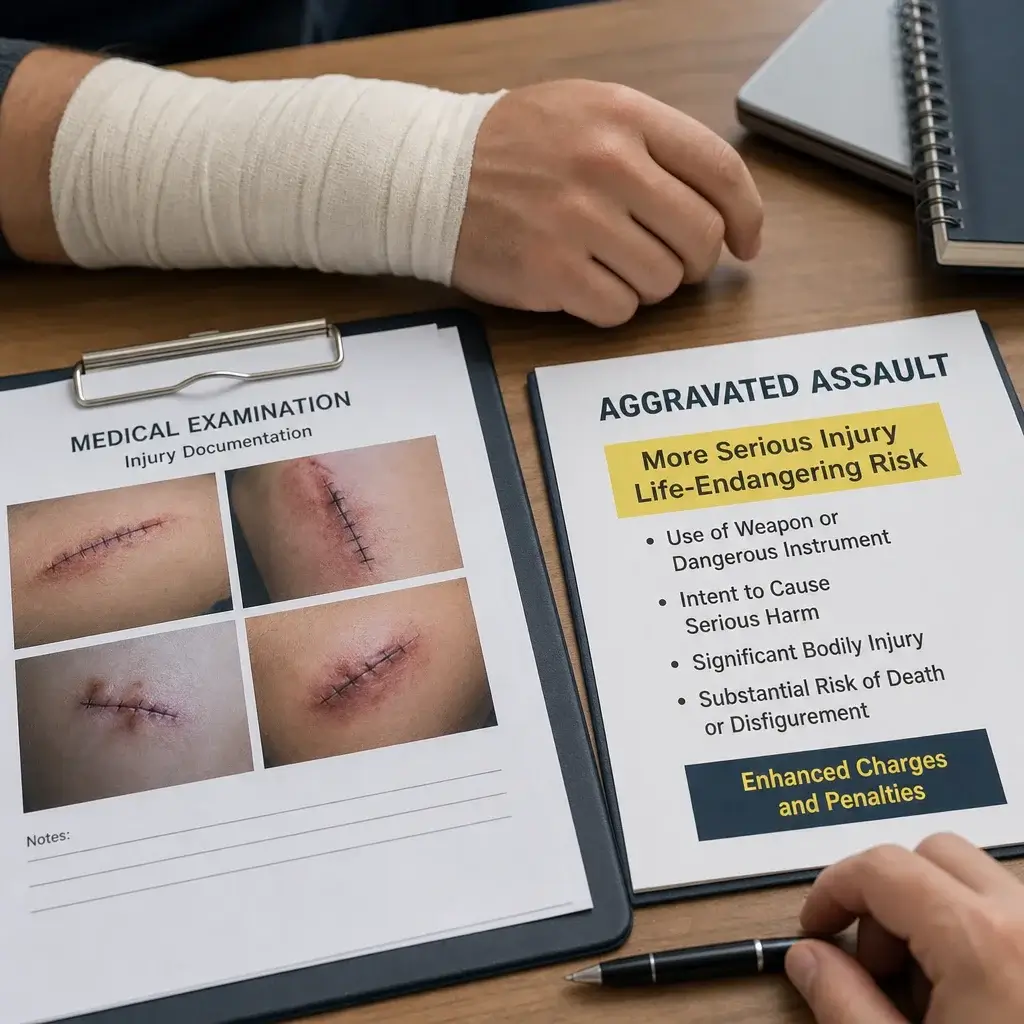
Section 267 can apply where an assault causes a meaningful but lower-level injury. A cut requiring stitches, a painful fracture, or a concussion may raise a bodily-harm issue, but the specific medical evidence and surrounding facts still determine whether the Crown can prove the charge.
By contrast, evidence of permanent facial scarring, loss of function, a serious penetrating injury, or a life-threatening complication may lead the Crown to consider section 268. A fracture is not automatically one category or the other; the nature, extent, duration, and consequences of the injury must be assessed.
For example, consider a person charged after throwing a glass during an argument. A superficial cut that quickly heals may lead to one analysis; a deep injury requiring surgery that leaves a permanent facial scar may lead to a very different section 268 analysis. The evidence must still establish identity, intent, causation, and the actual injury.
Sentencing questions about section 267 are addressed separately in this discussion of assault bodily harm.
Assault with a weapon is not automatically aggravated assault
Assault with a weapon is not automatically aggravated assault because section 267 can apply even if the section 268 level of harm is not proven. “Deadly weapon” is common U.S. wording, but it is not the usual Canadian Criminal Code charge label.
A weapon can include many objects depending on how they were used or intended to be used. Allegedly swinging a bottle, using a knife, or striking someone with an object may support a weapon allegation even if the complainant was not seriously injured. Conversely, an object need not be involved for an assault to be aggravated if the assault caused the harm described in section 268.
For example, someone who allegedly swings a baseball bat but misses may face an assault-with-a-weapon allegation despite no injury. If the alleged strike instead produces a life-endangering head injury, the Crown may assess whether aggravated assault is supported by the available proof.
Read more about the section 267 category in assault with a weapon criminal code. Where a weapon allegation is involved, a weapons & firearms defence lawyer in Toronto can review the charge and the release terms that apply.
Factors that influence how an assault is classified
The classification of an assault charge depends on the alleged conduct and the evidence capable of proving it, not on one fact alone. A weapon, a domestic relationship, or an allegation of injury can each be important, but none automatically establishes aggravated assault.
- What allegedly happened: the force used, threats, gestures, number of blows, and surrounding circumstances.
- The injury: its severity, duration, effect on health or function, permanence, and whether life was endangered.
- Medical proof: records, photographs, imaging, treatment notes, and expert evidence where needed.
- Causation: whether the alleged assault caused the injury, rather than another event or a pre-existing condition.
- Weapon use: whether an object was used, carried, or alleged to have been used in the assault.
- Intent and identity: whether the accused intentionally applied force and whether the evidence reliably identifies that person.
- Reliability: inconsistencies, video, independent witnesses, messages, 911 calls, and other evidence that may support or undermine the allegation.
Domestic context can affect how police, the Crown, and the Ontario Court of Justice address safety and release, but “domestic assault” is not itself a separate Criminal Code level of assault. A case involving partners or family members may be basic assault, section 267 assault, or aggravated assault depending on the evidence. In that context, a domestic assault lawyer Toronto can help assess the specific allegation and conditions.
Why aggravated assault is in a category of its own in Ontario
Aggravated assault is in a category of its own because section 268 is indictable-only and carries a maximum sentence of 14 years’ imprisonment. That does not predict a sentence, but it reflects Parliament’s treatment of the alleged harm as substantially more serious than basic assault.
These cases may involve detailed medical disclosure, specialist reports, extensive photographs or video, and closer examination of causation. An aggravated assault allegation can also create immediate practical problems with release, residence, family contact, work, immigration status, travel, and weapons licensing.
If a person is held for a judicial interim release hearing, the court decides whether release is appropriate and what conditions are required based on the particular circumstances. Conditions can include no-contact, non-attendance, weapons, reporting, or other restrictions. A bail hearing lawyer Toronto can address the release process and proposed conditions.
How the distinction affects the Crown’s case and the defence
The Crown must prove the underlying assault and, for aggravated assault, the required serious injury or danger to life beyond a reasonable doubt. Serious injury alone does not remove the need to prove identity, intent, causation, and every other required element.
Depending on the facts, issues may include whether force was intentional, whether the accused was the person involved, whether the injury resulted from the alleged assault, whether a witness is reliable, and whether medical evidence proves the level of harm alleged. A defence is never automatic simply because there are inconsistent accounts or an injury has another possible explanation.
Self-defence may be relevant under section 34 of the Criminal Code where a person acted for a defensive purpose and their act was reasonable in the circumstances. The Charter of Rights and Freedoms may also matter if police conduct raised a genuine issue about detention, counsel, searches, statements, or the admission of evidence.

What to do when the injury level is disputed
When injury level is disputed, comply exactly with every release condition and preserve evidence without editing it. Do not try to resolve the allegation yourself by contacting the complainant, asking others to contact them, or posting about the case.
Keep unedited messages, call logs, photos, video, location information, and relevant medical information. Write a private chronology while details are fresh, including names of potential witnesses and the sequence of events. Do not delete material because it seems unhelpful; deleting evidence can create a separate problem.
Get the information and disclosure reviewed before deciding how to respond. The charge wording, medical documentation, witness accounts, video, and release conditions are more useful than assumptions based on a police description. For immediate practical steps after any allegation, see aggravated assault charge.
FAQ: assault vs aggravated assault in Canada
Is aggravated assault worse than assault?
Yes. Aggravated assault is legally more serious because it requires the section 268 level of harm, is indictable-only, and carries a 14-year maximum penalty.
What are the three types of assault in Canada?
In this common comparison, the three levels are basic assault, assault with a weapon or assault causing bodily harm under section 267, and aggravated assault under section 268. The Criminal Code includes other assault-related offences and variations, so this is a practical summary rather than a complete list of every assault provision.
What is the lowest assault charge in Canada?
Basic assault, often called common or simple assault, is the lowest level in this group. It can still lead to a criminal record and other consequences, even if no injury is alleged.
What is an example of assault causing bodily harm?
A punch alleged to have caused a broken nose, concussion, or cut requiring stitches may be investigated as assault causing bodily harm. Whether the charge can be proven depends on the evidence of the assault, the injury, and causation.
What does aggravated assault vs battery mean in Canada?
“Battery” is not the usual Canadian Criminal Code label for this issue. In Canada, the question is normally whether the facts amount to assault and, if so, whether the injury or weapon allegation puts it under section 266, 267, or 268.
Does a weapon automatically make an assault aggravated?
No. A weapon can support a section 267 assault-with-a-weapon charge without proving the wounding, maiming, disfigurement, or life endangerment required for aggravated assault. For more on penalties in weapon cases, see assault with a deadly weapon Canada.
Speak with a Toronto criminal defence lawyer
Early advice can help you understand the charge, preserve relevant evidence, comply with release conditions, and assess how medical evidence may affect an assault or aggravated assault allegation.
Call 647-351-HELP (4357) or book a free consultation to discuss your case with Jeffrey I. Reisman.