

 Based on 116 Verified Google Reviews


Absolute discharge for assault in Canada: eligibility, record effects, and what judges consider depend on the exact charge, the facts, and the sentencing record before the court. An absolute discharge can be available in some lower-level assault cases, but it is never automatic and a person should not assume that a first offence, by itself, will avoid a conviction.
Can you get an absolute discharge for assault in Canada?
Yes. A court can grant an absolute discharge for assault in some cases, but only where the offence is legally eligible and the judge is satisfied that a discharge fits both the person and the public interest.
The question is not answered by the word “assault” alone. A brief push with no injury can be very different from repeated blows, an allegation involving a partner or family member, an assault while on release, or an incident involving a weapon. The disclosure, the agreed facts, any prior record, and the material put before the sentencing judge all matter.
In Ontario, many assault matters proceed in the Ontario Court of Justice. Before a guilty plea or sentencing hearing, the Crown attorney and defence will often address the facts being admitted, the available sentencing range, and whether a discharge is a realistic legal position.
What an absolute discharge means
An absolute discharge means the court has found a person guilty but orders a discharge instead of registering a conviction. It comes with no probation order, so there are no ongoing probation conditions attached to the sentence.
A discharge is not an acquittal. An acquittal means the Crown did not prove guilt; a discharge follows a finding of guilt, usually after a guilty plea or trial. It is also different from a withdrawal or stay, which ends a prosecution without a finding of guilt, and from a peace bond, which is a court order rather than a criminal conviction.
A conditional discharge also avoids a conviction at the time of sentence, but it includes probation. A suspended sentence is different again: it is a conviction followed by probation. For a fuller explanation of what is an absolute discharge, including the practical differences between these outcomes, review the linked discussion.
Section 730 of the Criminal Code is the provision that permits an absolute or conditional discharge when its legal requirements are met.
Am I eligible for an absolute discharge?
You may be legally eligible for an absolute discharge only if the offence qualifies under section 730 and the judge finds that a discharge is in your best interests and is not contrary to the public interest. Legal eligibility is only the first screen; it does not mean the judge must grant a discharge.
The legal screening usually includes:
- Confirming the exact charge, subsection, and mode of prosecution.
- Confirming that the offence is not punishable by a mandatory minimum penalty.
- Confirming that the offence is not punishable by 14 years’ imprisonment or life imprisonment.
- Reviewing whether another provision or the particular charge affects the available sentencing options.
The fact-specific assessment then asks whether a discharge is appropriate in this case:
- Would a conviction create real, documented consequences for employment, school, licensing, immigration status, or family responsibilities?
- Does the conduct show a lower level of force and harm, or does it raise substantial denunciation and safety concerns?
- Has the person shown insight, responsibility, and meaningful rehabilitation?
- Would a non-conviction sentence still be consistent with the public interest?
Common assault under section 266 of the Criminal Code is often where discharge arguments arise. That does not make every common-assault allegation a discharge case.
Why would someone get an absolute discharge for assault?
Someone may receive an absolute discharge where a conviction would have genuine consequences and the circumstances show that a non-conviction sentence would still be appropriate and accountable. The purpose is not to erase serious violence; it is to allow the court to tailor a sentence where a conviction would be disproportionate to the person and the proven conduct.
Relevant personal factors may include a lack of prior record, stable employment, school enrolment, a professional licence, caregiving duties, treatment progress, and evidence that the incident was out of character. The most persuasive consequences are usually specific and supported by documents, rather than general statements that a criminal record could make life harder.
For example, a person with no record who admits pushing another adult once during a brief argument, causes no injury, promptly begins appropriate counselling, and provides evidence that a conviction may affect a required professional licence may have facts that support a discharge request. The result would still depend on the complete record, the Crown’s position, and the judge’s assessment of the public interest.
These considerations do not outweigh serious violence. A court may decide that denunciation, deterrence, victim safety, or the seriousness of the assault requires a conviction even where a person has important employment or family consequences.
What judges consider in an Ontario assault case
Ontario judges consider the actual conduct and its impact, not simply the name of the charge. The agreed facts and the disclosure matter more than a label such as “common assault.”
Facts that can support a discharge request may include:
- A short, isolated incident involving low-level force.
- No injury or only evidence that the incident caused no meaningful harm.
- No weapon, threats, planning, or intimidation.
- No breach of bail, undertaking, probation, or other court order.
- Early responsibility, credible insight, and appropriate counselling or treatment.
- No prior violence and a strong record of work, school, or community support.
Facts that commonly work against a discharge include:
- Injury, repeated violence, choking allegations, or sustained force.
- A weapon or an object used as a weapon. Where that is alleged, advice from a weapons & firearms defence lawyer in Toronto may be relevant to the broader allegations.
- A vulnerable complainant, a significant power imbalance, or conduct in a domestic setting.
- Prior violence, intimidation after the incident, or attempts to interfere with a complainant or witness.
- Conduct while on release, including an alleged breach of a no-contact or stay-away condition.
 A person facing allegations involving a current or former partner should take release terms seriously. A no-contact condition means no direct or indirect contact unless the order is changed; having the other person initiate contact does not automatically make contact safe or permitted. For domestic-context allegations, a domestic assault lawyer Toronto can assess the charge, release conditions, and sentencing issues.
Common assault, bodily harm, and serious assault allegations
Common assault is often the category in which an absolute discharge is considered, while injury and more serious conduct make the public-interest hurdle much harder. The exact charge and facts must be assessed individually before anyone can responsibly say whether a discharge is available.
Assault causing bodily harm, aggravated assault, allegations involving a weapon, and sexual-assault charges require more careful charge-specific analysis. Meaningful injury, serious violence, or a sexual component can substantially affect both legal eligibility and the judge’s public-interest assessment.
Sexual assault should never be treated as a generic discharge example. The precise charge, applicable maximum penalty, facts, and current statutory framework must be reviewed individually. A person charged with a sexual offence should obtain charge-specific advice from a sexual assault lawyer Toronto.
Absolute discharge vs conditional discharge vs conviction
An absolute discharge avoids a conviction and has no probation, while a conditional discharge avoids a conviction at sentencing but includes probation. If the judge wants supervision, counselling, no-contact terms, or community service, a conditional discharge may be the more realistic fallback.
| Outcome | Conviction? | Probation or conditions? | Practical use |
|---|---|---|---|
| Absolute discharge | No | No probation order | Used where the court finds no conviction or supervision is needed. |
| Conditional discharge | No at sentencing | Yes, through a probation order | Used where a non-conviction outcome is appropriate but the court wants enforceable conditions. |
| Conviction with probation or fine | Yes | May include probation | Used where the court finds a conviction is required but custody is not necessarily required. |
| Suspended sentence | Yes | Yes, probation is imposed | A conviction-based sentence with supervision in the community. |
A conditional discharge can include conditions such as keeping the peace, reporting to probation, attending counselling, having no contact with a complainant, staying away from a location, or completing community service. 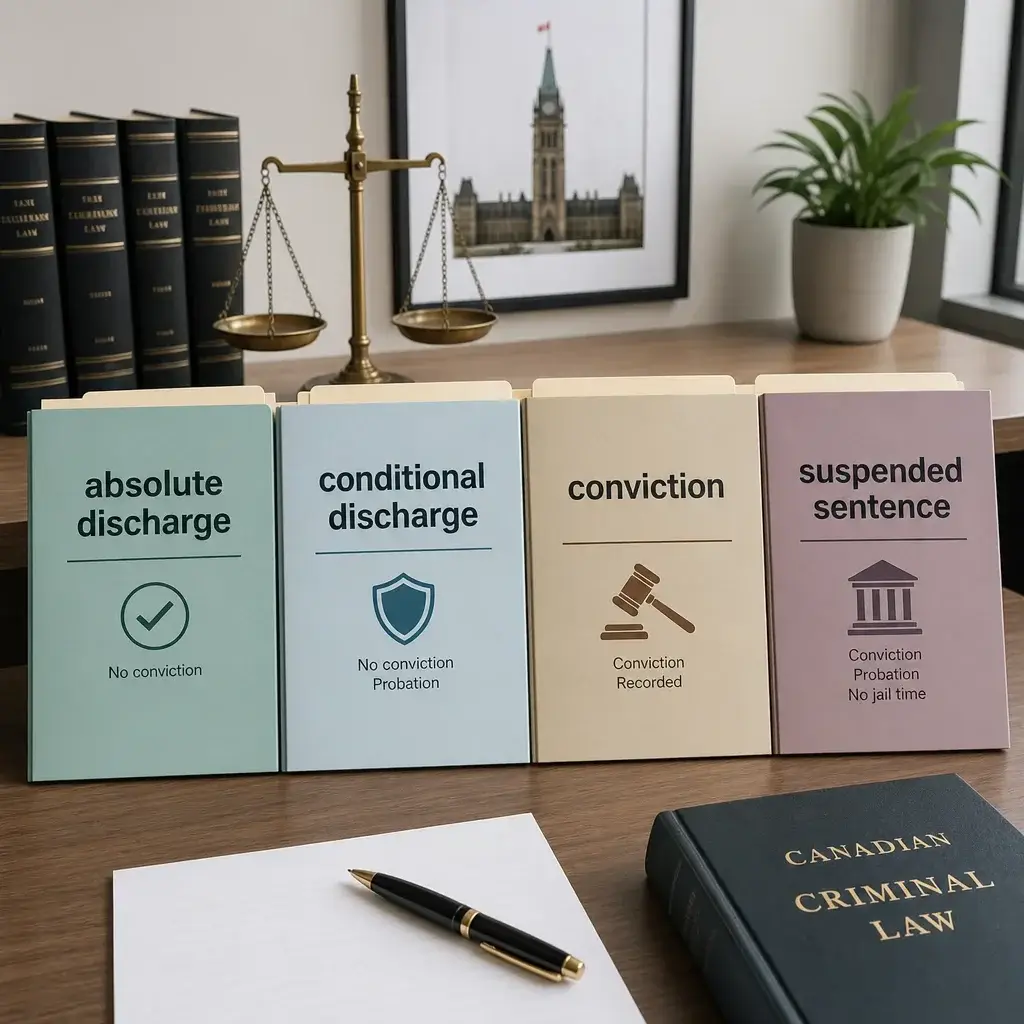
Do you have a criminal record with an absolute discharge?
An absolute discharge is not a criminal conviction, but information about it can still appear on some police information checks for a period of time. The answer to “do you have a criminal record with an absolute discharge?” depends on what a particular form asks and what kind of record check is being run.
A criminal record check, a judicial matters check, and a vulnerable sector check are different products and may have different disclosure rules. The RCMP manages the national criminal-record repository, but court records and local police holdings are separate sources that may not follow the same processes.
Under the Criminal Records Act framework, an absolute discharge is generally removed from the RCMP’s automated criminal records retrieval system one year after the discharge, while a conditional discharge is generally removed three years after the discharge. That does not mean all court files, local police information, fingerprints, photographs, or screening results automatically disappear at the same time.
 Employment, professional regulators, immigration processes, and foreign border officials may use different questions and rules. Do not assume that a Canadian discharge guarantees admission to the United States or resolves every disclosure obligation.
For the broader issue of how long does assault stay on your record, including the difference between a discharge and a conviction, see the linked article.
How to prepare a discharge request in Ontario
A discharge request is prepared by building reliable evidence for both parts of section 730: why avoiding a conviction is in the person’s best interests, and why a discharge is not contrary to the public interest. The work should begin well before the sentencing date, not on the morning of court.
- Follow every release condition exactly. Do not contact a complainant, attend a prohibited address, or communicate indirectly if your undertaking, bail order, or release order forbids it.
- Review the disclosure and any proposed agreed statement of facts carefully. The judge sentences the conduct that is admitted or proven, so accuracy matters.
- Start counselling, treatment, or programming that genuinely fits the issues in the case. A useful starting point is this discussion of anger management for an assault charge: what program fits and what courts may accept.
- Collect focused materials: employment letters, school records, proof of counselling, reference letters, and documents showing concrete licensing or immigration consequences.
- Raise Gladue materials where they apply. These materials can assist the court in understanding the background and systemic factors affecting an Indigenous person and in considering appropriate sentencing options.
Counselling is not a substitute for a legal defence and does not decide the case. It may, however, be relevant at sentencing if it is sincere, appropriate to the concerns raised by the incident, and supported by credible documentation. 
Depending on the evidence and stage of the case, other non-trial resolutions may also be worth exploring. This overview of alternatives for assault charges explains why eligibility and record consequences need to be assessed before a plea is entered.
What happens if an absolute discharge is not granted?
If an absolute discharge is not granted, the court may consider a conditional discharge if it is legally available, or it may impose a conviction-based sentence. The available outcome depends on the offence, the proven facts, the person’s circumstances, and the applicable sentencing principles.
A conditional discharge may be the practical middle ground where the judge accepts that a conviction is unnecessary but wants a probation order with counselling, no-contact, reporting, or other conditions. In more serious cases, the court may impose a conviction with a fine where lawful, probation, a suspended sentence, or custody.
The Crown attorney’s position matters, particularly if Crown and defence make a joint submission. However, the judge must still decide whether the proposed sentence is lawful and fit.
First-time assault: will you go to jail?
Jail is not automatic for a first assault allegation, but a first offence does not create an entitlement to an absolute discharge. Injury, the relationship between the parties, release compliance, the use of a weapon, prior conduct, and the sentencing materials can all change the result.
For example, a first-time allegation involving a brief, non-injurious incident may raise very different sentencing issues from a first-time allegation involving repeated punches, threats, a weapon, or an alleged breach of release conditions. A person dealing with a first-time domestic assault charge Canada should not make decisions based only on the fact that they have no record.
FAQ
Can you get an absolute discharge for assault in Canada?
Yes, some assault cases can result in an absolute discharge. The offence must be legally eligible, and the judge must find that a discharge is in the accused’s best interests and not contrary to the public interest.
Why would someone get an absolute discharge?
A court may grant one where the conduct is at the lower end of seriousness, the person has demonstrated accountability and rehabilitation, and a conviction would cause real consequences that are supported by evidence. Serious violence, injury, a domestic context, or public-safety concerns can outweigh those considerations.
Does an absolute discharge show on a background check?
It can appear on some checks for a time, depending on the timing, the record source, and whether the check is a criminal record check, judicial matters check, or vulnerable sector check. An absolute discharge is not a conviction, but it should not be treated as immediately invisible everywhere.
How long does an assault charge stay on your record in Canada?
There is no single answer because an outstanding charge, a discharge, a conviction, court records, and local police information can have different rules and timelines. For a more detailed explanation, see how long does assault stay on your record.
Speak with a Toronto criminal defence lawyer
Early advice can help you understand whether a discharge is legally available, comply with release conditions, and prepare the information a sentencing judge may need to see. The right approach depends on the exact charge, disclosure, and facts.
Call 647-351-HELP (4357) or book a free consultation to discuss your case with Jeffrey I. Reisman.