

 Based on 116 Verified Google Reviews

Anger management for an assault charge in Ontario
Anger management for an assault charge: what program fits and what courts may accept depends on the allegation, the evidence, and the stage of your case. Starting a suitable program can show proactive work, but it does not decide whether you are guilty and does not guarantee that a charge will be withdrawn, reduced, or resolved in a particular way.
In Ontario criminal courts, the important question is not whether you have obtained any certificate. It is whether the program addresses the concern raised by the allegation and whether it can be documented appropriately. Assault is defined in section 265 of the Criminal Code, but the facts, surrounding circumstances, and available evidence determine how a particular charge should be approached.
Do not treat counselling as a substitute for legal advice or for a defence. A lawyer can review the disclosure, explain the court process, and help decide whether counselling is useful before you spend money or release personal information.
Start with the allegation, disclosure, and your release conditions
Where possible, choose a program after your lawyer has reviewed the allegation and disclosure. Disclosure is the information the Crown Attorney provides about the case, such as police notes, witness statements, recordings, photographs, and other material relevant to the prosecution.
Your bail conditions or other release conditions come first. If an order says that you cannot contact or communicate with a complainant, do not ask them about counselling, reconciliation, a letter, or the criminal case, directly or through another person. Enrolling in a program does not create an exception to a no-contact, no-go, or residence restriction.
For example, consider someone charged after an argument with a former partner and released on a condition not to communicate with that person. That person can speak with a lawyer and a program provider about attendance, but should not send a message saying they have started counselling or ask a friend to pass the message along. A breach allegation can create a separate legal problem regardless of the person’s intentions.
If a court date is close, ask counsel whether proof of enrolment is useful now or whether it is better to wait until the disclosure has been reviewed. The answer can differ between a contested assault allegation, a possible peace bond, and a case being considered for an alternative measures program.
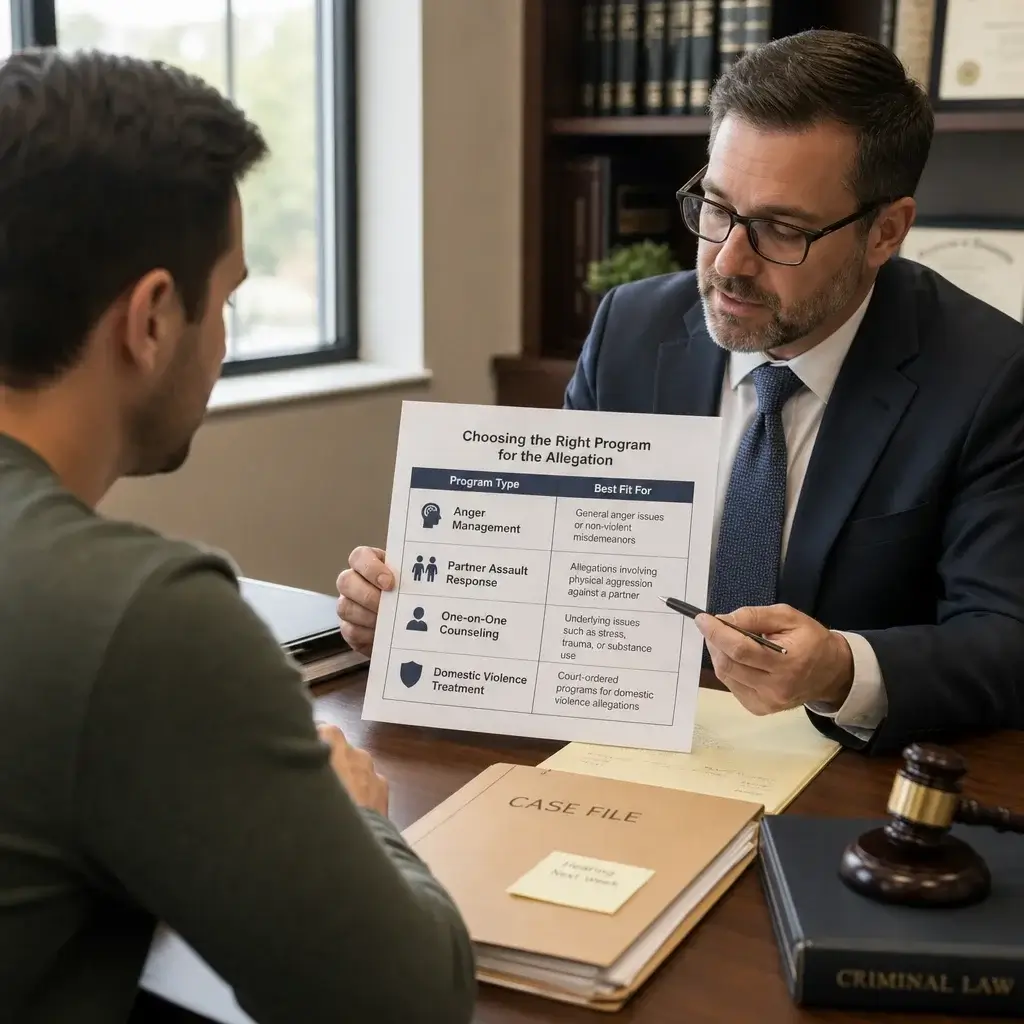
Which program fits: general anger management, individual counselling, or PAR?
General anger management may fit an isolated, non-partner conflict, while an intimate-partner allegation may require an assessment for Ontario’s Partner Assault Response (PAR) program or another intervention that addresses relationship violence. The correct choice turns on the alleged conduct and context, not on the cheapest course, a program label, or the participant’s gender.
General anger work commonly addresses triggers, escalation, impulse control, communication, and safer responses to conflict. Individual counselling may be more suitable where the disclosure raises personal issues requiring tailored work, such as grief, anxiety, trauma, stress, or a pattern of conflict in a particular setting.
PAR is not simply another name for a generic anger class. Partner and family allegations can involve concerns about control, intimidation, repeated conduct, safety, or relationship dynamics that a short online certificate may not address.
Alcohol or drug use, mental-health concerns, and other factors may also matter. For example, a person alleged to have pushed someone during an argument after heavy drinking may need legal advice about whether substance-use support should be considered alongside, or instead of, anger-focused counselling. Counselling should reflect the concern in the file rather than provide a convenient but mismatched document.
When anger management may be relevant to an Ontario assault case
Anger management can be relevant at some stages of an assault case, but its value is limited and case-specific. It may be considered in bail planning, resolution discussions with the Crown Attorney, a peace bond discussion, probation planning, or sentencing submissions.
It does not prove that the alleged assault did not happen. Nor does it replace a legal defence based on the evidence, including issues such as identity, intent, self-defence, credibility, or whether the Crown can prove the charge beyond a reasonable doubt.
For example, a person charged after a workplace confrontation may begin individual counselling after disclosure indicates an impulsive argument rather than an ongoing pattern of violence. Proof of meaningful participation may be one part of a broader presentation to the Crown, but counsel would still examine witness accounts, video, injuries, and the person’s legal position before deciding what to provide.
A Crown pre-trial and, where appropriate, a judicial pre-trial are opportunities for counsel to discuss issues and possible paths forward. They are not automatic rewards for taking a course.
What courts and the Crown may look for in program documentation
Useful program documentation is usually clear, factual, and limited to what is necessary. A court or Crown Attorney may be more able to assess a letter that identifies the provider and program, confirms dates and tracked attendance, and states whether the participant is enrolled, participating, or has completed the program.
Ask in advance whether the provider can provide:
- the provider’s name, role, and contact information;
- a short description of the program and its focus;
- the dates of enrolment and sessions attended;
- how attendance and identity are verified;
- the participant’s current status and, if applicable, completion status; and
- the provider’s policy for missed sessions and report preparation.
Do not casually disclose therapy notes or detailed personal history. Your lawyer should advise whether material should be provided, when it should be provided, and whether a short administrative letter is enough. The Law Society of Ontario regulates Ontario lawyers; it does not approve anger-management providers or guarantee that a provider’s certificate will be accepted in court.

How to choose a provider before paying
Choose a provider only after confirming that the program matches the alleged issue and can provide the documentation you may need. A provider should be able to explain the format, privacy limits, attendance policy, total fees, and available letters without promising a legal result.
- Ask whether the provider works with non-partner conflict, partner violence, substance use, or mental-health concerns relevant to your situation.
- Confirm the provider’s credentials and role.
- Ask how virtual attendance and participant identity are verified.
- Ask what happens if you miss a session or need to reschedule.
- Get the complete cost in writing, including intake, materials, taxes, and any letter or report fee.
- Ask what information would be shared only with your written consent.
Promises that a course will get charges dropped or guarantee court acceptance are red flags. A bare certificate with no provider identity, no attendance record, and no explanation of the program may carry little practical value.
What happens in anger-management counselling
Anger-management counselling generally helps a person identify triggers, recognize escalation, practise emotional regulation, and plan safer responses to conflict. The exact content and length are provider-specific, not an Ontario court standard.
Many programs begin with intake and goal setting. Sessions may address body signs of escalation, thoughts that fuel conflict, communication skills, accountability, problem solving, and plans for high-risk situations.
If you are angry at someone who hurt you, protect yourself from creating further legal problems. Pause before responding, leave the situation safely where lawful, do not send retaliatory texts or social-media posts, and seek support from a lawyer, counsellor, or trusted person without asking anyone to contact the complainant for you.

Online, group, and private programs
Online, group, and private programs can each be practical, but acceptability depends on the legal purpose and reliable participation records, not simply on whether sessions are virtual. Confirm the format with counsel before enrolling if proof may be used in a criminal case.
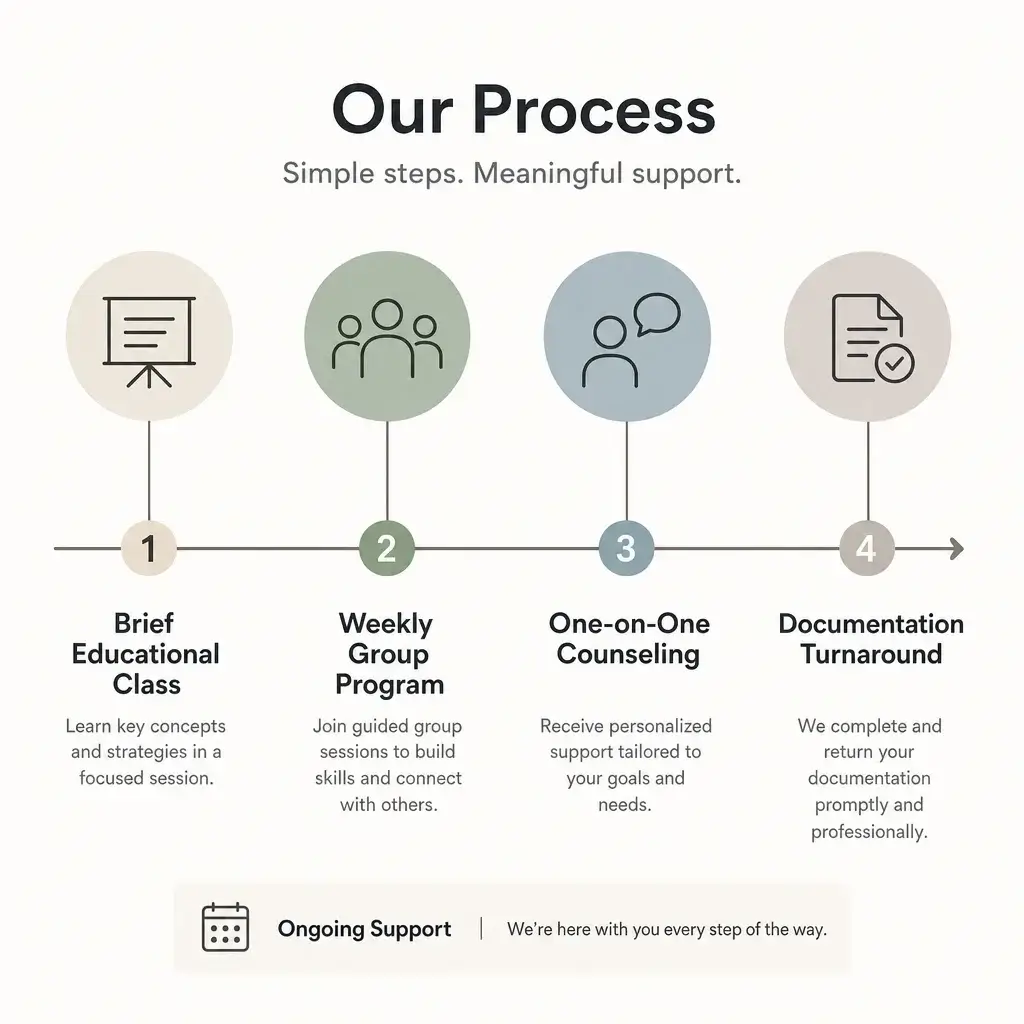
Private counselling can allow focused work on personal circumstances. A group program may offer structured education and accountability. Virtual programs can reduce travel and scheduling barriers, but should have a clear process for identity verification, attendance tracking, privacy, and document preparation.

Partner and family allegations need extra care
An intimate-partner allegation should not automatically be treated as a generic anger problem. Where the allegation involves a spouse, former partner, dating partner, co-parent, or family member, counsel should assess whether PAR or another appropriate intervention is more suitable.
Follow every no-contact, non-attendance, and residence condition unless a court formally changes it. Do not ask the complainant to support you, withdraw the complaint, attend counselling with you, or influence the case. If you face a domestic allegation, speaking with a domestic assault lawyer Toronto can help you understand the conditions and court process before you take further steps.
Questions to ask your lawyer before enrolling
Your lawyer can help prevent you from choosing the wrong program or disclosing information at the wrong time. Ask these questions before paying for a course:
- Should I wait until disclosure is reviewed?
- Does this allegation call for general anger work, individual counselling, PAR, substance-use support, or another service?
- Would group, private, or online attendance create any concern in my case?
- Would proof of enrolment be useful now, or is meaningful participation or completion more important?
- What should a provider’s letter say, and when should it be provided?
- Do my bail conditions affect where I can attend or whom I can discuss the program with?
- Could counselling be relevant to a peace bond, probation order, resolution discussion, or sentencing position?
For broader answers about charges, court procedure, and related issues, see the firm’s general criminal law faq.
FAQ
Does anger management help with an assault charge?
It can sometimes support a broader legal plan by showing proactive participation, but it does not determine guilt or guarantee an outcome. Its usefulness depends on the allegation, the evidence, the program’s fit, and the stage of the case.
Is anger management the same as PAR?
No. General anger management usually focuses on emotional regulation and conflict skills, while Ontario’s Partner Assault Response program is directed to partner-abuse circumstances and relationship-violence concerns.
Will a court or Crown Attorney accept an online course?
An online course may be suitable in some cases, but it should have credible provider information, attendance and identity verification, and a focus that fits the allegation. Ask counsel before relying on it for a criminal-court purpose.
What proof is most useful?
A concise letter confirming the provider, program, dates, tracked attendance, participation status, and completion status is often more useful than a detailed therapy narrative. Your lawyer should decide whether to provide it.
What is the best defence against an assault charge?
The appropriate defence depends on the evidence and legal issues in the individual case, not on whether you take counselling. Read more about how to defend an assault charge in Canada.
Will I go to jail for a first-time assault charge in Canada?
A first charge does not automatically mean jail, but it also does not make an allegation minor. The outcome depends on the charge, injuries, relationship between the parties, prior record, aggravating and mitigating factors, and the evidence; counselling alone does not decide sentencing. For a practical overview, see charged with assault first offence in Canada? what happens next.
Does anger management stay on your record?
Taking counselling is not itself a criminal conviction or a criminal record entry, but the effect of a particular resolution depends on the process used and the records held by the program and justice system. See alternative measures for an assault charge in Canada: eligibility, process, and record impact.
What if my case also involves an allegation about refusing a breath sample?
That is a separate Criminal Code allegation with its own issues and deadlines, even if it arose during the same incident. Learn about a failure to provide breath sample charge before assuming anger-management counselling addresses it.
Speak with a Toronto criminal defence lawyer
Early advice can help you understand your release conditions, review disclosure, and decide whether anger management, PAR, or another support is appropriate for your assault allegation.
Call 647-351-HELP (4357) or book a free consultation to discuss your case with Jeffrey I. Reisman.